
If you’re looking for Japanese classes for kids in Singapore, here’s the short answer up front: the Saturday hoshuko (Japanese Supplementary School) is not your only option — and for many families, it’s not even an option at all. Most of what you’ll find online is either a single review of the hoshuko or a roundup that’s years out of date. So we did the homework for you: eight schools where children in Singapore can learn Japanese (in person or online), sorted into four types — supplementary school, heritage-language school, juku (tutoring school), and online — with fees as published in July 2026, sources included. Where a school doesn’t publish fees, we say so honestly: “on inquiry.”
One crucial point before we start, especially for mixed-heritage families. The Japanese Supplementary School (JSS) and the Japanese School require Japanese nationality. If your child holds only a non-Japanese passport, they simply aren’t eligible — and that’s exactly where heritage-language schools, private classes, and online schools come in. This guide covers all of them.
Japanese schools for kids in Singapore: comparison at a glance
| School | Type | Format | Ages | Fee guide | Best for |
|---|---|---|---|---|---|
| Japanese Supplementary School (JSS) | Supplementary (kokugo) | Saturday afternoons, Clementi | Grades 1–9 (Japanese nationals) | From S$283.40/month (as listed Jan 2024) | Keeping up grade-level Japanese |
| SJkeisho (Japanese Heritage Language & Culture School) | Heritage language | Sundays, Newton | Age 5 to teens | On inquiry | Long-term residents; mixed-heritage kids without Japanese nationality |
| Satsuki Gakuen Singapore | Kokugo & maths support | In person + flexible booking, River Valley | Age 3 to high school | From S$1,058/half-term; credits from 4 sessions at S$88 | Families who need flexibility or didn’t get into JSS |
| Waseda Academy Singapore | Juku (exam prep & kokugo) | In person, Orchard | Grade 1 to high school | Enrolment S$272.50; tuition on inquiry | Junior-high and returnee entrance exams |
| KOMABA | Juku (kokugo & exam prep) | In person, Orchard/Clementi | Preschool to high school | On inquiry | Structured, level-based academics |
| ena Kokusaibu Singapore | Juku (returnee exams) | In person, Somerset | Grade 5 to junior high | On inquiry | Returnee (kikoku) exam prep |
| EDUBAL | Online 1-on-1 | Online private tutoring | Primary to high school | From ¥6,900/60 min | Targeted help with weak spots |
| TOMODACHI JAPAN | Online, conversation & friendship | Small groups, unlimited attendance | Ages 5–18 | One flat monthly fee — see the free guide | Kids who’ll grow through real friendships with peers in Japan |
Looking for a way to keep Japanese going from abroad?
TOMODACHI JAPAN is an online Japanese school for children growing up outside Japan. They talk with peers their own age in Japan every day, taught by teachers working at Japanese schools, in small classes of 8.
🎁 Register and we’ll email you our School Guide (PDF, in English) straight away. You’ll also be first to hear about tuition, scholarships and opening dates.
Free · takes about 30 seconds
Honest reviews, school by school
1. Japanese Supplementary School (JSS) — the classic route, with a nationality catch
Accredited by Japan’s Ministry of Education, JSS runs Saturday-afternoon kokugo (Japanese language arts) classes at the Japanese School campus in Clementi, following the same textbooks children use in Japan. With 321 students as of 2024, it’s one of the largest schools of its kind in Asia, and it remains the most reliable way to keep a child at grade level. But — and this matters — admission is limited to Japanese nationals in grades 1–9, mid-year entry happens only three times a year, and there’s an entrance interview. Because everything assumes grade-level Japanese, children whose Japanese is developing more slowly can find the pace punishing. “Powerful if you can get in — but not everyone can get in” is the honest summary. Official site
2. SJkeisho — built for long-term residents and mixed-heritage kids
SJkeisho meets on Sundays near Newton station and is designed for children who are staying in Singapore for good — including kids who don’t hold Japanese nationality. Alongside textbook work, classes lean into project-based learning (research, presentations) to grow “Japanese and culture” together. Courses run from an “a-i-u-e-o” starter class at age five up to levelled international courses, making it the natural landing place for families JSS can’t take — whether because of the passport rule or the pace. Fees are shared at information sessions. Official site
3. Satsuki Gakuen Singapore — fully published fees and flexible booking
A kokugo-and-maths school in River Valley. Beyond its regular courses (23 sessions per half-term, from S$1,058 for grades 1–3), it offers a credit system starting at 4 sessions for S$88 that lets you book lessons freely — and siblings can share the credits, which is genuinely useful. It’s also the only school in this roundup that publishes its full fee schedule online, a transparency we’d love to see more of. A flexible fit for families whose Saturdays are spoken for or who didn’t get a hoshuko place. Official site
4–6. Waseda Academy, KOMABA, ena — when exams enter the picture
The Orchard area is Singapore’s little cluster of Japanese juku. Waseda Academy covers everything from lower-primary kokugo to courses for international-school kids (enrolment fee S$272.50; tuition on inquiry). KOMABA is known for careful, level-based kokugo teaching and also supports international-school students. ena Kokusaibu is the specialist for kikoku (returnee) entrance exams. All three are first-rate as academic and exam machinery — but fees are mostly unpublished, and none of them gives your child someone to actually use Japanese with. Waseda Academy / KOMABA / ena Kokusaibu
7. EDUBAL — online 1-on-1 for targeted gaps
Online private tutoring by university students who grew up overseas themselves, with a dedicated Singapore page. Pricing is refreshingly clear — from ¥6,900 per 60 minutes — and it shines for spot-fixing specific weaknesses: just essays, just kanji. The flip side of 1-on-1 is that it’s always “child plus teacher,” so the motivation to keep going has to come from home. Official site
How to choose: start with “Can we get into JSS — and would it fit?”
In practice, choosing Japanese classes in Singapore comes down to one branching question: is JSS available to you, and is it right for your child? This flow makes the decision much less overwhelming.
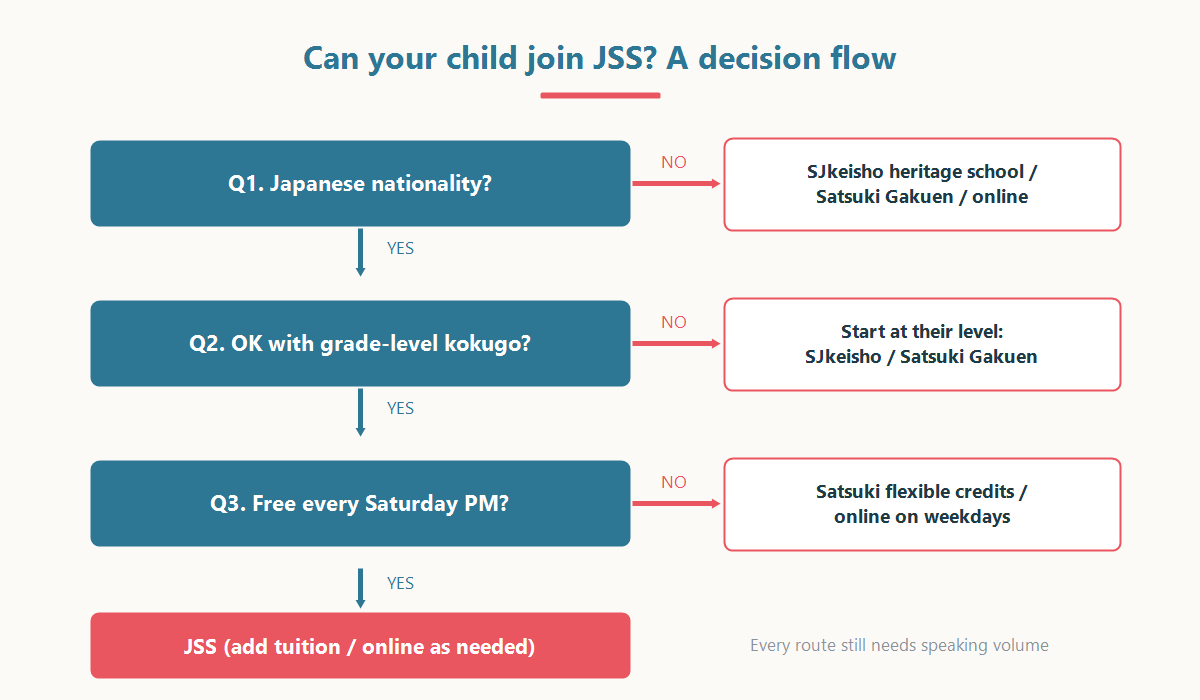
- Japanese passport, and reading/writing at grade level? JSS is the strong default. Add a juku later if exams appear on the horizon.
- No Japanese nationality, or settling in Singapore for good? SJkeisho or Satsuki Gakuen — start at a level that actually fits, without the pressure.
- Can’t sacrifice every Saturday afternoon, or the pace didn’t work? Satsuki Gakuen’s flexible credits, or go online.
- And the gap every one of these routes leaves open — speaking time, and someone to speak with? That’s the next section.
The online option: making the most of a one-hour time difference
Everything above is a place where children are taught Japanese. But what actually makes a language stick is how much a child uses it — and whether they have a reason to want to. That’s the gap TOMODACHI JAPAN, an online Japanese school for kids opening in December 2026, is built to fill.
- Real friends, not just teachers. Through our sister school NIJIN Academy — an online school in Japan with over 800 students — your child joins small group lessons with same-age kids who live in Japan. Not conversation practice with a textbook; actual friendships.
- Only one hour behind Japan. Japan’s late-afternoon classes land squarely in Singapore’s weekday after-school hours. Saturdays stay free, and there’s no drop-off or pick-up.
- Kids only, and come as often as you like. Classes are grouped by conversation level, not school grade — so a child who struggles with grade-level kokugo is never out of place. Unlimited attendance for one flat monthly fee.
To be clear, this doesn’t compete with JSS or a classroom — the combination most families land on is “reading and writing at a school, speaking volume and friendships online.” For a deeper look at the Saturday squeeze and how the time zones work in your favour, see how to keep your child’s Japanese alive on weekday evenings in Singapore.
FAQ from parents in Singapore
My child only holds a non-Japanese passport. Is Japanese a lost cause without the hoshuko?
Not at all. SJkeisho and Satsuki Gakuen have no nationality requirement, and online options widen the field further. What matters far more than grade-level kokugo is an environment where your child genuinely wants to use Japanese.
Can we combine JSS with another school?
Yes — in fact, combining is the norm: “JSS for reading and writing, online for conversation and friends,” or “juku for exam kokugo, family time for speaking.” We’ve mapped out the common combinations in the online alternative to Japanese hoshuko.
What time are TOMODACHI JAPAN lessons in Singapore?
Japan is just one hour ahead, so Japan’s late-afternoon and evening classes fall roughly between 4pm and 8pm on Singapore weekdays. Your child can join from home after local school or international school lets out.
What happens if we relocate to Japan or another country?
Nothing changes — that’s the point. Because it’s online, your child keeps the same friends after moving back to Japan or on to the next posting. For families whose Japanese-language environment resets with every relocation, a friendship circle that travels with you is a quiet superpower.