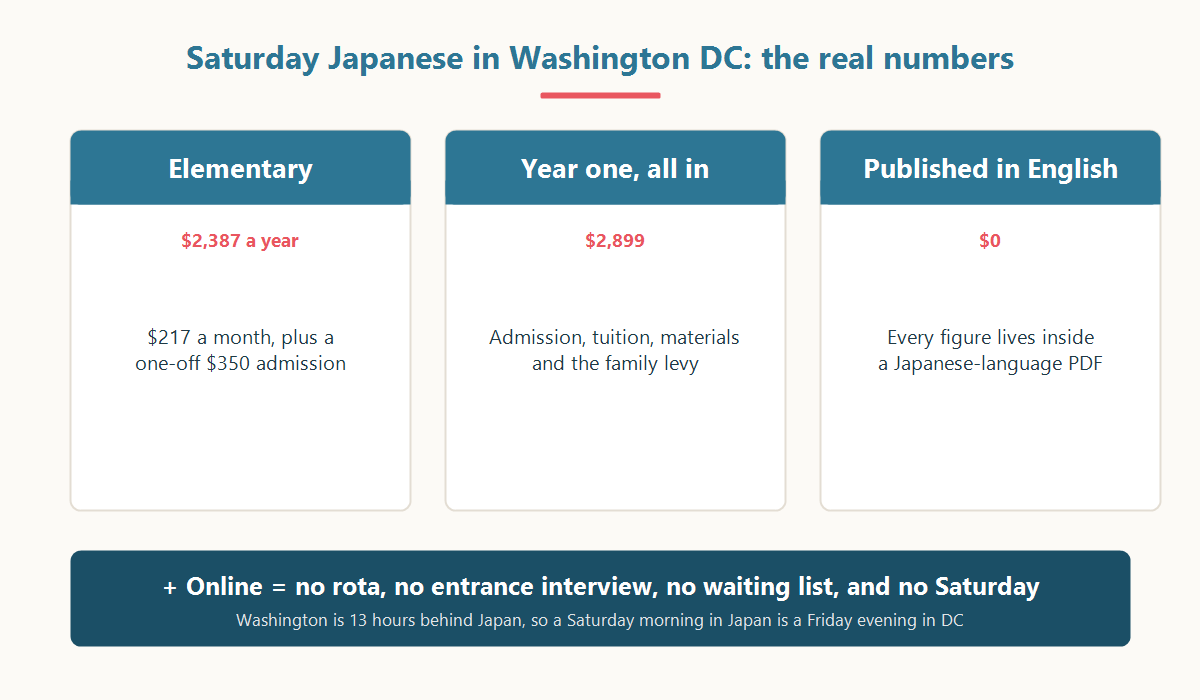
The full answer on Washington Japanese Language School tuition for 2026–27 is $350 to enrol, then $217 a month or $2,387 a year for elementary, $334 / $3,674 for kindergarten and $230 / $2,530 for junior high. The school publishes every one of those figures. It publishes every one of them only in Japanese, on page 20 of a 30-page PDF. Its website has had exactly two English pages in its entire history, and neither carries a price.
That gap is why the English answer is so bad. In English you meet a study-abroad programme at Western Washington University — Washington State, nothing to do with children. Or the Japanese Cultural & Community Center of Washington in Seattle, whose youth classes cost $465 a term: a real price at a real school in another city. Or the Japan-America Society of Washington DC, which is in DC and is called a Japanese Language School — and which states in its own information sheet that it is an adult school open to persons 14 years and older.
Two more things before the numbers. Washington Japanese Language School and ワシントン補習授業校 are the same school, not two. And there is no full-time Japanese day school anywhere in the DC area. Both are stated by primary sources in Japanese, and by nobody in English.
The short answer
| Tuition — elementary | $217 / month · $2,387 / year |
| Kindergarten | $334 / month · $3,674 / year |
| Junior high | $230 / month · $2,530 / year |
| Senior high | $275 / $3,025 (three subjects) · $200 / $2,200 (one) |
| Admission, plus family contribution | $350 per child, waived from a third child · $100 once per family |
| First year, elementary | $2,899 – $2,922 |
| First year, kindergarten | $4,144 – $4,149 |
| Full-time Japanese day school in DC | None |
Looking for a way to keep Japanese going from abroad?
TOMODACHI JAPAN is an online Japanese school for children growing up outside Japan. They talk with peers their own age in Japan every day, taught by teachers working at Japanese schools, in small classes of 8.
🎁 Register and we’ll email you our School Guide (PDF, in English) straight away. You’ll also be first to hear about tuition, scholarships and opening dates.
Free · takes about 30 seconds
One school, three names — and no full-time Japanese school in DC
English pages treat “Washington Japanese Language School” and “ワシントン補習授業校” as two institutions. The school’s own About page lists all three of its names together: the Japanese name ワシントン補習授業校, the local name ワシントン日本語学校, the English name Washington Japanese Language School. It opened in September 1958 in a room at the Japanese Embassy.
The second point is what a relocating family needs first. MEXT’s list of accredited overseas schools, dated 1 April 2026, shows 90 full-time Japanese day schools worldwide and four in the United States: Chicago, New York, New Jersey, Guam. Search it for ワシントン and you get nothing. The Japanese Embassy’s Japanese-language page, dated 15 January 2026, says the same in a parenthesis — there is no full-time Japanese day school here — then names three supplementary schools, WJLS first. The other two are 117.8 and 190.7 miles from the Bethesda venue.
| Option | Where | When | Fee | The catch |
|---|---|---|---|---|
| WJLS Saturday supplementary school | A borrowed campus near Bethesda, MD. Address not published — emailed after you apply | Saturdays, about 8:45–15:45. 41 days a year (40 for grade 1, 39 for kindergarten) | $217/mo elementary, $350 admission, $100 family contribution | Interview and reading aloud to get in; all communication in Japanese; about 14 parent duty days a year |
| Seichou Juku Commercial class | 807 North Royal Street, Alexandria, VA | Tuesday or Wednesday, 17:00–18:00 | $100/mo + $50 per half-year of materials. Months per year Not published | One hour a week, in Japanese. Not the Japanese curriculum |
| Nearest full-time Japanese day school | New York or New Jersey | Weekdays, full time | — | Not commutable. The nearest Japanese school outside this region is already 117.8 miles away |
| TOMODACHI JAPAN Online school | Online, anywhere in DC, Maryland or Virginia | Weekday and Friday-evening slots, Eastern time | In the school guide | No entrance exam, no Saturday, no duty roster — and we are not a MEXT supplementary school |
The full 2026–27 fee schedule
Page 20 of the handbook, in English.
| Item | Amount |
|---|---|
| Admission fee | $350.00 per child, once — waived from a third child |
| Kindergarten (ages 4–5) | $334.00 / month · $3,674.00 / year |
| Elementary | $217.00 / month · $2,387.00 / year |
| Junior high | $230.00 / month · $2,530.00 / year |
| Senior high | $275.00 / $3,025.00 (three subjects) · $235.00 / $2,585.00 (two) · $200.00 / $2,200.00 (one) |
| Supplementary materials | Kindergarten $20–$25 · elementary $62–$85 · junior high $55–$90 · senior high $10–$98. No period stated; billed each term |
| Family contribution (援助金) | $100.00, once per family |
| Textbooks | $0 for elementary and junior high, free from the Government of Japan. Charged for senior high; amount Not published |
| Sibling discount on tuition | None — the only sibling relief is the admission fee |
| Application fee, late fee, scholarships, PTA dues | All Not published — none appears in any of the school’s documents |
Three mechanics matter. Tuition is taken by direct debit in three terms — April–June, August–December, January–March, eleven months in all. Withdrawal is unforgiving: unless notice is filed by 5:00pm Eastern the day before a term starts, that whole term is payable, and one day of enrolment in a month makes that month payable. And next year’s figures do not exist yet: tuition is set each April at a special general meeting. The handbook says fees rise somewhat each year, but we could not retrieve last year’s table, so we will not quote a rate.
One oddity: kindergarten costs 54% more per month than elementary, $334 against $217, for fewer class days, 39 against 41. The school does not explain why.
What a first year actually costs
Nobody publishes a total. The arithmetic: $350 admission + annual tuition + materials + the $100 family contribution.
| Division | Admission | Tuition | Materials | Family | First-year total |
|---|---|---|---|---|---|
| Kindergarten | $350 | $3,674 | $20–$25 | $100 | $4,144 – $4,149 |
| Elementary | $350 | $2,387 | $62–$85 | $100 | $2,899 – $2,922 |
| Junior high | $350 | $2,530 | $55–$90 | $100 | $3,035 – $3,070 |
One number to ignore: “$150 a month”, attached to WJLS on a third-party directory. We could not verify it — the page refused to open — and it matches no division the school publishes.
The Embassy tells English readers something different
This is the sharpest thing we found. The Japanese Embassy’s Japanese page and its English page recommend different things to the same residents.
| Japanese page | English page | |
|---|---|---|
| Page date | 15 January 2026 | 24 September 2024 |
| Washington Japanese Language School | Listed first | Not listed at all |
| Says there is no full-time Japanese day school here | Yes, explicitly | No — never raised |
| Organisations named | Three supplementary schools and four preschool groups | Seven bodies, none of them WJLS |
| Prices | — | None — contact each organisation |
Read that in the order a family lives it. A Japanese-speaking parent opens the Japanese page and learns in the first line that there is no full-time Japanese school here, and that the supplementary school is WJLS. An English-speaking parent — often the non-Japanese spouse — opens the English page and finds seven organisations, none of which is the MEXT-accredited supplementary school with roughly 530 children in it. Two documents, maintained separately, sixteen months apart. The English reader loses.
The honest review
Start with what WJLS is good at. It teaches the Japanese national curriculum on Japanese government textbooks, free for elementary and junior high. It has run continuously since 1958, with around 30 classes, two teachers dispatched by the Japanese government, and 57 people on its payroll. Its finances are public: $1,738,193 of revenue against $1,788,087 of expenses in the year to March 2025. If your child is going back into a classroom in Japan, this is the building.
It is not an accredited school, and the English page does not say so
The English About page says WJLS is officially recognized as a supplemental school by MEXT, and stops. It is easy to hear that and assume the leaving certificate carries weight. The Japanese page is explicit that it does not: because it meets once a week, WJLS states it is not recognised as a regular school in either Japan or the United States and confers no formal graduation qualification. It issues its own certificate instead. That is a normal position for a supplementary school — but it is decisive if you were counting on transferable credit, and it appears nowhere in English.
The parent duty, with the numbers the English page omits
In English, the whole description of what parents owe is that WJLS is a co-op organization that requires parental support. The Japanese handbook says what that means.
- Safety duty, about six times a year. Three shifts — 8:45–11:05, 11:00–13:25, 13:20–15:45 — roughly nine parents each. No younger children with you.
- Library duty, about six times a year. Two or three parents a shift, and the stated requirements include being able to read Japanese.
- Event help, at least twice a year per family. The count is tracked, and families chronically short may be asked individually.
- Selection is by lottery, and it cannot be declined. Where nobody volunteers, roles are drawn by lot and in principle you may not refuse.
Six plus six plus two is fourteen Saturdays a year on which a parent is not dropping off but on duty, inside a window running to 15:45. The principle stated at the top of that section — keeping our own children safe is our own job — is honourable. It is also a second job, and English readers get four words about it.
The parent needs Japanese, not just the child
This is the most consequential omission, and for some families it decides everything. The handbook states that communication from the office and among teachers, students and parents is in principle conducted in Japanese, and that parents who find that difficult should go through family or friends. If a household emergency makes communication impossible, the office will broker an interpreter — for three months only, after which you find your own. The briefing adds that admission paperwork, everything sent home, and all correspondence with the homeroom teacher are in Japanese.
One English paragraph describing that three-month limit does exist — on page 6 of the Japanese PDF. There has never been an English admissions or fee page: those URLs return 404. The English Contact page answers enrolment questions by pointing readers at 入学案内, in Japanese.
There is an assessment, and there is a waiting list
In English, eligibility is described as children who can read and write Japanese at their grade level — which does not tell you there is a selection process. New entry requires every applicant to sit an interview on age-appropriate Japanese. Transfer entry, which covers everything else, adds an interview with the child and both parents, reading aloud from a textbook outside kindergarten, and for senior high a 15-minute written Japanese paper.
Passing is not the same as starting. Any division can go to a waiting list once full, and kindergarten applicants can be waitlisted even after passing. How many are waiting is Not published, and there is no second supplementary school in the region to wait at. Nor are you told where the school is until you apply: the address arrives by email afterwards. The one circulating in English — 9101 Rockville Pike — belongs to Stone Ridge School of the Sacred Heart, the campus WJLS borrows.
How many children are actually there
The Japanese principal’s message says about 530 students in 30 classes. The English About page says approximately 650, undated. Rather than pick a winner we did the arithmetic. In the year to March 2025 the school reported $1,302,207 of program service revenue: divided by 530 that is $2,456 per student, divided by 650 it is $2,003 — below every current annual tuition figure, including the cheapest senior-high option at $2,200. The arithmetic is consistent with 530. But that tax year ran on the previous fee schedule, which we could not retrieve, so 650 cannot be called an error.
As for what it is like to be the child, there is almost nothing online in either language. The closest first-hand account is a January 2019 feature in The Black and White, the student newspaper of Walt Whitman High School in Bethesda. One WJLS student, explaining that her mother wants her to keep being able to talk to her grandparents, adds that “it’s still a hassle going every Saturday”.
How to choose, in four questions
1. Is your child going back into school in Japan? If yes, WJLS is the answer — the only school in the region teaching the Japanese national curriculum.
2. Can a parent in your household operate in written Japanese, every week, for years? Not “speak a bit” — read notices, complete forms, correspond with a teacher. This is the condition that quietly excludes the most mixed-nationality families here.
3. Can you give up the whole Saturday, 41 times? The day runs roughly 8:45 to 15:45. Arlington is 10.9 miles each way; Fairfax 20.3; Baltimore 36.8; Annapolis 38.1. Either you wait seven hours or you drive it twice — then add fourteen duty days.
4. Can your child pass the interview today? Not next year — today, because the assessment is the gate. A child who speaks Japanese at home but was never taught to read it may sit below the line.
Where TOMODACHI JAPAN fits
We would rather be straight about the boundary than sell past it. TOMODACHI JAPAN is an online Japanese school for children living outside Japan. Three things define it. Children talk with peers their own age in Japan, daily rather than weekly. They are taught by teachers working to the standard of Japan’s current classrooms. And they learn in classes of eight with a homeroom teacher, grouped by level rather than age. No entrance interview, no requirement that a parent read Japanese, no duty roster.
The clock is on Washington’s side. Washington is 13 hours behind Japan, so a Saturday morning in Japan is a Friday evening in DC. Children in Japan are awake and free at exactly the hour your child has finished the week in Arlington or Rockville. Which means the weekend does not have to go on this: no 7:30am run up Rockville Pike, no seven-hour wait in a parking lot, no sixth Saturday of the year in a safety vest. Saturday stays yours.
What we do not do: we are not on Japan’s supplementary-school list, and we do not deliver the curriculum a child needs to slot straight back into a Japanese classroom. If your family is repatriating, WJLS is the right answer and we will tell you so. We are built for the case it is not designed to take — the child who is not going back but should not lose the language, the child below the entrance bar, the family with no Japanese-reading parent, the family on the waiting list. Tuition, scholarships and opening dates are in our school guide, free to anyone who registers.
Frequently asked questions
How much is Washington Japanese Language School tuition?
$217 a month, $2,387 a year for elementary; $334 / $3,674 kindergarten; $230 / $2,530 junior high; $275 / $3,025 senior high, $200 / $2,200 for a single subject. Plus $350 admission and a one-off $100 family contribution.
What does the first year actually cost?
Elementary: $2,899 to $2,922 — $350 + $2,387 + $62–$85 materials + $100. Kindergarten: $4,144 to $4,149. Junior high is $3,035–$3,070. From year two the admission fee and family contribution drop out.
Is WJLS the same thing as ワシントン補習授業校?
Yes — one school, three names, all listed on its own About page: ワシントン補習授業校, ワシントン日本語学校, and Washington Japanese Language School. It is accredited by MEXT as a supplementary school.
Is there a full-time Japanese school in Washington DC?
No. MEXT’s list as of 1 April 2026 has four in the whole United States: Chicago, New York, New Jersey and Guam. The Embassy’s Japanese page states outright that there is none in this district; its English page never raises it.
Is there an entrance test?
Yes. Every new applicant sits an interview on age-appropriate Japanese. Transfer applicants add an interview with the child and both parents, reading aloud from a textbook, and for senior high a 15-minute written Japanese paper.
How much parent duty is there?
About six safety-duty shifts and six library-duty shifts a year, plus two event help days per family — roughly fourteen Saturdays on site. Where nobody volunteers, roles are drawn by lottery and may not in principle be declined.
Is there a waiting list?
Yes. Any division can go to a waiting list once full, and kindergarten applicants may be waitlisted even after passing the interview. The number waiting is Not published, and there is no second supplementary school within reach.
Can a child with weak Japanese enrol?
Probably not. The published condition is enough Japanese to follow lessons in every subject conducted entirely in Japanese, and the briefing states that it is not a language school — it is a once-a-week supplementary school that teaches subjects in Japanese. The nearest softer option is the Keisho Center in Bethesda, which asks only for some Japanese ability: Saturdays 9:00–12:30, $1,720 a year plus a $40 joining fee.
Sources
Sources checked on 12 September 2026.
- WJLS, 学校のしおり(外部用), 29 August 2026 — fees p.20, parent duty pp.21–25, parent Japanese pp.5–6 — PDF
- WJLS About (Japanese), Principal’s message, Academics
- WJLS About (English), Contact (English) — the only two; /eng-admissions/, /eng-tuition/ and /english/ return 404
- WJLS 2026 new-entry briefing, 2026 transfer guide
- MEXT, accredited overseas schools, 1 April 2026
- Embassy of Japan — 教育情報 (Japanese), Learn Japanese Language (English)
- Keisho Center, Seichou Juku, JASWDC (PDF), JCCCW, Seattle, Western Washington University
- IRS Form 990, EIN 52-1445475 — ProPublica, Cause IQ
- Clara Koritz Hawkes, “Students spend Saturdays attending language schools”, The Black and White, 23 January 2019
- Distances measured on OSRM from 9101 Rockville Pike, Bethesda — free-flow driving