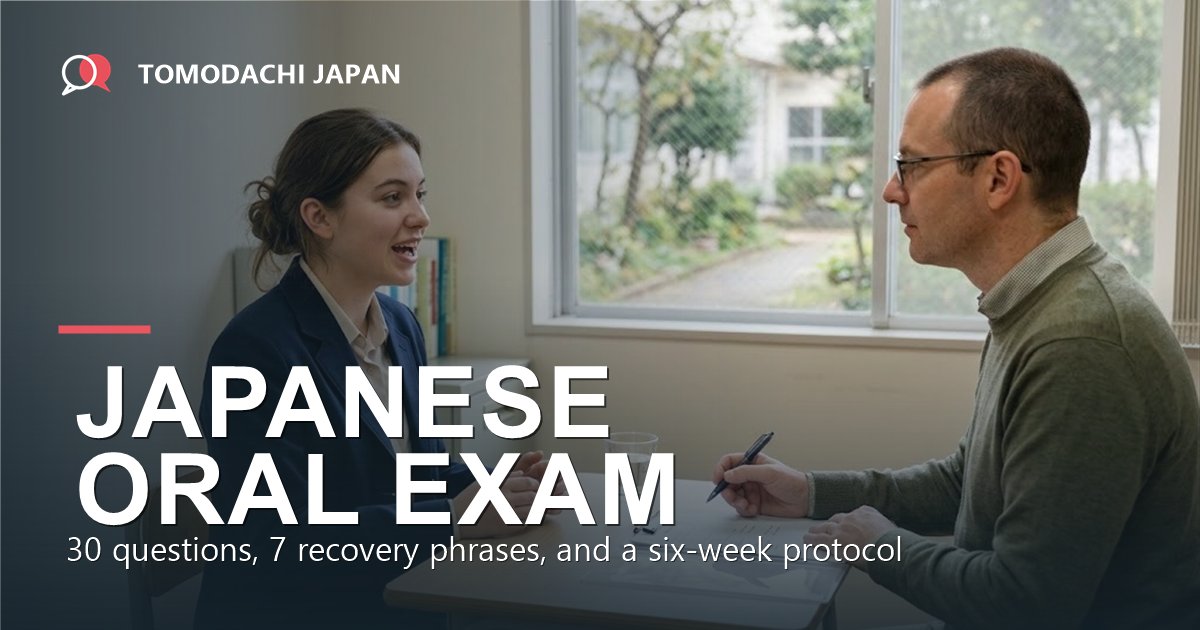
The Japanese oral is the part of the exam students prepare for last and lose sleep over first. It is also the only part where nothing can be looked up, edited or rewritten — you have one shot, in real time, in front of a person. This guide covers what the oral actually is in the major systems, what examiners are listening for, the recovery skills nobody teaches, and a practice protocol that works in the six weeks before the exam.
What the oral is, system by system
| System | Format | Weight |
|---|---|---|
| HSC Japanese Continuers (NSW) | A 10-minute interview-style conversation between the student and the examiner, relating to the prescribed topics from the perspective of the personal world. | 20 of 100 marks (the written paper is 80) |
| VCE Japanese Second Language (VIC) | An oral examination of about 15 minutes in two parts: a general conversation about the student’s personal world, then a discussion of their Detailed Study. | Part of the end-of-year examination assessment |
| GCSE Japanese (UK) | Offered by Pearson Edexcel. The speaking assessment is completed in April/May, ahead of the other papers in May/June — so it arrives earlier in the year than students expect. | Check the current Pearson specification for weighting and task types |
Notice the shape they share: a conversation, not a presentation. That single word is where most preparation goes wrong.
Looking for a way to keep Japanese going from abroad?
TOMODACHI JAPAN is an online Japanese school for children growing up outside Japan. They talk with peers their own age in Japan every day, taught by teachers working at Japanese schools, in small classes of 8.
🎁 Register and we’ll email you our School Guide (PDF, in English) straight away. You’ll also be first to hear about tuition, scholarships and opening dates.
Free · takes about 30 seconds
The mistake almost everyone makes
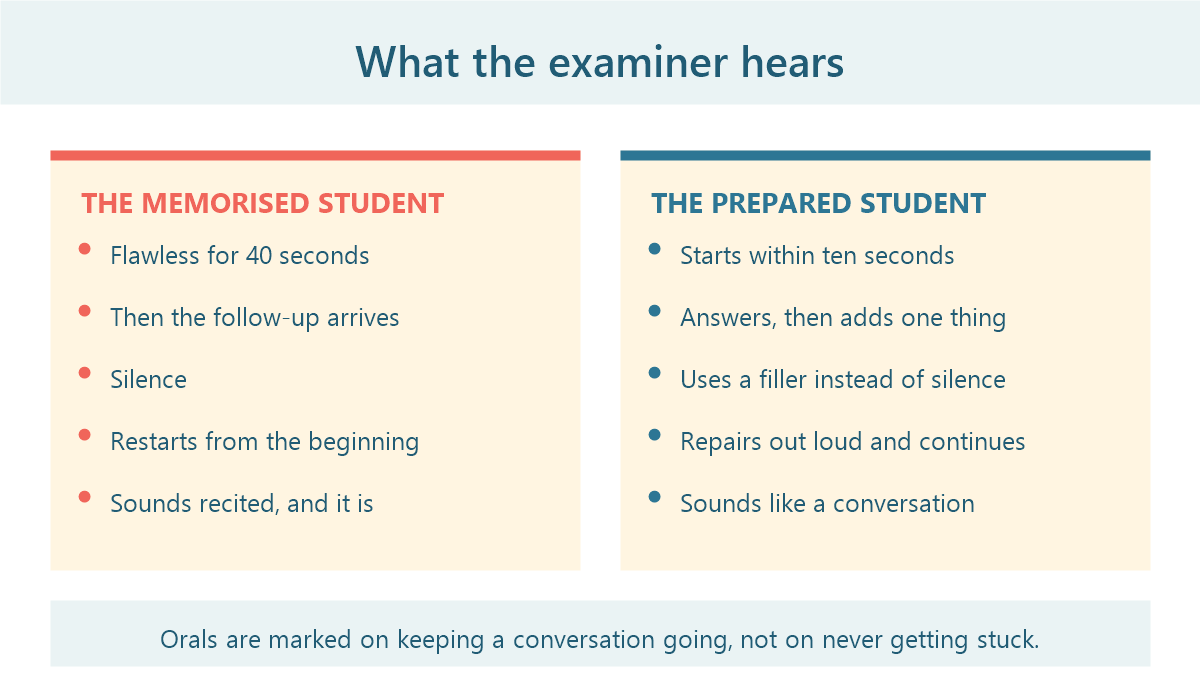
Students prepare for an oral by writing perfect answers to twenty predicted questions and memorising them. Then in the room the examiner asks a follow-up — “why?”, “since when?”, “and your brother?” — and the script has no line for it. What follows is a silence that feels like a minute and costs more than a grammar error ever would.
Memorised answers are not wasted; they are the raw material. But an examiner is trained to hear the difference between a student reciting and a student responding, and the recited answer sounds unmistakable: flawless for forty seconds, then nothing. Prepare material, not scripts.

Thirty questions you should be able to start answering in ten seconds
Not memorise — start. Ten seconds to the first sentence is the target. If you cannot begin within ten seconds, that topic is not ready.
Your personal world — the core thirty
- 自己紹介をしてください。 Introduce yourself.
- 家族について話してください。 Tell me about your family.
- 兄弟はいますか。どんな人ですか。
- どこに住んでいますか。どんな町ですか。
- 学校はどうですか。
- 何の教科が好きですか。どうしてですか。
- 苦手な教科は何ですか。
- 日本語をどのぐらい勉強していますか。
- どうして日本語を勉強していますか。
- 日本語は難しいですか。何が一番難しいですか。
- 趣味は何ですか。いつからしていますか。
- 週末は何をしますか。
- 昨日は何をしましたか。
- 放課後は何をしますか。
- スポーツをしますか。
- 音楽が好きですか。どんな音楽ですか。
- 友達とよく何をしますか。
- どんな友達がほしいですか。
- あなたの性格はどうですか。
- 将来何になりたいですか。どうしてですか。
- 大学に行きたいですか。何を勉強したいですか。
- アルバイトをしていますか。
- 日本に行ったことがありますか。
- 日本のどこに行ってみたいですか。
- 日本の食べ物は好きですか。
- 日本とこの国の違いは何だと思いますか。
- 日本の文化で興味があることは何ですか。
- 休みには何をする予定ですか。
- もし一年間自由な時間があったら、何をしますか。
- 最後に、何か言いたいことがありますか。
Say each answer aloud. Then have somebody ask you “どうしてですか” after every one, and answer that too. The follow-up is the exam.
The recovery phrases nobody teaches you
An oral is not marked on being perfect. It is marked on keeping a conversation going. The students who score well are usually not the ones who never get stuck — they are the ones who get stuck and keep talking anyway. Learn these until they come out without thinking.
| When you need to… | Say | Why it works |
|---|---|---|
| Buy two seconds | そうですね… | Natural, adult, and used constantly by Japanese speakers. Silence sounds like failure; this does not. |
| Ask them to repeat | すみません、もう一度お願いします。 | Politely asking is a communication skill, not a mistake. Guessing wrong is far more expensive. |
| Ask them to slow down | もう少しゆっくりお願いします。 | Shows control. Examiners generally comply. |
| Not know a word | ええと、日本語で何と言いますか。 | Turns a gap into an exchange. This is what a real learner does abroad. |
| Repair a sentence | あ、違います。~と言いたかったです。 | Self-correction is credited in most marking schemes. Ploughing on with a wrong sentence is not. |
| Add length when the answer is thin | …、それに、~ | One extra clause turns a one-line answer into a developed one. |
| Give a reason without thinking | なぜなら、~からです。 | Every “why” question has the same frame. Learn the frame once. |
A six-week practice protocol
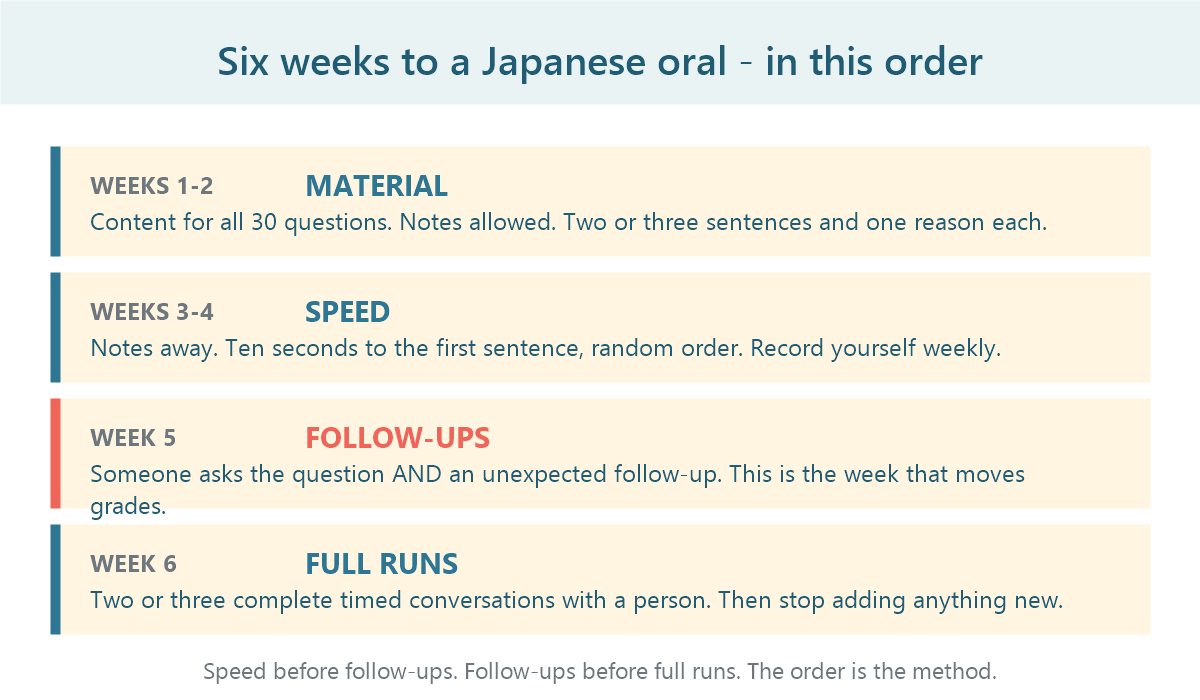
| Weeks | Focus | What that looks like |
|---|---|---|
| 1–2 | Material | Build content for all thirty questions. Written notes are fine at this stage. Two or three sentences each, with one reason. |
| 3–4 | Speed | Notes away. Ten seconds to the first sentence, every question, in random order. Record yourself once a week and listen back. |
| 5 | Follow-ups | Someone else asks the questions and a follow-up you did not expect. This is the week that separates grades. |
| 6 | Full runs | Two or three complete timed conversations with a person, no stopping, no restarting. Then rest — do not cram new vocabulary in the last three days. |
Two rules run through all six weeks. Practise out loud, always — silent rehearsal builds a false sense of readiness, because your mouth never had to do it. And practise with a person, not a recording, from week three onwards. A recording never interrupts, never mishears you, never asks the thing you hoped it would not.
On the day
- Speak first, think second. Start with そうですね and a simple sentence you are sure of. Momentum is worth more than a perfect opening.
- Answer the question, then add one thing. Bare answers invite the examiner to work harder than you are.
- If you break a sentence, repair it out loud. Do not pretend it did not happen; do not restart from the beginning.
- Do not translate in your head. Say the simpler Japanese sentence you already own rather than the clever English one you are trying to convert.
- Be a person. Examiners are having a conversation with you for ten or fifteen minutes. Interest, humour and a real opinion all read through an accent.
Why practice partners decide this exam
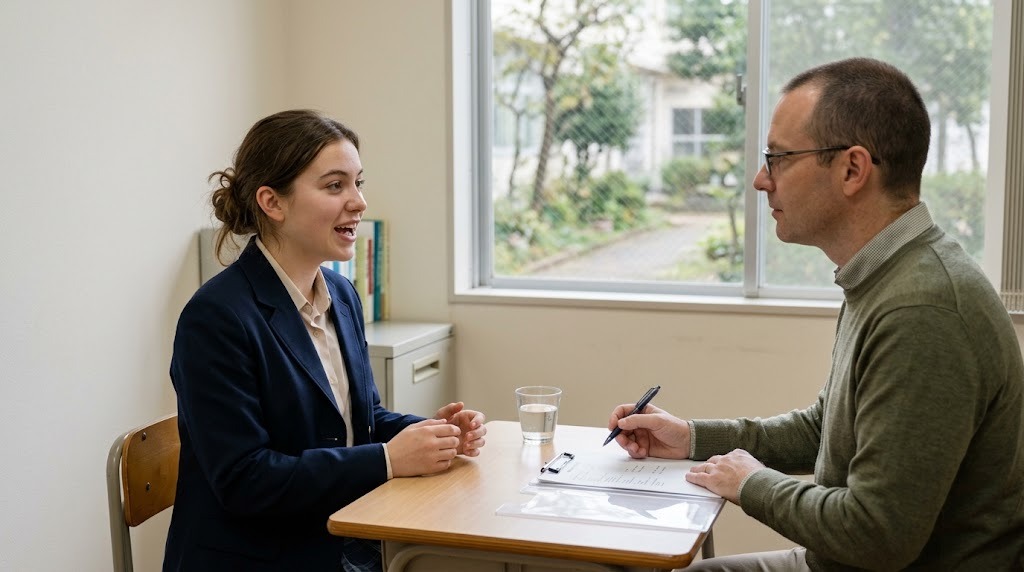
Everything above can be done alone except the part that actually gets marked. You cannot self-administer an unexpected question. You cannot surprise yourself. Students who have spent a year speaking Japanese only to a textbook walk into a conversation for the first time on the day it counts.
That is the gap TOMODACHI JAPAN is built to fill: small groups, qualified Japanese teachers, and children and teenagers who actually live in Japan — so unrehearsed conversation is a weekly habit long before it is an examination. Request the school guide here.
Course-specific detail: the HSC Continuers speaking examination, the vocabulary you need to produce for it, VCE Japanese Second Language eligibility and assessment, and the VCE Japanese study design.
FAQ
Should I memorise my answers?
Memorise content — the facts, opinions and reasons you want to be able to reach for. Do not memorise sentences word for word. Examiners hear recitation immediately, and a memorised answer collapses at the first follow-up.
What happens if I do not understand the question?
Ask, in Japanese: すみません、もう一度お願いします。Asking politely is a communication skill and is usually credited. Answering a question you did not understand is the expensive option.
Does my accent matter?
Comprehensibility matters; sounding native does not. Rhythm and pitch carry more of that than individual consonants, which is why shadowing helps — we set out the method in shadowing Japanese.
How much should I practise in the last week?
Two or three full conversations, then stop adding anything new. In the final days you are protecting fluency, not building vocabulary. A tired mouth performs worse than a slightly smaller one.
The oral needs no characters at all, but the written paper does. When that becomes your next hurdle, work from the VCE Japanese kanji list or, for NSW students, the HSC Japanese Continuers kanji list.