Every year students search for “the HSC Japanese Continuers vocabulary list” hoping to find one file that guarantees the marks. There is an official list, and you should download it. But before you print 40 pages and start highlighting, there is one fact in the syllabus documents that should change how you study it entirely — and most students never notice it.
What NESA actually prescribes
The NSW Department of Education’s Japanese Continuers Stage 6 Quick Reference Guide 2026 states it plainly: there is “a prescribed character list and a vocabulary list comprising basic vocabulary relevant to the themes and topics” for the course. Two things follow from that sentence.
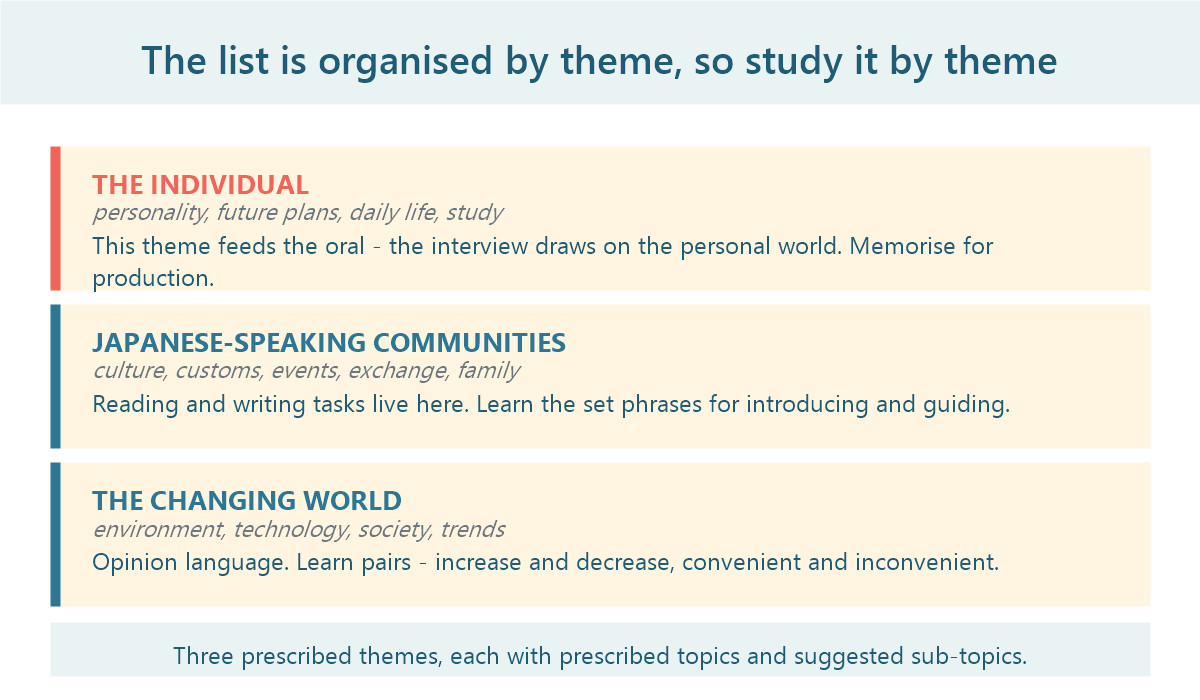
- The list is organised around the themes, not around difficulty. The syllabus prescribes three themes — the individual, Japanese-speaking communities, and the changing world — each with prescribed topics and suggested sub-topics. Vocabulary that has nothing to do with those themes is, for exam purposes, decoration.
- It is “basic vocabulary”. The list is a floor, not a ceiling. It tells you what you cannot afford to be missing; it does not promise that everything in the exam will come from it.
Two more facts worth having straight: the course is designed for students who will typically have studied Japanese for 400–500 hours by the end of Stage 6, and students wishing to undertake Continuers must apply for an eligibility determination. Settle eligibility with your school early — it is not a decision you make in Year 12.
Looking for a way to keep Japanese going from abroad?
TOMODACHI JAPAN is an online Japanese school for children growing up outside Japan. They talk with peers their own age in Japan every day, taught by teachers working at Japanese schools, in small classes of 8.
🎁 Register and we’ll email you our School Guide (PDF, in English) straight away. You’ll also be first to hear about tuition, scholarships and opening dates.
Free · takes about 30 seconds
The fact that should change how you study it
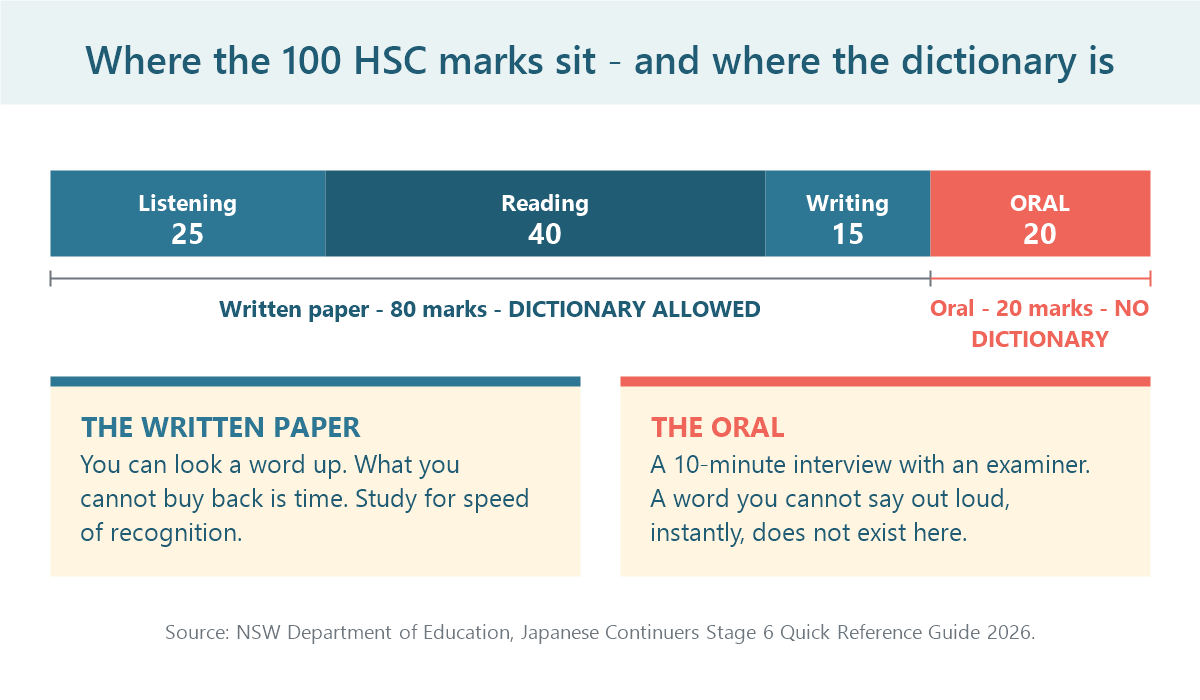
Here it is: students are able to use monolingual and/or bilingual dictionaries in the written examination. The written paper is 80 marks. The oral examination — a 10-minute interview-style conversation with an examiner — is 20 marks, and there is no dictionary in that room.
So the vocabulary list splits into two piles, and they deserve completely different treatment:
| Words for the written paper | Words for the oral | |
|---|---|---|
| Can you look it up? | Yes — dictionaries are permitted | No |
| What you actually need | Speed of recognition. Knowing a word 80% is fine; you can confirm it. Time is the scarce resource, not knowledge. | Instant production. A word you can recognise but not say does not exist in the oral. |
| How to study it | Read widely, meet words in context, learn to skim | Say them out loud, in sentences, to a person, until they are automatic |
| Marks at stake | 80 (Listening 25, Reading 40, Writing 15) | 20 |
Notice the awkward consequence. The 20-mark oral is the section where raw vocabulary knowledge matters most, and it is the section almost every student prepares for last. If you have limited hours between now and the exam, the highest-value vocabulary work is not another silent reading of the list — it is saying the words out loud at conversational speed until nobody has to wait for you.
A working vocabulary set, organised by the three themes
This is not the official list — download that from NESA and treat it as the authority. What follows is a working set our teachers use with Continuers students, organised the same way the syllabus is, so you can drill in the shape the exam is built in. Say every one of these aloud in a full sentence; do not just read the column.
Theme 1 — The individual
| Japanese | Reading | English | Use it for |
|---|---|---|---|
| 性格 | せいかく (seikaku) | personality | Describing yourself or a friend in the interview |
| 得意(な) | とくい (tokui) | good at, one’s strength | 「数学が得意です」 — safer and more natural than 上手 |
| 苦手(な) | にがて (nigate) | not good at, weak point | The polite way to admit a weakness |
| 将来 | しょうらい (shourai) | the future (one’s own) | Almost guaranteed in an oral: 「将来は~になりたいです」 |
| 進学する | しんがくする (shingaku suru) | to go on to further study | Year 12 answers about university |
| 経験 | けいけん (keiken) | experience | 「いい経験になりました」 — a strong closing line |
| 努力する | どりょくする (doryoku suru) | to make an effort | Talking about study, sport, music |
| 忙しい | いそがしい (isogashii) | busy | Daily routine questions |
| 趣味 | しゅみ (shumi) | hobby | Expect it; have two sentences ready |
| 明るい | あかるい (akarui) | cheerful, bright (of personality) | 「性格が明るいです」 — an adjective examiners hear far too rarely |
Theme 2 — Japanese-speaking communities
| Japanese | Reading | English | Use it for |
|---|---|---|---|
| 文化 | ぶんか (bunka) | culture | The spine of this theme |
| 伝統的(な) | でんとうてき (dentouteki) | traditional | 「伝統的な行事」 traditional events |
| 行事 | ぎょうじ (gyouji) | event, ceremony | Festivals, school events |
| 習慣 | しゅうかん (shuukan) | custom, habit | Comparing Australia and Japan |
| 地域 | ちいき (chiiki) | region, local area | Reading texts about towns |
| 祖父母 | そふぼ (sofubo) | grandparents | Family texts; note the humble form |
| 留学する | りゅうがくする (ryuugaku suru) | to study abroad | Extremely high frequency in this course |
| 交流 | こうりゅう (kouryuu) | exchange, interaction | 「交流会」 exchange gathering |
| 紹介する | しょうかいする (shoukai suru) | to introduce | Writing tasks: introducing your school or town |
| 案内する | あんないする (annai suru) | to show around, to guide | The classic “a Japanese guest is visiting” task |
Theme 3 — The changing world
| Japanese | Reading | English | Use it for |
|---|---|---|---|
| 環境 | かんきょう (kankyou) | environment | The single most examinable noun in this theme |
| 技術 | ぎじゅつ (gijutsu) | technology, skill | 「技術が進む」 technology advances |
| 社会 | しゃかい (shakai) | society | Opinion sentences |
| 問題 | もんだい (mondai) | problem, issue | 「一番大きな問題は~です」 |
| 増える | ふえる (fueru) | to increase | Describing trends and graphs |
| 減る | へる (heru) | to decrease | The pair to 増える — learn them together |
| 影響 | えいきょう (eikyou) | influence, effect | 「~に影響がある」 |
| 便利(な) | べんり (benri) | convenient | Common, and easy to overuse — vary it |
| 心配する | しんぱいする (shinpai suru) | to worry | Expressing concern about a change |
| 大切(な) | たいせつ (taisetsu) | important, precious | Concluding an opinion |

Vocabulary for the text types you have to produce
The Quick Reference Guide lists the written text types you may be asked to produce in the external examination: article, diary entry, email, letter, message, note, notice, postcard, recount, report, script of an interview, and script of a speech or talk. Each of those has a small set of fixed expressions, and marks are quietly lost when a student writes good Japanese in the wrong shape.
Fixed expressions worth memorising cold
- Letter / email opening: 「お元気ですか。」 / 「ごぶさたしています。」
- Letter / email closing: 「お返事お待ちしています。」 / 「体に気をつけてください。」
- Speech opening: 「みなさん、こんにちは。今日は~についてお話しします。」
- Speech closing: 「ご清聴ありがとうございました。」
- Diary entry: plain form throughout, and 「~と思った」 rather than 「~と思います」
- Notice: noun-ending style — 「日時」「場所」「持ち物」
- Giving an opinion: 「私は~と思います。なぜなら~からです。」
Text types are prescribed. Learn the frame first, then pour your vocabulary into it.

How to actually learn a list, from a teacher who marks these
Highlighting a printed list feels like study and produces almost nothing. Three things do work, and they take less time than the highlighting:
- Test in the direction the exam tests. For the oral, cover the Japanese, look at the English, and say the Japanese out loud. If it takes more than two seconds it is not learned. Recognition-only study inflates your sense of progress.
- Learn words in a sentence you would actually say. 「将来」 alone is a flashcard. 「将来は先生になりたいです」 is an answer. Examiners are listening to a conversation, not auditing your flashcards.
- Learn pairs and families together. 増える/減る, 得意/苦手, 便利/不便. Half the words on any list have a partner, and the partner is free.
And the uncomfortable one: vocabulary you have never said to another person is not oral vocabulary. The 10-minute interview is a conversation with a human being who reacts, changes direction and asks the follow-up you did not rehearse. Students who have only ever practised alone lose marks not because they lack words but because they have never had to find them in real time.
That is the gap we exist to close. At TOMODACHI JAPAN, students talk in small groups with qualified Japanese teachers and with children who actually live in Japan — so the words on your list get used on someone who answers back, weekly, long before the examiner does. You can request the school guide here.
For the rest of the course: the HSC Japanese Continuers syllabus explained, how the speaking examination is marked, and what to do in Section I listening.
FAQ
Where do I download the official vocabulary and character list?
From NESA, on the Japanese Continuers Stage 6 Syllabus pages. Get it from NESA directly rather than from a study forum — syllabus documents are amended, and an old PDF circulating in a group chat is exactly the kind of thing that costs marks.
If dictionaries are allowed, do I need to memorise anything for the written paper?
Yes — for speed. A dictionary rescues the occasional unknown word; it cannot rescue a student who has to look up one word per line in a 40-mark reading section. Think of memorisation as buying time, and of the dictionary as insurance.
How many words should I be able to produce for the oral?
Fewer than students fear, used better than students expect. A 10-minute conversation on the personal world rewards fifty words you can deploy instantly and accurately far more than five hundred you can only recognise. Depth of use beats breadth of coverage in that room.
Is the vocabulary list the same for Japanese Beginners or Japanese in Context?
No. Those are separate Stage 6 courses with their own syllabus documents and their own prescribed lists, and NESA has issued corrections to at least one of them in the past. Make sure the file you are studying says Continuers on it.
Vocabulary and characters are two halves of the same prescribed set. The companion piece to this page is the HSC Japanese Continuers kanji list.