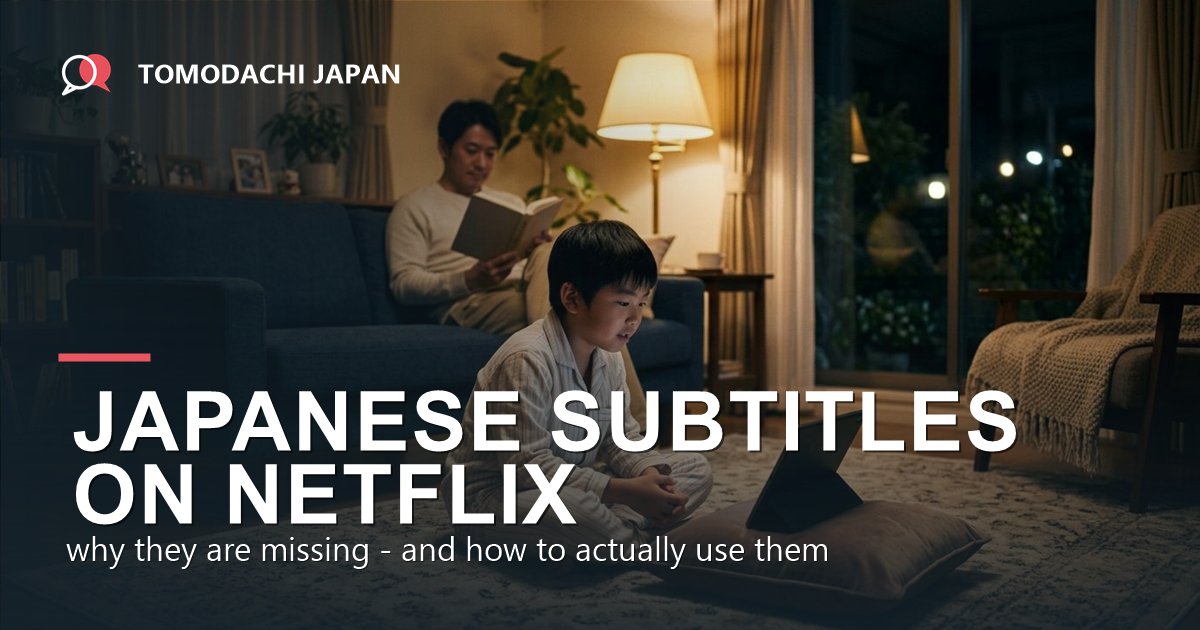
You want your child watching anime with Japanese subtitles, not English ones — because reading the words they are hearing is where anime stops being entertainment and starts being input. Then you open Netflix, scroll the subtitle menu, and Japanese is not there. This guide explains why that happens, the three things that actually change it, and — the part most articles skip — how to use Japanese subtitles so your child actually learns from them.
Why Japanese subtitles are missing
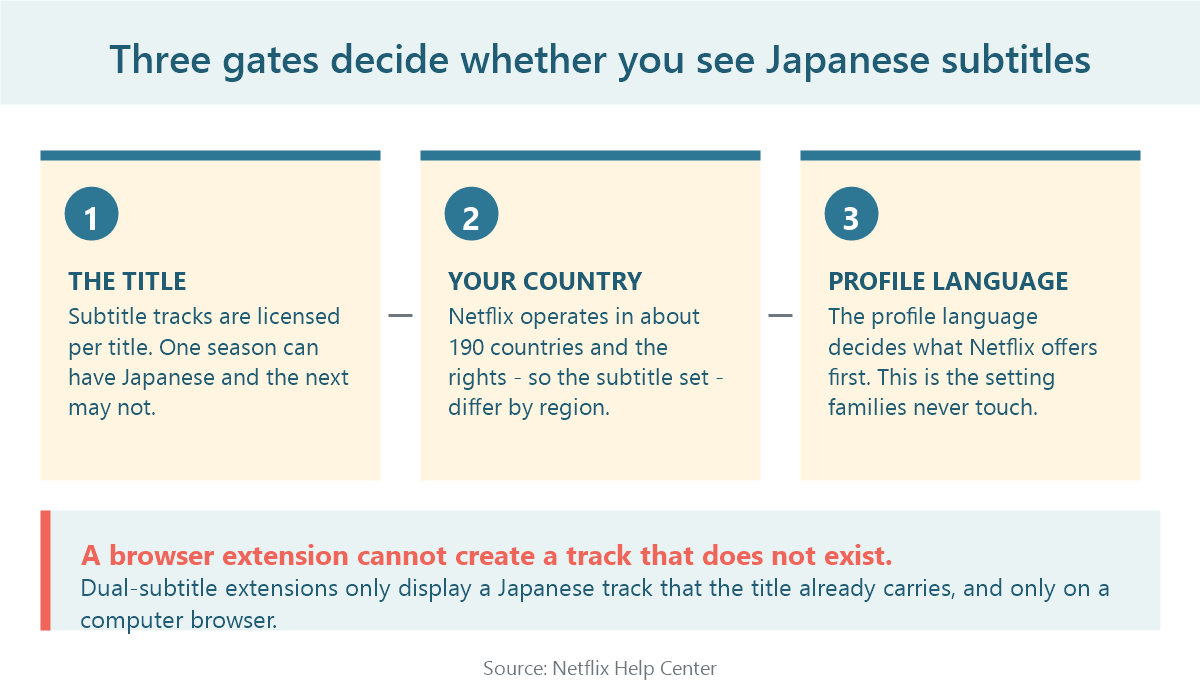
Japanese is one of the languages Netflix supports for subtitles. When it does not appear, it is almost never a bug. Three things decide what you see:
- The title itself. Subtitle tracks are licensed per title. Netflix states plainly that subtitles or audio may be unavailable in a language because of content licensing and show agreements. A series can have Japanese subtitles in one season and not the next.
- Your country. Netflix operates in around 190 countries and the subtitle set differs by region, because the rights differ by region.
- Your profile language. The language on your profile changes the menus — and Netflix will default to that language’s audio and subtitles when a title has them. This is the setting most families never touch, and it is the one that most often reveals Japanese.
Want to go from quoting anime to actually talking with friends in Japan?
TOMODACHI JAPAN is an online Japanese school for children growing up outside Japan. They talk with peers their own age in Japan every day, taught by teachers working at Japanese schools, in small classes of 8.
🎁 Register and we’ll email you our School Guide (PDF, in English) straight away. You’ll also be first to hear about tuition, scholarships and opening dates.
Free · takes about 30 seconds
The three fixes, in the order to try them
| Try this | Where | Works when |
|---|---|---|
| 1. Check the playback menu first | Start the episode, open the audio and subtitle icon during playback | The title already carries a Japanese track — often true for Japanese-produced anime |
| 2. Change your profile language to Japanese | Account → your profile → Language | The track exists but Netflix was not surfacing it. Menus turn Japanese too — which is itself useful exposure |
| 3. Pick a different title | Anything Japanese-produced, recent, and popular | The first two failed. Do not fight a title that simply has no Japanese track licensed in your country |
A note on browser extensions such as Language Reactor: they are genuinely useful — dual subtitles, pausing on each line, saved words — but they cannot create a subtitle track that does not exist. Japanese subtitles must already be available on that title for the extension to show them. Extensions also only work on a computer browser, not on a TV or tablet app. Fix availability first, then add the extension if your child studies at a laptop.
Now the part that matters: how to actually use them
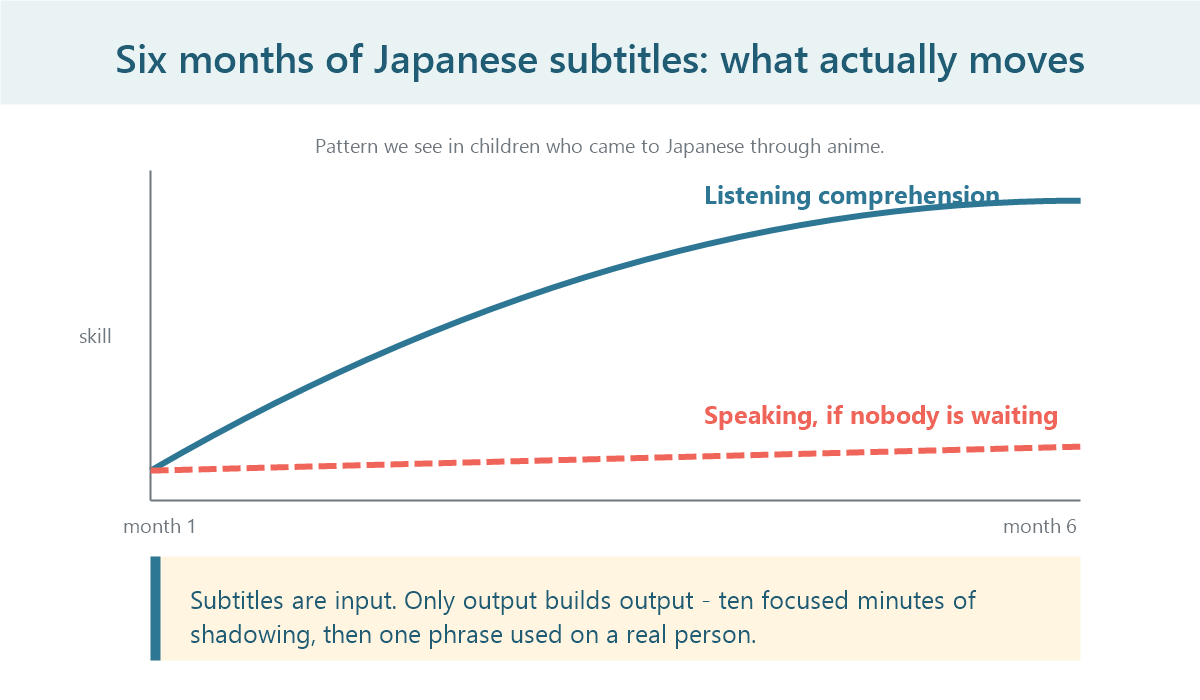
Here is where we have to be honest with parents. Turning on Japanese subtitles does not, by itself, teach a child Japanese. We see this constantly: a child watches hundreds of hours with Japanese subtitles on and their speaking does not move at all. Subtitles are input. Input builds comprehension. It does not build the ability to say something to a person who is waiting for an answer.
Used deliberately, though, they are excellent. This is the routine we give families, and it takes ten minutes, not a whole episode:
The 10-minute subtitle routine
- Watch one scene normally (2–3 minutes), Japanese subtitles on, no pausing. Enjoyment first.
- Re-watch the same scene and pause on three lines your child half-understood — not the hardest ones, the nearly-there ones.
- Say each line out loud, copying the rhythm and the emotion. This is shadowing; it is the step everyone skips.
- Pick one phrase to keep for the week and use it with a real person. One is plenty.
- Ask “would you say that to a teacher?” Half of anime speech is casual or rough, and children do not hear the difference until someone points it out.
Ten focused minutes beats a whole episode with subtitles on in the background.
A Japanese teacher’s warning about anime subtitles
Anime dialogue is written to be dramatic, and a lot of it is speech no real person uses with a teacher, a shopkeeper, or a friend’s parent. Children who learn from anime alone arrive fluent in a register that reads as blunt or rude — “omae” for “you”, dropped particles, commands where a request belongs. That is not a reason to stop watching. It is a reason to make sure someone is there to say “that one is fine with friends, this one you soften.” Subtitles cannot do that. A person can.
What subtitles do and do not fix
| Japanese subtitles | Subtitles + shadowing | Talking with people | |
|---|---|---|---|
| Listening comprehension | ◎ | ◎ | ◎ |
| Reading kana and kanji in context | ◎ | ◎ | △ |
| Pronunciation and rhythm | × | ○ | ◎ |
| Saying something unrehearsed | × | × | ◎ |
| Knowing what is polite | × | × | ◎ |
| Still doing it in three months | ○ (it is fun) | △ (needs discipline) | ◎ (friends pull them back) |
So use Netflix for the input — it is free, they already love it, and it builds the ear. Then give them somewhere to spend what they have absorbed. At TOMODACHI JAPAN that place is a small group with children who actually live in Japan, taught by qualified Japanese teachers, so the phrase your child collected this week gets used on a real person this week. If anime is the way in, we have written the fuller version of that path in learning Japanese through anime, and a list of shows worth starting with in anime with Japanese subtitles.
FAQ
Should we use Japanese subtitles or English ones?
Japanese, if your child can read kana. English subtitles let the eye do all the work and the ear switches off. If they cannot read kana yet, watch with no subtitles for short bursts and let them listen, then switch to Japanese subtitles once kana is comfortable.
Does changing the profile language mess up the rest of the family?
No — make a separate profile for your child and set that one to Japanese. Everyone else keeps their own language, and your child gets Japanese menus as a small daily dose of reading.
My child watches for hours but still cannot speak. Why?
Because watching is input and speaking is output, and only output builds output. It is the single most common pattern we see. The fix is not more hours of anime; it is a few hours a week where somebody is waiting for them to answer. We wrote about that gap in raising a bilingual Japanese child abroad.
Is a VPN the answer for missing subtitles?
We do not recommend it. It runs against Netflix’s terms, it breaks often, and it teaches a workaround rather than a habit. Changing the profile language and choosing Japanese-produced titles solves the problem for most families without any of that.