If your child can name forty anime characters but not order lunch in Japanese, welcome — you are in very good company, and this is actually a great place to start. Anime is now one of the biggest on-ramps into the Japanese language on earth, and a child who wants to understand their favorite show already has the one thing money can’t buy: motivation. The question isn’t whether anime can teach Japanese. It’s how to turn “I love anime” into real, usable Japanese your child can actually speak. Here’s the honest roadmap.
Anime is now the world’s biggest Japanese teacher
This isn’t a hunch. In Duolingo’s 2025 global report, Japanese climbed to the fourth most-studied language in the world, overtaking German — and the app found that over 26% of Japanese learners name anime as their main motivation. Japanese and Korean are especially popular with Gen Z, driven by anime, film and music. The trend is so strong that Duolingo launched its own anime series in late 2025 to ride it. If you’ve ever felt that your child’s anime habit was “just cartoons,” the data says otherwise: it’s the exact spark that millions of learners are now building real language skills on.
Want to go from quoting anime to actually talking with friends in Japan?
TOMODACHI JAPAN is an online Japanese school for children growing up outside Japan. They talk with peers their own age in Japan every day, taught by teachers working at Japanese schools, in small classes of 8.
🎁 Register and we’ll email you our School Guide (PDF, in English) straight away. You’ll also be first to hear about tuition, scholarships and opening dates.
Free · takes about 30 seconds
What anime genuinely gives your child
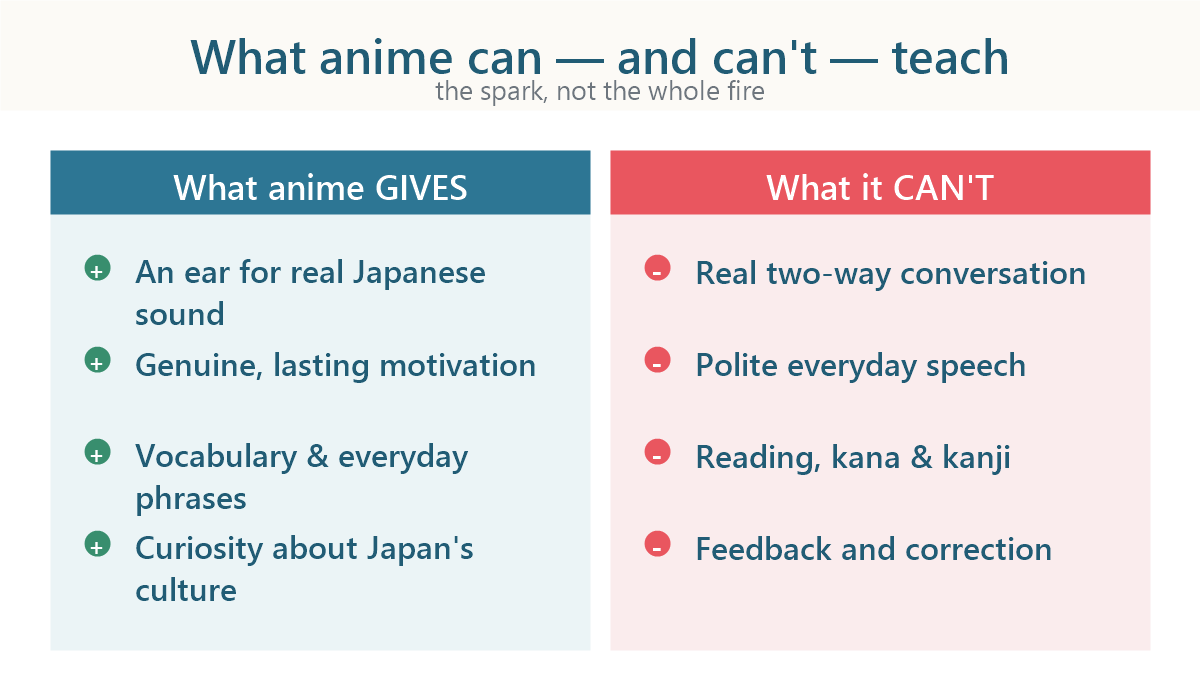
- An ear for the language. Hours of listening tune a child to the sounds, rhythm and melody of natural Japanese — something textbooks can’t replicate.
- Real motivation. Wanting to understand a beloved character is a far stronger engine than “you should learn this.” Motivation is the fuel that survives hard weeks.
- Vocabulary and set phrases. Kids absorb words, exclamations and catchphrases naturally, and light up when they recognize one.
- Cultural curiosity. Food, festivals, school life, manners — anime quietly builds a mental picture of Japan that makes the language feel worth learning.
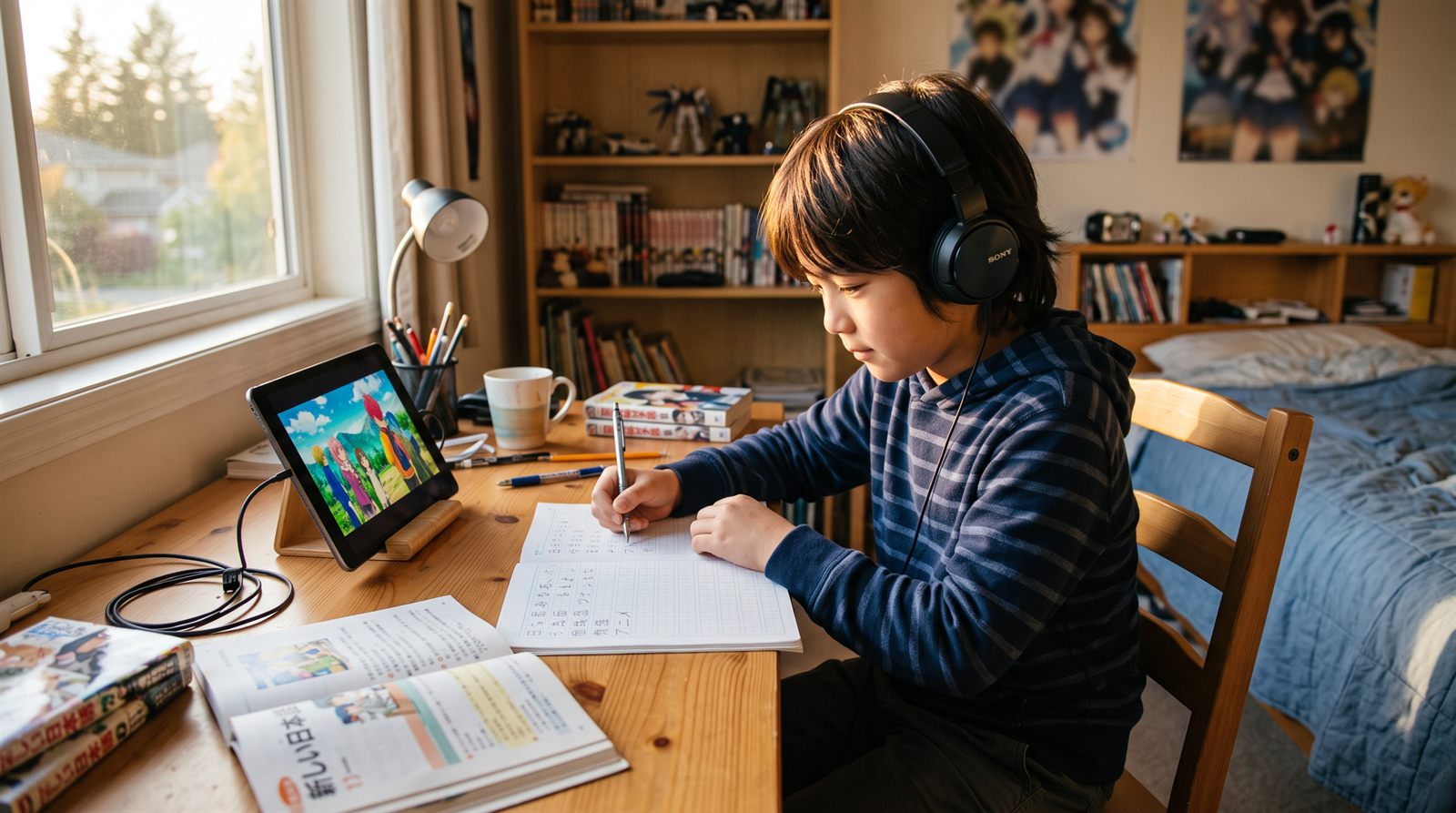
The honest limits of learning from anime
Here’s what no fan wants to hear, but every parent should: anime alone will not make your child fluent. A few honest reasons why:
- Anime Japanese isn’t everyday Japanese. Shows are full of dramatic, rough, or old-fashioned speech (“お前”, battle cries, boy-hero slang). A child who copies it can sound rude or strange in real life without knowing it.
- It’s one-way. Watching builds understanding, never production. You cannot learn to speak by only listening — the mouth has to practice, with someone who answers back.
- No reading or writing. Subtitles are usually in English. Anime does almost nothing for hiragana, katakana or kanji.
- No feedback. Nobody corrects your child or gently nudges them to the polite form. Habits — good and bad — just set.
None of this means “stop watching.” It means anime is the spark, not the whole fire. The job is to add the parts anime can’t give: speaking practice, feedback, and reading — without killing the joy that got your child here.
The bridge: from watching to speaking
How do you convert passion into skill without turning it into a chore? Here are the realistic options, and what each is best at.
| Next step | Best at | The catch | Rough cost |
|---|---|---|---|
| Apps (Duolingo, etc.) | Daily habit, cheap, starts the reading basics | No real conversation; motivation dips without people | Free–US$10/month |
| 1-on-1 tutor (italki, Preply) | Focused correction, flexible times | An adult appointment; kids clam up, and it’s per-lesson | ≈US$10–25/lesson |
| Short group courses (Outschool) | Live, themed, fun for a few weeks | Classmates change; friendships rarely last | per-course pricing |
| Ongoing kids’ group with friends in Japan (TOMODACHI JAPAN) | Speaking with same-age friends who love the same shows | Opens December 2026 | one flat monthly fee, unlimited |
Want the deeper breakdown of tutoring versus groups for children? We compare the leading options in our honest comparison of online Japanese lessons for kids. And if your child already parrots anime lines, they’ll enjoy our list of real Japanese phrases kids hear in anime — and what they actually mean.
Where TOMODACHI JAPAN fits
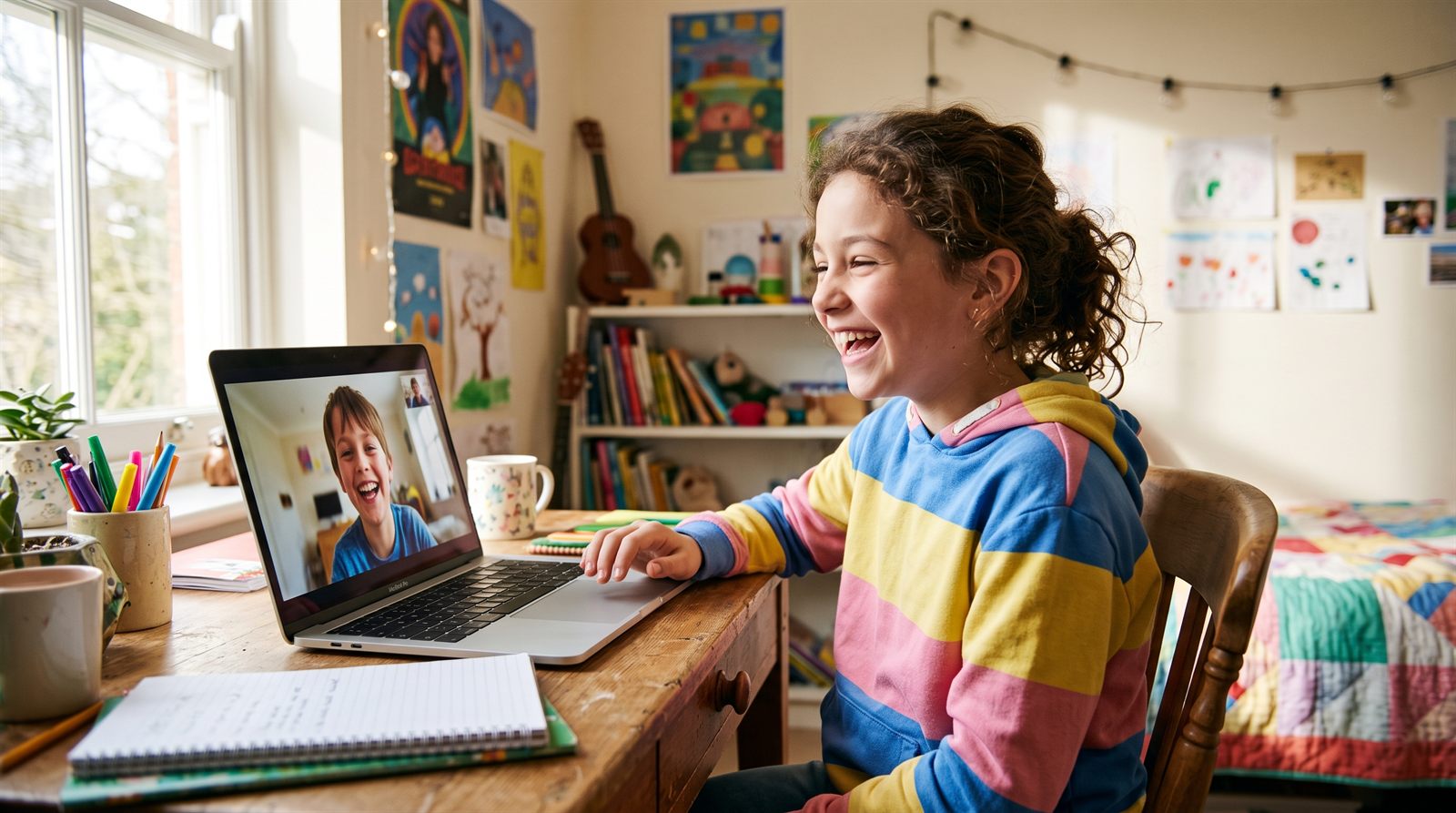
The fastest way from “loves anime” to “speaks Japanese” is to give a child friends who love the same shows and happen to live in Japan. That’s what TOMODACHI JAPAN is built for. In small online groups, your child talks — about anime, games, everyday life — with same-age children in Japan (from our sister school, NIJIN Academy). The motivation anime lit stays lit, because now there are real people on the other side who care about the same things. Classes are small groups, not one-off appointments; the friends are kids actually living in Japan, so the Japanese is current and two-way; and it’s built only for children, grouped by conversation level so beginners and near-natives both fit. One flat fee covers unlimited sessions. We open in December 2026; see tuition details and who we are.
FAQ
Can my child really learn Japanese from anime?
They can learn a lot — listening, vocabulary, and above all motivation — but not fluency on its own. Think of anime as the spark that makes a child want Japanese. Turning that into speaking, reading and polite everyday language takes practice with real people. Used together, anime plus conversation is a genuinely powerful combination.
Is anime Japanese rude or inappropriate to copy?
Some of it, yes. Action and comedy shows are full of rough, dramatic or masculine slang that sounds off in real conversation. It’s not a reason to stop watching — it’s a reason to pair anime with someone who can show your child what’s natural, and what to save for the screen.
My child isn’t Japanese — is anime a good way in anyway?
Absolutely. Most of the millions of new Japanese learners worldwide have no Japanese heritage at all — anime is their door in. A child who’s curious and motivated has the hardest part solved. From there it’s about finding a fun, low-pressure place to actually use the language.
How much anime is “too much”?
If it’s sparking curiosity and your child is starting to notice words and phrases, it’s doing its job. The goal isn’t less anime — it’s adding an outlet where that curiosity turns into speaking. When watching and talking feed each other, both get better.