Search Penang Japanese School fees in English and you will be told the school is at 140 Jalan Sungai Pinang, and that fees are somewhere between RM8,000 and RM80,000 a year depending on which page you land on. Both are wrong. The school moved campus in September 2025 and now publishes no street address at all — its own website tells families that Google Maps is out of date and to phone before visiting. And the fees are not a mystery: they are published in full, in Japanese, in a PDF two clicks deep. RM5,850 to enter, RM1,390 a month tuition, RM100 facility fee, RM280 for the bus. This page gives you the real schedule, the one fee that genuinely is not published, and the membership rule that decides whether your family is eligible at all — which no English page-one result mentions.
Japanese for children in Penang: the whole market
| Option | What it is | When | Ages | Published cost | Who can enrol |
|---|---|---|---|---|---|
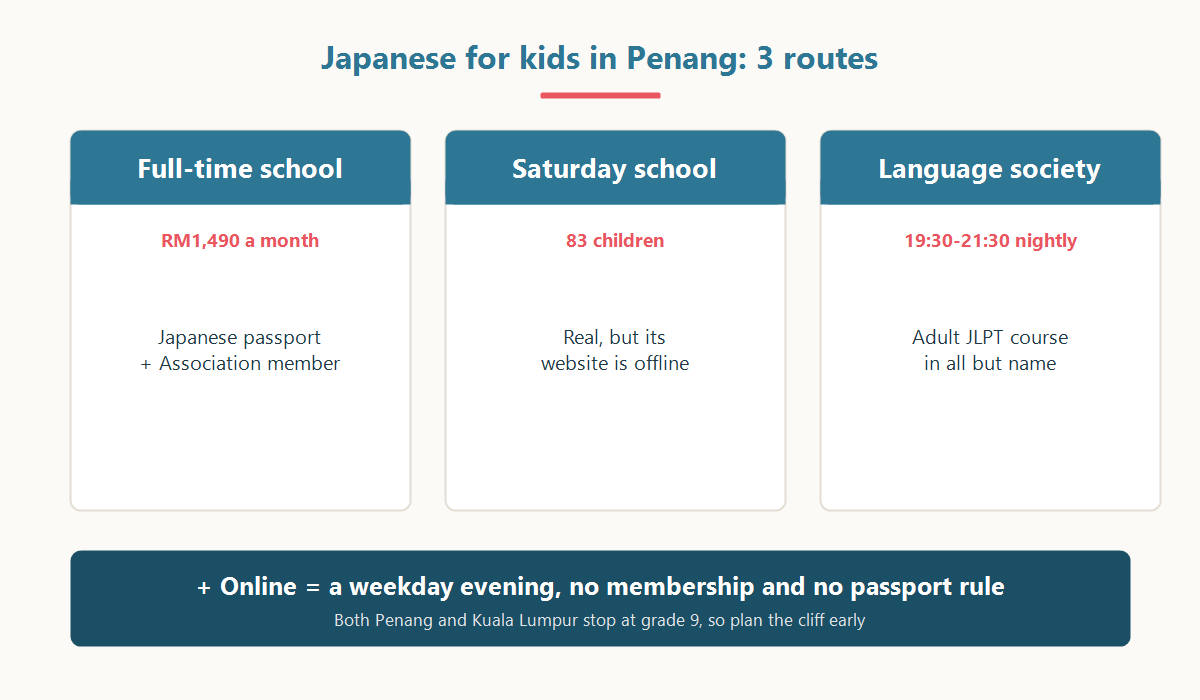
| Penang Japanese School (ペナン日本人学校) | Full-time 日本人学校, on Japan’s MEXT list; founded 5 Oct 1974; new campus since Sept 2025 | Mon–Fri | 6–15 (G1–G9) | Entrance RM5,850 one-off · tuition RM1,390/mo · facility RM100/mo · bus RM280/mo · PTA RM50/yr · plus an unpublished 特別入学金 | Japanese nationality, Penang residence, guardian must be an individual member of the Japanese Association |
| Penang Japanese Saturday School (ペナン日本人補習授業校) | Saturday 国語 and maths alongside a local or international school; opened Jan 2012; 83 children as of March 2026; max 15 per class with a teacher and a TA | Saturdays | Kindergarten (年長) – junior high | Not published anywhere | Contact admin@pjss.info |
| Penang Japanese Language Society (PJLS) | Japanese as a foreign language, Minna no Nihongo → JLPT, plus workplace classes | Weeknights 19:30–21:30 | Adults in practice | RM541–687 per course | Anyone — but “Elementary stage 1” means beginner, not primary school |
| TOMODACHI JAPAN | Online, classes of 8 with a homeroom teacher, grouped by actual level | Weekday evenings, Penang time | 5–18 | Sent in the free school guide | Any child of Japanese heritage, any passport |
Looking for a way to keep Japanese going from abroad?
TOMODACHI JAPAN is an online Japanese school for children growing up outside Japan. They talk with peers their own age in Japan every day, taught by teachers working at Japanese schools, in small classes of 8.
🎁 Register and we’ll email you our School Guide (PDF, in English) straight away. You’ll also be first to hear about tuition, scholarships and opening dates.
Free · takes about 30 seconds
The fees, in full, for the 2026 school year
| Item | Amount | Basis |
|---|---|---|
| Entrance fee (入学金) | RM5,850 | Per child, once |
| Tuition (授業料) | RM1,390 | Per child, per month — the same rate for elementary and junior high |
| Facility fee (学校施設設備拡充費) | RM100 | Per child, per month |
| School bus | RM280 | Per child, per month |
| Parents’ association (父母会費) | RM50 | Per family, per year |
| 特別入学金 (special entrance fee) | Not published — “to be determined separately” | Payable by the guardian or the guardian’s company |
Two mechanics in that document matter more than the headline numbers, and neither appears in English anywhere.
There is no pro-rata. A single day in a month costs the full month. The school’s own worked example: transfer in on 15 July and you pay the RM5,850 entrance fee plus three months — July, August and September — of tuition and facility fee up front. RM10,320 due on day one, for a child who has attended two weeks. Withdrawal works the same way in reverse: give notice on 2 August and leave on 31 August, and only September is refunded.
And one fee genuinely is not published. The school rules require, on top of the RM5,850, a 特別入学金 — a special entrance fee — payable by the guardian or by the company the guardian belongs to, at an amount “determined separately”. We are not going to guess at it, and you should distrust any page that prints one. For a family on a corporate posting, HR may already know the figure; for a locally hired or self-employed parent, this is a question for the school office before anything else. It is also the reason we will not tell you Penang is cheaper to enter than Kuala Lumpur, even though the published entrance fee is lower.
One more thing about the numbers you may have seen elsewhere. A widely copied schedule gives RM4,500 entrance and RM1,070 tuition. That is the 2022 sheet. Fees have risen about 30% in four years. If a page quotes RM1,070, it is quoting 2022 and has not been checked since.
Why nobody can give you the address — including the school
This is the strangest fact about Penang Japanese School, and once you know it the whole confused search result makes sense.
The school moved to a new campus in September 2025 and has chosen not to publish the new street address. Its access page says the school relocated, that the address shown on Google Maps may be the old one, and that visitors should contact the school by phone or email before coming. Its own school prospectus opens by telling readers to contact the school directly for the address. This is policy, not an oversight.
The move is independently confirmed. The Consulate-General of Japan in Penang records that the Consul-General attended the farewell event at the old campus on 24 July 2025, and that the school would move to its new building from the second term. The school’s own chronology lists a new building completion ceremony in September.
So what about the two addresses circulating in English?
- 140 Jalan Sungai Pinang is the campus the school used before September 2025. Every English page-one result that gives an address gives this one.
- 93 Muntri Street, 10200 is not a campus at all. It is the registered seat in Article 2 of the school’s constitution — the address of the Japanese Association of Penang, the school’s proprietor. It has stayed unchanged through campus moves.
That is why one directory prints both addresses on the same page and contradicts itself. It is not sloppiness on their part so much as an artefact of the school’s own document set: a scraper finds Muntri Street in the rules PDF and Sungai Pinang in the map data, and neither is where your child would go on Monday morning. If you are planning a visit, phone or email first. Do not drive to an address you found on the internet, including ours — which is why there isn’t one on this page.
The rule that decides eligibility: you must join the Association first
Article 8 of the school rules sets four conditions: Japanese nationality, residence in Penang, age 6–15, and — the one nobody writes about in English — the guardian must be an individual member (個人会員) of the Japanese Association of Penang. There is also a visa condition: a child without a Dependent Pass within six months is required to withdraw.
For Malaysian–Japanese families, the membership rules are worth reading carefully, because they are more open than the nationality line suggests — and more procedural than families expect.
- Individual membership requires Japanese nationality. So at least one parent needs a Japanese passport for the family to clear this gate. One existing member’s signature is also needed as an introducer.
- Family membership has no nationality requirement. It is defined by relationship — the parents, spouse and under-20 children of an individual member. A Malaysian spouse can be a family member.
- The child must personally be registered as a family member in order to enrol at the school. The Association flags this separately, with an asterisk, precisely because families assume it is automatic. It is not.
Practically: a Malaysian–Japanese household in which one parent is a Japanese national can enrol, provided that parent joins as an individual member and the child is registered as a family member. Association cost is RM50 once and RM40 a month — a small sum that appears on no school fee schedule. A household with no Japanese-national parent has no route through individual membership. There is a discretionary admission clause involving the principal and the management committee, so the honest advice is to ask rather than to assume — but treat it as a question, not an entitlement.
The Saturday school almost nobody in English knows exists
Penang has a supplementary school. It has had one since January 2012. Penang Japanese Saturday School teaches 国語 and mathematics on Saturdays to children from the final kindergarten year through junior high, capped at 15 per class with a teacher and a teaching assistant. As of March 2026 it had 83 children — 10 in kindergarten, 59 in elementary, 14 in junior high. It describes itself as a school receiving Japanese government support.
This is the option that fits the largest number of families reading this page: your child attends an international or local school on weekdays, and keeps Japanese literacy moving on Saturday. It is also the option that is hardest to find. The Consulate directs families to pjss.info, and as of August 2026 that domain serves a hosting placeholder rather than a website. The route that works is email to admin@pjss.info, or the school’s Facebook page.
We could not find a published fee for it anywhere — not on the flyer, not on the Consulate page, not in the magazine feature. So: not published, ask them. We would rather leave a blank in the table than fill it with a plausible number. One correction while we are here: some third-party pages describe it as designated by Japan’s Ministry of Education. On its own account it claims government support, not MEXT designation.
The Grade 9 cliff — and why Kuala Lumpur does not solve it
Families often plan on the assumption that if Penang runs out of school, Kuala Lumpur will take over. It is worth checking that assumption early, because it does not hold.
The Japanese School of Kuala Lumpur also stops at Grade 9. It requires Japanese nationality verified by passport, and membership of the Japan Club of Kuala Lumpur — a different association, so Penang membership does not transfer. Its monthly tuition is higher (RM1,670 elementary, RM1,890 junior high, against Penang’s single RM1,390 rate), and its one-off entry charges are higher on the published figures — though Penang’s unpublished special entrance fee makes that comparison unsafe to call.
In other words the Grade 9 cliff is national, not local. At 15, the options are: return to Japan, move to an international school and continue Japanese some other way, or send the child ahead alone. That is a decision worth starting in Grade 6, not in Grade 9 — and the “some other way” is the part most families leave until it is urgent.
What Penang does not have
We went looking for private Japanese classes for children in Penang and found none. The one substantial provider, the Penang Japanese Language Society, publishes its fees clearly (RM541–687 per course) and runs every 2026 class from 19:30 to 21:30 on weeknights, working through Minna no Nihongo towards the JLPT, plus corporate classes. That is an adult programme in everything but its wording. Its “Elementary stage 1 and 2” means beginner level, not primary school — a genuinely easy thing to misread when you are searching in English.
So the children’s market in Penang is exactly two institutions: the full-time school, gated by nationality and Association membership, and the Saturday school with 83 children and no published fees. That is the whole of it. If neither fits — and for a Malaysian–Japanese family, or a child whose Japanese is warm but not grade-level, often neither does — the local answer is nothing, and that is the honest state of the city.
How to choose, in three questions
Will your child re-enter a Japanese classroom? If yes, grade-level 国語 is not negotiable and the full-time school is the most direct route — if you are eligible. If you are settled in Penang, the goal is different and gentler: a child who still enjoys Japanese at eighteen.
What does Saturday actually cost your family? Not in ringgit — in Saturdays. The supplementary school is a good institution and one weekend morning is a real price, especially with siblings in different activities. Plenty of families decide it is worth it. Decide it deliberately rather than by default.
Who does your child speak Japanese to? Ability is built in lessons and kept alive in friendships. A child whose only Japanese-speaking partner is one parent usually holds on until around Grade 4 or 5, and then goes quiet — not because they forgot, but because what they can say stops matching what they think.
Online, and the one-hour offset
Malaysia is UTC+8 and Japan UTC+9, and neither observes daylight saving, so Penang is JST − 1 all year round. The offset never moves.
| Japan (JST) | Penang (MYT) | At home |
|---|---|---|
| 18:00 | 17:00 | Straight after school |
| 19:00 | 18:00 | Before dinner |
| 20:00 | 19:00 | After dinner |
| Sat 10:00 | Sat 09:00 | Clashes with the Saturday school — use a weekday instead |
TOMODACHI JAPAN is an online school for children of Japanese heritage, opening December 2026. Three differences from a tutor:
- Friends, not just lessons. Classes of eight with a homeroom teacher, and children the same age in Japan in the room — the thing one-to-one cannot provide, and the thing that makes a child keep going.
- Teachers at Japan’s current classroom standard, which matters when the goal is 国語 rather than conversation.
- Grouped by actual level, not school year. No nationality clause, no Association membership, no entrance test. A Malaysian–Japanese child in Grade 5 reading at Grade 3 level is placed where they can succeed.
Fair comparison: if your child is grade-level and heading back to Japan, the full-time school is more school than we are. And if the Saturday school suits you and you can get a place among the 83, take it — we work well alongside it on a weekday evening rather than instead of it.
Questions parents in Penang actually ask
What are Penang Japanese School fees in 2026?
RM5,850 entrance once, RM1,390 a month tuition, RM100 a month facility fee, RM280 a month for the bus, RM50 a year parents’ association. That is RM1,490 a month excluding the bus, or RM17,880 a year. Billing is quarterly with no pro-rata. On top of this there is a special entrance fee whose amount the school does not publish.
Where is the school now?
At a new campus since September 2025, at an address the school does not publish. It asks families to phone or email before visiting. “140 Jalan Sungai Pinang” is the old campus; “93 Muntri Street” is the Association’s registered seat, not a school building.
My spouse is Malaysian. Can our child enrol?
If one parent holds a Japanese passport, yes in principle: that parent joins the Japanese Association as an individual member, the non-Japanese spouse can join as a family member, and the child must be registered as a family member too. If neither parent is a Japanese national, there is no route through individual membership; ask the school about the discretionary clause rather than assuming.
Is there a Japanese Saturday school in Penang?
Yes — Penang Japanese Saturday School, since 2012, 83 children as of March 2026, Saturdays, 国語 and maths. Its website domain is currently not serving a site; email admin@pjss.info or use its Facebook page. Fees are not published.
Does the school go up to high school?
No — Grades 1 to 9, ages 6 to 15. Kuala Lumpur stops at Grade 9 as well, so moving there does not extend the runway.
Reading around the region: Japanese classes for children in Kuala Lumpur · Japanese classes for kids in Singapore · the online alternative to a Japanese supplementary school