Every English page about Manila Japanese School quotes the same two numbers: ₱17,000 tuition and ₱7,000 facility fee per month. Those numbers are from April 2023. The school’s own 2026 handbook, revised 5 February 2026, says ₱18,000 and ₱8,000. That is the small error. The large one is this: on top of the ₱26,000 admission fee, the school requires a donation at entry — US$2,000 per household for a self-employed family — and states in writing that paying it is a condition of admission. Not one page-one result mentions it. This article is the fee sheet as the school actually publishes it, the four conditions that decide whether your child is eligible at all, and what is left for the families who are not.
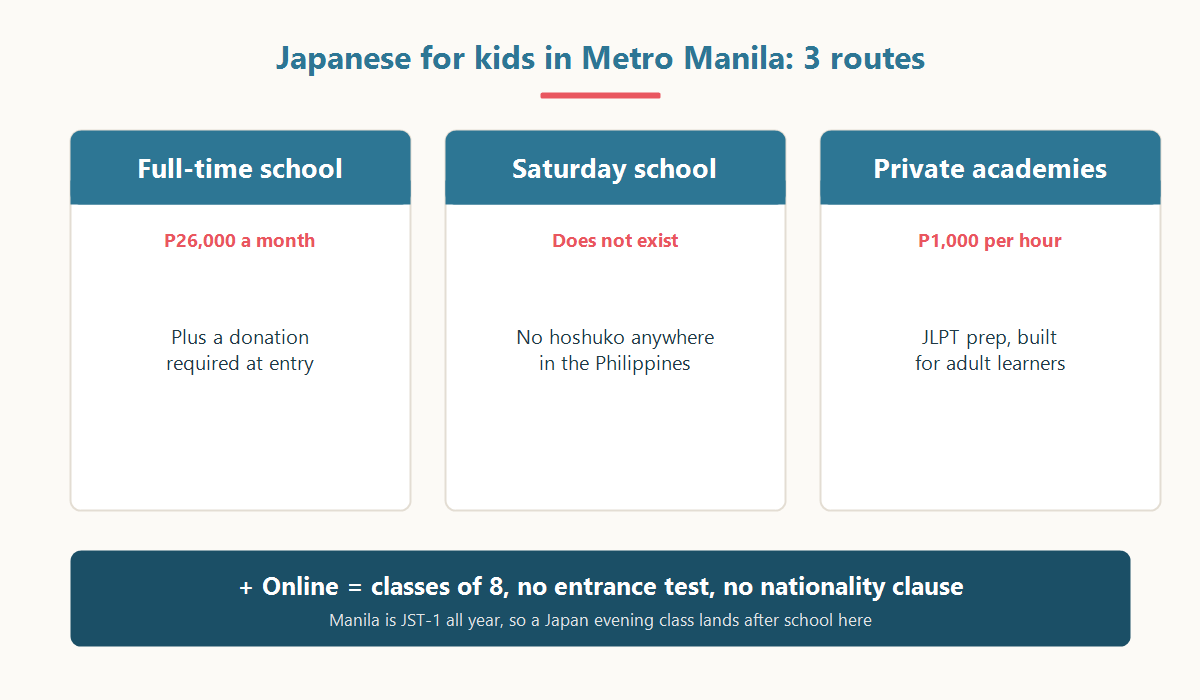
Japanese for children in Metro Manila: the comparison
| Option | What it is | Ages | Published cost | Who can actually enrol |
|---|---|---|---|---|
| Manila Japanese School (MJS) | Full-time school attached to the Embassy of Japan, BGC, Taguig. 497 pupils as of 15 April 2026 | 6–15 (Grades 1–9; no high school) | Admission ₱26,000 one-off; tuition ₱18,000/month; facility fee ₱8,000/month; plus a donation at entry: US$2,000 self-employed, US$500 first child for government/international bodies, company families “ask the office” | Japanese nationality in principle; age-appropriate Japanese; intention to return to Japan; parent must be a JAMI member; interview and written test |
| Saturday supplementary school (補習授業校) | — | — | — | Does not exist anywhere in the Philippines |
| Sundai Manila (験台海外校) | Japanese cram school for Japanese entrance exams; in-person and online, BGC | Grade 3 – Year 12 | Not published | Assumes grade-level Japanese already |
| CEVAS | JLPT / JFT exam preparation for Filipino learners; 12 branches | Not published | ₱3,950 online (30×3h) – ₱7,950 in person, promotional pricing | Anyone — but this is Japanese as a foreign language |
| PJLink, Makati | One-to-one conversation and JLPT, Legazpi Village | Not published | ₱1,000 / 60 min, VAT excluded | Anyone — foreign-language framing |
| TOMODACHI JAPAN | Online, classes of 8 with a homeroom teacher, grouped by actual level rather than school year | 5–18 | Sent in the free school guide | Any child of Japanese heritage, any passport, anywhere |
Looking for a way to keep Japanese going from abroad?
TOMODACHI JAPAN is an online Japanese school for children growing up outside Japan. They talk with peers their own age in Japan every day, taught by teachers working at Japanese schools, in small classes of 8.
🎁 Register and we’ll email you our School Guide (PDF, in English) straight away. You’ll also be first to hear about tuition, scholarships and opening dates.
Free · takes about 30 seconds
The 2026 fee sheet, as the school publishes it
The fees are public. They are just not on any web page. They sit on page 22 of a 26-page parent handbook PDF, in Japanese, linked from the Japanese side of the school’s site. The English admission page carries the application dates and nothing else — no fees, no eligibility rules. If you read only English, none of what follows is visible to you.
| Item | Amount | When |
|---|---|---|
| Admission fee (入学金) | ₱26,000 | One-off, at entry |
| Tuition, elementary and junior high | ₱18,000 / month | Billed three months in advance |
| Facility fee (施設費) | ₱8,000 / month | Billed three months in advance |
| Donation, self-employed household | US$2,000 per household | One-off, at entry |
| Donation, government / international organisation | US$500 first child, US$250 second and subsequent | One-off, at entry |
| Donation, company employee | Not published — “please ask the office” | One-off, at entry |
| PTA fee | ₱500 per household per year for FY2024 | Set each May at the PTA general meeting |
| Materials fee | “Set per year group” — amounts not published | Termly |
| School bus | Not published. Paid directly to the bus company | — |
So the monthly figure that actually leaves your account is ₱26,000, not ₱24,000 — and once you add the Japanese Association membership that admission requires (below), ₱27,800. The difference from the number circulating in English is ₱3,800 a month, plus a four-figure US-dollar payment at the door that no English page mentions at all.
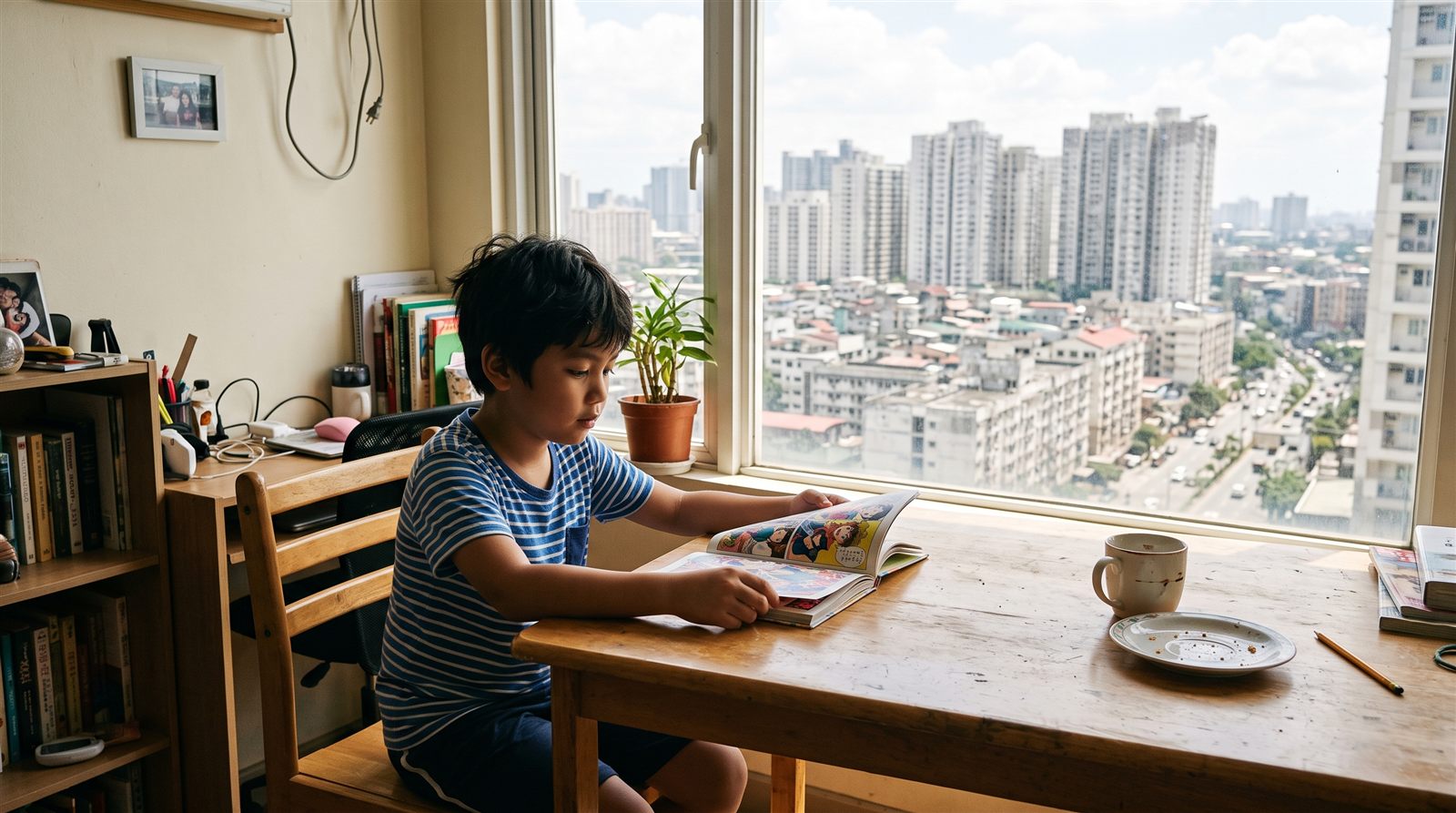
The donation is not a donation
This is the part worth reading twice, because the English word chosen for it is misleading. The handbook says, in a note directly under the fee table, that the school is a private school and that at entry or transfer, separately from the admission fee above, payment of a donation is a condition. Not a request. Not “gratefully received”. A condition.
And the amount depends on how the parent is employed, by a factor of four:
- Government bodies and international organisations: US$500 for the first child, US$250 for each child after.
- Company employees: the handbook does not print a figure. It says to ask the office.
- Self-employed households: US$2,000 — per household.
Read the pattern rather than the numbers. The families paying the most are the ones with no employer behind them: the locally hired, the entrepreneurs, the freelancers, and — very often — the Japanese–Filipino families who live here permanently rather than on a three-year posting. The families paying the least are those whose costs an institution is absorbing. Meanwhile the figure for the largest group, company employees, is not published anywhere, which is the structural reason no article on the internet can give you a correct total. We are not making one up either. If you are employed by a company, the honest answer is that you have to phone.
Before the money: the four conditions that decide eligibility
Page one of the same handbook lists nine admission conditions. Four of them decide the outcome for most families reading this in English.
1. Japanese nationality, in principle. There is an exception, and it is worth knowing precisely because it is narrow. A child without Japanese nationality must satisfy all four nationality clauses: at least two cumulative years of Japanese-medium education at a Japanese school or an overseas Japanese educational institution; passing the entrance or transfer examination; a parent who joins the PTA and takes part; and a parent who understands Japanese and is always contactable. It is the two-year clause that decides it. A Japanese–Filipino child raised in Manila, however fluent at home, usually has no such record.
2. Age-appropriate Japanese in all four skills. Reading, writing, listening and speaking, judged by the school, at the level of the child’s year group. This is a Japanese school taught in Japanese, not a place to acquire Japanese.
3. The intention to return to Japan. Condition (3) reads: applicants must intend to return to Japan in the near future and receive Japanese school education there. This single line is the most under-reported fact about MJS, and it is not a technicality — it is the school’s stated purpose. MJS is built for families on posting who will re-enter the Japanese system. If your family lives in the Philippines and intends to stay, you are, by the school’s own definition, outside its design.
4. An interview and a written examination. Elementary applicants sit Japanese and mathematics, about 30 minutes; junior high applicants sit Japanese, mathematics and English, about 30–40 minutes. Parents are interviewed alongside the child. The result is given immediately, and the school notes that a child who passes can start the next day. Sitting dates are arranged individually, and the school states plainly that the process is only for families who meet the admission conditions.
You have to join a members’ club before you can join the school
Condition (7): the parent must, in principle, be a member of the Japanese Association of Manila (JAMI). That association is also the school’s founding body, so this is not a formality — and joining it is its own process.
- Individual membership costs ₱1,800 a month, ongoing. It appears on no school fee schedule.
- You need the recommendation of two existing members. Supporting, family and junior members are explicitly not eligible to act as recommenders.
- Applications are reviewed at the board meeting on the fourth Tuesday of each month, with membership effective the first of the following month.
Say that plainly: to enrol your child you must first be introduced by two people who are already inside. For a family arriving on a corporate posting, the employer usually supplies both signatures without anyone noticing the step exists. For a locally hired parent, a founder, or a Japanese–Filipino family who have simply always lived here, that is a real barrier, sitting in front of a school gate, invisible from every English article about fees. It is also a timing trap: apply in the last week of a month and your membership — and therefore your child’s eligibility — can slip by five weeks.
The Philippines has no Saturday supplementary school. Anywhere.
Across Asia, the usual answer for a child who cannot or does not attend a full-time Japanese school is the 補習授業校 — the Saturday supplementary school, teaching Japanese language and mathematics to the Japanese curriculum alongside a local or international school. Singapore has one. Bangkok has one. Kuala Lumpur has one. Ho Chi Minh City has one.
The Philippines has none. On Japan’s Ministry of Education list of certified overseas educational institutions, the Philippines has exactly one entry — Manila Japanese School — and no supplementary school at all. In the whole of Asia, only Chennai and Singapore appear as supplementary schools with dispatched teachers.
This is why Manila is a harder city than its size suggests. Everywhere else, a family that fails an eligibility test, or that wants their child in an international school on weekdays, still has a Saturday route. Here the menu is two items long: get into MJS, or improvise. Every page-one article is written on the assumption that you got in.
The private options, honestly reviewed
There is a real Japanese-language industry in Metro Manila. Almost none of it is aimed at your child. The distinction that Google collapses, and that decides whether a school is useful to you, is between Japanese as a foreign language — a Filipino adult preparing for the JLPT or the JFT so they can work in Japan — and Japanese as a home language, a heritage child keeping up with the 国語 their cousins are doing.
- Sundai Manila is the closest thing to what a returning family needs: a branch of a major Japanese cram school in BGC, taking Grade 3 to Year 12, in person and online, open weekday afternoons and evenings and both weekend days, closed Tuesdays. Its honest limitation is that it is an exam school. It assumes your child already has grade-level Japanese and is aiming at a Japanese entrance examination. It does not publish fees.
- CEVAS publishes its prices clearly — ₱3,950 for a 30-session online course, ₱7,950 in person, at promotional rates — and has twelve branches from Quezon City to Davao. It is explicitly a JLPT and JFT preparation programme. It does not publish an age range, and its curriculum starts from zero for a foreign learner, which is the wrong starting point for a bilingual child.
- PJLink in Makati is transparent about price too — ₱1,000 per 60-minute one-to-one lesson, VAT excluded — and one-to-one does let a good teacher meet a child where they are. Two caveats: the age range is not published, and one-to-one gives a child no peers. A child who only ever speaks Japanese to an adult tends to stop.
- Everything else we checked did not survive verification. One frequently listed children’s tutorial service in Rizal no longer resolves as a domain. One centre’s “Nihongo for Kids” course is documented only in a 2015 article. We have left both out rather than send you to a phone number that no longer rings.
The pattern is worth naming: the providers who publish prices are teaching a different subject, and the provider teaching the right subject does not publish prices. No amount of searching resolves that. It is the market, not your search terms.
What the English internet gets wrong about this school
We checked page one against the school’s own documents. Four of the five results are wrong in a way that would change a decision.
- The most-cited article gives ₱17,000 and ₱7,000 — figures marked as updated in April 2023 — and labels the ₱26,000 admission fee “(monthly)”. It is a one-off payment. Read literally, that page overstates a year’s cost by more than ₱280,000.
- One international-school database states the school “does not make their fees public”. It does; they are in the handbook. The same page gives the age range as 6 to 18. The school ends at Grade 9 — ages 6 to 15. There is no high school. A family planning a whole education around that entry is planning around a school that stops three years early.
- The English Wikipedia article contains no fee information at all and rests on a single 2014 citation, which itself points at a 2006 document.
- Even the operator’s own site is stale: the Japanese Association’s school page still says 395 pupils, as of December 2016. The school’s own page says 497, as of 15 April 2026. The parent body’s description of its own school is roughly a decade out of date.
None of this is anyone acting in bad faith. It is what happens when the authoritative document is a Japanese-language PDF and everyone downstream is copying from each other. It is also why we would rather write “not published” eight times on this page than hand you a tidy number we cannot source.
How to choose, in three questions
Are you returning to Japan, and when? If your child will re-enter a Japanese classroom within a few years, grade-level 国語 is not optional and MJS — if you are eligible — is the most direct route in the country. If you are staying in the Philippines, the goal is different: a child who stays comfortable in Japanese for life, which is a longer, gentler project and does not need a full-time school.
Does your child’s Japanese match their school year, honestly? Not “do they understand me” — can they read and write at year level. If yes, MJS and Sundai are open to you. If not, and your household runs mostly in English or Tagalog, the entrance examination is a hard place to discover it, and a level-based route will be kinder and faster.
Who does your child speak Japanese to? This is the one families underweight. Ability is built in lessons and kept alive in friendships. A child whose only Japanese-speaking partner is a parent will hold on for a while and then quietly stop — usually somewhere around Grade 4 or 5, when what they can say stops matching what they think.
Online, and why Manila is unusually well placed for it
Most cities pay a time-zone tax on Japanese classes. Manila does not. The Philippines has had no daylight saving since 1978 and Japan has none, so Manila is JST − 1 every day of the year — the gap never moves, unlike Australia or Europe where the offset shifts twice a year.
| Japan (JST) | Manila (PHT) | What it means at home |
|---|---|---|
| 18:00 | 17:00 | Straight after school |
| 19:00 | 18:00 | Before dinner |
| 20:00 | 19:00 | After dinner, before homework winds down |
| 21:00 | 20:00 | Workable for older children |
| Sat 10:00 | Sat 09:00 | Saturday morning free either way |
TOMODACHI JAPAN is an online school for children of Japanese heritage, opening December 2026. Three things make it different from a tutoring service, and they map onto the three questions above.
- Friends, not just lessons. Classes of eight with a homeroom teacher, and children of the same age in Japan in the room. That is the part a one-to-one tutor structurally cannot supply, and it is what makes a child keep going.
- Teachers at Japan’s current classroom standard. Serving-level Japanese teachers, not conversation volunteers — which matters if the goal is 国語 rather than chat.
- Grouped by actual level, not by school year. No entrance examination and no nationality clause. A Japanese–Filipino child in Grade 5 who reads at Grade 3 level is placed where they can succeed, not turned away at an interview.
To be fair about it: if your child is fully grade-level and returning to Japan next year, a full-time Japanese school is more school than we are, and we will say so. We exist for the families Manila currently has no answer for — and after the last section, you know how many of those there are.
Questions parents in Manila actually ask
So what does Manila Japanese School really cost per month?
₱26,000 a month in school charges — ₱18,000 tuition plus ₱8,000 facility fee — billed three months ahead, plus ₱1,800 a month for the Japanese Association membership that admission requires. At entry, add ₱26,000 admission and the donation: US$2,000 for a self-employed household, US$500 for the first child of a government or international-organisation family, and an unpublished amount for company employees. Materials fees and the bus are extra and not published.
My child has a Philippine passport. Can they enrol?
Possibly, but all four nationality clauses must be met, and the binding one is two cumulative years of Japanese-medium education at a Japanese school or an overseas Japanese educational institution. A child raised entirely in Manila normally cannot meet it, regardless of how well they speak. Ask the school directly rather than assuming either way — the school states that unusual cases are decided by the management board.
We are staying in the Philippines long term. Is MJS still right for us?
By the school’s own admission conditions, its pupils are expected to intend to return to Japan and continue in the Japanese system. That does not automatically exclude a settled family, but it tells you what the school is optimised for — and it is worth raising in the interview rather than after enrolment.
Is there a Saturday Japanese school in Manila or Cebu?
No. There is no certified supplementary school anywhere in the Philippines. This is the single biggest structural difference between Manila and Singapore, Bangkok, Kuala Lumpur or Ho Chi Minh City.
Does Manila Japanese School go up to high school?
No. Grades 1 to 9 only — ages 6 to 15. Directories saying “ages 6 to 18” are wrong. Plan the transition before Grade 9, not during it.
Can we do MJS and something online at the same time?
Yes, and some families do — typically for the conversation and friendship side, which a full-time school in an expatriate bubble does not automatically provide. Because Manila is JST − 1 all year, an evening class in Japan lands in the Manila early evening and does not collide with a school day.
Reading around the region: Japanese classes for children in Kuala Lumpur · Japanese classes for kids in Singapore · the online alternative to a Japanese supplementary school