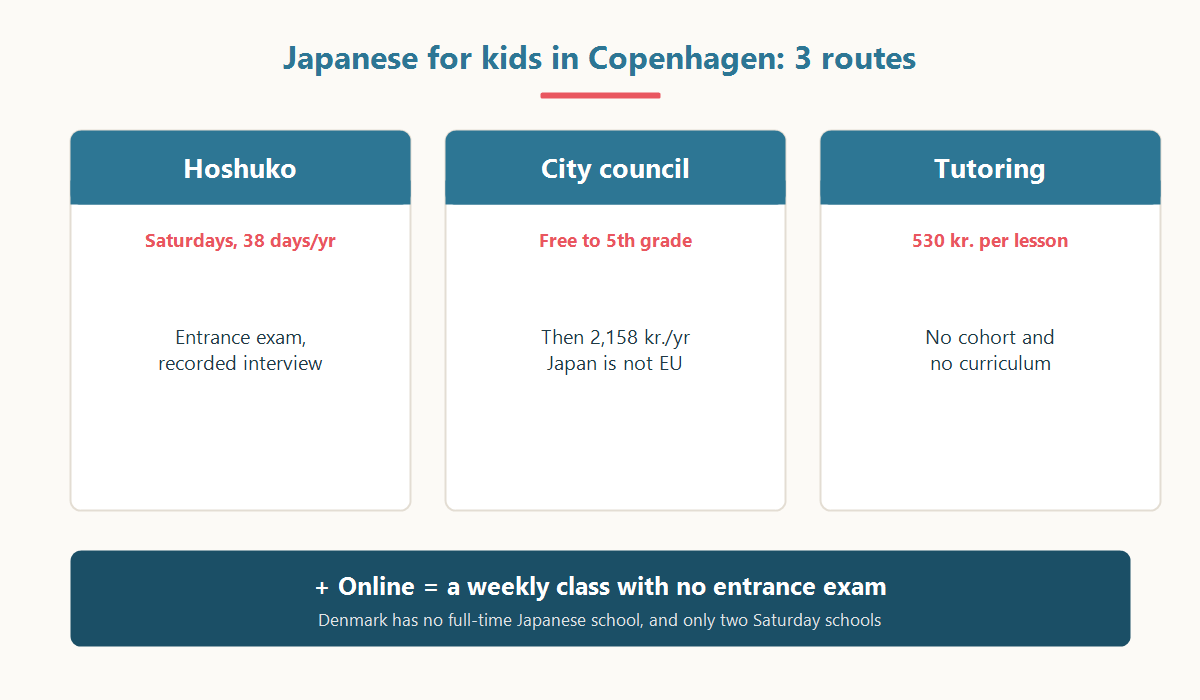
Search “Japanese supplementary school Copenhagen” and you get one answer: コペンハーゲン日本補習学校, founded 1974, Saturday mornings, 38 days a year, ages 4–15. What no English page tells you is that (a) your child must pass a recorded entrance exam to get in, (b) the tuition is 8,690 kr. a year and appears nowhere in English, and (c) Copenhagen has a second Japanese class for children, run by the city council, that is free through 5th grade — no exam, no interview, no committee duty. That second option is genuinely invisible: it is documented only in Danish, and no English article naming this query mentions it. It also has a catch that arrives at exactly the wrong age. Here is the whole map.
Japanese for children in Copenhagen: the comparison
| Option | Type | Day | Ages | Published cost | Gate |
|---|---|---|---|---|---|
| コペンハーゲン日本補習学校 (小中学部) | 補習授業校; 国語 + maths, Japanese textbooks | Sat mornings, 38 days/yr | 6–15 (grades 1–9) | 250 kr. exam fee + 700 kr. enrolment + 8,690 kr./year | Entrance exam + parent must operate in Japanese |
| Same school, 幼稚部「かなクラブ」 | Kindergarten division | Saturday mornings | 4–5 | 710 kr. entry + 7,810 kr./year | Waiting list; no trial, no observation |
| Modersmålsskolen (Copenhagen city council) | Municipal mother-tongue class — heritage, not Japanese curriculum | Mon 15.30–18.00 (0.–3. kl.) Tue 15.30–18.00 (4.–9. kl.) | ~6–16 | Free to 5th grade; then 2,158 kr./year (siblings 1,618 kr.) | Must live in Københavns Kommune |
| FEGU Hellerup | Private tutoring, takes children | By arrangement | Not published | 530 kr. per 1-to-1 lesson; 350 kr. each in a pair | None published |
| TOMODACHI JAPAN | Online, classes of 8 with a homeroom teacher, grouped by level | Any day | 5–18 | Sent in the free school guide | No entrance exam |
Looking for a way to keep Japanese going from abroad?
TOMODACHI JAPAN is an online Japanese school for children growing up outside Japan. They talk with peers their own age in Japan every day, taught by teachers working at Japanese schools, in small classes of 8.
🎁 Register and we’ll email you our School Guide (PDF, in English) straight away. You’ll also be first to hear about tuition, scholarships and opening dates.
Free · takes about 30 seconds
The free class nobody mentions — and the cliff at 6th grade
Københavns Kommune runs a mother-tongue school, Modersmålsskolen, and Japanese is a live, timetabled class on it for 2026/2027: at Tove Ditlevsens Skole in Vesterbro, Mondays 15.30–18.00 for grades 0–3 and Tuesdays 15.30–18.00 for grades 4–9. Any bilingual child living in the municipality who actively uses the language at home may attend. There is no entrance exam, no requirement that a parent speaks Japanese to the school, and no nationality requirement. For grades 0–5 it is free.
Then comes the part worth knowing a few years in advance. From 6. klasse, free tuition continues only for the official languages of EU and EEA countries. The council prints the qualifying list — Poland, Germany, Sweden, Bulgaria, Hungary, Austria and the rest — and Japan is not on it. So from 6th grade a Japanese-speaking child pays 2,158.00 kr. per school year (1,618.00 kr. each for siblings), while a Polish or German classmate in the very same building continues free to 9th grade. The charge is not a means test or cost recovery. It is triggered by Japan’s non-membership of the EEA.
And it depends on your postcode in a way that catches people out. Frederiksberg is a separate municipality entirely enclosed by Copenhagen, and it offers free mother-tongue teaching only for EU/EEA languages plus Norwegian, Icelandic, Greenlandic and Faroese. For Japanese there is no free route at any age — only self-paid tuition at 4,000 kr. per school year. Same metropolitan area, same language, three different prices: 0 kr., 2,158 kr., or 4,000 kr., decided by which side of a municipal boundary you live on.
Be clear about what this class is and is not. It is heritage-language teaching, not the Japanese curriculum — no 国語, no maths, no Japanese textbooks, no return-to-Japan framing. It will not keep a child at Japanese grade level for a move back. But if your goal is that your child keeps speaking, reading and enjoying Japanese, it is a real, free, weekly option that costs you nothing to try, and the fact that it is documented only in Danish is why Japanese-speaking parents in Copenhagen routinely never hear about it. A language runs only if at least 12 children in the municipality ask for it, so enquiring is itself useful.
Modersmålsskolen — about · Terms and prices · Frederiksberg’s rules
The supplementary school: what the English page leaves out
コペンハーゲン日本補習学校 is a 補習授業校: a parent-run non-profit, supported financially by Japan’s education ministry and advised by the Embassy, teaching 国語 and maths only on the Japanese national curriculum with Japanese textbooks. Roughly 80 children in the main division and 30 in the kindergarten. All teachers are hired locally — a Japanese teaching licence is not required, and there are no ministry-dispatched teachers.
The school’s English page runs to about 2,300 characters. It contains no fee figure at all — neither “kr.” nor “DKK” appears — and it never mentions the entrance exam, the interview or the recording. Its student numbers are dated April 2022 while the Japanese page dates the identical numbers March 2026. An English-reading parent therefore cannot learn the price, or that their child will be tested, from the page that ranks first for this search. Here is what the Japanese pages say.
- 1. Admission is by competitive exam, and it is recorded. Entry or transfer requires passing an entrance test run by the school’s own teachers: an individual assessment of about 10 minutes, written and oral, with two examiners to one child, recorded on video and audio. Listening and speaking carry the primary weight, with reading, writing and classroom attitude also assessed.
- 2. The parent interview checks what language you speak at home. A three-way interview of about 10 minutes with the parents examines which language the parent and child actually speak to each other, and how home study will be supported. The school is candid about the bar: if a child can barely speak Japanese, it says frankly that admission is difficult.
- 3. There is no nationality requirement — the word does not appear in the admission or FAQ pages, and permanent residents’ children are explicitly admitted. The gate is language, not passport.
- 4. Every parent serves a two-year term on the management committee at least once while their child is enrolled, on top of key duty, sub-committees, events, weekly homework marking, and using the school’s email and document tools.
- 5. The intake runs on one annual cycle. A briefing around October, which you must attend, then the exam around January, then entry in April.
Two fee traps on the school’s own website
First: the page that answers your question has the wrong numbers. The admission page gives the 2026 rates — 250 kr. exam fee, 700 kr. enrolment, 8,690 kr. annual tuition including supplementary materials. But the FAQ — the page that literally answers “how much is the tuition?” — still carries April 2024 figures of 600 kr. and 7,040 kr., with a 200 kr. trial fee. Both pages are live, neither points at the other, and a parent budgeting from the FAQ is short by about 23% on annual tuition. Take your figures from the admission page, and confirm them in writing.
Second: finishing the kindergarten does not get your child into Grade 1. This is the one that hurts. The admission page states that the entrance exam is administered including children already enrolled in the kindergarten division. So a family can pay 710 kr. plus 7,810 kr. a year through two years of かなクラブ, and their child still sits the recorded interview — and can still not pass. Compounding it, the kindergarten offers no trial lesson and no observation at all, so you cannot preview any of it before committing. If you are choosing the kindergarten as a route into Grade 1, ask the school directly what proportion of its own kindergarten children are admitted.
Two smaller notes. The street address is not published anywhere on the official site — it says only that it borrows a Copenhagen public primary school. Wikipedia places the school in Hellerup, which is in Gentofte, a different municipality altogether; that contradicts the school’s own wording, and we cannot resolve it, so ask. And the school’s old website is dead but still ranks, carrying superseded fees under a slightly different spelling of the school’s name.
Admission page (2026 fees) · Kindergarten かなクラブ · Embassy education page
One thing to claim whether or not you enrol
Worth knowing because families miss it: free Japanese government textbooks come from the Embassy, and they are not conditional on attending the supplementary school. Compulsory-school-age children in Denmark with Japanese nationality — dual nationals included — who are long-term residents, or permanent residents who intend to be educated in Japan in future, receive MEXT textbooks free of charge direct from the consular section. Only shipping and packing are chargeable, and late arrivals can request a supplementary shipment. If your child does not sit the exam, is not admitted, or you choose the municipal class instead, you can still have the same textbooks on the shelf at home.
What Denmark does not have
There is no full-time 日本人学校 in Denmark, and no international school in Copenhagen teaching in Japanese. The country has exactly two supplementary schools: Copenhagen and Aarhus (founded 2015, Sundays), about 190 km apart — so for a Copenhagen family Aarhus is not a fallback. Denmark’s Japanese population is small: 2,129 Japanese nationals as of October 2025. A useful signal of how thin provision is: the Copenhagen school notes that many families travel in from Malmö and southern Sweden across the Øresund to attend.
Above 15 there is nothing at all. The supplementary school stops at Grade 9 and Modersmålsskolen stops at 9. klasse — which is precisely the window in which families start thinking about returnee university entrance.
How to choose: three questions, in this order
- What are you actually trying to buy? If your family returns to Japan and your child steps back into a Japanese classroom, only the supplementary school does that job — 国語 and maths on the national curriculum, government textbooks, grade-aligned. If your goal is that Japanese stays alive and enjoyable in a Danish childhood, the free municipal class does much of that at zero cost and with no exam, and the two are not mutually exclusive.
- Can your child clear the bar — and can the household carry the load? Answer honestly before October. The exam is real, the school says so plainly, and the parent interview probes what language you use at home. Add a compulsory two-year committee term, key duty, weekly homework marking, and 38 Saturdays. For two parents with free weekends this is very doable. For a single parent, a shift worker, or a household where the Japanese-speaking parent is not the one handling school admin, it is the thing that breaks.
- Will the child keep going — and who are the friends? With roughly 80 children across nine year groups, some year groups are small. Ask how many children are in the exact grade you are applying to, because that number predicts whether your child stays more reliably than the syllabus does. A child keeps a language when it is attached to people they like.
The online option: for the child who would not pass the exam
Copenhagen’s provision has a precise shape. One selective Saturday school with a recorded entrance exam and a parent-language condition; one free municipal class that is excellent but is not the Japanese curriculum and starts charging at 6th grade; private tutoring at 530 kr. an hour; and nothing at all below age 4 or above 15. TOMODACHI JAPAN is built for what that leaves out — the child whose spoken Japanese is real but below the exam bar, the Danish–Japanese household where no available parent can run school business in Japanese, the family in Frederiksberg or out in Sjælland, and the teenager who has aged out at Grade 9.
- The other children live in Japan. Classes are groups of eight with a homeroom teacher who knows your child, and the friends they make are children their own age in Japan — not a small pool of Copenhagen children practising on each other.
- It keeps the connection, not just the grammar. For a child growing up in Denmark, Japanese is identity before it is a subject. Regular contact with Japanese peers, taught by qualified practising Japanese teachers, is what stops the language fading between ten and fifteen.
- Grouped by level, not by school year, and no entrance exam. A child does not need to be at Japanese grade level to start, and there is no recorded interview, no committee term and no key duty. Fees, scholarships and opening dates are in the free school guide.
The timezone, honestly. Copenhagen runs seven hours behind Japan in summer. Japan’s weekday evening classes land in the middle of your child’s Danish school day, so those do not work. The weekend does: a late-afternoon or evening class in Japan falls late morning in Copenhagen. One clash to plan around — Japan’s Saturday sessions overlap the supplementary school’s Saturday morning. If your child does both, use Sunday, when Japan’s evening is Copenhagen’s lunchtime. Decide that at the start rather than in week three.
Thirty-eight Saturdays keep 国語 and maths at grade level. The other days are what keep the language worth having.
FAQ from families in Copenhagen
How much does the supplementary school cost?
For the main division the admission page gives 250 kr. to sit the exam, 700 kr. to enrol, and 8,690 kr. a year in tuition including supplementary materials. The kindergarten is 710 kr. to join and 7,810 kr. a year. A trial visit combined with an observation is 250 kr., observation alone 100 kr. A sibling discount exists but the amount is not published. Ignore the FAQ page’s figures — they are 2024 rates, still live, and about 23% low on annual tuition. None of these numbers appear in English anywhere on the site.
Is there really an entrance exam?
Yes, for the main division, and it is more formal than most parents expect: about ten minutes one-to-one with two examiners, written and oral, recorded on video and audio, followed by a ten-minute interview with the parents that asks what language you and your child speak to each other. Listening and speaking count most. The school states openly that if a child can hardly speak Japanese, admission is honestly difficult. This applies including to children already in its own kindergarten. It is not gatekeeping for its own sake — one Saturday morning has to carry a week of 国語 and maths, with no capacity to start from zero.
Do we need Japanese nationality?
No. Nationality is not mentioned as a condition on the admission or FAQ pages, and children of permanent residents are explicitly admitted. What is required is that at least one parent understands Japanese and can communicate with the school and with other parents in it. That distinction matters: this school screens on language, not passport — and the language screen falls partly on the adult. Free government textbooks, on the other hand, are tied to Japanese nationality, dual nationals included, and come from the Embassy independently of the school.
Where is the school?
The official site does not publish a street address; it says only that it borrows a public primary school inside Copenhagen. Wikipedia says Hellerup, which is in Gentofte Kommune rather than Copenhagen, and that contradicts the school’s own description — we could not resolve which is right, so treat any map pin as unverified and ask when you enquire. Since a Saturday commute is usually what decides whether a family lasts the year, get the venue confirmed before the October briefing, not after.
What if my child does not pass, or we are not in Københavns Kommune?
There is no bridging or preparatory class at the supplementary school, which is the real gap in Copenhagen. If you live in the municipality, the free Modersmålsskolen class takes any bilingual child with no exam — that is the first thing to try. If you are in Frederiksberg, the equivalent is 4,000 kr. a year. Beyond that it is private tutoring at 530 kr. a lesson, or an online school that groups children by actual level rather than school grade. Whichever you choose, protect the thing that matters: regular contact with other children who speak Japanese. A child who only ever speaks Japanese to one parent usually stops.
Is there a full-time Japanese school in Denmark?
No. Denmark has no full-time 日本人学校 and no international school in Copenhagen teaching in Japanese. There are two supplementary schools in the whole country — Copenhagen and Aarhus, roughly 190 km apart — so for a Copenhagen family there is no second Saturday option. Japanese families’ children attend Danish or international schools during the week and top up at the weekend, and some travel in from Malmö across the Øresund to do it.
Elsewhere in Europe, see our guides to Japanese Saturday school in Amsterdam, and the wider picture in the online alternative to a Japanese Saturday school.