If you have just moved to Bergen County, or your family is weighing up whether Saturdays should belong to Japanese school, the Japanese Weekend School of New Jersey is probably the name you have been given. This guide sets out what it is, where it meets, how entry works, plus — honestly — the situations in which it is not the right fit.
First, three schools that get confused
Families searching in this region routinely mix up three different institutions. They are not the same thing.
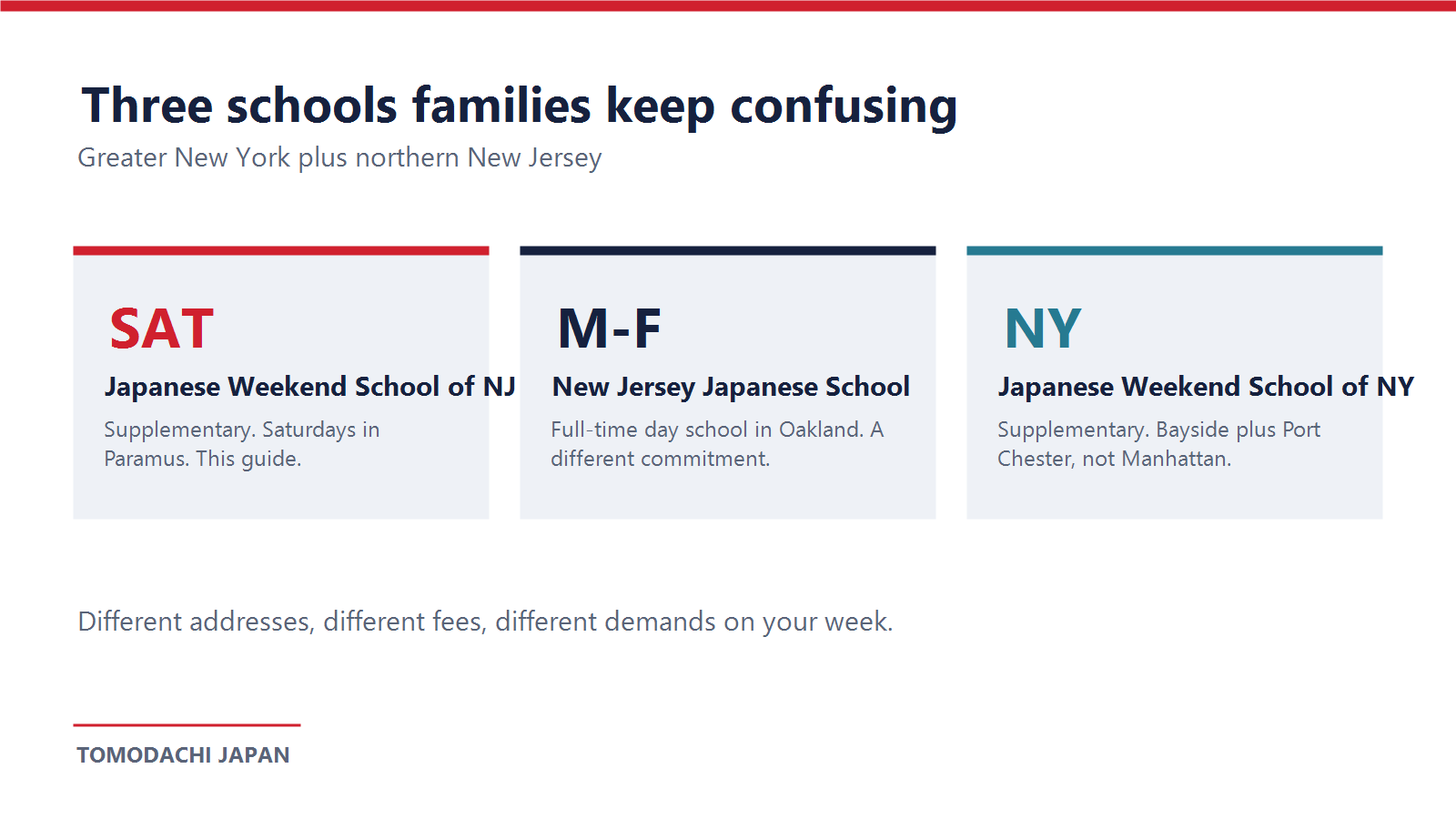
- Japanese Weekend School of NJ (ニュージャージー補習授業校) — a supplementary school. Saturdays only, alongside your child’s regular American school. This is the school this guide is about.
- New Jersey Japanese School in Oakland — a full-time day school following the Japanese curriculum, a completely different commitment.
- Japanese Weekend School of New York — the New York supplementary school, whose campuses sit in Bayside plus Port Chester. We cover it in our guide to Japanese Saturday school in NYC.
Get this straight before you enquire anywhere, because the three have different addresses, different fee structures, plus entirely different demands on your week.
Looking for a way to keep Japanese going from abroad?
TOMODACHI JAPAN is an online Japanese school for children growing up outside Japan. They talk with peers their own age in Japan every day, taught by teachers working at Japanese schools, in small classes of 8.
🎁 Register and we’ll email you our School Guide (PDF, in English) straight away. You’ll also be first to hear about tuition, scholarships and opening dates.
Free · takes about 30 seconds
Where it meets, plus when
The school’s administrative office is at 619 E. Palisade Avenue, Suite 1, Englewood Cliffs, NJ 07632. Saturday classes themselves are held in Paramus, at 425 Paramus Rd, Paramus, NJ 07652, in borrowed high-school facilities — a normal arrangement for supplementary schools worldwide.
Saturday classes run 9:00 to 14:00. Read that as a five-hour block, then add travel at both ends. For most Bergen County families the realistic figure is six to seven hours of the weekend, every week, in term. That is the number worth discussing at home before anything else.
Who it takes
The school runs from preschool through high school: preschool from around ages four to five, elementary from six, middle school from twelve, high school from fifteen. That full ladder is genuinely unusual — many supplementary schools stop at grade nine, so families in the region who want the Japanese curriculum to continue into the senior years have a real option here.
There is also an international class covering elementary through middle grades, for children learning Japanese language plus culture rather than following the full Japanese national curriculum. If your child is a heritage learner whose Japanese is conversational but not academic, this is usually the stream to ask about first.
Entry: there is a screening
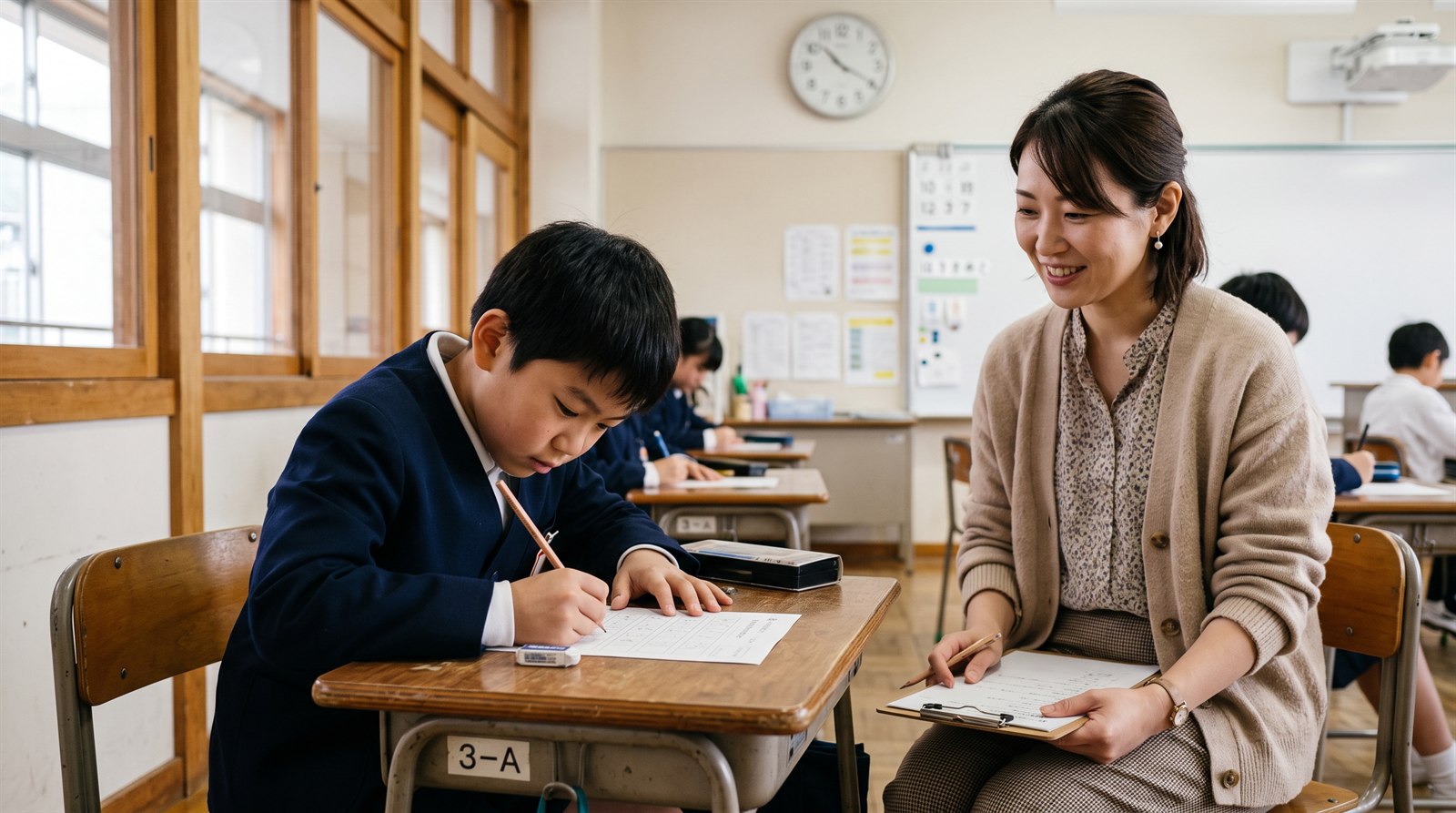
Admission is not simply a form. Prospective students sit a screening lasting roughly twenty minutes, covering kanji plus reading comprehension, together with interviews. Weekday screening appointments run 9:30 to 16:00.
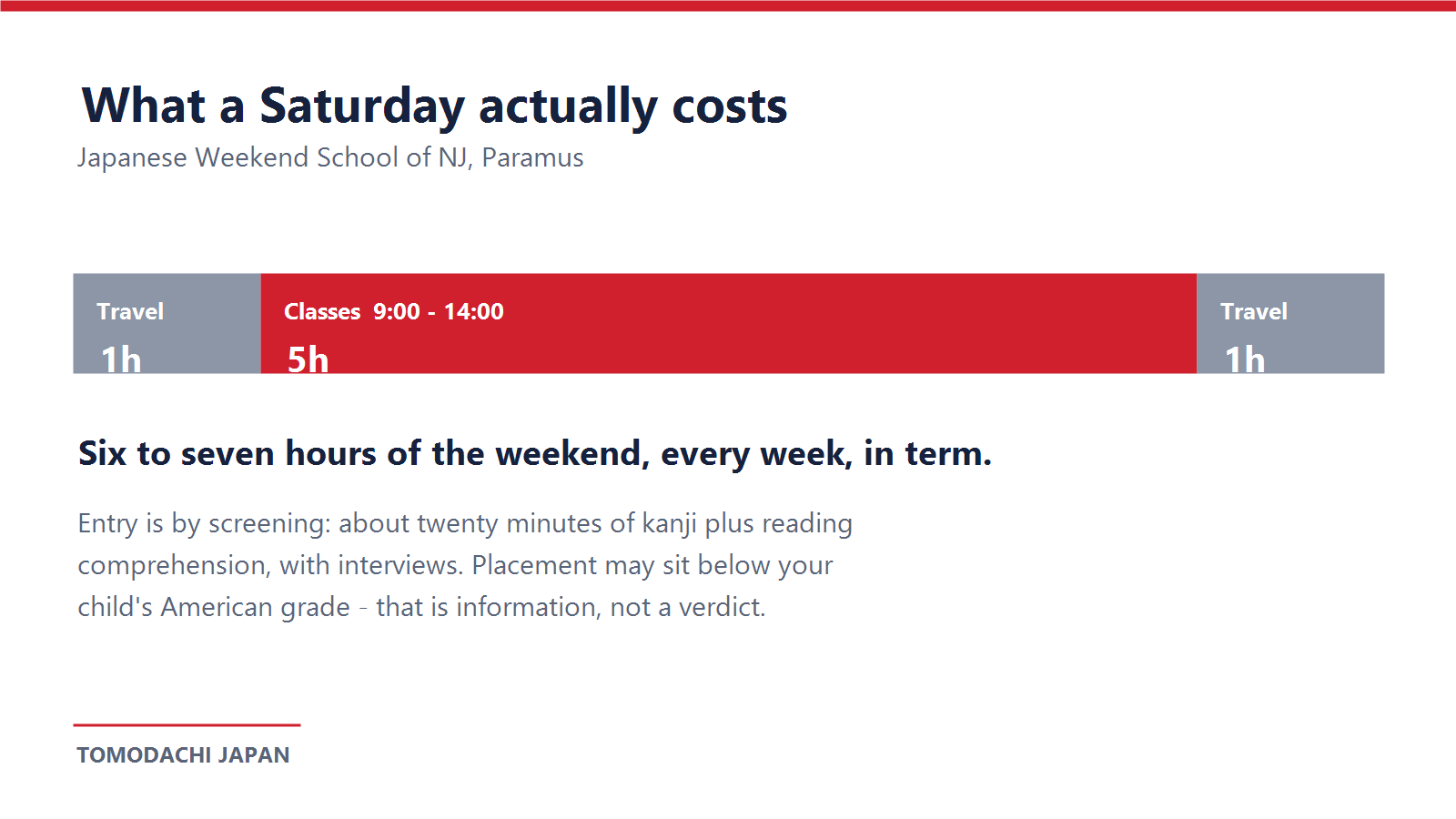
This surprises families who assumed a supplementary school would take any child with a Japanese parent. It should not. Because classes follow the Japanese curriculum at grade level, a child placed above their reading ability spends Saturday lost, then does homework they cannot read. The screening exists to prevent exactly that, so treat a placement below your child’s American grade as useful information rather than a verdict.
Fees, plus how they are billed
Tuition together with materials is divided into three annual instalments, covering April to July, August to November, then December to March. Two details matter for budgeting:
- There is no proration. Joining or withdrawing partway through a period does not reduce that period’s charge, so timing a move around the instalment boundaries can save real money.
- Returning students may have the entrance fee waived — relevant for families who leave for a posting in Japan, then come back.
Current amounts are published by the school on its fee page. We deliberately do not reprint figures here, because supplementary school fees change annually and a stale number on a third-party site is worse than none. Ask the school directly.
When Saturday school is not the answer
Weekend schools do something no app replicates: they put your child in a Japanese-speaking room with other children. They also carry costs that families discover in month three rather than week one.
| Saturday supplementary school | TOMODACHI JAPAN | |
|---|---|---|
| When | Saturdays, 9:00–14:00, in term | Weekday sessions, join as often as you like |
| Travel | To Paramus, both ways | None — online |
| Entry | Kanji plus reading screening | Grouped by conversation level, beginners welcome |
| Curriculum | Japanese national curriculum, at grade level | Conversation with peers in Japan, teacher-led |
| Homework | Weekly, at grade level | No compulsory homework load |
| If you relocate | You leave the school | Same class, same friends, anywhere |
Four situations come up again and again in New Jersey, in which the Saturday school alone does not solve the problem: the child who reads well below their American grade so cannot be placed comfortably; the family whose Saturdays are already committed to sport; the teenager who has stopped speaking Japanese despite years of attendance; the child who is fine academically but has no Japanese friends their own age.
The last is the one parents mention most, so it is the one TOMODACHI JAPAN was built around. Classes are small groups led by teachers who currently work in Japanese schools, with children in Japan of the same age in the room. Children come for the friends, so the language follows. It runs alongside Saturday school perfectly well — many families use both.
Frequently asked questions
Does my child need to be a Japanese citizen?
No. Supplementary schools generally serve Japanese plus Japanese-American families in the area, with the international class specifically designed for children whose Japanese is not at national-curriculum level. Confirm your child’s situation with the school.
What if we live in New York City?
Compare the commute honestly against the New York school’s Bayside plus Port Chester campuses — see our NYC guide. For many Hudson-side families the New Jersey school is the shorter trip.
Can we do both weekend school plus online classes?
Yes, and it is a common combination: the school supplies the curriculum plus written Japanese, while weekday conversation keeps speech alive between Saturdays. See when a hoshuko is not the whole answer.
What time are online classes on the US East Coast?
Japan is ahead, so Saturday morning in Japan is Friday evening in New Jersey. Our time zone guide has the conversions, plus the North America hub covers local pricing.
For the Boston area, the equivalent Saturday option is the Japanese Language School of Greater Boston — its five divisions and entry routes are laid out in our separate guide.
Japanese friends, without giving up Saturday
TOMODACHI JAPAN opens in December 2026. Tell us where you are — we’ll send opening news, class times for New Jersey, plus trial-session details first.