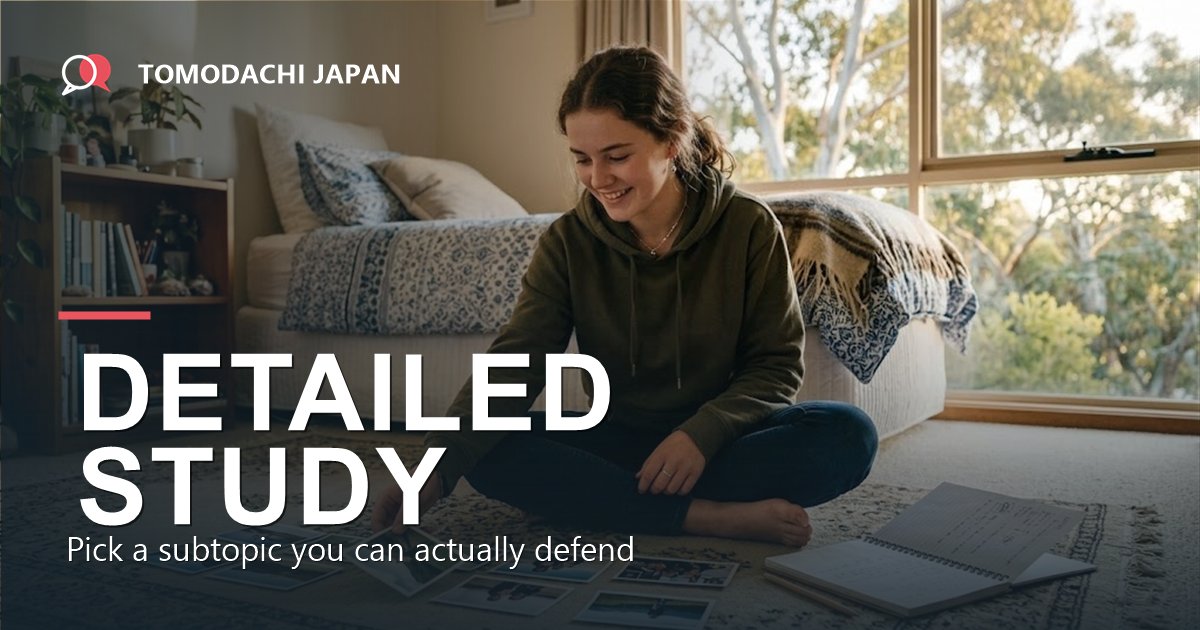
Every VCE Japanese Second Language student has to pick one. A Detailed Study subtopic — the thing you will study for roughly 15 hours of class time, and then discuss, in Japanese, for about eight minutes in front of two assessors who are allowed to ask you anything about it. Choose well and the discussion feels like talking about something you like. Choose badly and you spend October reciting sentences you don’t really understand about a topic you stopped caring about in March.
Most guides tell students to “pick something you’re interested in.” That’s true and almost useless. This guide is the practical version: the three tests a subtopic has to pass, the topics that reliably work (and the ones that quietly sabotage students), and how to build the one thing that actually determines your mark — the ability to hold an unscripted conversation about it.
First, what the Detailed Study discussion actually is
The VCE Japanese Second Language oral examination runs about 15 minutes in two parts. Part 1 is a roughly seven-minute general conversation about your personal world. Part 2 — the part this article is about — is the Detailed Study discussion: you take up to one minute to introduce your subtopic, then spend around seven minutes discussing it with the assessors.
Two details change everything about how you should choose:
- It is a discussion, not a presentation. The assessors ask follow-up questions. They will push on your opinions. The criteria reward presenting information and exchanging ideas and opinions — so a subtopic you can only describe, rather than argue about, caps your mark before you open your mouth.
- Your support material is deliberately restricted. You may bring objects such as photographs, diagrams and maps, but they must be free of all but minimal writing — a heading, name or title only. You cannot bring notes. Whatever you say has to already be in your head.
The oral exam contributes 12.5% of your study score (oral and written exams together make up 50%). It is held in October, ahead of the November written exams. For the full format breakdown, see our VCE Japanese oral exam guide. Always confirm current-year details against the VCAA study design and your teacher’s advice.
Looking for a way to keep Japanese going from abroad?
TOMODACHI JAPAN is an online Japanese school for children growing up outside Japan. They talk with peers their own age in Japan every day, taught by teachers working at Japanese schools, in small classes of 8.
🎁 Register and we’ll email you our School Guide (PDF, in English) straight away. You’ll also be first to hear about tuition, scholarships and opening dates.
Free · takes about 30 seconds
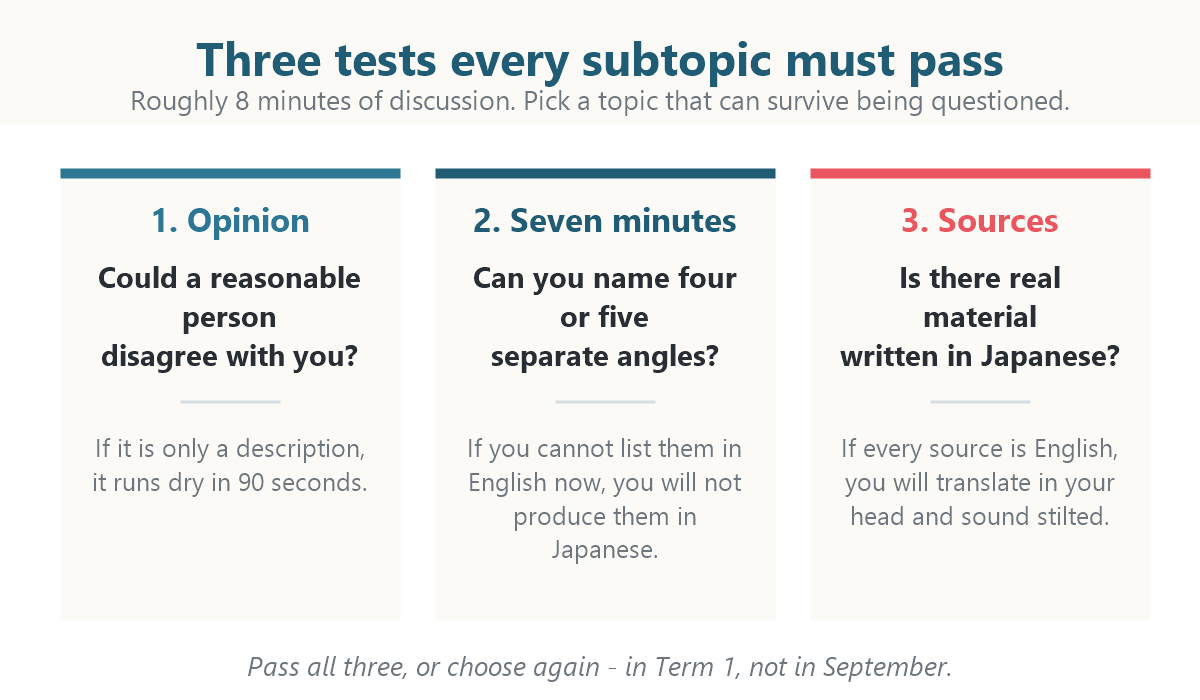
The three tests every subtopic must pass
Test 1 — The opinion test: can you disagree with someone about it?
Write your subtopic as a sentence and ask: could a reasonable person take the other side?
“Japanese school lunches” is a description. “Whether Japanese school lunch programs are better for children than the Australian canteen system” is an argument. The second one survives seven minutes of questioning because every follow-up has somewhere to go: why, compared to what, what would you change, would that work in Australia. The first one runs out of road in ninety seconds and then you are just listing foods.
The single most common failure in Part 2 is a student who has prepared facts and gets asked for a view. Choose a subtopic where you have a view, and where you can also fairly state the opposite view — assessors reward students who can say “on the other hand…” in Japanese and mean it.
Test 2 — The seven-minute test: does it have at least four angles?
Seven minutes of two-way Japanese is longer than students expect. Before you commit, sketch four to five distinct angles you could talk about for roughly ninety seconds each. If you can’t list them now in English, you certainly won’t produce them under pressure in Japanese.
A good subtopic naturally splits into: what it is → why it exists / its history → how people experience it today → a problem or criticism → your view and a comparison with Australia. If your topic can’t fill that shape, it’s too narrow.
Test 3 — The Japanese-source test: can you find enough material in Japanese?
The Detailed Study is meant to be studied through Japanese-language material, and it needs to sustain around 15 hours of class work. If everything you can find is in English, two things go wrong: your teacher can’t build the unit properly, and — more painfully — you end up mentally translating during the exam, which is exactly what makes students sound stilted.
Before you lock it in, do a five-minute check: search your topic in Japanese and see whether you find articles, videos, or interviews aimed at ordinary Japanese readers. If the results are all Japan-explained-to-foreigners content, pick something else.
Subtopics that work — and the traps
| Subtopic type | Example | Why it works / fails | Verdict |
|---|---|---|---|
| A social question in Japan | Part-time work (アルバイト) among Japanese high school students | Built-in opinions, easy comparison with Australian teens, endless follow-ups, plenty of Japanese material | ◎ Strong |
| A change over time | How Japanese convenience stores changed daily life | Has history, present, criticism and a future — the four-angle shape almost writes itself | ◎ Strong |
| A comparison you live | School club culture (部活) vs Australian school sport | You can speak from experience; assessors can ask personal follow-ups you’ll actually enjoy | ◎ Strong |
| A single famous person | The life of one director or athlete | Becomes a biography recital; follow-up questions have nowhere to go after the facts run out | △ Risky |
| Your favourite anime series | “The story of [series]” | Plot summary isn’t discussion. Works only if reframed as a question (e.g. how the series portrays working life in Japan) | △ Reframe first |
| A huge national theme | “Japanese culture” / “Japanese food” | Too broad to prepare and too shallow to defend; you’ll be vague for seven minutes | ✗ Avoid |
| A technical topic in translation | Japanese economic policy | Vocabulary load is brutal and sources are all English; you’ll translate in your head | ✗ Avoid |
How to turn a subtopic into eight minutes you can survive
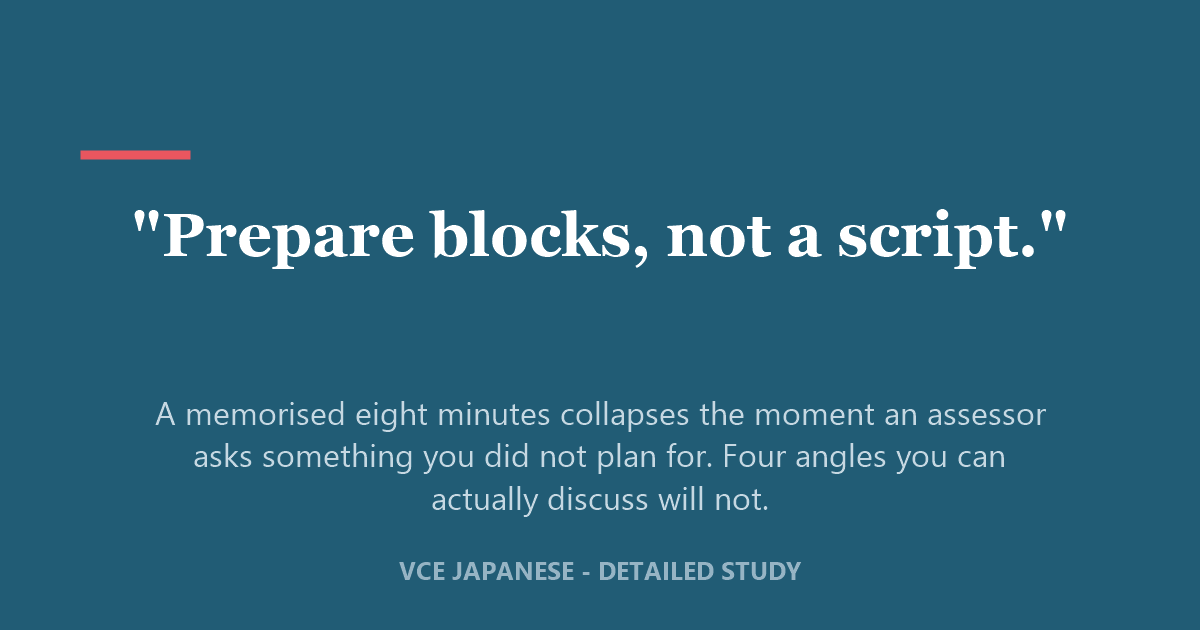
Here is the mistake nearly every student makes: they write an eight-minute script in English, translate it, and memorise it. It feels productive. It is the fastest route to a mid-band mark, because the moment an assessor asks something the script didn’t cover — and they will — the student stops, resets, and the conversation dies.
What actually works is building blocks, not a script:
- Write your four or five angles as questions, in Japanese, on separate cards. Not answers — questions. These are the questions you want to be asked.
- For each angle, learn about eight to ten key words and two or three ready sentence patterns for opinion (…と思います / …のほうがいいと思います / たしかに…ですが、…). Depth of vocabulary beats breadth here.
- Prepare your one-minute introduction properly. This is the only part that is genuinely rehearsed, and it sets the assessors’ expectations. Make it clear, natural, and slightly interesting.
- Then practise being interrupted. Have someone ask you about your angles in a random order, in Japanese, including questions you didn’t prepare. Your goal is not perfect answers — it’s never going silent.
That last step is the one students can almost never do alone, and it’s the one that separates bands. You need a real Japanese speaker who will genuinely push back — ask “why?”, disagree politely, and follow a tangent — rather than a friend who nods along or an app that has no idea what you said.
An honest look at your options for that practice
| Option | Can it run a real Detailed Study discussion? | Cost shape | Watch-out |
|---|---|---|---|
| Your school teacher | Yes — and they know the criteria best | Included | Time is limited and shared across a whole class; you’ll get a handful of runs, not dozens |
| Language apps | No — there’s no discussion at all | Free–low | Useful for vocabulary upkeep only; cannot rehearse being questioned |
| 1-on-1 tutor (italki / Preply) | Sometimes, if the tutor knows VCE | Per lesson — ramping up before October gets expensive fast | Many tutors teach adult conversational Japanese, not VCE criteria; one voice, one accent |
| TOMODACHI JAPAN | Yes — teacher-led mock discussions plus unscripted talk with same-age Japanese students | One flat monthly fee, unlimited attendance | Runs on Japan time — which is an advantage in Australia (see below) |
Why a real Japanese teacher — not just a tutor — changes the Detailed Study
TOMODACHI JAPAN is an online school staffed by currently practising Japanese teachers — the same educators who teach children inside Japan — not a marketplace of freelance tutors. For the Detailed Study that matters in three concrete ways:
- They can stress-test your subtopic before you commit. A teacher can tell you in ten minutes whether your topic has seven minutes in it, or whether you’ll be repeating yourself by minute three. Changing topic in March is easy; discovering the problem in September is not.
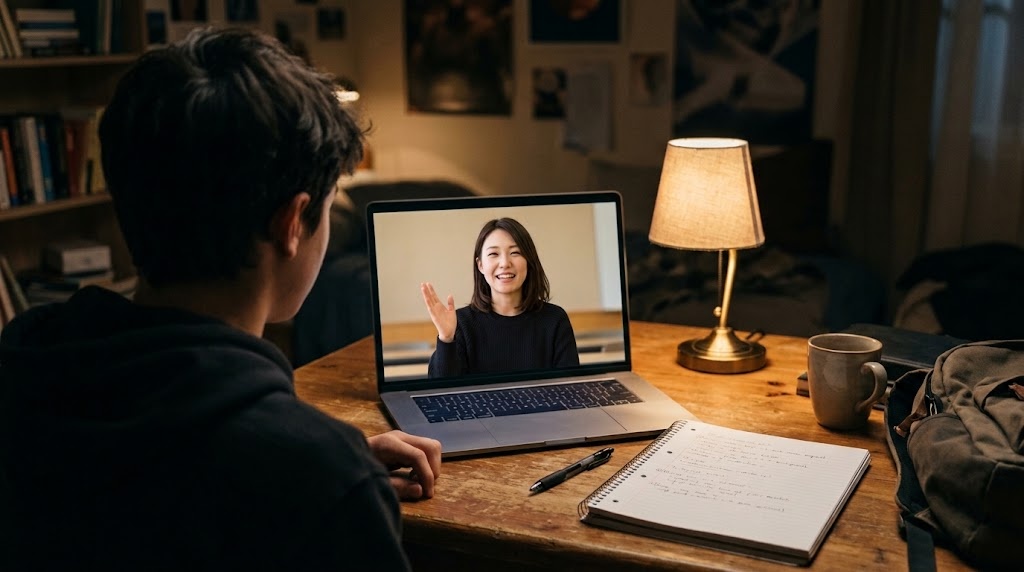
- They can play the assessor. A trained teacher runs a genuine mock discussion — one-minute introduction, then real follow-up questioning — and tells you exactly where the band drops and why. That’s diagnosis, not conversation practice.
- You also talk to Japanese teenagers your own age. This is the part tutoring can’t manufacture. Natural intonation, casual reactions, and the ability to keep talking when you don’t know a word come from talking with peers, not from lessons. It’s also why students keep going: it stops feeling like exam prep.
The timing advantage Australian students have
Melbourne runs one hour ahead of Japan in winter and two hours ahead during daylight saving. In practice a late-afternoon or early-evening session in Victoria lands squarely inside the Japanese school day and evening — so Australian students can practise with Japanese teachers and Japanese teenagers on ordinary weeknights, without anyone staying up late. Our time-zone guide for online Japanese classes has the full conversion table, and our Australia & New Zealand page covers local class times.
That matters more than it sounds for Part 2. Preparation for a discussion isn’t a thing you do in three intensive sessions in September — it’s a thing you do a little at a time from Term 1, which only happens if the practice is convenient and cheap enough to be routine.
A term-by-term plan for Year 12
- Term 1 — Choose and stress-test. Run the three tests. Sketch your four or five angles. Have someone question you in Japanese for five minutes to see if the topic holds up. Change it now if it doesn’t.
- Term 2 — Build the blocks. Vocabulary and opinion patterns per angle, from Japanese-language sources. Start talking about your topic casually — with a teacher, with Japanese peers — long before it needs to be exam-ready.
- Term 3 — Practise being interrupted. Full mock discussions with real follow-up questions, in random order. Record one. Watch it once. Fix the top two habits only.
- September–October — Volume, not new content. Keep talking daily, keep it light. Confidence and recovery speed are the goal now; this is the worst possible time to start memorising.
FAQ
How long is the Detailed Study discussion?
About eight minutes: up to one minute to introduce your subtopic, then roughly seven minutes of discussion with the assessors. It is the second part of the ~15-minute VCE Japanese Second Language oral examination.
Can I bring notes or cue cards into the oral exam?
No. You may bring support objects such as photographs, diagrams or maps, but they must be free of all but minimal writing — a heading, name or title only. Nothing you can read from. Confirm the current rules with your teacher and the VCAA specifications for your exam year.
Can my Detailed Study subtopic be about anime or games?
Yes, if you reframe it as a question rather than a story. “The plot of my favourite series” has nowhere to go under questioning. “How anime portrays working life in Japan — and whether it’s accurate” is arguable, has Japanese-language sources, and gives assessors somewhere to push. The reframe is the whole job.
How many hours should I spend on the Detailed Study?
The Detailed Study is designed around approximately 15 hours of class time, and your subtopic must be able to sustain that. Speaking practice about the topic sits on top of that and should be spread across the year rather than compressed into Term 3.
We’re in NSW — is there an equivalent?
The NSW format differs: HSC Japanese Continuers has a roughly ten-minute conversation worth 20 marks out of 100, without a separate detailed-study discussion. See our HSC Japanese Continuers oral exam guide. The speaking skills are identical; only the packaging changes.
Do we need a tutor as well?
Sometimes — a tutor is genuinely good for targeted grammar and written-exam technique. For the oral, the binding constraint is speaking volume, and per-lesson pricing works against you exactly when you need to ramp up. We wrote an honest breakdown in HSC & VCE Japanese tutor: do you actually need one?
What does TOMODACHI JAPAN cost?
One flat monthly fee for unlimited daily attendance (billed in Japanese yen; your local-currency amount is on the tuition page). Because attendance is unlimited, adding sessions in the weeks before the October oral costs nothing extra.