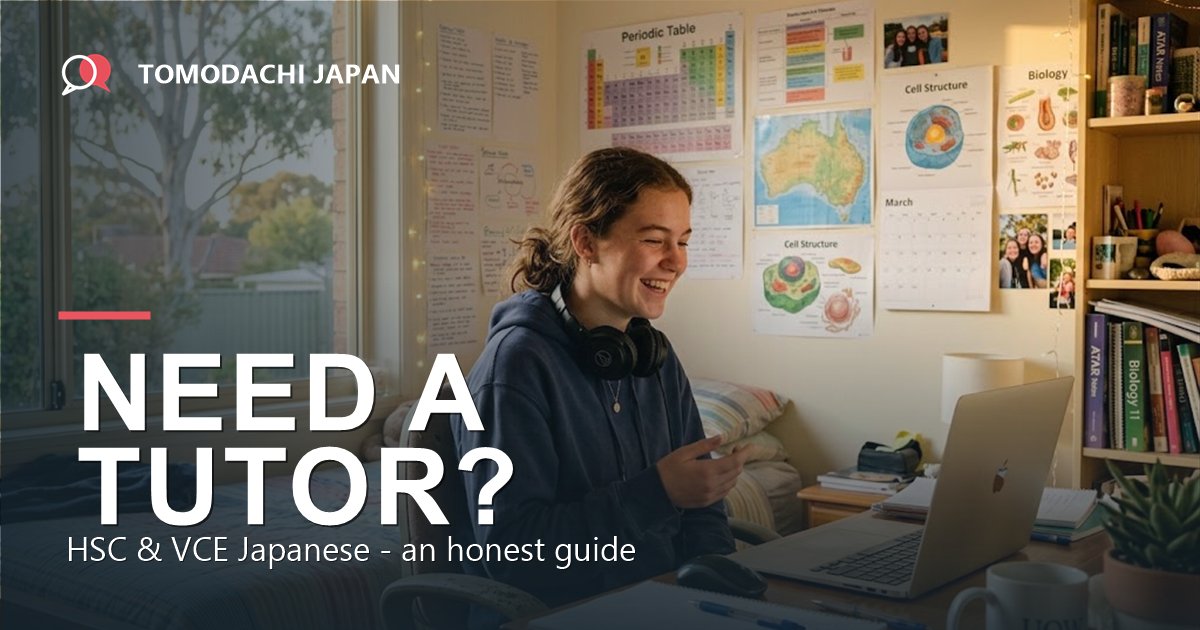
Somewhere around the middle of Year 11, most Australian families sitting HSC or VCE Japanese ask the same question: should we get a tutor? It feels like the responsible move — everyone else seems to have one. But Japanese isn’t Maths, and the exam that decides the most marks isn’t a paper you can drill. Before you commit to A$100 an hour, it’s worth knowing exactly what a tutor can and can’t fix — and what the honest alternatives are in 2026.
First, be clear about what’s actually holding your teen back
A tutor is a tool, not a cure. The right question isn’t “do we need one?” — it’s “what is the weakest link, and does a tutor fix that?” For HSC and VCE Japanese, weak links usually fall into three buckets, and they don’t all have the same answer.
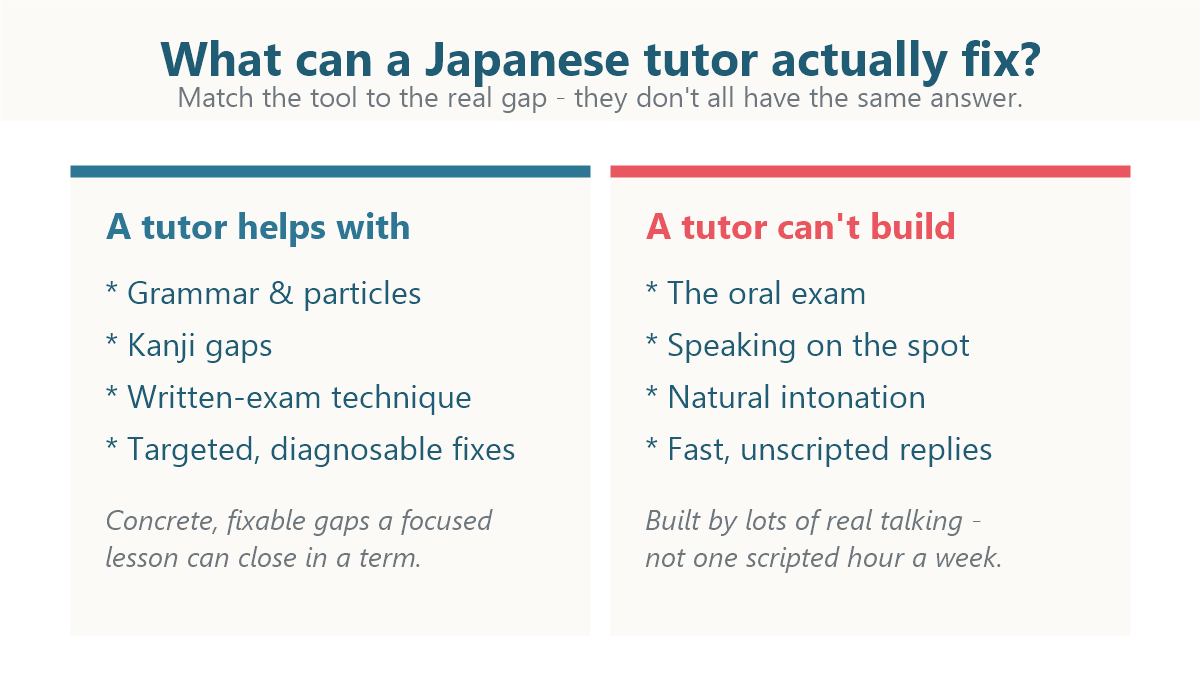
- Grammar and kanji gaps. Particles, verb forms, a shaky kanji list — these are concrete and fixable. A good tutor (or even a workbook and a disciplined term) closes them.
- Written-exam technique. Structuring a response, reading comprehension, timing. A subject-specialist tutor who knows the HSC or VCE marking guide genuinely helps here.
- Spontaneous speaking — the oral exam. This is the one most families underestimate, and the one a weekly tutor is least able to fix. More on why below.
Looking for a way to keep Japanese going from abroad?
TOMODACHI JAPAN is an online Japanese school for children growing up outside Japan. They talk with peers their own age in Japan every day, taught by teachers working at Japanese schools, in small classes of 8.
🎁 Register and we’ll email you our School Guide (PDF, in English) straight away. You’ll also be first to hear about tuition, scholarships and opening dates.
Free · takes about 30 seconds
What a one-on-one tutor is genuinely good at
Let’s be fair to tutors. If your teen has a specific, diagnosable gap — they keep losing marks on the written paper, or they never quite understood the causative-passive — a focused tutor is efficient. They can look at a past paper, see the pattern, and target it. For the written exam, a specialist who knows the syllabus is a reasonable investment, especially in the final two terms.
Where a weekly tutor quietly falls short
Here’s the uncomfortable part. In both HSC Japanese Continuers and VCE Japanese, the oral exam is worth a large slice of the marks — 20% of the HSC exam mark, and 12.5% of the VCE study score — and it tests the one thing a once-a-week lesson can’t build: the ability to hold an unscripted conversation with a stranger, in real time. One hour a week with the same familiar tutor, whose questions and accent your teen already knows, is simply not enough repetition to make speaking automatic. It also tends to sound like a lesson, not a conversation — and assessors can tell.
What HSC & VCE Japanese tutoring actually costs in Australia (2026)
Going in with real numbers helps. In 2026, private one-on-one tutoring in Australia runs roughly A$40–120 an hour, with the national average around A$64 (Australian Tutoring Association). Senior specialist language subjects sit higher — commonly A$75–130 an hour for an experienced HSC/VCE tutor. Marketplace tutors advertise from about A$18/hour, but qualified, exam-savvy Japanese tutors are scarce and priced accordingly. Across a full exam year, families using premium tutors can spend A$10,000–15,000. Online sessions typically cost 10–15% less than in-person.
None of that is wasted if the gap you’re fixing is grammar or written technique. It’s a lot of money if the real gap is speaking — because you’re paying premium per-hour rates for the very thing per-hour lessons build slowly.
A third option most families don’t consider: a real Japanese school
Between “muddle through with the school class” and “pay a premium tutor” sits a third path: an online Japanese school staffed by currently practising Japanese teachers — the same educators who teach children inside Japan — where your teen can attend as often as they like on one flat fee. For the oral exam specifically, that changes the maths. Instead of one scripted hour a week, your teen gets frequent, unscripted conversation, plus sessions with same-age Japanese kids — which is where natural intonation and fast responses actually come from. And a trained teacher can run a proper mock oral and tell them exactly where the band drops.
Tutor vs school vs app — honestly compared
| Option | Typical cost | Speaking practice | Best for | Watch-out |
|---|---|---|---|---|
| School class | Included | A few min/week, same voices | Syllabus, SACs, assignments | Little 1-to-1 speaking; one familiar teacher |
| Language app | ~A$15/mo | None — no real dialogue | Vocab & kanji upkeep | Does nothing for the oral exam |
| 1-on-1 tutor | A$75–130/hr | 1 hr/week, one adult, one accent | Grammar gaps, written technique | Costly for speaking; motivation dips; per-hour billing |
| TOMODACHI JAPAN | one flat monthly fee, unlimited | Daily, unscripted — teachers and peers in Japan | Oral-exam fluency + mock orals | Runs on Japan time (ideal for AU/NZ) |
A simple test to decide
Ask your teen one question: “When you imagine the exam, which part scares you most?”
- If it’s the written paper, grammar, or kanji → a focused specialist tutor for a term is a sensible, targeted spend.
- If it’s the oral — speaking on the spot to a stranger → no amount of weekly one-on-one drilling substitutes for lots of real conversation. That’s the case for unlimited practice with real Japanese people, ideally starting in Year 11.
Whichever way you lean, don’t leave the speaking to the last term. We break down the two exams in detail in our VCE Japanese oral exam guide and HSC Japanese Continuers oral exam guide, and gather local class times and details on our Japanese classes for Australia & New Zealand page.
FAQ
Do you need a tutor for HSC or VCE Japanese?
Not necessarily. A tutor is worth it for a specific gap in grammar, kanji, or written-exam technique. But the oral exam — which is worth 20% of the HSC exam mark and 12.5% of the VCE study score — is built through frequent, unscripted conversation, which a once-a-week tutor is poorly set up to provide.
How much does a Japanese tutor cost in Australia?
In 2026, expect roughly A$40–120 an hour for general subjects and A$75–130 an hour for a specialist senior-language tutor. Over a full HSC or VCE year, premium tutoring can total A$10,000–15,000. Online sessions usually cost 10–15% less than in-person.
Is a Japanese teacher different from a Japanese tutor?
Yes. Many online “tutors” are freelance native speakers, not trained teachers. TOMODACHI JAPAN is a school staffed by currently practising Japanese teachers who teach children in Japan — so they can run a genuine mock oral and diagnose exactly where marks are lost, not just chat.
When should we start?
For speaking, Year 11 is ideal — confidence built early is worth far more than a rushed program in Term 3 of Year 12. Because attendance is unlimited on one flat fee, students simply speak more, earlier, without paying per hour.
What does TOMODACHI JAPAN cost?
One flat monthly fee for unlimited daily attendance (billed in Japanese yen; your local-currency amount is on the tuition page). Unlike per-hour tutoring, ramping practice up before the exam costs nothing extra.