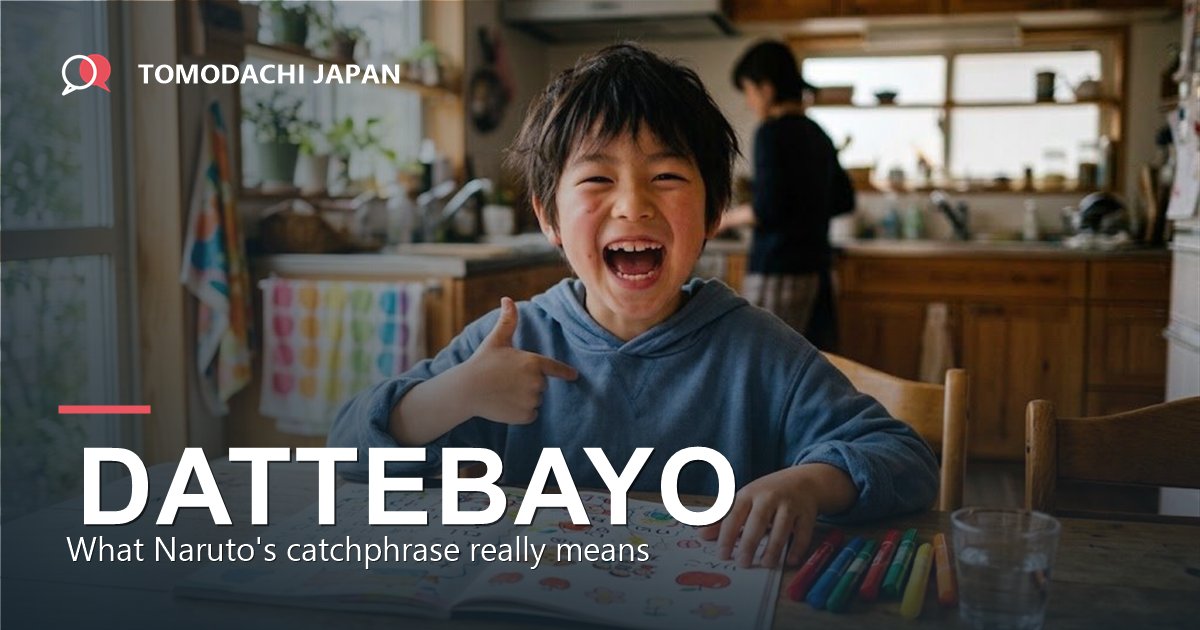
If you’ve watched Naruto, you’ve heard it a thousand times: “…dattebayo!” tacked onto the end of nearly everything Naruto says. So what does dattebayo actually mean — and can you use it yourself? I’m a Japanese teacher, and the short answer is: it means almost nothing, it’s not real Japanese, and you should not say it to a real person. But hidden inside it is a genuinely useful piece of casual Japanese. Let’s break it down properly.
What does “dattebayo” mean?
Here’s the honest truth that surprises a lot of fans: だってばよ (dattebayo) has no real dictionary meaning. It’s a verbal tic — a personal speech habit invented by creator Masashi Kishimoto to make Naruto sound stubborn, childish, and unmistakably himself. It roughly works like an emphasis marker, adding a “…I’m telling you!” energy to whatever he just said. The famous English dub rendered it as “Believe it!” (and later “Ya know”), but that was a creative choice to fill the same slot — it’s not a translation, because there’s nothing literal to translate.
Looking for a way to keep Japanese going from abroad?
TOMODACHI JAPAN is an online Japanese school for children growing up outside Japan. They talk with peers their own age in Japan every day, taught by teachers working at Japanese schools, in small classes of 8.
🎁 Register and we’ll email you our School Guide (PDF, in English) straight away. You’ll also be first to hear about tuition, scholarships and opening dates.
Free · takes about 30 seconds
Breaking it down: だ + ってば + よ
| Part | Rōmaji | What it does | Real Japanese? |
|---|---|---|---|
| だ | da | Casual “is/are” (plain form of です) | ◎ Yes |
| ってば | tteba | “like I said / I’m telling you” — exasperated insistence | ◎ Yes (this is the gem) |
| よ | yo | Emphasis, like “!” at sentence end | ◎ Yes |
| だってばよ | dattebayo | All three stuck together as Naruto’s tic | ✗ Not standard Japanese |
Teacher’s note — the useful part: The piece worth stealing is ってば (tteba). It’s a real, everyday casual ending that means something like “like I said!” or “I’m telling you!” — used when you’re a little exasperated because you’re repeating yourself. For example: もう、大丈夫だってば!(Mō, daijōbu datte ba!) — “I said I’m fine already!” or 行くってば!(Iku tte ba!) — “I’m going, okay!” It carries a slightly whiny, insistent, childish tone — which is exactly why it fits Naruto so perfectly. Among close friends and family it’s natural; with teachers or strangers, skip it (it sounds too petulant).
The whole family: dattebane and dattebasa
Kishimoto gave the tic to a whole bloodline, which is a lovely detail once you know it:
| Character | Japanese | Rōmaji | The final particle |
|---|---|---|---|
| Naruto | だってばよ | dattebayo | よ (yo) — punchy, boyish emphasis |
| Kushina (his mother) | だってばね | dattebane | ね (ne) — softer, seeking agreement |
| Boruto (his son) | だってばさ | dattebasa | さ (sa) — casual, matter-of-fact |
Teacher’s note: This is a brilliant, accidental grammar lesson in sentence-final particles — the tiny words Japanese adds to the end of a sentence to set the mood. The base だってば stays the same; only the last particle changes, and each one shifts the feeling. よ (yo) asserts (“I’m telling you!”), ね (ne) softens and invites agreement (“right?”), and さ (sa) is a light, casual “you know.” Master these three real particles and your everyday Japanese will instantly sound far more natural.
So… can you say “dattebayo”?

Please don’t — at least not seriously! To a Japanese person, saying dattebayo is instantly recognisable as “cosplaying Naruto.” It’s fun as an inside joke with fellow fans, but it isn’t something anyone actually says, and it won’t help you communicate. The good news: now you know the real pieces behind it (だ, ってば, よ / ね / さ), and those are genuine, useful Japanese. That’s the whole idea behind learning from anime — take the thing you love, then find the real language living inside it. Our full guide to learning Japanese with anime shows you how to do this with any show.
Frequently asked questions
Does “dattebayo” mean “believe it”?
No. “Believe it!” was invented for the English dub to fill the same rhythmic slot. In Japanese, だってばよ has no literal meaning — it’s just an emphatic verbal tic unique to Naruto.
Is “dattebayo” real Japanese?
The whole phrase, no — it’s a character coinage. But its parts are real: だ (casual “is”), ってば (“like I said!”), and よ (emphasis) are all genuine, usable Japanese.
What can I actually use instead?
Use the real ending ってば (tteba) when you’re insisting on something with friends — 大丈夫だってば! (“I said I’m fine!”). And learn the particles よ / ね / さ to fine-tune the tone of your everyday sentences.
Where can my child practise real casual Japanese?
At TOMODACHI JAPAN, kids join small-group classes with peers who live in Japan and real Japanese teachers — the perfect place to learn which anime phrases are real and which are just for fun. Read Naruto quotes in Japanese next, or see our plans and pricing.