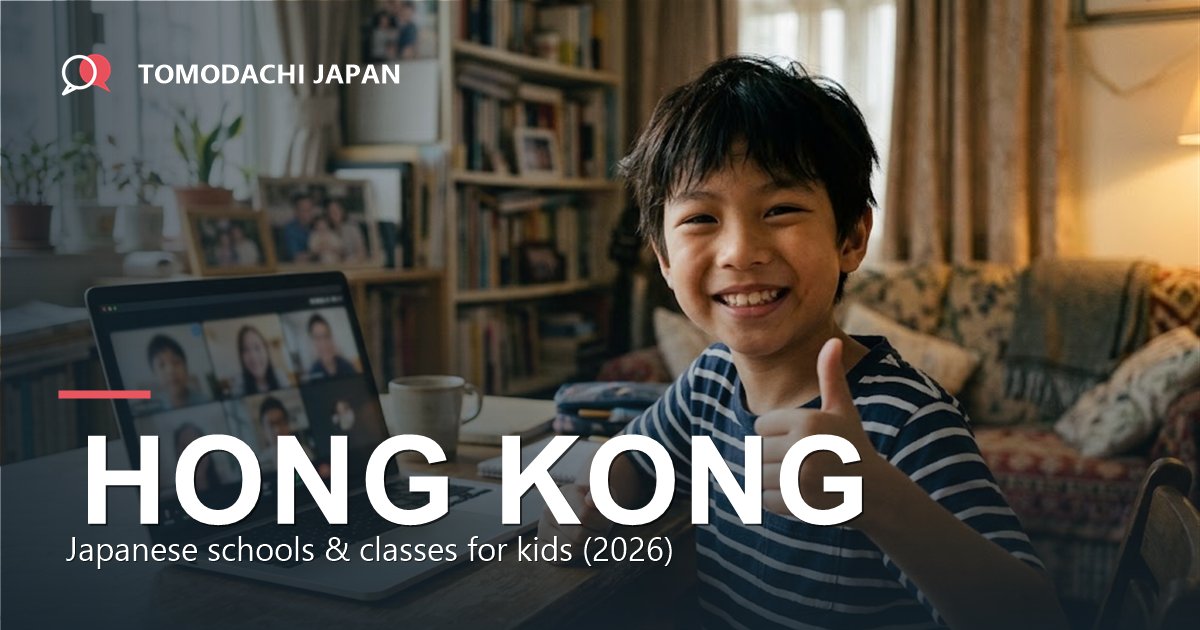
Your child loves Japan — the anime, the J-pop, the trips — and wants to actually speak Japanese. But search “Japanese classes for kids in Hong Kong” and you hit a wall: mostly stale 2019 fees and adult-focused listicles (aaac.co’s “5 kids’ Japanese classes” has no table and no online option; the Coto Academy roundup is adult-first with kids buried and dated to 2021; Little Steps and Baby-Kingdom forum threads are thin and anecdotal, with no fees). Until now, no single article has lined up current, sourced 2026 fees and — crucially — separated a hoshuko/curriculum school from a foreign-language class. Here we sort Hong Kong’s main options into three types — full-time Japanese school, hoshuko (supplementary), and kids’ foreign-language class — with fees and sources as of July 2026, then add an online option that fits Hong Kong’s time zone better than anywhere else.
The short version up front: the genuine Japanese-curriculum options — the Japanese International School’s Japanese section and the Hong Kong Japanese Supplementary School — are in practice built for Japanese-national and expat (“chuzai”) families, requiring the Japanese curriculum track or existing kana literacy. For a local, Cantonese-speaking beginner, the realistic choice is a foreign-language class — and the ceiling of those classes (one hour a week, hobby level) is exactly what this guide unpacks.
Japanese classes for kids in Hong Kong: fee comparison
| School | Type | Day | Ages | Tuition | Area |
|---|---|---|---|---|---|
| Japanese International School — Japanese Section | Full-time (Japanese curriculum / MEXT) | Mon–Fri | Grades 1–9 | Elem ~HK$5,600/mo; JH ~HK$6,640/mo | Happy Valley / Wan Chai |
| JIS International Section (IB) | Full-time IB international school (Japanese as additional language) | Mon–Fri | Ages 4–11 | ~HK$156,420/yr | Tai Po Kau (Tai Po) |
| Hong Kong Japanese Supplementary School (HKJSS) | Hoshuko (kokugo) | Saturday | Kindergarten, G1–7 | ~HK$1,600–2,000/mo | Hong Kong (see site) |
| Nikkei Japanese Language School | Kids’ foreign-language class | Weekly | Ages 6–10 | ~HK$1,050/mo (confirm official quote) | Jordan / Mong Kok / Causeway Bay |
| Watashi Create | Kids’ foreign-language class | 1 hr/week | Ages 4–11 | HK$3,300–3,600 / 12 lessons | Central / TST / Causeway Bay |
| Ekimae Children’s Japanese | Kids’ foreign-language class | Weekly | Ages 1.5–12 | HK$2,900–3,100 / 10–12 lessons | Prince Edward, Wan Chai / Mong Kok |
| Todaimae Japanese | Kids’ foreign-language class | Weekly | Ages ~5–10 | On inquiry | Ma On Shan (Sha Tin) / Tseung Kwan O |
| TOMODACHI JAPAN | Online, conversation & friendship | Any day (unlimited attendance) | 5–18 | One flat monthly fee — see the free guide | Your home |
Looking for a way to keep Japanese going from abroad?
TOMODACHI JAPAN is an online Japanese school for children growing up outside Japan. They talk with peers their own age in Japan every day, taught by teachers working at Japanese schools, in small classes of 8.
🎁 Register and we’ll email you our School Guide (PDF, in English) straight away. You’ll also be first to hear about tuition, scholarships and opening dates.
Free · takes about 30 seconds
Three types — and why the difference matters
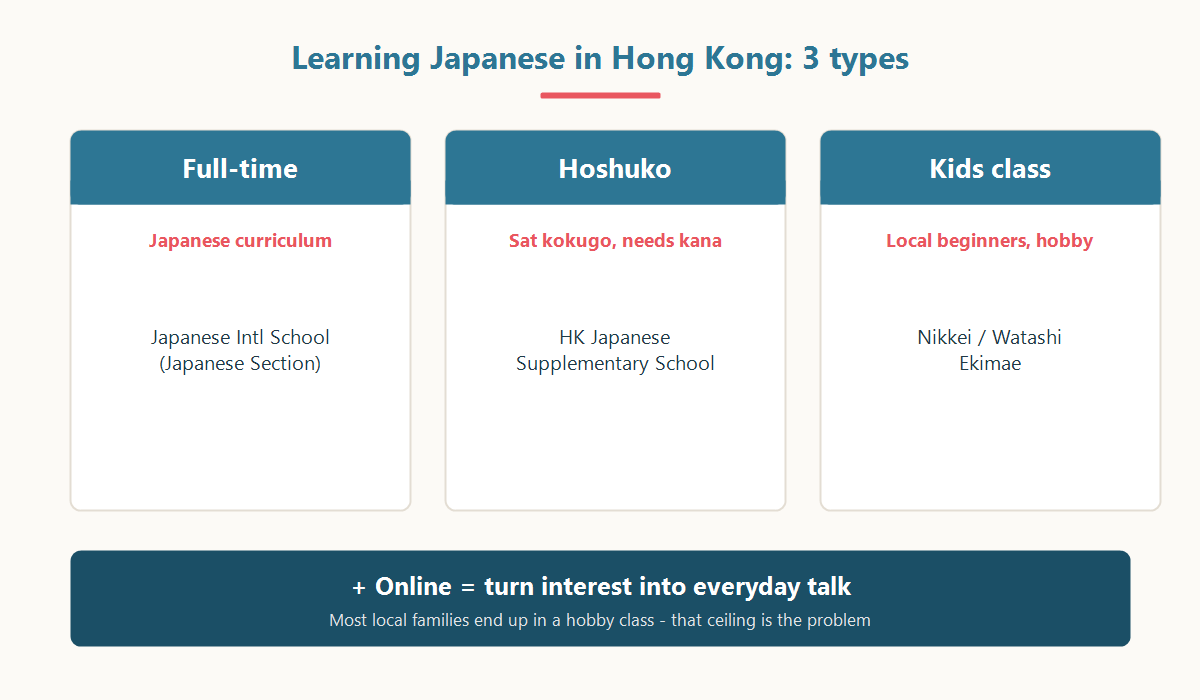
Hong Kong’s options can look interchangeable on paper, but they split into three quite different types. Mixing them up is the number-one reason families end up saying “we enrolled, and it just wasn’t the right fit.”
Full-time Japanese school — built for expat and Japanese-national children
The Japanese International School — Japanese Section (Happy Valley / Wan Chai) is a full-time weekday school running Japan’s authentic national curriculum (MEXT) with Japan-licensed teachers — the gold standard for children heading back into the Japanese school system. Tuition runs about HK$5,600/mo for elementary (~HK$67,200/yr) and HK$6,640/mo for junior high (~HK$79,680/yr). In practice, though, it’s for Japanese-national and expat (“chuzai”) children, not a place for a local Cantonese-speaking child to “learn Japanese” — and a 2026 school-consolidation plan makes it a moving target. The JIS International Section (IB) in Tai Po Kau is a different animal: a full-time English-medium IB PYP international school (ages 4–11) where Japanese is a supporting subject, for families who want an English IB path with some Japanese exposure — HK$156,420/yr (tuition plus capital levy) and a HK$600 application fee. Japanese Section / JIS International (IB)
Hoshuko (kokugo) — Saturday classes to keep pace with Japan
The Hong Kong Japanese Supplementary School (HKJSS) is a Saturday hoshuko teaching kokugo (Japanese “national language”) to MEXT standards, with kindergarten, G1–7 and heritage classes, at friendly fees (HK$2,000 enrolment; kindergarten HK$2,000/mo × 12; levels and heritage classes HK$1,600/mo × 12). It’s an excellent, low-cost way to keep expat children on track with Japan. But the school states plainly that it is “not a Japanese language school” — children must already read hiragana and katakana, and enrolment is in principle for Japanese nationals. For a local absolute beginner, this isn’t the door in (mixed-heritage children with some Japanese can look at the heritage classes). Official site
Kids’ foreign-language class — where most local beginners actually land
For a local, Cantonese-speaking child who loves Japan, this is usually the only realistic door. Nikkei Japanese Language School runs a purpose-built kids’ course (ages 6–10) with native teachers and three MTR-side branches in Jordan, Mong Kok and Causeway Bay — around HK$1,050/mo (plus HK$50 enrolment and materials; fees aren’t on the official site, so WhatsApp or call to confirm the official quote). Watashi Create (Central / TST / Causeway Bay) takes ages 4–11 in small classes of 3–6, one hour per lesson, with a transparent published price (HK$3,300–3,600 per 12-lesson course) — small classes are the draw, but a weekly hour is hobby-level exposure. Ekimae Children’s Japanese (Prince Edward, Wan Chai / Mong Kok) covers the widest age range (1.5–12) with strong parent word-of-mouth, at HK$250–310 per class (toddler) or HK$2,900–3,100 per 10–12-class package — which adds up. Todaimae Japanese (Ma On Shan / Tseung Kwan O) serves the New Territories districts the central chains don’t reach; pricing on inquiry. The shared ceiling of this whole type: short hours (often one hour a week), hobby-grade, with no continuous progression alongside same-age Japanese peers. Nikkei / Watashi Create / Ekimae / Todaimae
Three Hong Kong-specific things to watch out for
- The Japanese school and the hoshuko are essentially for expat kids. The JIS Japanese section and HKJSS require the Japanese curriculum track or existing kana literacy — a local Cantonese-speaking beginner has no place there, which leaves only foreign-language centres.
- Genuine kids’ classes are few, and mostly adult centres bolting on a children’s slot. Hours are short (often one hour a week), fees are opaque (WhatsApp or call), and the ceiling is hobby-grade — not continuous progression with same-age Japanese peers.
- Compact city, but you’re limited to whichever 1–2 MTR-side branches are near you (Causeway Bay / Jordan / Mong Kok / Central, plus NT nodes like Sha Tin and Tseung Kwan O) — and Japanese has to compete with an already heavy local-school and tutorial load.
The online option: turning once-a-week into every day
Hobby classes have real value. But as most families discover, one lesson a week won’t make a child a Japanese speaker. That’s the gap we built TOMODACHI JAPAN to fill — an online Japanese school opening in December 2026, designed as the “weekday Japanese time” that pairs with a local class. And here Hong Kong has a genuine advantage: the time difference. Hong Kong (HKT) is just one hour behind Japan (JST), so Japan’s after-school 5–7 pm slot is 4–6 pm in Hong Kong — right after local school, before dinner. It’s the ideal weekday window, with no late nights. For the Americas or Europe, a Japanese afternoon class falls in the middle of the night; Asia, including Hong Kong, is the single best-fit region for real-time online lessons with live teachers in Japan. (For another city nearby, see our guide to the online alternative to Japanese hoshuko.)
- Friends — the one thing a hobby class can’t manufacture. Your child talks in small groups with children from our sister school, NIJIN Academy (800+ students across Japan), and makes real friends the same age in Japan. A weekly class in Hong Kong simply can’t produce that.
- A lasting connection to Japan. An interest turns into a long-term link and part of who they are — not a few memorised phrases, but a circle of Japanese friends they grow up with.
- Kids-specialised, grouped by conversation level. Classes are grouped by conversation level, not grade or age, so a local beginner starts right at their level. And with unlimited attendance — a once-a-week habit becomes everyday, breaking the hobby-class ceiling.
For a local Hong Kong child who loves Japan but only has a one-hour-a-week hobby class nearby, an online school with Japanese kid friends is the missing layer — the “everyday, real conversation” that a hobby class can’t supply.
FAQ from Hong Kong families
Hoshuko or a kids’ foreign-language class — which is right for my child?
It depends on your child’s starting point. The hoshuko (HKJSS) is for children who already read kana and are, in principle, Japanese nationals, keeping pace with Japan’s school grade level. A local, Cantonese-speaking beginner should start with a kids’ foreign-language class or an online course grouped by conversation level. Put simply: to “catch up with Japan,” choose the hoshuko; to “start from zero and learn to speak,” choose a kids’ class or online.
Is an online class a bad fit for a younger or complete beginner?
No. TOMODACHI JAPAN takes ages 5–18 and groups by conversation level rather than age, so young children and absolute beginners have a group that fits. Because it’s small-group conversation with same-age children in Japan, many kids actually open up more — because they’ve made friends.
Is there a time difference between Hong Kong and Japan?
Just one hour — Hong Kong is one hour behind Japan. Japan’s after-school 5–7 pm class is 4–6 pm in Hong Kong, right after school and before dinner, an ideal weekday slot with no late nights. Unlike the Americas or Europe, where a Japanese afternoon class falls in the middle of the night, Hong Kong is one of the best-fit regions for real-time online lessons in Japan.
Can we combine it with an in-person class?
Yes — that’s exactly the intended use. TOMODACHI JAPAN is unlimited-attendance, so kids join on the days that suit them and scale back in busy homework weeks. The roles don’t overlap: reading, writing and grammar at the in-person class or hoshuko; speaking volume and friendships online. Used together is where it works best.
Families comparing options in Hong Kong can also consider an online Japanese school for kids where children learn with peers in Japan every day.