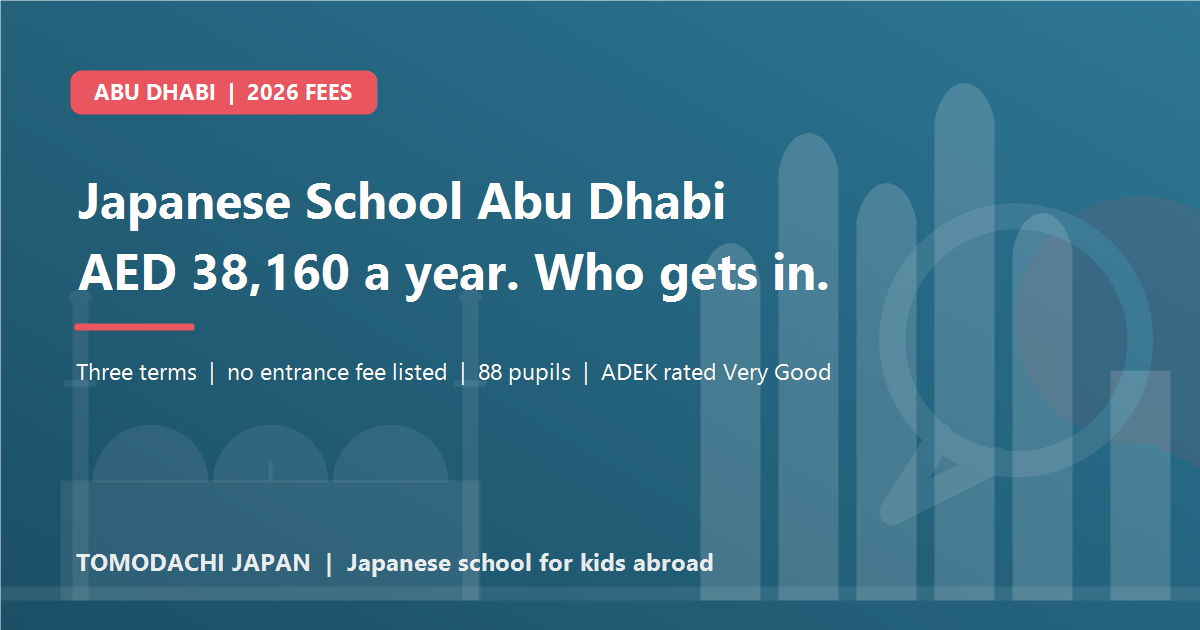
The Japanese School in Abu Dhabi — アブダビ日本人学校, JSAD — charges AED 38,160 a year for Grades 1 to 9 in the 2026–27 school year, paid in three unequal terms of AED 12,720, AED 15,900 and AED 9,540, plus AED 240 in PTA dues. The figure is the fee approved by Abu Dhabi’s Department of Education and Knowledge (ADEK), and it has not moved since 2025. No entrance fee, registration fee or deposit appears anywhere in the school’s current admission documents. The kindergarten on the same site costs AED 17,215 a year. That is roughly US$10,400 a year before the parent-run bus — cheap by Abu Dhabi standards. The catch is not the money. The school’s own rule is that a child must hold Japanese nationality and have a parent who is a member of the Japanese Association of Abu Dhabi, with one exception: Emirati children, who join through a government programme and only at Pre-KG. And most English directories are out of date on everything from the principal to the website.
This page is the single-school deep dive: what the Japanese School in Abu Dhabi costs, who can actually enrol, what the November 2025 ADEK inspection found, and what English-language listings still get wrong. Everything comes from the school’s own Japanese and English pages at jsadedu.com, its admission rules and fee documents, the kindergarten handbook and the ADEK Irtiqa’a inspection report, all read on 24 October 2026. Where something is not published, we say not published. If you are weighing Abu Dhabi against the other Japanese school in the Emirates, 130 kilometres up the E11, read this alongside our page on the Japanese School in Dubai, its 2026 fees and who can enrol — the two schools have different boards, different fees and different rules.
The short answer
| What it is | A full-time Japanese school (nihonjin gakko) opened on 15 April 1978, teaching Japan’s national curriculum in Japanese, Grades 1 to 9, with a kindergarten (Pre-KG to KG2) opened in 1981. An ADEK-registered private school attached to the Embassy of Japan, run by its own board |
| Where | Al Bateen, on King Abdullah Bin Abdulaziz Al Saud Street opposite the Crown Prince Court (ADEK: 9 Al Tawwash Street). On this site since March 2012 |
| Cost, 2026–27 | Grades 1–9: AED 38,160 a year (Term 1 AED 12,720, Term 2 AED 15,900, Term 3 AED 9,540) plus PTA AED 240. Kindergarten: AED 17,215 (AED 6,260, 6,260 and 4,695). No entrance fee is listed. School bus run by parents; fee not published |
| Who it takes | Children of Japanese school age with Japanese nationality whose parent is a member of the Japanese Association of Abu Dhabi, admitted by the board chair. Plus Emirati children through the UAE national students’ programme — up to four per grade, entering at Pre-KG only. No other nationality |
| Size | The school publishes 90 children: 49 primary (20 Emirati), 16 junior high (10 Emirati), 25 kindergarten (7 Emirati), undated. ADEK counted 88 pupils, 36 Emirati, in November 2025. One class per grade |
| Rating | ADEK Irtiqa’a inspection 17–19 November 2025: Very Good, the same as 2023. Health and safety and self-evaluation were marked down; Japanese, maths and science were Very Good in every phase |
| The real catch | Japanese passport plus Japanese Association membership, a school that stops at Grade 9, a one-month paid trial with no refunds, and no entry to Grade 9 after 31 July |
Looking for a way to keep Japanese going from abroad?
TOMODACHI JAPAN is an online Japanese school for children growing up outside Japan. They talk with peers their own age in Japan every day, taught by teachers working at Japanese schools, in small classes of 8.
🎁 Register and we’ll email you our School Guide (PDF, in English) straight away. You’ll also be first to hear about tuition, scholarships and opening dates.
Free · takes about 30 seconds
First, which school do you actually mean?
Search for “Japanese school Abu Dhabi” and the results mix one school with its kindergarten, a second school in another emirate, an adult course and two dead websites. Some pages headed “Japanese schools in Dubai” list the Abu Dhabi school among them. Here is what each name is.
| Name you will see | What it actually is | Language and ages | Where |
|---|---|---|---|
| Japanese School in Abu Dhabi / JSAD / “Japanese private school Abu Dhabi”, アブダビ日本人学校, jsadedu.com | The full-time Japanese school this page is about. Japan’s national curriculum and textbooks, Monday to Friday. “Private school” is simply its ADEK category | Japanese; Grades 1–9 (ages 6–15) | Al Bateen, Abu Dhabi |
| Abu Dhabi Japanese Kindergarten, アブダビ日本人幼稚園 | The same board’s kindergarten, opened 1981, own fee sheet and phone. The only entry point for Emirati children | Japanese; Pre-KG to KG2 (ages 3–6) | Same site |
| Japanese School in Dubai, ドバイ日本人学校, japanese.sch.ae | A different school with a different board, 130 km away, own fees and rules. Not a branch | Japanese; Nursery to Grade 9 | Al Wasl, Dubai |
| Japan Center / UAE-Japan Cultural Centre | A Saturday course for adults — entry from 15, or 13 with consent | Japanese as a foreign language; teens and adults | Sharjah |
| jsad.ae and jsaduae.com | The school’s former web addresses, still quoted by Wikipedia, directories and the ADEK report. One shows a web-host placeholder, the other does not resolve. E-mail still uses jsad.ae | — | Use jsadedu.com |
Two things follow. First, there is no Japanese Saturday school (hoshuko) anywhere in the UAE: Japan’s education ministry lists two schools for the Emirates, Abu Dhabi and Dubai, both full-time. Second, the Abu Dhabi school is, by its own description, the only one of Japan’s overseas schools that formally admits children of a non-Japanese nationality — Emiratis — which is why four in ten of its pupils are UAE nationals.
What it costs in 2026–27: AED 38,160 a year, paid in three terms
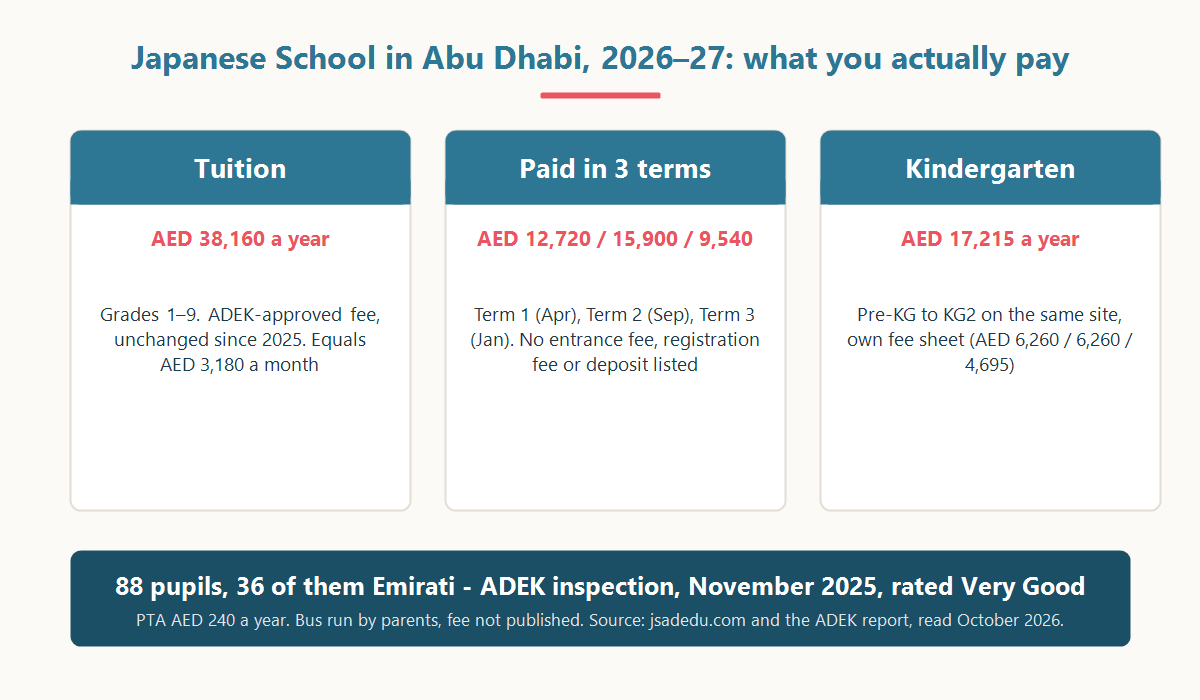
The fees are on the Japanese-language admissions page and in a two-page admissions PDF, in dirhams, per child, for a school year running April 2026 to March 2027 in three terms. The school says it collects fees “in accordance with instructions from ADEK”, and the PDF cites the ADEK-approved schedule directly. The three term amounts look odd until you notice they are exactly AED 3,180 a month for four, five and three months.
| Item | Kindergarten (Pre-KG–KG2) | School (Grades 1–9) |
|---|---|---|
| Entrance or registration fee | An “entrance payment” is mentioned in the payment steps; amount not published | Not listed in the current admission documents |
| Term 1 (April–July) | AED 6,260 | AED 12,720 |
| Term 2 (September–December) | AED 6,260 | AED 15,900 |
| Term 3 (January–March) | AED 4,695 | AED 9,540 |
| Tuition per year | AED 17,215 | AED 38,160 |
| PTA dues per year | — | AED 240 (two payments of AED 120) |
| Monthly equivalent | — | AED 3,180 (the rate used for mid-year entrants) |
| Extracurricular costs (desert camp, school trip) | — | Billed separately; amounts not published |
| School bus | Run by a parents’ association, not the school. Fee not published online; directories quote around AED 5,000 a year | |
| Textbooks | — | Free, issued by JOES before you leave Japan |
| Per year, school charges only | AED 17,215 (about US$4,690) | AED 38,400 (about US$10,460) |
Three things are worth knowing about how these numbers behave:
- Mid-year entry is pro-rated by the month. Tuition runs from the date the board chair grants admission, in monthly units of AED 3,180 — so an October entrant pays six months, not a full Term 2. The kindergarten does the same, and charges during voluntary absences.
- The trial month is paid, and non-refundable. A trial “with a view to admission” lasts up to one month, tuition paid in advance (two months at most), and the rules say fees once paid are not refunded for any reason. No textbooks are issued for a trial.
- Unchanged since 2025, up since 2022. The same AED 38,160 is labelled 2025 in the PDF and 2026 on the page. A Japanese parents’ site recorded the 2022 terms at AED 11,060, 13,825 and 8,295 — AED 33,180 a year — plus an AED 800 entrance fee that no longer appears. About 15% more in four years, and one fee fewer.
Is AED 38,160 expensive? Not in Abu Dhabi, where many international schools charge more for a single primary year. And the figure is published and ADEK-approved, which is more than can be said for the Japanese School in Dubai, where every fee in circulation is third-party: roughly AED 32,400 to 38,400 a year plus an entrance fee of about AED 2,800 and VAT. Abu Dhabi sits at the top of that range with no entrance fee listed. Still not published here: any sibling discount, a uniform (the pages do not mention one), the bus fee, and whether an employer can be billed directly — though the kindergarten handbook says INPEX and JODCO staff are billed through the company, which tells you who many parents work for.
Who can enrol: a Japanese passport and a membership card
The admission rules (nyugaku ni kansuru saisoku, in force since 7 May 2024) are short and specific. A child may be admitted if the board chair gives permission and the child meets one of two conditions:
- Japanese nationality, of school age, and the child of a member of the Japanese Association of Abu Dhabi (アブダビ日本人会). The admissions PDF puts the same rule first: “in principle, the child must be the child of a Japanese Association member, and the chair of the school board grants permission.” You submit proof of membership — your member number — with the application.
- A UAE national who has graduated from the Abu Dhabi Japanese Kindergarten. This is the Emirati programme, begun at the request of the then Crown Prince in 2004. Emirati children enter at Pre-KG only (for 2026 entry, born 2 April 2022 to 1 April 2024), sit an interview and test because seats are limited, and ADEK covers their fees. Up to four per grade.
Special cases go to the full board. The home page is blunter: “For Japanese, we accept only students who hold Japanese nationality.” The kindergarten handbook lists three conditions — toilet-trained, Japanese nationality, child of an Association member. So a non-Japanese, non-Emirati family cannot enrol however good the child’s Japanese, and a Japanese family must join the Association first. One detail matters for mixed families: a child without a Japanese passport submits a copy of the Japanese family register (koseki) instead — so a dual-national child in a Japanese parent’s koseki qualifies.
There is no entrance exam for Japanese children and no published waiting list. Admission starts the day the paperwork is complete; the school asks families planning to join from April 2027 to get in touch early even if dates are unsettled. The hard deadline is for the oldest children: no admission to Grade 9 from Term 2 onwards — procedures must be finished by 31 July — because Japanese high-school entrance depends on the Grade 9 record. A transfer from Japan brings the previous school’s guidance and health records, an English transcript for ADEK registration, passport and Emirates ID copies and vaccination records in English; a transfer from an Abu Dhabi international school brings the last academic report instead. There is a one-month trial, paid in advance, and a case-by-case “temporary admission” for children who need continuity of schooling.
How it works: one class per grade, two anthems every morning
The school describes itself as a combined primary and junior high (sho-chu ikkan): Grades 1 to 9 in one building, mixed-age group activities, junior-high pupils as leaders. Its pamphlet for Emirati families gives the scale: one class per grade, five to fifteen pupils. With 90 children across twelve year groups, that averages seven or eight.
| What | What the school publishes |
|---|---|
| Campus | Al Bateen, on King Abdullah Bin Abdulaziz Al Saud Street, next to Majlis Al Bateen and opposite the Crown Prince Court entrance; about 4 km from the Japanese Embassy. Occupied since March 2012. Every room air-conditioned; a shade tarp over the sports ground |
| The day | Emirati pupils arrive 7:05 for extra Japanese; Japanese pupils 7:40; 7:55 the whole school sings the UAE and Japanese anthems; 8:00 morning study; 8:15 first of the 45-minute periods; 11:45 packed lunch (a “Samurai bento” can be ordered by 9:00); 13:00 fifth period |
| Home time | Monday and Wednesday 15:00; Tuesday 14:00 (Grades 1–2) or 15:50; Thursday 14:00 (Grades 1–3) or 15:50; Friday 11:25. Emirati pupils stay an hour longer Monday to Thursday |
| Languages | All subjects in Japanese except languages. English conversation two periods a week with native speakers; Arabic two periods in primary, one in junior high. Emirati pupils also take Arabic, Islamic education and UAE social studies with ADEK-registered teachers |
| Teachers | Teachers seconded by Japan’s education ministry, plus school hires from Japan and NPO teachers for the Emirati programme. Principal: Eiki Fukuda, the school’s 17th |
| Technology | A Chromebook for every pupil since 2024; Google Classroom |
| Junior high | Planner-based study habits, two achievement tests a year against Japanese high-school entrance, Eiken twice a year |
| Local learning | Desert camp, National Day with Emirati parents, an Abu Dhabi Festival for local schools, factory and water-plant visits, a sports day with the Japanese Association. Swimming resumed in October 2023 |
The year follows Japan’s three terms, adjusted for the Gulf: Term 1 from April, a summer break from late July to early September, Term 2 to late December with a desert tour and National Day, Term 3 from January with sports day and the culture festival, and graduation in March. Eid and National Day are observed and the Ramadan timetable follows government instructions. Other things the school publishes about daily life:
- Packed lunch, Monday to Thursday. No canteen; a bento is brought from home or ordered. Fridays end before lunch.
- Buses run by parents. A voluntary association of parent users sets routes and fees and takes applications by e-mail. Apply at least two weeks ahead; routes take one to two weeks to adjust, and nobody answers during school holidays. Emirati families are told to arrange their own transport.
- Afternoon clubs are modest. Basketball, table tennis, kendo, football and tea ceremony are listed; ADEK’s inspectors called extracurricular provision “limited”.
- After Grade 9, the only route is out. There is no Japanese high school in the UAE. Japanese pupils return to Japan or move to an international school; 13 Emirati graduates had gone on to high school in Tokyo by 2025.
- An open school on 30 October 2026. By reservation only, 8:50 to 11:15, with a music recital.
The honest review: what the English pages leave out
People search for “Japanese school in Abu Dhabi reviews” hoping for parents’ voices. We found three short reviews on one directory, dated 2017, 2022 and 2024, all warm and generic, and nothing on the other review sites. We will not build a verdict on three sentences. What Abu Dhabi does have, and most cities do not, is a government inspection report: ADEK’s Irtiqa’a team spent three days in the school in November 2025. That report and the school’s own documents are what we check the English pages against.
1. “Fees from AED 17,250 to AED 38,180.” Close, but wrong on both ends
Almost every English listing quotes a range of AED 17,250 to 38,180, usually without a year. The low end is the kindergarten, the high end the school — and both are off: the ADEK-approved tuition is AED 38,160 and the kindergarten AED 17,215. Others quote AED 38,100, an “average” of AED 34,500, or headline figures of AED 27,830 and AED 29,580 that match no charge the school makes. One review site marks the 2025/26 and 2026/27 fees “undisclosed”; they are on the admissions page in Japanese. None shows the term split, the AED 3,180 monthly rate, or that no entrance fee is listed.
2. Enrolment: 65, 75, 88 or “around 100”?
Directories give all four. “Around 100” comes with a 2017–18 breakdown. The 65 is the most interesting mistake: one review site reports “KG 7 (capacity 25), elementary 20 (capacity 49), junior high 10 (capacity 16)” — the school’s own table read backwards. The school lists 25, 49 and 16 pupils, with 7, 20 and 10 Emiratis in brackets: 90 children, 37 of them Emirati, undated. ADEK counted 88, with 36 Emirati, in November 2025. Treat anything else as stale.
3. The wrong principal and two dead websites
Listings name the principal as Yukio Miyazaki — who was principal at the November 2025 inspection — or, on one infobox, Masahiro Ogawa. The school’s site now carries a message from Eiki Fukuda, its 17th principal. Japanese schools abroad rotate seconded heads every few years, so a directory principal is usually stale; the inspectors’ note of “unusually high staff turnover, including the departure of two vice principals” is the same thing seen from inside. The websites are worse: Wikipedia and several directories still point to jsaduae.com, which does not resolve, or jsad.ae, which shows a web-hosting placeholder. The live site is jsadedu.com, with English at en.jsadedu.com. One site also puts the 2012 move “on Al Muroor Street”; the school is in Al Bateen.
4. The admission rule nobody prints
Most pages skip eligibility or imply a school open to anyone who applies. One directory gets closest with “effectively restricted to Japanese nationals and Emirati students in the government programme”. The actual rule adds a step: Japanese nationality and membership of the Japanese Association of Abu Dhabi, with the board chair’s permission; for Emiratis, entry at Pre-KG only, by selection. Also missing everywhere: the 31 July cut-off for Grade 9, the paid non-refundable trial month, and the koseki route for dual nationals. Reading only English, you would not know the Japanese Association exists, let alone that joining it is a condition.
5. “Rated Very Good in 2017–18.” True, but seven years late
One widely read guide still cites the 2017–18 inspection. The current judgement is from 17 to 19 November 2025, also Very Good, sustained since 2023. The detail matters more than the label. Japanese, mathematics and science were Very Good for attainment and progress in every phase; attendance was 97%; teaching, the curriculum and parents’ engagement were Very Good. On the other side, health and safety fell from Outstanding to Very Good — ageing facilities, overloaded sockets, trailing cables, damaged washroom fittings; self-evaluation fell to Good; Arabic as a first language was only Acceptable in the upper phases; and support for pupils with additional needs or high ability was “not yet fully developed”. The school sits no TIMSS, PISA or PIRLS and relies on Japan’s national assessment in Grades 6 and 9. That is a fuller “review” than any directory offers, and it is free to read.
6. What to ask, since the reviews won’t tell you
- How many Japanese children are in my child’s year? With 53 Japanese pupils across twelve year groups, some grades will have two or three.
- What does the bus cost from our area, and is it covered? The route map was “being adjusted” when we checked; the fee sheet is not online.
- Which Japanese Association membership do we need, and what does it cost? Not published by the school.
- Can the trial month be refunded? The rules say no, for any reason — confirm before paying.
- Is there an entrance payment this year? None is listed for the school; the kindergarten mentions one without an amount.
Other options in Abu Dhabi
If your child does not qualify, or you want an international school, the honest picture for Japanese in Abu Dhabi is thin.
| Option | Who it takes | What to know |
|---|---|---|
| A Japanese Saturday school (hoshuko) | — | None exists in the UAE. Japan’s education ministry lists 246 supplementary schools worldwide and none in the Emirates. Our guide to finding a Japanese Saturday school near you explains why some cities go without |
| Abu Dhabi Japanese Kindergarten | Association members’ Japanese children, and Emiratis by selection | Same board, AED 17,215 a year; 9:15 start, home by 13:30 or 14:00. For Emirati families, the only door into the school |
| Adult Japanese courses | Teens from 13 or 15, and adults | The UAE-Japan Society’s evening courses excluded under-12s; the Japan Center in Sharjah takes 15-plus. Not for a primary-age child |
| Private tutors | Any age, by arrangement | A small, informal market reached through the Japanese community; one-to-one, no classmates |
| Online classes | Anyone, anywhere in the emirate | No commute, no nationality rule; quality varies widely |
The gap is sharper here than in most Asian cities. In Singapore or Manila a child who cannot attend the full-time school usually has a Saturday school as a fallback — compare our pages on Singapore Japanese School fees and Manila Japanese School tuition. In Abu Dhabi there is the full-time school for Association members’ children and Emiratis, and then nothing structured. A half-Japanese child at a British school in Khalifa City has no local classroom to keep Japanese going.
How to choose, in four questions
- Does your child qualify? Japanese nationality (or a place in a Japanese parent’s koseki) plus Japanese Association membership, or an Emirati child aged three. If neither applies, the rule is not negotiable at the front desk.
- Is your child going back into Japanese schooling? If a return to Japan or a Japanese high-school exam is likely, this is the school built for it: same curriculum, textbooks and April start, and a Grade 9 record Japanese high schools recognise. If you are settled in the UAE, weigh what a Japanese-medium day means for English and for the step after Grade 9, which will be outside the UAE.
- How small is too small? One class per grade, five to fifteen pupils, perhaps two or three Japanese children in some years. Visit on an ordinary day, not only the open school.
- Who pays? At AED 38,400 a year the money is rarely decisive for a posted family, and INPEX and JODCO staff are billed through the company. A self-funding family should add the bus and trips, and note that a mid-year arrival is pro-rated but a trial month is not refundable.
Where TOMODACHI JAPAN fits
We are not a substitute for the Japanese School in Abu Dhabi, and if your child qualifies and is heading back to a school in Japan, we would point you there. We exist for the families the four questions above leave stuck — the half-Japanese child at an international school whose Japanese reading is slipping, the family that does not meet the Association rule, and the Grade 9 leaver who wants to keep Japanese alive through an English-medium high school.
- Japanese friends of the same age, every day. Classes with children the same age in Japan — not only the handful of other Japanese children in Abu Dhabi. The reason children keep going is usually the other children.
- Teachers working at Japan’s current classroom standard — not a syllabus written abroad and not a tutoring marketplace.
- Small classes of eight children. Enough to be a class, few enough that every child speaks every lesson.
- Abu Dhabi is five hours behind Japan, and that gives two windows. an evening class in Japan at 8 p.m. lands at 3 p.m. to 4 p.m. in Abu Dhabi — just after a 14:00 or 15:00 dismissal, and a whole afternoon after Friday’s early finish. A Saturday morning here is Saturday afternoon in Japan, so the weekend fits too. To be honest, Japan’s late-afternoon slots fall during your school day, so for a UAE family it is those two windows, not every hour. No commute, no nationality rule, no membership card.
- Unlimited classes for a flat monthly fee. Tuition, scholarships and opening dates are in our free school guide, which we email to everyone who registers, with no obligation.
If a Saturday school is what you wish Abu Dhabi had, our guide to online alternatives to a Japanese hoshuko sets out what an online class can and cannot replace.

Frequently asked questions
How much are the Japanese School Abu Dhabi fees?
For 2026–27, tuition for Grades 1 to 9 is AED 38,160 a year, paid as AED 12,720, AED 15,900 and AED 9,540 by term, plus AED 240 PTA dues. It is the ADEK-approved fee, unchanged from 2025. The kindergarten is AED 17,215 a year. No entrance fee is listed for the school; the parent-run bus fee is not published; trips and camps are billed separately.
Can a non-Japanese child enrol at the Japanese School in Abu Dhabi?
Only an Emirati national entering the kindergarten at age three through the UAE national students’ programme, which admits up to four children per grade after an interview and test. For everyone else the rule is Japanese nationality and a parent who is a member of the Japanese Association of Abu Dhabi. A dual-national child without a Japanese passport applies with a copy of the Japanese family register.
Is the Japanese School in Abu Dhabi the same as the Japanese School in Dubai?
No. They are separate schools with separate boards, about 130 kilometres apart. Abu Dhabi publishes an ADEK-approved fee of AED 38,160 and admits Emirati children through a government programme; Dubai publishes no fee schedule and frames its intake around Japanese nationals and children of Japanese heritage.
What did the ADEK inspection say?
The inspection of 17 to 19 November 2025 rated the school Very Good overall, as in 2023, with 88 pupils on roll, 36 of them Emirati. Japanese, maths and science were Very Good in every phase and attendance was 97%. Health and safety dropped from Outstanding to Very Good because of ageing facilities, self-evaluation dropped to Good, and inspectors noted high staff turnover and limited extracurricular provision.
Can we join in the middle of the year?
Yes, for Grades 1 to 8: admission begins once the paperwork is complete and tuition runs monthly from that date at AED 3,180. Grade 9 is the exception — no entry after Term 1, so procedures must be finished by 31 July. A one-month trial is possible, paid in advance and not refundable.
Is there a Japanese Saturday school in Abu Dhabi?
No, and not anywhere in the UAE. Japan’s education ministry lists two full-time Japanese schools in the Emirates, Abu Dhabi and Dubai, and no supplementary school. For a child at an international school, the options are private tutors or online classes.
Sources
- Japanese School in Abu Dhabi (official): Home, Overview, enrolment and history, Admissions and fees, Admissions PDF, Admission rules, 7 May 2024 (PDF), School life, Why choose JSAD, School bus, Kindergarten, Kindergarten handbook (PDF, 16 January 2026), For Emirati families, UAE national students’ programme pamphlet (PDF, October 2024), About JSAD (English)
- ADEK Irtiqa’a inspection report, Japanese School, AY 2025/26 (inspection 17–19 November 2025): PDF (hosted by WhichSchoolAdvisor)
- Ministry of Education, Culture, Sports, Science and Technology (Japan): Overview of overseas educational institutions (as of 15 April 2026)
- The National, 9 July 2008: Living and learning in two cultures (origins of the Emirati programme)
- Third-party pages checked: Wikipedia; Bayut; Edarabia; SchoolsCompared; Edcare; WhichSchoolAdvisor; Kaigai School Jiten (Japanese, 2022 fees). All checked 24 October 2026.