The Seoul Japanese School — officially the Japanese School in Seoul (ソウル日本人学校, 서울일본인학교) — charges ₩470,000 a month for an elementary or junior high pupil in the 2026 school year: ₩390,000 tuition, plus ₩50,000 for the building fund and ₩30,000 for heating and cooling. That is ₩5,640,000 a year. On top comes a ₩650,000 entrance fee, the parents’ bus at ₩283,500 a month, and Seoul Japan Club membership. The bigger issue is who can get in. Unlike some Japanese schools abroad, this one asks for Japanese nationality, a Japanese parent posted to Korea and a plan to go back to Japan. And a child who holds Korean nationality faces Korean law as well: they cannot enter any foreign school in Korea without at least three years spent living abroad.
This page is the single-school deep dive: what the Seoul Japanese School costs, who can actually enrol, how daily life works, and what English-language pages get wrong. It draws on the school’s Japanese-language 2026 admissions guide and handbooks, the Seoul Japan Club’s fee rules and the Korean Ministry of Education’s foreign-school disclosure, all read on 17 October 2026. Where something is not published, we say not published. If you already know the Japanese schools in Southeast Asia, our guides to the Japanese School of Kuala Lumpur and the Manila Japanese School’s tuition make a useful comparison — Seoul is cheaper than both, and stricter.
The short answer
| What it is | A full-time Japanese school (nihonjin gakko) founded on 8 May 1972 by the Japanese community, now run by the Seoul Japan Club (SJC). Japan’s national curriculum, taught in Japanese, with a kindergarten, an elementary division (Grades 1–6) and a junior high (Grades 7–9). No high school |
| Where | One campus at 11 World Cup-buk-ro 62-gil, Sangam-dong, Mapo-gu, in Digital Media City. It left Gaepo-dong in Gangnam in 2010 |
| Monthly cost, 2026 | Elementary and junior high ₩470,000 (₩390,000 tuition + ₩50,000 building fund + ₩30,000 heating and cooling). Kindergarten ₩590,000–₩630,000. Bus ₩283,500 a month on top |
| One-off at entry | Entrance fee ₩650,000 per child (charged again when a kindergartner moves up to Grade 1, but not from Grade 6 to Grade 7). Third and later siblings pay ₩390,000. No donation or debenture is listed |
| Who it takes | Japanese nationals who can learn in Japanese, with a Japanese parent posted to Korea and a parent in the SJC. Non-Japanese children only in three narrow cases. Korean nationals also need three years’ residence abroad under Korean law |
| Size | 273 children on 1 September 2026 (38 kindergarten, 173 elementary, 62 junior high), of whom 5 hold Korean nationality, according to the Korean government disclosure. The school itself gave 296 in January 2026 |
| The real catch | Nationality and the “going back to Japan” condition. Then the logistics: no school lunch, a bus that runs only from Ichon-dong, and parents escorting children up to Grade 3 |
Looking for a way to keep Japanese going from abroad?
TOMODACHI JAPAN is an online Japanese school for children growing up outside Japan. They talk with peers their own age in Japan every day, taught by teachers working at Japanese schools, in small classes of 8.
🎁 Register and we’ll email you our School Guide (PDF, in English) straight away. You’ll also be first to hear about tuition, scholarships and opening dates.
Free · takes about 30 seconds
First, which school do you actually mean?
Search for “Japanese school Seoul” and you get a mix of four quite different things: the full-time Japanese school, Korean language institutes that teach Japanese to adults, international schools, and the Japanese school in Busan. Only the first is a school that replaces your child’s weekday school with a Japanese one.
| Name you will see | What it actually is | Where |
|---|---|---|
| Japanese School in Seoul, ソウル日本人学校, 서울일본인학교 | Full-time school, kindergarten to Grade 9, Monday to Friday, taught in Japanese. Registered in Korea as a foreign school (외국인학교); recognised by Japan’s education ministry (MEXT) as equivalent to a Japanese elementary and junior high school | Sangam-dong, Mapo-gu |
| Seoul Japan Club (SJC), ソウルジャパンクラブ | The Japanese business and residents’ association that founded and runs the school. A parent must join before a child can enrol | Office in central Seoul, separate from the school |
| Busan Japanese School | The other full-time Japanese school in Korea, run separately for families in Busan. Different fees and rules | Busan |
| “Japanese language school Seoul” | Private language institutes (hagwon) teaching Japanese as a foreign language, mostly to adults and teenagers. Not schools in the legal sense | All over the city |
One more source of confusion: the school’s old address, sjs.or.kr, still appears on Wikipedia and in directories, but it now only forwards to a new site on Google Sites (“オソオセヨ!ソウル日本人学校”). It is in Japanese only, and the fees and rules sit in PDF handbooks rather than on the pages — one reason English summaries miss them. Older pages that place the school in Gangnam are fifteen years out of date. Enrolment figures in English date from 2005.
What it costs in 2026–27: ₩470,000 a month plus ₩650,000 to start
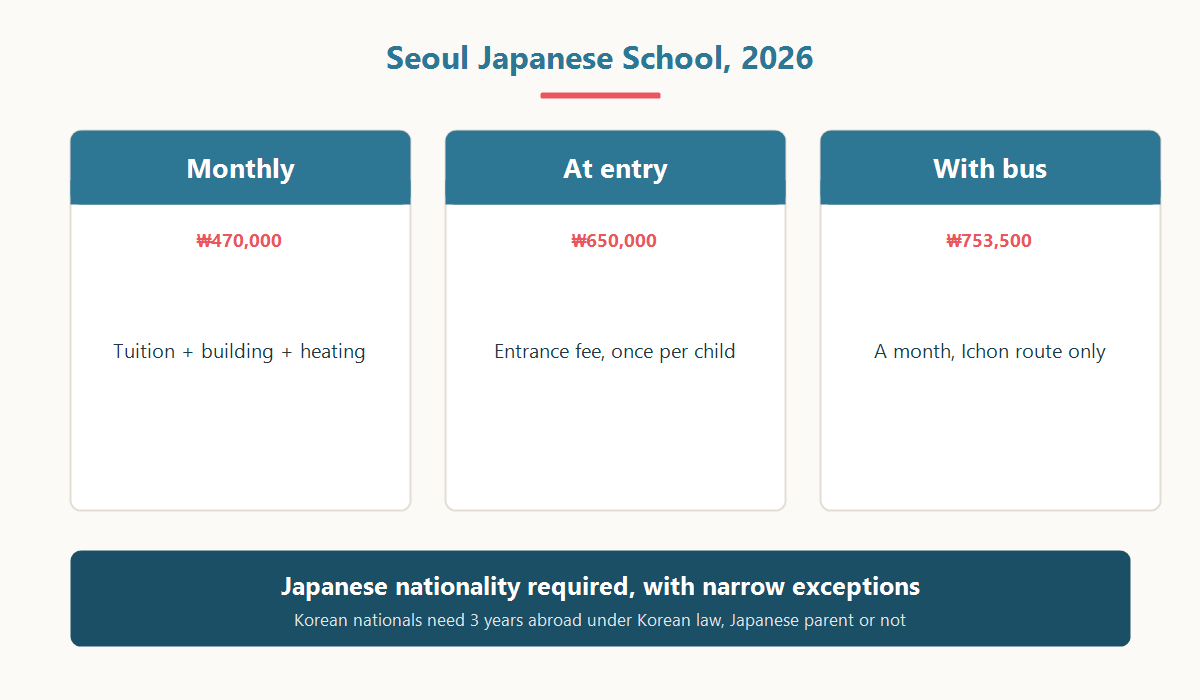
The school publishes its fees in its admissions guide for the 2026 school year (令和8年度), which runs from April 2026 to March 2027. Amounts are in Korean won, per child, per month.
| Item | Kindergarten, youngest year | Kindergarten, middle and top years | Elementary (Grades 1–6) | Junior high (Grades 7–9) |
|---|---|---|---|---|
| Entrance fee (once) | ₩650,000 | ₩650,000 | ₩650,000 | ₩650,000 (not for the school’s own Grade 6 leavers) |
| Tuition (monthly) | ₩550,000 | ₩510,000 | ₩390,000 | ₩390,000 |
| Building reconstruction fund (monthly) | ₩50,000 | ₩50,000 | ₩50,000 | ₩50,000 |
| Heating and cooling (monthly) | ₩30,000 | ₩30,000 | ₩30,000 | ₩30,000 |
| Monthly school charges | ₩630,000 | ₩590,000 | ₩470,000 | ₩470,000 |
| Per year (twelve months) | ₩7,560,000 | ₩7,080,000 | ₩5,640,000 | ₩5,640,000 |
| Paid at entry (entrance fee + first month) | ₩1,280,000 | ₩1,240,000 | ₩1,120,000 | ₩1,120,000 |
| School bus (monthly, optional) | ₩283,500 | ₩283,500 | ₩283,500 | ₩283,500 |
| PTA (yearly, voluntary) | ₩30,000 | ₩30,000 | ₩30,000 | ₩30,000 |
Fees are invoiced after enrolment and paid by bank transfer, at an ATM or online. There is no pro-rating for part months: you pay in whole months. Three months of arrears and the school’s operating committee discusses whether your child stays. Teaching materials (workbooks, drills, the contact notebook and their shipping) and an ICT fee for the LoiLoNote app and device management are charged separately; those amounts are not published.
The bus deserves its own line. It is run not by the school but by a parents’ association, which sets the fare each May. For 2026 it is ₩283,500 a month — ₩3,402,000 a year, more than half the annual tuition. And it runs from one area only: Ichon-dong in Yongsan-gu, with no stops between Ichon and the school.
Then there is the Seoul Japan Club. A parent must join. Under the club’s fee rules (in force since January 2023), individual members pay no entrance fee and ₩300,000 a year for a family (₩240,000 single). Supporting members, the route for people who do not meet the full-member conditions, pay ₩210,000 a year for a family. Japanese staff posted by a member company, and their families, are exempt from individual dues because the company pays ₩280,000 a year per posted employee instead. Dues are not refunded if you leave mid-year.
Put together, these are our additions of the published lines for one elementary child in 2026:
- Posted by a Japanese company that is an SJC member, living in Sangam-dong: ₩1,120,000 on the first invoice, then ₩470,000 a month — about ₩5.67 million a year with the PTA, plus materials. Club dues are covered by the employer.
- Same family in Ichon-dong, using the bus: ₩753,500 a month, or about ₩9.07 million a year.
- Japanese parent whose case is approved but who pays club dues personally, using the bus: about ₩9.37 million a year, plus the ₩650,000 entrance fee.
Several things are not published: whether any part of the entrance fee is refunded if you leave early (the only rule is that a child who returns within six months pays no new entrance fee), the materials and ICT amounts, and whether the 2027 tuition will change. Is it expensive? Not by Seoul standards, where international school fees commonly run several times higher — and there is no donation or debenture on top.
Who can enrol: Japanese nationality, a posting, and a plan to go home
Section II of the admissions guide is short and strict. A child needs the approval of the school’s operating committee and must meet all of these:
- Japanese nationality.
- The ability to cope with education in Japanese.
- A Japanese parent posted to Korea — meaning sent by a Japanese company or a Japanese-affiliated firm. Any other situation goes to review, and the family must show documents that objectively prove the parent plans to return to Japan.
- A parent who joins the Seoul Japan Club as a full or supporting member.
- An understanding of what the school is for — continuity with education in Japan. The guide states plainly that finishing here does not automatically qualify a child to enter or transfer into a Korean middle or high school.
Children without Japanese nationality cannot enrol in principle. The committee can make an exception only if the child falls into one of three groups — a child of zainichi Korean residents of Japan, confirmed by a Korean diplomatic mission in Japan; a foreign national other than a Korean national who holds Japanese permanent residency; or a Korean-national child of foreign background with a letter from the Korean education office confirming special circumstances — and the child has been educated in Japan with Japanese at grade level, and the parent is in Korea only temporarily, with parent and child both planning to return to Japan.
Then comes Korean law, which the school quotes in its own guide: a child with Korean nationality cannot enter any foreign school in Korea, this one included, without having lived abroad for at least three years. The rule comes from the Presidential Decree on foreign schools, Article 10, which defines the Korean nationals a foreign school may admit as those who have lived outside Korea for a total of three years or more, and caps them at 30% of the school’s places (an education superintendent may raise that by up to 20 points). Korean press coverage when the rule was introduced in 2009 made clear it applies to dual nationals too.
What that means for a mixed Korean-Japanese family:
- A dual national child who has just moved from Japan after three or more years there can meet both sets of rules — Japanese nationality for the school, three years abroad for Korea — provided the family case passes review. That is how the school comes to have a handful of Korean-national pupils: five in the 2026 disclosure.
- A dual national child who has grown up in Seoul does not meet Korea’s three-year rule, however good their Japanese.
- A Japanese parent settled in Seoul, locally employed and married to a Korean, falls outside “posted” and has to show a concrete plan to return to Japan. A family intending to stay is not who the school is built for.
Capacity limits exist too. The kindergarten has year-group caps of roughly 30, 40 and 50, and if the April intake is oversubscribed there is a lottery, with priority for children of full SJC members and for siblings already at the school in Grade 3 or below. There is no special-needs class, so families of children needing extra support must consult the school first. Grade 9 takes no transfers after 1 May.
The process itself starts with a phone call to the vice-principal. The school checks eligibility, may ask further questions about nationality, and only then releases the enrolment documents. Pupils arriving from Japan collect their textbooks from Japan Overseas Educational Services (JOES) before they fly. No entrance test is mentioned.
How it works: one campus, a Japanese school year, Korean holidays
All three divisions share the Sangam-dong campus, which opened in September 2010. The school is small and getting smaller. Wikipedia’s figure is 403 children in 2005; the Korean disclosure gives 300 in September 2025 and 273 in September 2026. The junior high has one class per grade — 54 students across three grades in December 2025 — so a child keeps the same classmates for three years.
| Term | Dates (2026 school year) | Holidays published |
|---|---|---|
| First term | 13 April to 16 July 2026 | Summer holiday 17 July to 17 August 2026 |
| Second term | 18 August to 23 December 2026 | Winter holiday 24 December 2026 to 5 January 2027 |
| Third term | 6 January to 6 March 2027 | Year-end holiday 7 to 31 March 2027 |
Other things the school publishes about daily life:
- Korean and English every week. On top of the Japanese curriculum, children study Korean and English conversation; in the junior high that is one lesson of each a week, 35 hours a year apiece.
- No school lunch. Every child brings a packed lunch (bento) and a water bottle every day.
- Parents escort the youngest. Up to Grade 3, a parent must take and collect the child, whether they walk or ride the bus.
- An early start. Elementary and junior high begin at 8:10; kindergarten at 9:40.
- The bus is a parents’ operation, departing only from Ichon-dong. Families near the school in Sangam-dong walk or use public transport.
The honest review: what the English pages leave out
People search for “Japanese school in Seoul reviews” to find out what it is like from the inside. We want to be straight: we found no body of verifiable parent reviews in English, and the school publishes no parent survey or satisfaction scores. The top results are a Wikipedia stub, tutoring marketplaces and a listing for the Busan school. We will not invent a consensus; what we can check is the public record.
1. “A Japanese international school.” Not in the way you might think
The English Wikipedia article calls it a “Japanese international school”. Families reading that phrase may picture an international school with a Japanese flavour, open to any child. It is the opposite: a Japanese national school abroad, for Japanese children who will go back to Japan. If you were searching “Japanese international school Seoul” for a bilingual school open to Korean families, this is not it.
2. No fees anywhere in English — and the official disclosure undercounts
We found no English page with Seoul’s fees; AI summaries tend to borrow the Busan school’s figures from a directory listing, which is a different school. The Korean Ministry of Education disclosure does give Seoul figures — but you have to pick the year first (left on the default, it can look empty), and its 2026 line shows tuition of ₩4,680,000 a year. That matches ₩390,000 × 12. What it leaves out is the ₩50,000 building fund and ₩30,000 heating and cooling charge that the school bills every month: ₩960,000 a year the disclosure does not show. Budget from the school’s own guide.
3. A school of comings and goings
One genuinely useful signal is turnover. The 2026 disclosure counts 106 children joining (new entrants and transfers) and 100 leaving during the 2025–26 school year — in a school of about 300. A new arrival is rarely the only new face — but friendships end often, and families who stay longer than a typical posting say goodbye a lot.
4. What to ask, since the reviews won’t tell you
- Does our family situation count as “posted”? If not, what documents prove a return to Japan?
- If our child is a dual national, how does the school count the three years abroad? The Korean rule counts total residence, not consecutive years.
- What do materials and the ICT fee come to each year? Not published.
- Is any of the entrance fee refunded if we leave within a year? Not published.
- Is there space in the kindergarten year we need? Year-group caps and a lottery apply.
- Will we live on the bus route? It serves Ichon-dong only.
Other options in Seoul
If your child cannot enrol — because they are not Japanese, because they hold Korean nationality without three years abroad, or because your family is staying in Korea — these are the routes that remain.
| Option | Who it takes | What to know |
|---|---|---|
| Japanese School in Seoul | Japanese nationals with a parent posted to Korea; narrow exceptions | ₩470,000 a month plus ₩650,000 entrance fee (2026). Full Japanese school day, Sangam-dong |
| Korean public or private school | Korean nationals and residents | Taught in Korean. Japanese, where offered, is a beginner-level foreign-language elective |
| International schools | Foreign nationals; Korean nationals only with three years abroad, within the 30% cap | Mostly taught in English; Japanese sometimes offered as a subject. Fees typically several times higher |
| Japanese language institutes (hagwon) | Anyone | Japanese as a foreign language, often for JLPT. Rarely suitable for a child who already speaks Japanese at home |
| Home study with Japanese textbooks | Anyone with access to the books | Families of Japanese nationals abroad can apply for free MEXT textbooks through JOES. Depends entirely on the parent |
| Online classes | Anyone in Seoul | No commute or nationality rule; quality varies widely. Seoul is on Japan’s time zone |
The gap is the same one we see in most cities, only sharper. Seoul has a good full-time school for Japanese children on a posting — and nothing in between for the Korean-Japanese children growing up here who speak Japanese with one parent. The same pattern shows up in Vietnam, where our guide to the Japanese School in Ho Chi Minh City covers who gets in there.
How to choose, in four questions
- Does your child hold Japanese nationality? If not, the school is closed apart from three narrow exceptions.
- Does your child also hold Korean nationality? Then count three years’ total residence abroad before planning around any foreign school.
- Is your family going back to Japan? A settled family, or a locally hired Japanese parent, goes to review and must show a return plan.
- Can your child follow a full day of lessons in Japanese? If yes, this is the most direct route back into Japanese schooling, at a modest price.
Where TOMODACHI JAPAN fits
We are not a substitute for the Japanese School in Seoul, and if your child is Japanese, on a posting and heading back to a school in Japan, we would point you there. We exist for the families the four questions leave stuck — the Korean-Japanese child who cannot enrol, the child at a Korean or international school whose Japanese reading is slipping, and the family that is staying in Seoul for good.
- Japanese friends of the same age, every day. Classes with children the same age in Japan — not only other learners in Seoul. The reason children keep going is usually the other children.
- Teachers working at Japan’s current classroom standard — not a syllabus written abroad and not a tutoring marketplace.
- Small classes of eight children. Enough to be a class, few enough that every child speaks every lesson.
- Seoul and Japan share a clock. There is no time difference at all, so an after-school class in Japan is an after-school class in Seoul — around a Korean school day, a hagwon timetable or an international school. No nationality rule, no three-year rule and no club membership.
- Fees and scholarships are in our free school guide, which we email to everyone who registers, with no obligation.
If a weekend school is what you are weighing us against, our guide to online alternatives to a Japanese hoshuko sets out what an online class can and cannot replace.
Frequently asked questions
How much are the Seoul Japanese School fees?
For the 2026 school year, elementary and junior high cost ₩470,000 a month (₩390,000 tuition, ₩50,000 building fund, ₩30,000 heating and cooling), or ₩5,640,000 a year. Kindergarten is ₩590,000 to ₩630,000 a month. The entrance fee is ₩650,000 per child. The parent-run bus is ₩283,500 a month, and Seoul Japan Club dues are ₩300,000 a year for a family unless an employer covers them.
Can Korean children attend the Seoul Japanese School?
Rarely. The school requires Japanese nationality in principle, and Korean law bars any Korean national from a foreign school in Korea unless they have lived abroad for a total of three years or more. A Korean-Japanese dual national who has lived in Japan for three years or more and whose family is returning to Japan can qualify; a child who has grown up in Seoul generally cannot.
Does my child need a Japanese passport?
In principle, yes. Exceptions exist only for children of zainichi Korean residents of Japan, non-Korean foreign nationals with Japanese permanent residency, and certain Korean-national children of foreign background — and only if they were educated in Japan, speak Japanese at grade level and are returning to Japan with a parent.
Is there a time difference between Seoul and Japan?
No. Seoul and Tokyo are both on UTC+9, so live online classes held after school in Japan happen after school in Seoul too.
Sources
- Japanese School in Seoul (Japanese-language pages): official website, Admissions, 2026 admissions guide (PDF), 2026 elementary handbook (PDF), junior high handbook (PDF), Transfer process, School bus
- Korean Ministry of Education, foreign-school disclosure: Japanese School in Seoul (select 2026 and 2025). Presidential Decree on the establishment and operation of foreign schools and kindergartens, Article 10 (as amended 8 April 2025), under Article 60-2 of the Elementary and Secondary Education Act
- Seoul Japan Club: Membership, Bylaws and fee rules (PDF)
- Third-party pages checked: Wikipedia, Japanese School in Seoul; doris.school, Busan Japanese School listing; Hankyung report on the 2009 foreign-school decree. All checked 17 October 2026.