
Online Japanese lessons for children are now easy to find and very hard to compare. Every provider promises native speakers, fun lessons and fast progress; the websites look interchangeable; the prices differ by a factor of ten. This is a buyer’s guide written by people who teach children online — the six things that actually determine whether your child is still learning in a year, what the formats really cost, and the questions that expose a weak programme in a five-minute email.
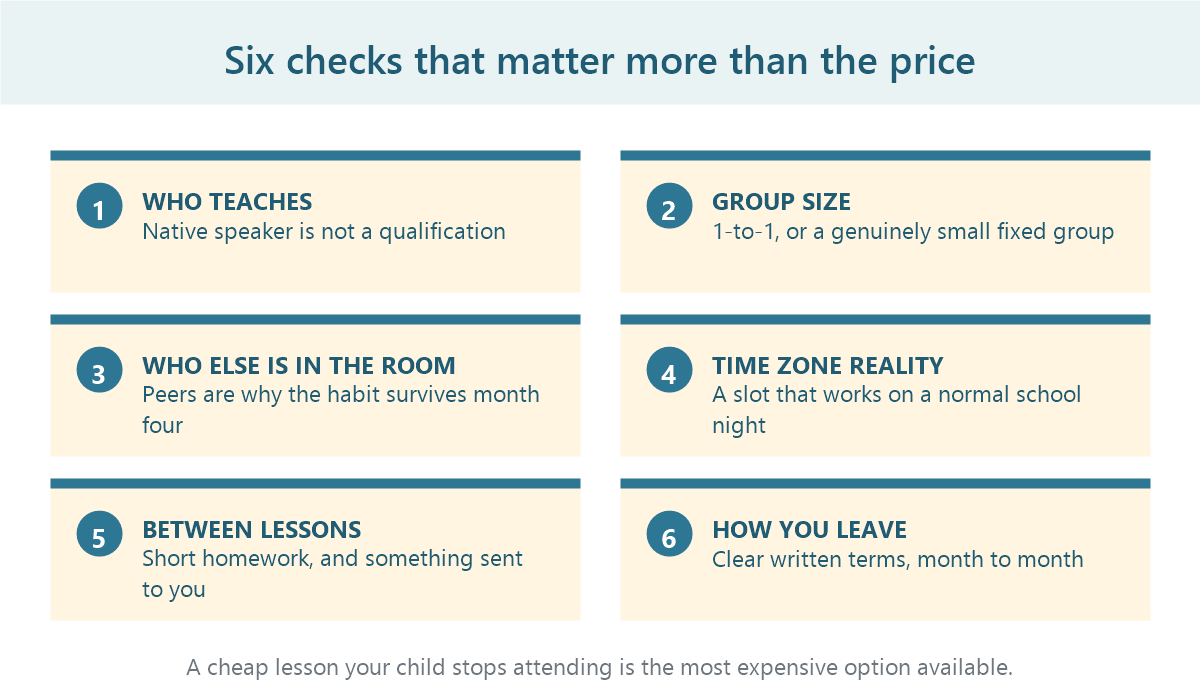
The six things that decide everything
| What to check | Why it matters more than the price | Good answer looks like |
|---|---|---|
| 1. Who teaches | “Native speaker” is not a qualification. Teaching children is a specific skill, and it is the difference between a lesson and a conversation with a stranger. | Named, qualified teachers with experience teaching children — and you can find out who your child’s teacher will be before you pay. |
| 2. Group size | One-to-one maximises speaking minutes; a small group supplies the thing a child comes back for. Twenty in a webinar supplies neither. | Either 1-to-1, or a genuinely small group with a fixed roster your child gets to know. |
| 3. Who else is in the room | For a child with no exam to sit, other children are the reason the habit survives month four. | Peers of a similar age — ideally including children who actually speak Japanese daily. |
| 4. Time zone reality | The most common cause of quitting is not boredom. It is a 6:30am lesson that stops being possible in week five. | A slot that works on a normal school night, all year, without heroics. |
| 5. What happens between lessons | Forty minutes a week is not a language education. What your child does on the other six days decides the outcome. | Short, specific homework a child can do alone, and something you receive so you know what happened. |
| 6. How you leave | Cancellation terms tell you what a provider thinks of its own retention. | Clear, written, month-to-month. Long lock-ins for young children are a warning sign. |
Looking for a way to keep Japanese going from abroad?
TOMODACHI JAPAN is an online Japanese school for children growing up outside Japan. They talk with peers their own age in Japan every day, taught by teachers working at Japanese schools, in small classes of 8.
🎁 Register and we’ll email you our School Guide (PDF, in English) straight away. You’ll also be first to hear about tuition, scholarships and opening dates.
Free · takes about 30 seconds
The formats, honestly compared
Published rates give a rough sense of the market. italki’s own 2026 pricing guide puts community tutors at $4–$20 per hour and professional teachers at $15–$50 per hour; Preply advertises Japanese lessons for beginners from about $5 per hour. Marketplaces are cheap per hour because you are buying an hour, and nothing else.
| Tutor marketplace | Group class programme | Weekend Japanese school | App or self-study | |
|---|---|---|---|---|
| Speaking minutes per session | ◎ | ○ | △ | × |
| Peers your child knows | × | ◎ | ◎ | × |
| Continuity if a teacher leaves | × | ◎ | ◎ | — |
| Progression through a curriculum | △ depends entirely on the tutor | ◎ | ◎ | ○ |
| Fits a normal school week | ◎ | ○ | × takes the Saturday | ◎ |
| Cost shape | Per hour, meter running | Usually a flat monthly fee | Term or annual fees | Low or free |
If you are weighing one-to-one specifically, we went through when it is the right format and when it quietly fails a young child in Japanese tutor for kids. For a cost breakdown, see how much Japanese lessons cost for kids.
What a good online lesson for a child actually looks like
Ask to observe a trial, or watch over your child’s shoulder. You are looking for a shape, not for entertainment.
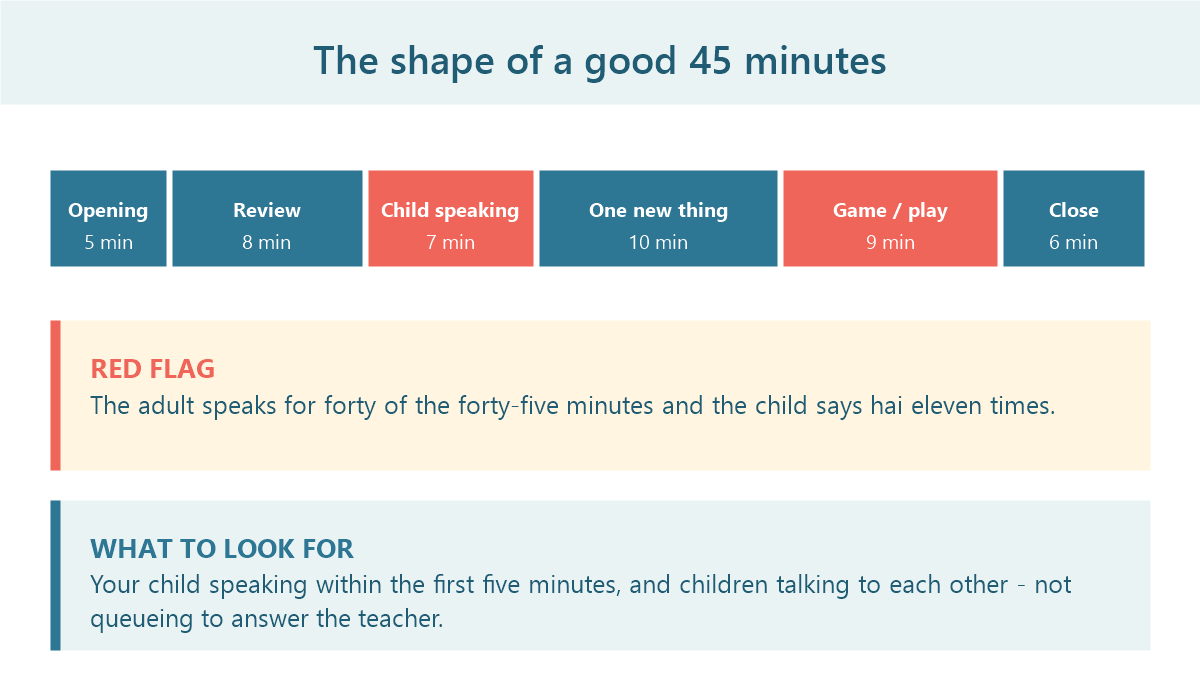
The shape of a good 45 minutes
- A fixed opening routine — the same greetings every week. Children need a runway.
- Review before new material — last week’s words used, not just mentioned.
- Your child speaking within the first five minutes, not listening for twenty.
- One new thing, not six. A single structure, used many times.
- Something playful in the middle — a game, a race, a picture task. This is where the register drops and real speech happens.
- Child-to-child talk if it is a group. If the children only ever speak to the teacher, it is a queue, not a class.
- A clear close — what was learned, what to do before next week.
Red flag: a lesson where the adult speaks for forty of the forty-five minutes and the child says “hai” eleven times.
Eight questions to send before you book
- Who will teach my child, what are their qualifications, and have they taught this age group?
- How many children are in the class, and is it the same children each week?
- How many minutes will my child actually be speaking?
- What do you do with a child who freezes and says nothing?
- What will my child be able to do after one term? Give me something concrete.
- What do you send home after each lesson?
- Which time slots are available in my time zone, all year?
- What are the cancellation terms, in writing?
Question 4 is the one that separates providers. A teacher will describe a technique. A speaker of Japanese will say “we encourage them.”
Three mistakes that end programmes early
- Booking a slot that only works during the holidays. Test the slot against a normal, tired Wednesday in term time before you commit.
- Starting with too much. Three sessions a week for an enthusiastic beginner almost always collapses to zero. Start with one your family can hold forever, and add later.
- Measuring the wrong thing. Parents check whether the child “liked it”. Check instead whether the child said anything, and whether they can still say it on Saturday.
Where we sit
Treat this as our position rather than neutral advice. TOMODACHI JAPAN runs small groups of about eight children with qualified Japanese teachers — the kind who teach in Japanese schools — and with children who actually live in Japan in the class, which is the row in the table above that online providers almost never fill. Classes run on a timetable across several time bands so a workable slot exists in most regions, and the fee is a flat monthly rate with unlimited classes rather than an hourly meter. The fee, the scholarship bands and the full timetable are in the school guide: request it here and we will email it to you.
If your child is starting from zero, what a first term should look like is the right next read. If you would rather begin at home first, Japanese for kids has a first fifty words and an age-by-age plan.
FAQ
What age can a child start online lessons?
Around six is where most children can hold a short online session independently. Below that, online works only if a parent sits alongside — which is fine, but plan for it rather than discovering it in week two.
How often should lessons be?
Once a week sustained beats three times a week abandoned. If you can add anything, add ten minutes daily at home rather than a second formal lesson — frequency of contact matters more than length of session at this age.
Group or one-to-one for a shy child?
Counter-intuitively, a small group is usually kinder. One-to-one gives a shy child nowhere to hide and no one to copy; in a group of eight they can listen first, borrow courage from the child who just answered, and join on their own terms.
Do online lessons work as well as in-person?
For language, the gap is smaller than parents expect, and for families abroad the alternative is usually nothing rather than an in-person class. What online cannot fake is the presence of other children — so the thing to check is not the technology, it is who else is in the room.