Most parents start here: find a Japanese tutor for my child. It is the obvious move, and for some children it is exactly right. But after teaching a lot of children who arrived at Japanese through a tutor — and a lot who quit one — we would ask you to spend ten minutes on two questions before you book anyone. What does a tutor actually cost, once you count the lessons a child will really need? And is one adult, one child, one hour the format your particular child will keep doing in six months?
What a Japanese tutor for kids costs in 2026
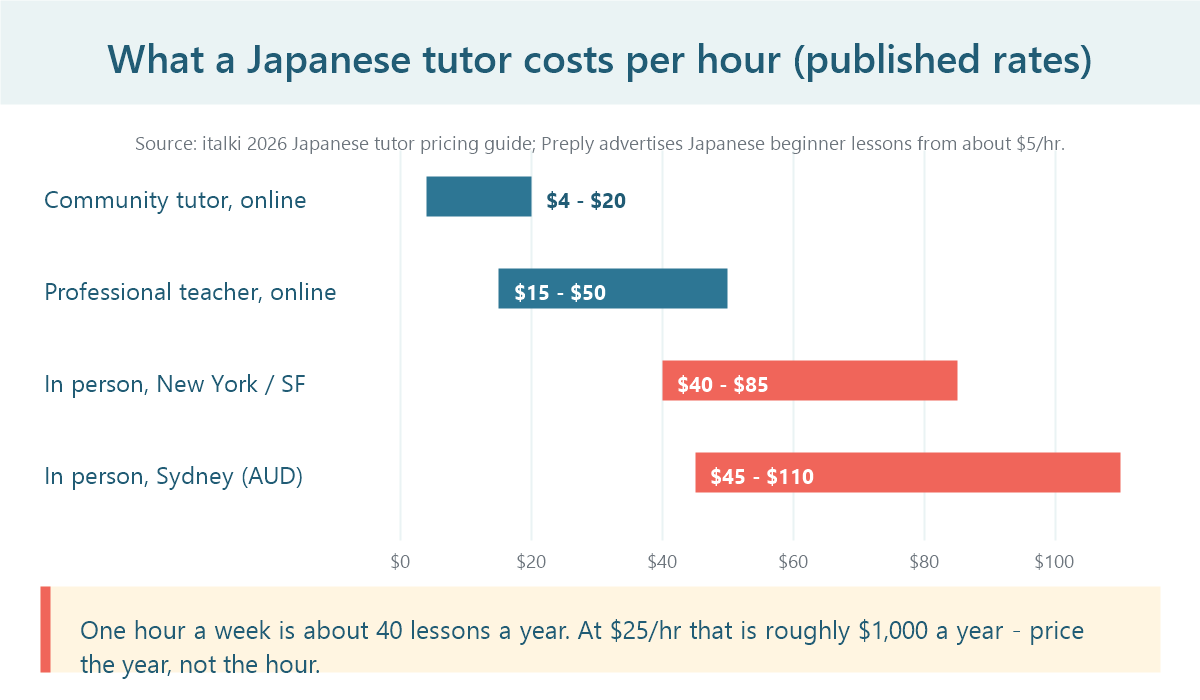
Prices are public, so let us use published numbers rather than vague talk. On italki, one of the largest tutor marketplaces, the company’s own pricing guide puts community tutors — conversation practice, no teaching qualification required — at $4–$20 per hour, and professional teachers at $15–$50 per hour. The same guide puts in-person local tutoring far higher: $40–$85/hr in New York and San Francisco, £30–£70/hr in London, AUD $45–$110/hr in Sydney. On Preply, Japanese lessons for beginners are advertised from around $5 per hour, with reported platform averages for Japanese in the high teens to low twenties per hour.
| Option | Published rate | What you are buying |
|---|---|---|
| Community tutor (online) | $4–$20/hr | Conversation practice with a native speaker. No teaching qualification implied. |
| Professional teacher (online) | $15–$50/hr | Structured lessons, a syllabus, JLPT or exam preparation. |
| In-person, big city | $40–$85/hr (NY/SF) £30–£70/hr (London) AUD $45–$110/hr (Sydney) | The same hour, plus travel and location overhead. |
Now do the arithmetic parents rarely do at the start. A child does not learn a language in ten lessons. At one hour a week — the most common pattern — a year is roughly 40 lessons. At a modest $25/hr that is about $1,000 a year for one hour of Japanese a week. That is not an argument against tutors. It is an argument for being honest about the real unit of purchase: not the hourly rate, but the year.
Looking for a way to keep Japanese going from abroad?
TOMODACHI JAPAN is an online Japanese school for children growing up outside Japan. They talk with peers their own age in Japan every day, taught by teachers working at Japanese schools, in small classes of 8.
🎁 Register and we’ll email you our School Guide (PDF, in English) straight away. You’ll also be first to hear about tuition, scholarships and opening dates.
Free · takes about 30 seconds
The costs that are not on the price tag
- Cancellations. A single tutor means a single point of failure. They get sick, they move country, they take exams. Every gap costs momentum, and momentum is most of what young learners have.
- Scheduling. A tutor in Japan is a lovely idea until you discover that their available hours are your child’s bedtime.
- Your time. With younger children, a 1-to-1 online lesson very often needs a parent sitting nearby to keep it on the rails. Count that hour too.
- Re-starting. Families who stop and restart pay twice, because a child who has drifted for four months comes back below where they left.
When a 1-to-1 tutor is the right answer — and when it is not
We will say the unpopular part plainly, because it is what we see week after week. One-to-one is the strongest format for a motivated teenager with a specific target, and one of the weakest for a young child with no target at all.
A fifteen-year-old sitting a Japanese exam has a reason to speak: the exam. A tutor can drill precisely the thing they are weak at, and every minute is theirs. That is superb value.
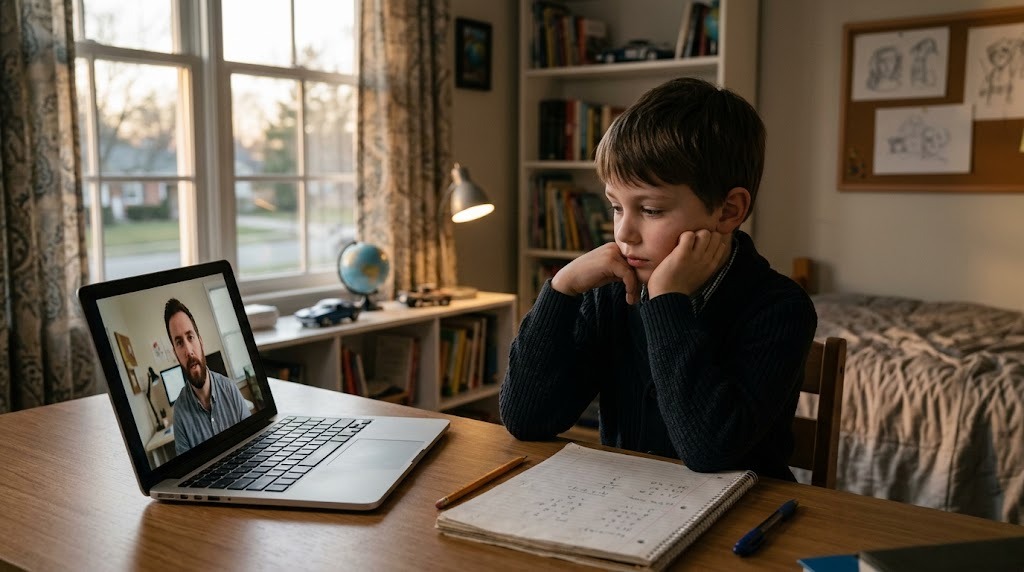
An eight-year-old has no exam. What an eight-year-old has is an appetite for other children. Put that child alone with an adult for sixty minutes and two things tend to happen: the lesson becomes a performance for a grown-up, and Japanese becomes homework. Children in that position work hard for a term, then start finding reasons not to log on. Nothing is wrong with the tutor. The format simply gave the child no social reason to come back.
A quick way to tell which side your child is on
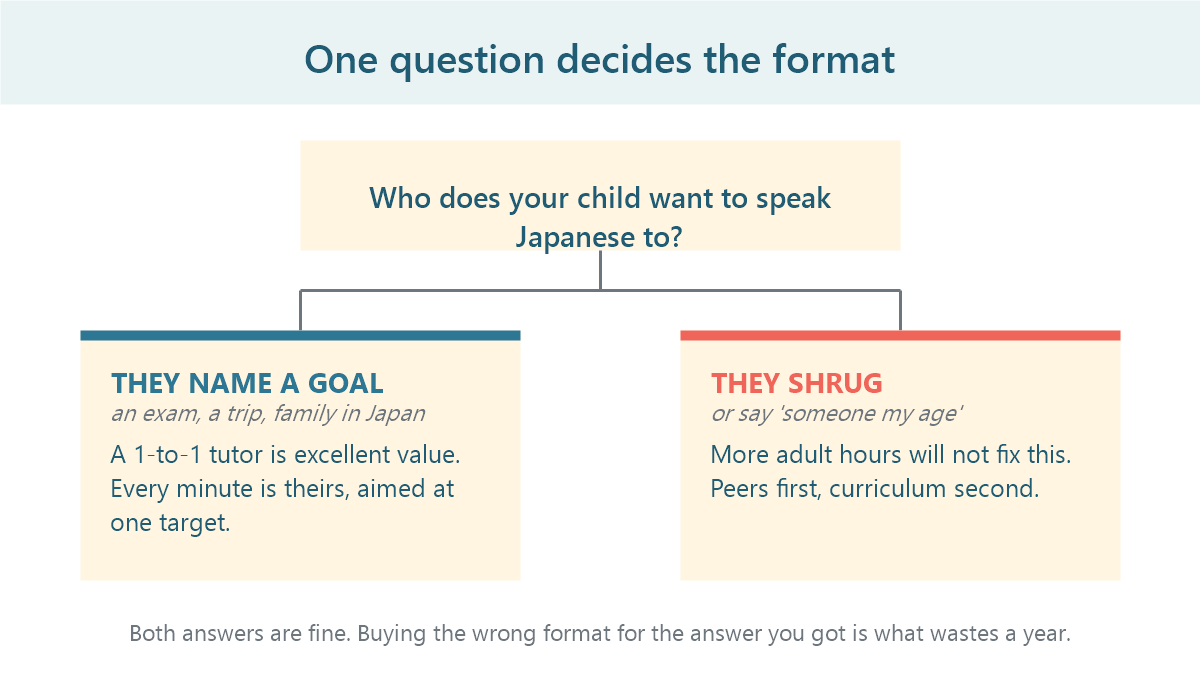
Ask your child: “Who would you want to speak Japanese to?”
If the answer names a goal — an exam, a trip, grandparents in Japan — a tutor will work well. If the answer is a shrug, or “I don’t know, someone my age,” buying more adult hours will not fix it. That child needs peers first and a curriculum second.
The four options, compared honestly
| 1-to-1 tutor | Small group class | Saturday hoshuko | App / self-study | |
|---|---|---|---|---|
| Typical published cost | $15–$50/hr online | Lower per hour | Term or annual fees | Low or free |
| Minutes your child actually speaks | ◎ highest | ○ good | △ varies with class size | × none |
| A reason to come back | △ depends on the goal | ◎ the other children | ○ classmates, one day a week | × willpower only |
| Fits around a school week | ◎ flexible | ○ fixed but online | × takes the whole Saturday | ◎ |
| Suits a child with no exam goal | △ | ◎ | ○ | × |
| Survives a tutor’s illness or move | × | ◎ | ◎ | — |
If cost is the deciding factor for you, we have broken the numbers down further in how much Japanese lessons cost for kids. If your child is starting from zero, Japanese classes for kids who are complete beginners covers what a first term should look like. For older children, see Japanese classes for teens.
Twelve questions to ask before you book a trial lesson
Print this, or keep it open in a tab. Most parents ask about price and availability and stop. These are the questions that predict whether your child is still learning next year.
Before the trial — 12 questions
- Are you a qualified teacher, and qualified where? “Native speaker” is not a qualification.
- Have you taught children of my child’s age? Teaching adults is a different job.
- What happens in the first ten minutes of a lesson? Listen for a routine, not improvisation.
- How much of the hour will my child be speaking? Ask for a number.
- What do you do when my child says nothing? This is the question that separates teachers from speakers of Japanese.
- Which script do you start with, and when does kanji begin?
- What will you send me after each lesson?
- What happens if you are ill or move away? Is there any cover at all?
- Can my child hear Japanese from anyone but you? One voice is a narrow diet.
- What is the cancellation policy, in writing?
- What does progress look like in three months? Vague answers here become vague lessons.
- Will my child ever speak Japanese to another child? If the honest answer is no, decide whether you are comfortable with that.

What we do instead, and why
We are not a tutor marketplace, so treat this as our position rather than neutral advice. TOMODACHI JAPAN teaches children in small groups of about eight, with qualified Japanese teachers — the kind who teach in Japanese schools — and with children who actually live in Japan in the room. The reason is the one in the comparison table above: for a child without an exam to sit, the thing that keeps them coming back is other children. The curriculum matters, but it is the friends who make the curriculum survive month four.
Practically, that also removes the fragility of a single tutor: classes run on a timetable, a teacher’s illness does not end your child’s Japanese, and the fee is a flat monthly rate with unlimited classes rather than an hourly meter that makes you count minutes. We publish the fee, the scholarship bands and the full timetable in the school guide — request it here and we will send it by email.
FAQ
How much should I pay for a Japanese tutor for my child?
Published online rates run about $4–$20/hr for community tutors and $15–$50/hr for professional teachers, with in-person rates in major cities considerably higher. For a child, price is the wrong first filter: a cheap tutor your child stops attending costs more than a good one they keep.
Is a native speaker enough?
For conversation practice with a teenager who already has a base, often yes. For a young beginner, no. Someone has to know the order to introduce things in, how to teach kana without killing the mood, and what to do in the silence after a question. That is training, not nationality.
My child is shy. Wouldn’t 1-to-1 be easier for them?
It feels safer, and for the first few weeks it is. But a shy child alone with an adult has nowhere to hide and no one to copy, and the pressure is constant. In a small group a quiet child can listen first, join on their own terms, and borrow courage from the child who answered before them. Most of the shy children we teach speak more in a group of eight than they did one-to-one.
Can we use a tutor and a group class together?
Yes, and it is a sensible combination when there is an exam in view: the group supplies the habit and the peers, the tutor attacks the specific weakness. Just decide which one is the backbone, so the other can be dropped without the whole thing collapsing.