Hiring an online Japanese tutor for your child is the obvious move, and for a lot of families it is the right one. But it is also the default that gets chosen without comparison — parents search for a tutor, find thousands, pick one, and never ask whether one-to-one was the correct format for a nine-year-old in the first place.
This guide covers what tutors actually cost in 2026, what they are genuinely better at, the three situations where they are the wrong tool for a child, and how to vet one properly if you go ahead.
What an online Japanese tutor costs in 2026
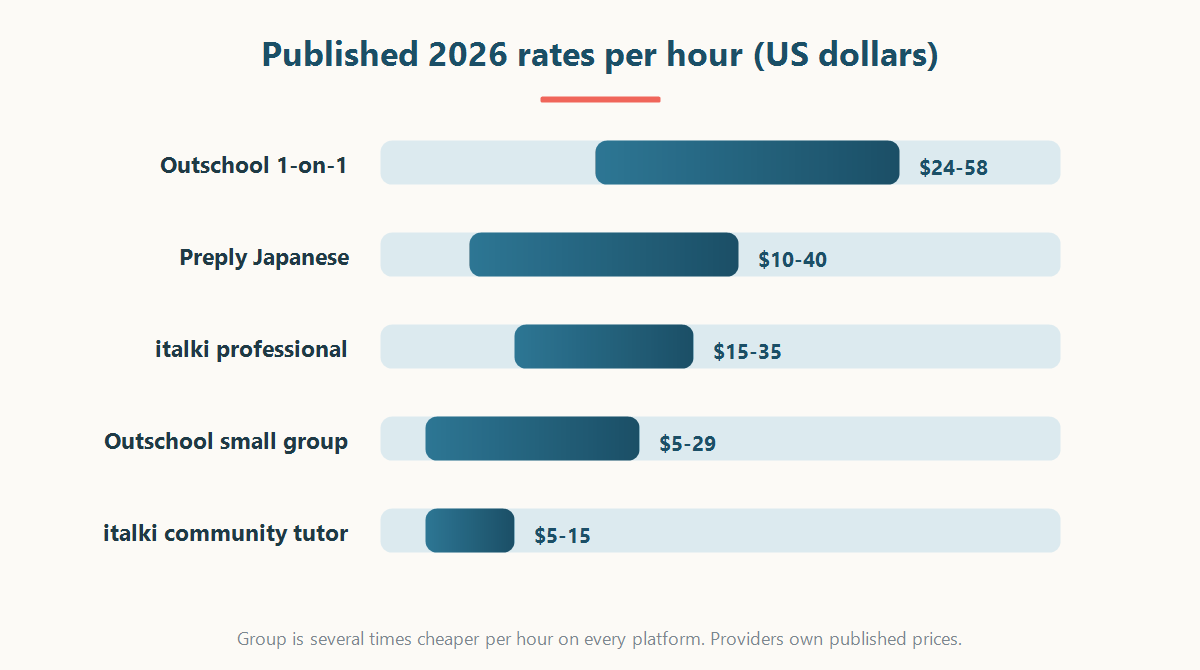
The two large marketplaces are not single products — they are thousands of individual sellers, which is why the advertised “from” price and what you will actually pay are so far apart.
| Platform | Published 2026 range | What the low end buys |
|---|---|---|
| Preply | Roughly US$10–$40 per hour for most tutors; Japanese tutors commonly quoted at US$19–$39 per lesson | An untrained fluent speaker, often teaching from a free textbook PDF |
| italki | Community tutors about US$5–$15/hr; professional teachers about US$15–$35/hr | italki labels this distinction openly — community tutors are not trained teachers |
| Outschool (group and 1-on-1) | 1-on-1 tutoring typically US$24–$58 per session; small-group live classes about US$5–$29 per class | Vetted listings, but quality varies by individual teacher |
Note the structural fact hiding in that table: on every platform, group is several times cheaper per hour than one-to-one. If your budget is fixed, the format you choose decides how many hours your child gets — and hours are what actually accumulate into a language.
Looking for a way to keep Japanese going from abroad?
TOMODACHI JAPAN is an online Japanese school for children growing up outside Japan. They talk with peers their own age in Japan every day, taught by teachers working at Japanese schools, in small classes of 8.
🎁 Register and we’ll email you our School Guide (PDF, in English) straight away. You’ll also be first to hear about tuition, scholarships and opening dates.
Free · takes about 30 seconds
What a tutor is genuinely better at
- A specific, dated goal. An HSC or VCE oral exam, a JLPT sitting, an entrance test. A tutor can aim everything at one date.
- Repairing one broken thing. A child who has lost the thread on verb forms, or who can read hiragana but stalls on katakana, benefits from targeted attention that a class cannot pause to give.
- Fitting an impossible schedule. Booked hour by hour, a tutor bends around your week in a way that a fixed class never will.
- A child who genuinely freezes in groups. Some children do. For them one-to-one is not second best, it is the only thing that works.
If your goal is an Australian senior exam specifically, we have a dedicated comparison of HSC and VCE Japanese tutors, which is a different market from general kids’ tutoring.
Three situations where a tutor is the wrong tool
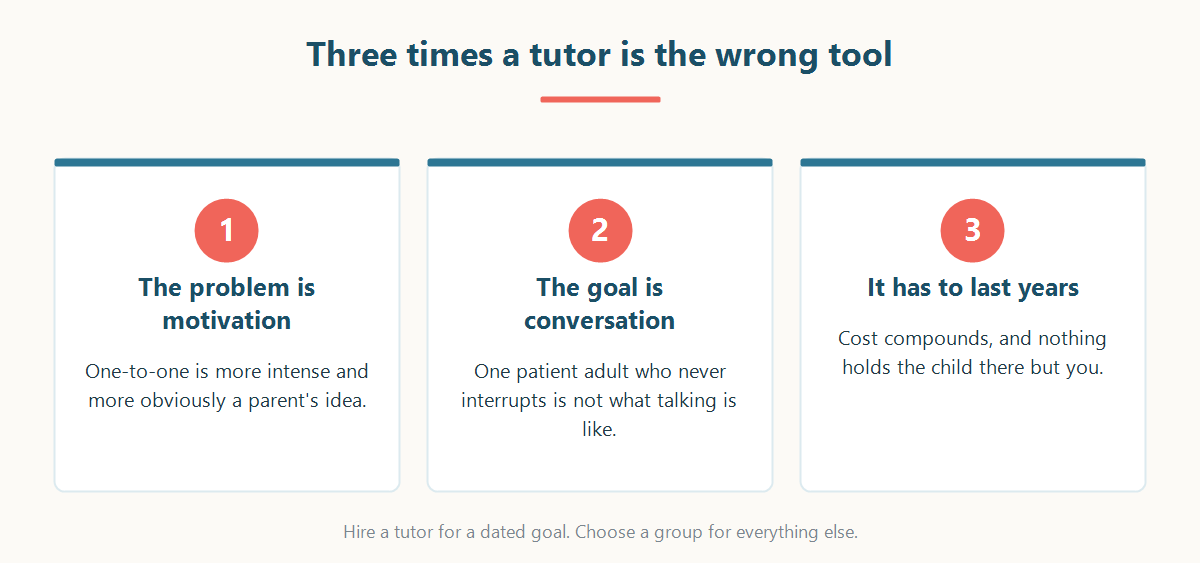
1. When the real problem is motivation
This is the most common misdiagnosis. A child who has gone quiet on Japanese, or who resists the Saturday morning, does not usually have a knowledge gap — they have stopped seeing the point. One-to-one lessons make that worse, not better: they are more intense, more exposed, and more obviously an obligation arranged by a parent. What tends to restart a child is other children.
2. When the goal is conversation
A tutorial teaches a child to talk to one patient adult who already knows what they are trying to say, speaks slowly, and never interrupts. That is not what talking to people is like. Children who only ever practise one-to-one with a teacher are frequently thrown by a normal conversation with a peer — the speed, the interruptions, the slang, the assumption that you will keep up.
3. When you need it to last for years
Language is a multi-year project, and the cost per hour compounds. At marketplace rates, one weekly one-to-one hour is a meaningful annual commitment, and there is nothing holding the child in it but the parent’s will. Classmates create their own gravity — children keep going because their friends are there.
How to vet an online tutor for a child
If a tutor is the right call, the vetting is different from vetting one for yourself.
- Ask what they do when a child is bored, not what they teach. Anyone can list a syllabus. Managing a distracted ten-year-old over video is the actual skill.
- Check “teacher” versus “fluent speaker”. italki states this distinction on the profile. On other platforms you have to ask directly: what is your teaching qualification, and have you taught children?
- Ask for their child-specific experience by age. Teaching adult beginners and teaching an eight-year-old share almost no methods.
- Book a trial at your child’s real lesson time. A tired child at 7pm behaves differently from a fresh one on Saturday morning — test the slot you will actually use.
- Watch the first full lesson. You are checking whether your child talks. If the tutor is talking most of the time, that is the wrong lesson at any price.

The comparison most tutor pages will not show you
| 1-on-1 online tutor | Small group class | |
|---|---|---|
| Cost per hour | Highest | Several times lower on the same platforms |
| Pace | Exactly your child’s | The group’s — a real trade-off |
| Talking time per child | Maximum | Shared, but with peers rather than an adult |
| Reason to keep going | The parent | Classmates |
| Handles a fixed deadline | Best | Less flexible |
| Builds real conversation | Weaker — one adult, always patient | Stronger — unpredictable, at speed |
Our own school sits deliberately on the right-hand column: small classes of eight, taught by qualified teachers from Japan, with other children in the room. That is not a better choice for every family — if your child has an exam in eight weeks, hire a tutor. It is the better choice for the families whose actual goal is a child who can talk to Japanese people and wants to keep going.
If you are weighing formats more broadly, see how much Japanese lessons cost for kids and our list of Japanese classes for kids near you.
Frequently asked questions
How much does an online Japanese tutor for kids cost?
In 2026, published rates run roughly US$10–$40 per hour on Preply, about US$5–$15 for italki community tutors and US$15–$35 for italki professional teachers, and about US$24–$58 per session for 1-on-1 tutoring on Outschool. Small-group classes on the same platforms are several times cheaper per hour.
Is a tutor or a group class better for my child?
A tutor is better for a dated goal like an exam, for repairing one specific gap, and for a child who freezes in groups. A group is better for motivation, for real conversation skill, and for anything you need to sustain for years.
What is the difference between a community tutor and a professional teacher?
On italki the labels are explicit: community tutors are fluent speakers without teaching credentials, professional teachers are qualified and experienced, and the price gap reflects it. On platforms that do not label this, ask directly about qualifications and experience teaching children.
Can a beginner child start with a tutor?
Yes, though a complete beginner often does better in a beginners group, where hearing other children make the same mistakes normalises them. See our guide to Japanese classes for kids who are complete beginners.
How often should a child have Japanese lessons?
More frequently and for shorter stretches beats one long weekly session. Total exposure hours are what accumulate, which is also the argument for choosing the format that lets you afford more of them.
Sources
- Preply — published Japanese tutor rates and platform averages, 2026
- italki — published rates and the community tutor versus professional teacher distinction, 2026
- Outschool — published 1-on-1 and group class price ranges, 2026