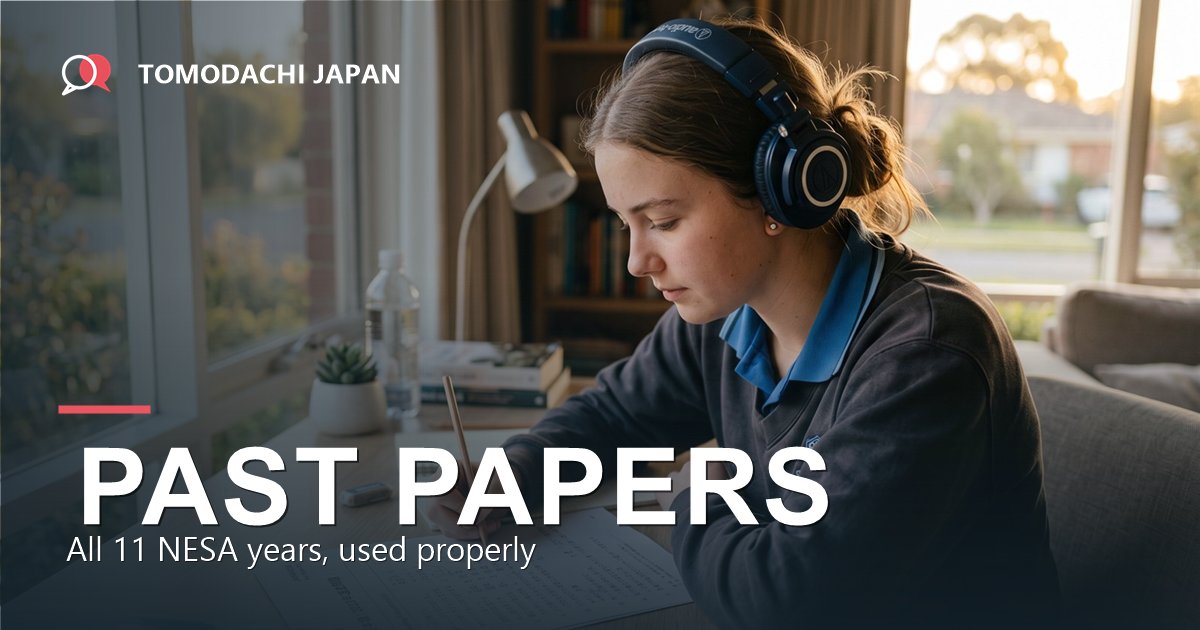
The 2026 HSC written exams run from Tuesday 13 October to Thursday 5 November. If you are sitting Japanese Beginners, that leaves about six weeks — and the single most useful resource for those six weeks is already free on NESA’s website.
Not just the past papers. Most students download the question paper, do it, mark it against the guidelines, and stop there. That leaves behind the two documents that actually show where the marks go: the audio and transcript, and the marking feedback written by the people who marked last year’s papers.
What is in an HSC Japanese Beginners exam pack
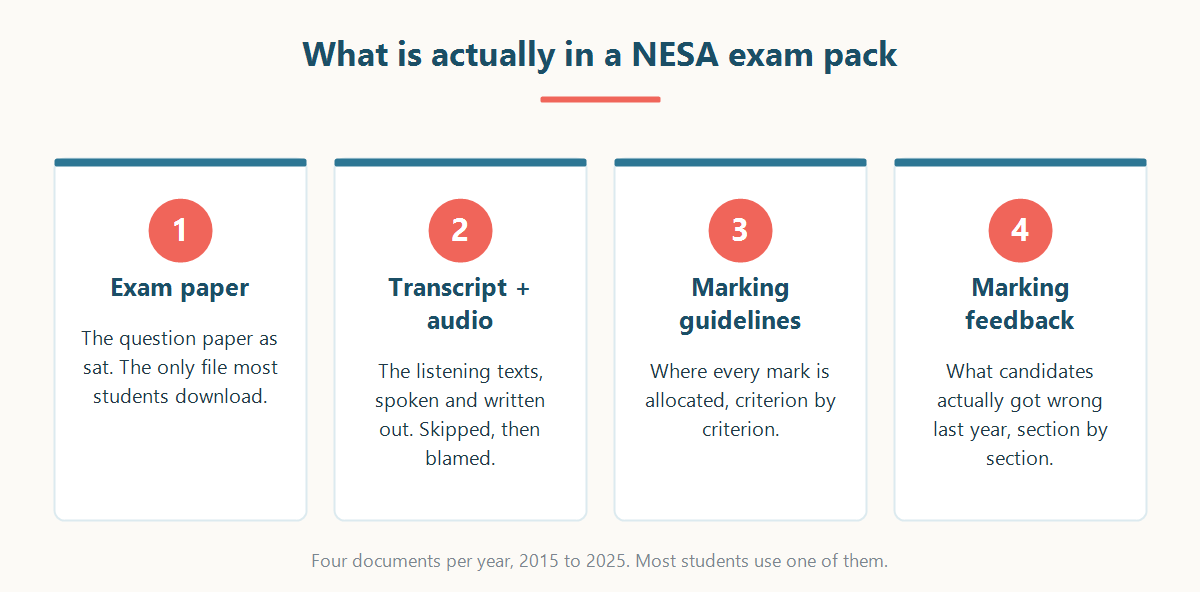
Every year’s pack on NESA’s site contains four things, not one:
| Document | What it is | What most students do with it |
|---|---|---|
| Exam paper | The full question paper as sat | Download it — and stop here |
| Transcript and audio | The listening texts, spoken and written out | Ignore it, then wonder why listening is their worst section |
| Marking guidelines | The mark allocation, criterion by criterion | Skim it to check answers |
| Marking feedback | Markers’ notes on what candidates actually got wrong, by section | Never open it |
The marking feedback is organised by section — oral examination (conversation), then listening, reading and writing. It is the closest thing to sitting in the marking room, and the only document that tells you which mistakes are common enough to be worth naming.
Looking for a way to keep Japanese going from abroad?
TOMODACHI JAPAN is an online Japanese school for children growing up outside Japan. They talk with peers their own age in Japan every day, taught by teachers working at Japanese schools, in small classes of 8.
🎁 Register and we’ll email you our School Guide (PDF, in English) straight away. You’ll also be first to hear about tuition, scholarships and opening dates.
Free · takes about 30 seconds
Which years are available
NESA publishes Japanese Beginners exam packs for 2015 through 2025 — eleven years. Each year sits at the same URL pattern, so you can jump straight to a year by editing the last part:
nsw.gov.au/education-and-training/nesa/curriculum/hsc-exam-papers/japanese-beginners/[year]
A practical note on the older years: the course runs on the Japanese Beginners Stage 6 (2009) syllabus, and it has not been replaced. The 2015 paper is testing the same six prescribed topics as the 2025 paper. Old papers are not stale here the way they are in some subjects — you have eleven usable years, not three.
Know the shape of the paper before you sit it
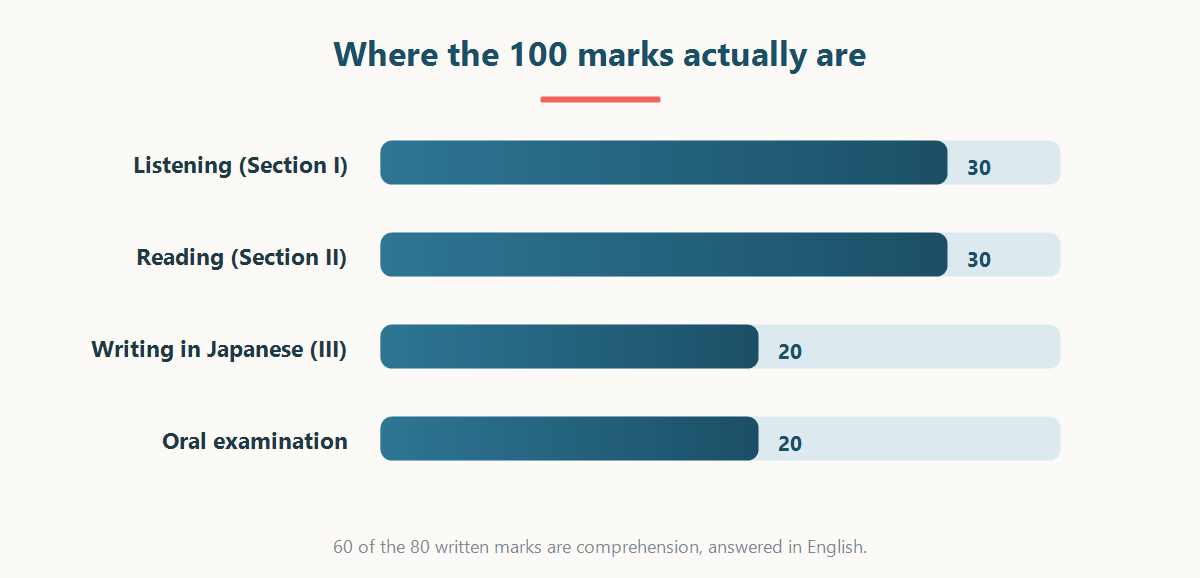
The HSC Japanese Beginners examination is worth 100 marks across two sittings. The oral examination is held earlier — in August or September, usually on a Saturday — and the written paper falls inside the October to November window.
| Component | Marks | Shape |
|---|---|---|
| Oral examination | 20 | About 5 minutes of conversation with an examiner on the prescribed topics |
| Section I — Listening | 30 | About 10 questions in English, answered in English. No more than 13 items. At least one worth 5 marks. Roughly 8 minutes for one complete reading of all texts |
| Section II — Reading | 30 | About 5 questions in English, answered in English, across roughly 12 items. At least one worth 5 marks |
| Section III — Writing in Japanese | 20 | Part A: two short answers (4 and 6 marks). Part B: choose 1 of 2 (10 marks) |
The written paper runs 2 hours 30 minutes plus 10 minutes reading time, and candidates may use monolingual and/or bilingual dictionaries in it. Two things follow from that table, and they should change how you use past papers.
- Sixty of the eighty written marks are answered in English. Listening and Reading are comprehension, tested in English. A student who spends all six weeks drilling written Japanese is polishing the 20-mark section and neglecting the 60-mark one.
- The 5-mark items are where papers are won. Listening and Reading each contain at least one item worth 5 marks. Those are the inference questions — tone, purpose, the speaker’s attitude — not the “what time does the train leave” questions. Find them in each past paper and do those first.
A six-week plan that uses all eleven years
Eleven papers is more than you need to sit end to end. Sitting all eleven under timed conditions is the most common way to waste them — you get eleven scores and no diagnosis. Use them by section instead.
- Weeks 1–2 — listening only. Take six years’ listening sections. Play the audio once, at full speed, exactly as in the exam. Then read the transcript and mark the moment you lost the thread. Almost always it is one unknown word early on, and everything after it collapsed. That is a vocabulary problem wearing a listening costume.
- Week 3 — reading only. Six years’ Section II. Time yourself per item rather than per section, so you find out which item types eat your minutes.
- Week 4 — writing only. Section III across all eleven years is only about thirty short tasks. Write Part B twice for each year: once with a dictionary, once without. The gap between the two versions is your real vocabulary.
- Weeks 5–6 — three full papers, timed. Now sit whole papers, including the 10 minutes reading time. Three is enough. Mark them against the guidelines, then read that year’s marking feedback before you look at your own errors, so you know what the markers were watching for.
If you are also sitting Continuers, or still deciding between the courses, we have a walkthrough of the HSC and VCE Japanese course levels, and a general guide to HSC Japanese past papers covering the Continuers packs.
The part past papers cannot fix
The oral examination is 20 marks — a fifth of the course — and it is the one component you cannot rehearse alone. It is roughly five minutes of unscripted conversation with an examiner about the prescribed topics: family life and home, people and communities, education and work, friends and pastimes, holidays and travel, future plans.
Past papers do not contain the oral. What they contain is the marking feedback on it, which is worth reading precisely because it describes a failure you cannot see in yourself: candidates who have memorised answers, and who come apart when the examiner asks a follow-up in a different order than expected.
The NSW Department of Education publishes a free set of practice speaking questions for Japanese Beginners, organised by topic. They are the right raw material. What they cannot supply is someone to ask them back at you unpredictably, in Japanese, at conversational speed — which is the only condition under which you find out whether you can hold the conversation.
For a structured approach to that, see our six-week HSC Japanese oral plan, and our comparison of HSC and VCE Japanese tutors.

Frequently asked questions
How many years of HSC Japanese Beginners past papers are there?
Eleven — 2015 through 2025 — published free on NESA’s website. Because the Japanese Beginners Stage 6 (2009) syllabus still applies, all eleven test the same six prescribed topics.
Can I use a dictionary in the HSC Japanese Beginners exam?
Yes. Candidates may use monolingual and/or bilingual dictionaries in the written examination. Practise with one and separately without one, so you know which words you actually own.
When is the 2026 HSC Japanese Beginners exam?
The oral examination is held in August or September, typically on a Saturday. The written paper sits inside the 2026 HSC written exam period, which runs from 13 October to 5 November. Your personal timetable is in NESA’s Students Online portal, because exact dates depend on your subject combination.
Is Japanese Beginners easier than Continuers?
It covers less language, but it is not a soft option and you cannot simply choose it — strict eligibility rules apply. See our companion guide to the Japanese course levels.
What is the best way to practise the oral exam at home?
Use the NSW Department of Education’s free practice speaking questions, but have someone ask them out of order and follow up on your answers. Rehearsing a script alone trains the wrong skill — the examiner’s follow-up question is the part that decides the mark.
Sources
- NESA — Assessment and reporting in Japanese Beginners (examination structure, marks, timing, internal weightings)
- NESA — Japanese Beginners HSC exam packs, 2015–2025 (paper, transcript and audio, marking guidelines, marking feedback)
- NESA — Japanese Beginners Stage 6 Syllabus (2009), prescribed topics
- NESA — 2026 HSC written examination timetable
- NSW Department of Education — Practice speaking questions, Japanese Beginners
If you are still choosing between Beginners and Continuers, the reading load is the clearest difference between them. Compare what you see here against the HSC Japanese Continuers kanji list.