
Metro Atlanta has one of the largest Japanese business communities in the American South, a Japanese Consulate-General, a Japanese immersion charter school and a Saturday school that has been running since 1974. On paper, a child here has more Japanese options than a child almost anywhere else in the region.
In practice, most Atlanta parents who search for Japanese classes for their child find that the good options are built for someone else’s child — and nobody explains that until you have driven to Mableton on a Saturday morning to find out. This guide lists what actually exists in Atlanta in 2026, who each option is really for, and what to do if none of them fit.
Japanese classes for kids in Atlanta: the real options
| Option | Where | Really designed for |
|---|---|---|
| Georgia Japanese Language School | Mableton, GA | Children from Japanese-speaking families |
| International Charter Academy of Georgia | Peachtree Corners, GA | Georgia residents, elementary grades, from Kindergarten |
| Atlanta Institute of Language | Metro Atlanta / online | Adults and older teens; some kids & family classes |
| Private tutors | Metro Atlanta / online | Motivated older children and teens |
| Japan-America Society of Georgia | Atlanta | Adults (business and conversation); youth exchange programmes |
Looking for a way to keep Japanese going from abroad?
TOMODACHI JAPAN is an online Japanese school for children growing up outside Japan. They talk with peers their own age in Japan every day, taught by teachers working at Japanese schools, in small classes of 8.
🎁 Register and we’ll email you our School Guide (PDF, in English) straight away. You’ll also be first to hear about tuition, scholarships and opening dates.
Free · takes about 30 seconds
1. Georgia Japanese Language School (Atlanta hoshuko)
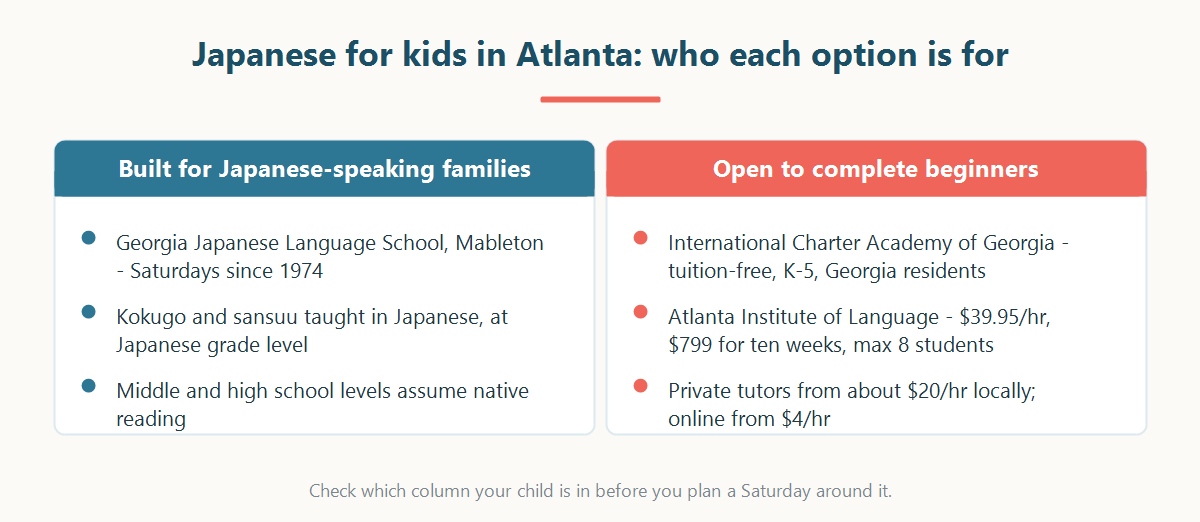
The Georgia Japanese Language School — known in Japanese as the Atlanta supplementary school, or Atlanta hoshuko — is at 1550 Pebblebrook Circle, Mableton, GA 30126. It was established in 1974 and runs on Saturdays, serving students from kindergarten age through high school.
What it teaches is the key detail. The programme covers kokugo (Japanese language arts) and sansuu / mathematics, taught in Japanese, alongside the passing on of Japanese culture. This is the standard supplementary-school model used worldwide: it exists so that children of Japanese families can stay on grade level with schools in Japan.
Who it fits: a child who already speaks Japanese at home and can follow a lesson taught entirely in Japanese at their Japanese grade level.
Who it does not fit: a child starting from zero. This is not a criticism of the school — it is doing precisely the job it was founded to do. But parents whose children love Japan and speak no Japanese often approach a hoshuko first and are surprised. Tuition is not published online; the school lists (770) 941-0533 on weekdays and (404) 797-8177 on Saturdays, and contact is by phone or email. Ask directly whether they have a track for beginners before you plan around it.
We explain the distinction in more detail in our guide to what a hoshuko is and what to do if one is not an option.
2. International Charter Academy of Georgia
This is Atlanta’s most unusual option and the one most parents have never heard of. The International Charter Academy of Georgia in Peachtree Corners is a tuition-free public charter elementary school teaching a bilingual English–Japanese programme — the first of its kind in Georgia. It opened in autumn 2018 and is funded by the state, with additional federal funds.
The model is transitional immersion. In kindergarten roughly 80% of content is delivered in Japanese; this shifts to about 60% Japanese in grades 1–2, and roughly half by grade 3. Students must reside in Georgia. In 2019 the school had about 160 students against a capacity goal of 300.
The catches are structural, not academic: it is elementary only, so it does not solve middle or high school; you have to live in Georgia and secure a place; and it is a full school, not an add-on — you are choosing your child’s entire education, not a language class. For a family already deciding on schools it is outstanding value. For a family who wants their ten-year-old to learn Japanese while staying at their current school, it is not the answer.

3. Language institutes and tutors around Atlanta
Atlanta Institute of Language offers Japanese from beginner level, including kids and family group classes. Its beginner course runs as a weekly two-hour class, capped at eight students, priced at $39.95 per hour, or $799 for a ten-week course, with both Tuesday-evening and Saturday-morning intakes. Two hours in a single weekly block is a demanding format for a younger child — worth asking how the kids’ classes differ in length.
Private tutors are plentiful. Tutor marketplaces list Japanese tutors in Atlanta from around $20 per hour, and online marketplaces such as Preply and italki go lower still — Preply’s Japanese lessons start at $4 an hour and average around $22. The caveat everywhere is the same: most of those tutors have taught adults, and one-to-one is a demanding format for a primary-school child. Ask how many of their current students are under twelve.
The Japan-America Society of Georgia runs Japanese classes across winter, spring, summer and autumn sessions, but these focus on business and everyday adult conversation. Its children’s offering is the Asian-Pacific Children’s Convention — a one-week summer camp plus a one-week homestay with a Japanese host family, held in July, with applications due the preceding February. That is a wonderful experience and not a language programme; treat it as a motivator, not a curriculum.
The Atlanta gap
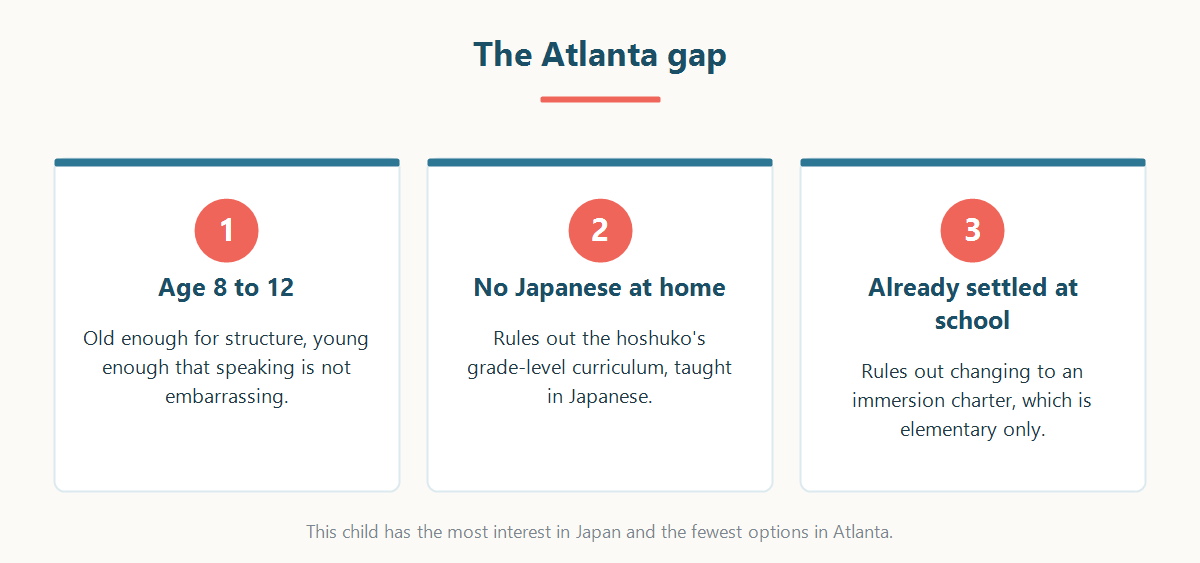
Line the options up and a specific hole appears. Suppose your child is eight to twelve, speaks no Japanese at home, is already settled at their current school, and became interested through anime, games or a family trip. Then:
- the hoshuko is built around Japanese-speaking families,
- the charter academy would mean changing schools entirely, and is elementary only,
- the institute classes are adult-shaped and priced per term,
- a private tutor is one adult and one child on a screen — the format children abandon soonest.
And every in-person option adds the thing no fee schedule shows: metro Atlanta traffic. Mableton to Alpharetta is a straightforward hour each way on a bad day. A 90-minute class becomes a three-and-a-half-hour Saturday, every Saturday, for years. That is the commitment families actually abandon — not the tuition.
What we do differently — and where we don’t
TOMODACHI JAPAN is an online Japanese school for children opening in December 2026, taught by teachers working to the standard of currently-practising Japanese schoolteachers. For an Atlanta family, three things are relevant:
- Complete beginners are the normal case, not an exception — there is no assumption that Japanese is spoken at home.
- Classes are small groups of eight children, and children build ongoing friendships with peers in Japan. For a child whose motivation came from anime, talking to someone their own age in Japan is a far stronger reason to continue than a worksheet is.
- Atlanta is on Eastern Time, 13 hours behind Japan. That makes Japanese Saturday and Sunday mornings land on Friday and Saturday evenings in Georgia — a workable slot for a school-age child. We run several daily bands with time-zone adjustment; the guide lists the exact times.
Where we are honestly not the answer: if your child already speaks Japanese fluently at home and you need them to stay on Japan’s grade-level curriculum for a return to Japan, the Georgia Japanese Language School is doing something we do not attempt. Call Mableton first.

How to choose, in order
- Does your child speak Japanese at home? If yes, start with the Georgia Japanese Language School.
- Are you choosing an elementary school right now, and do you live in Georgia? If yes, look seriously at the International Charter Academy of Georgia.
- Is your child a beginner staying at their current school? Then you are choosing between a tutor, an institute class, and an online group school — and the deciding question is which one they will still be attending next year.
- Check the commute before the price. Map it at the actual class time, not at 2pm on a Tuesday.
Frequently asked questions
Is there a Japanese school for kids in Atlanta?
Yes, two quite different ones. The Georgia Japanese Language School in Mableton is a Saturday supplementary school established in 1974, teaching Japanese language arts and mathematics in Japanese for children from Japanese-speaking families. The International Charter Academy of Georgia in Peachtree Corners is a tuition-free public charter elementary school with a bilingual English–Japanese immersion programme.
Can my child learn Japanese in Atlanta if we don’t speak it at home?
Yes, but your realistic in-person choices narrow to language institutes and private tutors, both of which are shaped around adult learners. The charter academy is an option only if you are choosing an elementary school and live in Georgia. Many beginner families end up combining a local option with an online class built for children.
How much do Japanese classes cost in Atlanta?
Published 2026 prices in the metro area run from about $20 an hour for a local private tutor to $39.95 an hour at Atlanta Institute of Language, whose beginner course is $799 for ten weeks. The charter academy is tuition-free. The Georgia Japanese Language School does not publish tuition — contact them directly. Our full breakdown of every format is in how much Japanese lessons cost for kids.
What age should an Atlanta child start Japanese?
If you are considering the charter academy, the decision point is kindergarten, because the immersion model front-loads Japanese in the earliest grades. For everything else, six to eleven is a comfortable starting window, and teenagers do perfectly well — they simply need a stronger reason than “it’s good for you.”
Are online classes a real substitute for a Saturday school?
For a beginner from a non-Japanese-speaking family, online small-group classes are often a better fit than a hoshuko, because they start where your child actually is and remove the commute. For a fluent child who needs to stay on Japan’s curriculum, they are not a substitute. Be honest about which child you have. Request our free school guide for class times in Eastern Time and what a beginner’s first term covers.