A parent in Ecuador wrote to us this month about her nine-year-old daughter. The girl loves Japan, speaks no Japanese at all, and there is no Japanese school anywhere near them. Her mother’s questions were completely practical: can a total beginner actually join? What time would class be for us? Will anyone speak English to her while she can’t understand? Will she really get to talk to children in Japan?
Those are the right questions, and most “Japanese classes for kids” pages answer none of them. This guide answers all of them — including the ones where the honest answer is “it depends” — and shows you how to tell a genuinely beginner-friendly class from one that only says it is.
“Complete beginner” means three different things
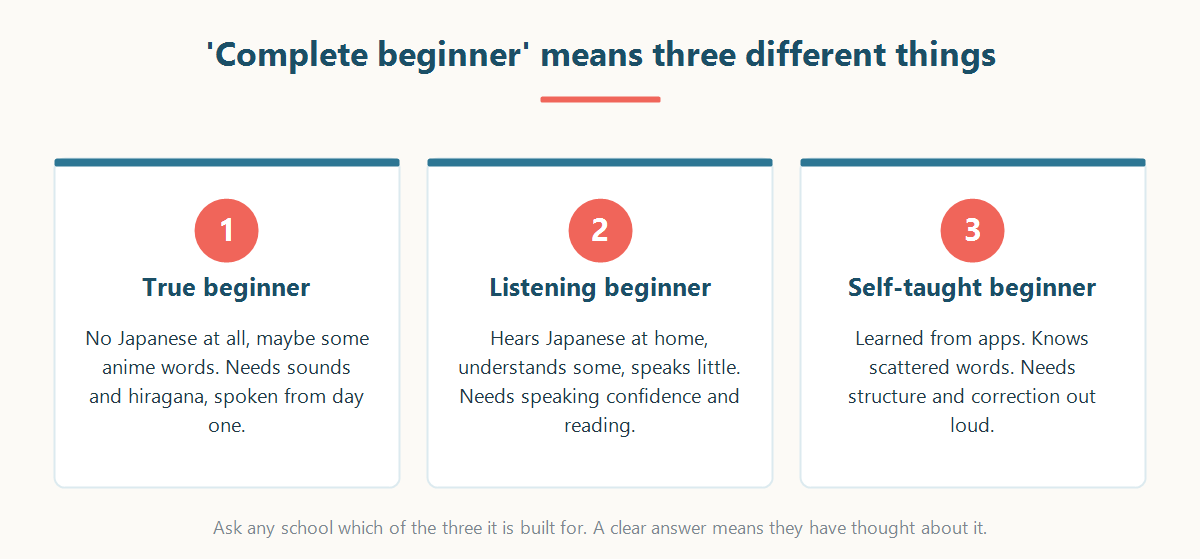
Before you compare classes, work out which kind of beginner your child is. Schools use one word for three very different starting points, and putting a child in the wrong one is the single most common reason a family gives up in the first term.
| Type of beginner | What the child already has | What they need first |
|---|---|---|
| True beginner | No Japanese at all. Possibly some words from anime. | Sounds and hiragana, spoken from day one |
| Listening beginner | Hears Japanese at home, understands some, speaks little | Speaking confidence and reading — not vocabulary |
| Self-taught beginner | Learned from apps; knows scattered words and phrases | Structure, and someone to correct them out loud |
A class built for listening beginners will quietly leave a true beginner behind by week three, because the teacher assumes the sounds are already familiar. Ask any school which of the three they are designed for. A school that has a clear answer has thought about it.
Looking for a way to keep Japanese going from abroad?
TOMODACHI JAPAN is an online Japanese school for children growing up outside Japan. They talk with peers their own age in Japan every day, taught by teachers working at Japanese schools, in small classes of 8.
🎁 Register and we’ll email you our School Guide (PDF, in English) straight away. You’ll also be first to hear about tuition, scholarships and opening dates.
Free · takes about 30 seconds
Can a nine-year-old with zero Japanese really start?
Yes — and children between roughly six and eleven tend to have the easiest time of anyone, for reasons that have nothing to do with the myth that “kids absorb languages like sponges.”
- Japanese sounds are unusually kind to beginners. The sound inventory is small and regular. Compared to English, there are very few sounds a child has to learn to hear before they can start repeating sentences.
- Hiragana is finite. Forty-six basic characters, entirely phonetic. A child who practises a little most days generally reads hiragana within about six to ten weeks. That is a real, visible finish line, which matters enormously for motivation.
- Nobody expects kanji yet. Published estimates for reaching JLPT N5, the first formal level, range from about 150 hours to well over 500 depending on the source and whether the learner already reads Chinese characters. Do not aim a nine-year-old at that number. Aim at hiragana, then at holding a two-minute conversation.
The genuine difficulty for young beginners is not grammar. It is that the first three months are the only period where Japanese gives back almost nothing — and a child alone with an app or a one-to-one tutor has no reason to push through it. That is a social problem, not a linguistic one.
What a real beginner class looks like in month one
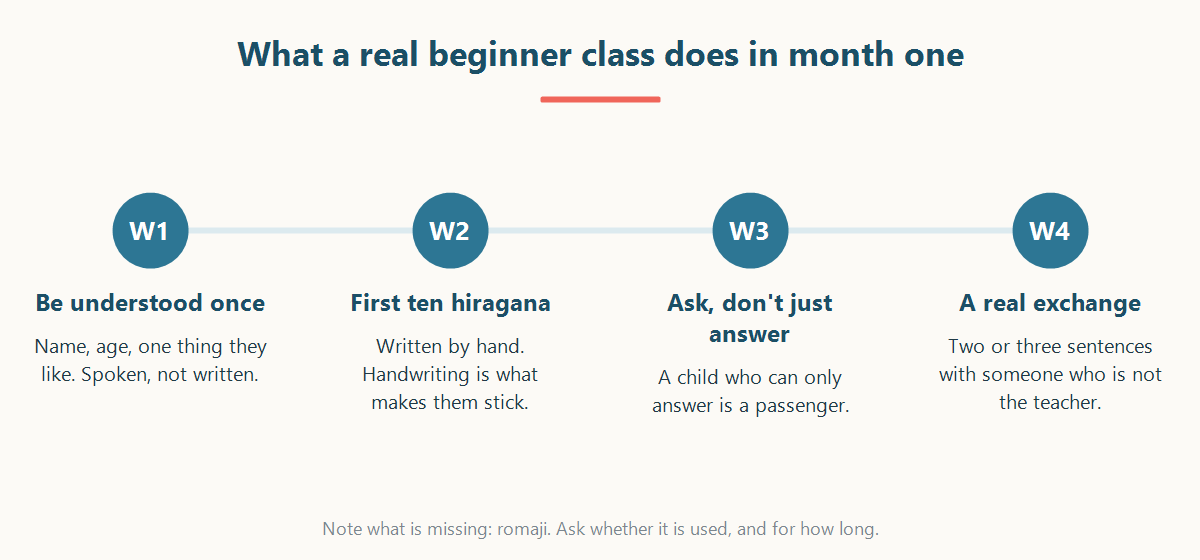
If a school cannot describe the first four weeks concretely, it does not have a beginner programme — it has a general programme it will let beginners into. A good first month looks roughly like this:
- Week 1 — being understood once. Name, age, one thing they like. Spoken, not written. The goal is that the child says something in Japanese and another human reacts to it.
- Week 2 — the first ten hiragana. Written by hand, not typed. Handwriting is what makes them stick.
- Week 3 — questions, not just answers. A child who can only answer is a passenger. A child who can ask nani ga suki? can hold a conversation with a beginner’s vocabulary.
- Week 4 — a small, real exchange. Two or three sentences with someone who is not the teacher.
Notice what is not in that list: romaji. Classes that lean on romaji feel faster in week one and cost the child months later, because they end up reading Japanese through English spelling. Ask whether romaji is used, and for how long.
The seven questions to ask before you enrol
These are not our questions. They are the ones a real parent sent us, in her order of priority. We think they are the best checklist available, so here they are with the answers a school should be able to give you — and ours.
1. Can an absolute beginner be admitted?
Ask specifically whether there is a beginner cohort starting, not just a beginner level. Joining an existing beginner class in month five is not beginning. At TOMODACHI JAPAN, complete beginners are expected: a child with no Japanese at all is a normal enrolment, not an exception.
2. What does it cost, and is there help?
Ask for the total annual cost including enrolment and materials, and whether any scholarship or regional pricing exists. We charge a flat monthly rate with unlimited classes and operate a scholarship that varies by country of residence; because the two only make sense together, we send both in the free school guide rather than posting a headline figure. If you want the numbers, request the guide.
3. Will there be a class time that works in my time zone?
This is where most online Japanese schools quietly fail non-Asian families. Japan is 13–14 hours ahead of the Americas, 8–9 hours ahead of Western Europe, and 1–2 hours behind eastern Australia. A school running only one Japan-evening session is unusable from Ecuador or Chicago.
We run several daily time bands with time-zone adjustment so that families across the Americas, Europe, Asia and Oceania can attend live. Our guide to online Japanese classes and time zones explains how the maths works for each region.
4. How many times a week can my child attend?
Ask about frequency, not lesson length. For a beginner, four short contacts a week beats one long one every time — forgetting happens on the days between. Our model is unlimited attendance rather than a fixed weekly count, precisely so that frequency is not rationed by price.
5. Will my child actually talk to children in Japan?
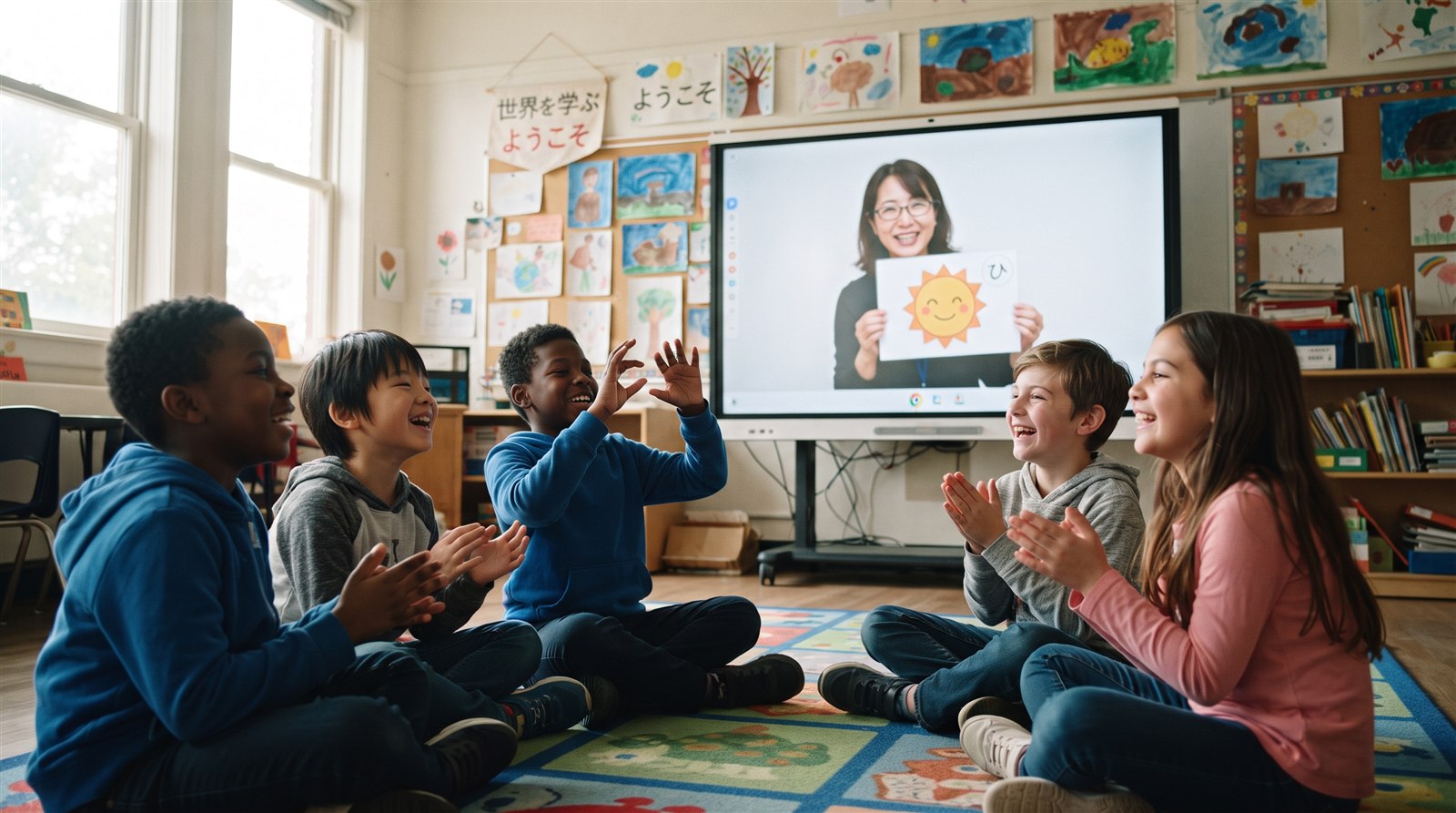
Ask this bluntly, because “cultural exchange” on a website can mean anything from a live weekly conversation to a pen-pal letter once a term. For us this is the whole point of the school rather than a feature of it: children join small classes and build ongoing relationships with peers, so Japanese becomes something they use with friends rather than something they are tested on.
6. Is there English support while my child understands nothing?
There should be, and it should be temporary and deliberate. English is needed for instructions, comfort and explaining rules — not for teaching the Japanese itself. A class conducted mostly in English is an English class about Japanese. Ask what proportion of a beginner lesson is spoken in Japanese, and how that changes by month six.
7. Can you issue a certificate of enrolment or completion?
Families ask for this more often than schools expect — for local school credit, for visa or homeschool paperwork, or simply because a certificate is meaningful to a child. Ask before enrolling rather than after; it is much easier to arrange up front.
Beginner options compared, honestly
| Option | Good for a true beginner? | The catch |
|---|---|---|
| Free apps (Duolingo and similar) | Yes, for kana drilling | No one notices when your child stops. Streaks are not speaking. |
| 1-on-1 online tutor | Sometimes | Built for adults; most tutors have never taught a child. Attention is total, which many young children find exhausting. |
| Local Saturday school (hoshuko) | Often no | Many follow Japan’s national curriculum in Japanese, for children who already speak it at home. |
| Community or institute group class | Yes if a children’s beginner cohort exists | Availability is entirely a matter of where you live, and the commute is the real cost. |
| Online small-group school | Yes, by design | Only works if the time zone genuinely fits and the group is small enough to speak in. |
If cost is your deciding factor, we broke down every published 2026 price in how much Japanese lessons cost for kids.
Three months in: what “working” looks like
Parents often can’t tell whether a beginner class is succeeding, because they can’t assess the Japanese. Use these markers instead:
- Your child reads hiragana slowly but without guessing.
- They say something in Japanese outside class, unprompted — at dinner, to the dog, at a Japanese restaurant.
- They mention another student by name.
- They are mildly annoyed to miss a class.
The last two matter more than the first two. A child who has a friend in the class has a reason to be there in month nine, which is when almost all beginners quit.
Frequently asked questions
Can my child join Japanese classes with no prior knowledge at all?
Yes. Look specifically for a beginner cohort that is starting rather than a beginner level you join mid-stream, and confirm the class is designed for children who do not hear Japanese at home. That single distinction predicts more than teacher qualifications do.
What age is best to start Japanese?
Six to eleven is a comfortable window: old enough to handle handwriting and structure, young enough that speaking without embarrassment comes easily. Older children and teenagers do fine too — they learn grammar faster — but they need a reason beyond “it’s good for you,” which is usually a friend, a trip, or an exam.
Should my child learn hiragana before joining a class?
Not necessary, and not worth delaying for. A good beginner class teaches it in the first weeks. If your child wants a head start, a free app for ten minutes a day is genuinely useful here — kana is the one part of Japanese that responds well to solo drilling.
How long before my child can hold a conversation?
With consistent weekly classes plus small daily practice, most children manage a simple two-minute exchange — greetings, likes, family, one question of their own — within about six months. The variable is not talent; it is how many days a week they hear and use Japanese.
Do you teach children who are not Japanese and have no Japanese family?
Yes. A large and growing share of the families who contact us have no Japanese heritage at all — the child became interested through anime, games, food or a trip, and the parents want that interest turned into something real. Request the free school guide for class times in your time zone and what a beginner’s first term covers. If the form does not load for you, email us at tomodachijapan@nijin.co.jp and we will send it directly.