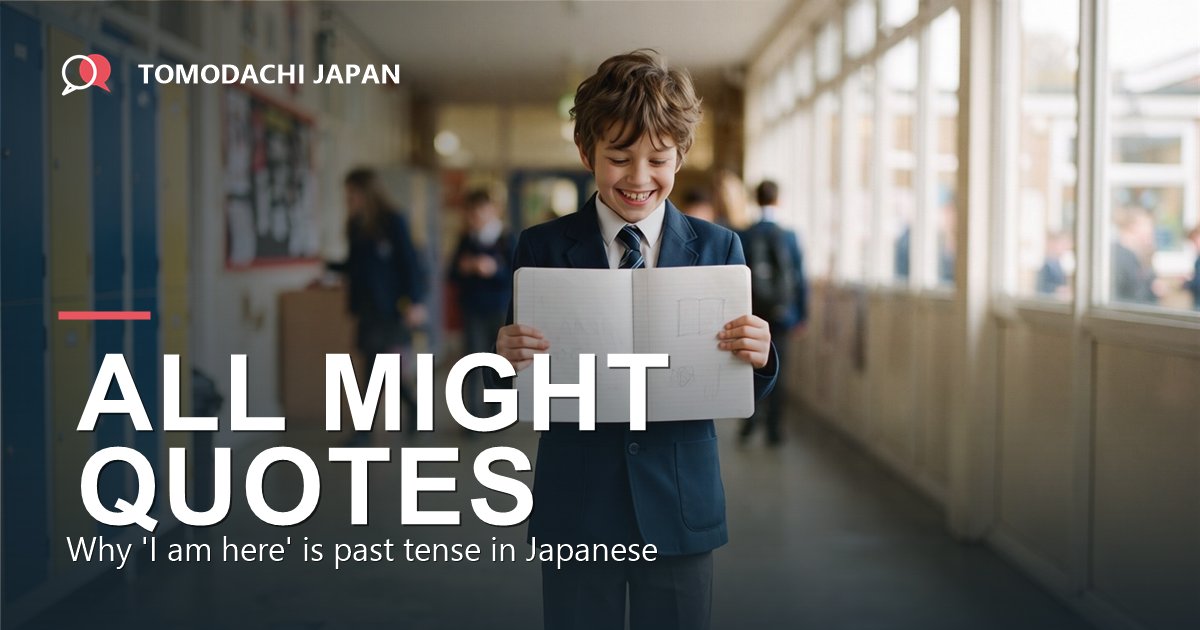
All Might’s catchphrase is translated “I am here!” — but the Japanese is 私が来た, which is past tense and literally means “I came.” That gap is not a translator’s slip. It is a real property of Japanese verbs that English does not have, and it is the reason the line hits the way it does. I’m a Japanese teacher, and here are All Might’s quotes in Japanese with rōmaji, English, and the grammar behind them.
Can-you-use-it legend: ◎ = safe in real conversation · △ = fine in anime, odd in life · ✗ = rude or role-play only.

All Might quotes in Japanese
| Japanese | Rōmaji | English | Use it? |
|---|---|---|---|
| 私が来た | Watashi ga kita | I am here. (literally “I came”) | ◎ Grammatically ordinary; the delivery is not |
| もう大丈夫。何故って?私が来た | Mō daijōbu. Naze tte? Watashi ga kita | It’s all right now. Why? Because I am here. | ◎ もう大丈夫 is genuinely useful |
| 君はヒーローになれる | Kimi wa hīrō ni nareru | You can become a hero. | ◎ Perfect potential-form model |
| 考えるよりも先に体が動いていた | Kangaeru yori mo saki ni karada ga ugoite ita | My body moved before I could think. | ◎ Natural spoken Japanese |
| さらに向こうへ | Sara ni mukō e | Go beyond — Plus Ultra. | △ A slogan, not a sentence |
| 常にトップを狙う者とそうでない者、そのわずかな気持ちの差は社会に出てから大きく響くぞ | Tsune ni toppu o nerau mono to sō de nai mono, sono wazuka na kimochi no sa wa shakai ni dete kara ōkiku hibiku zo | Those who always aim for the top and those who don’t — that small difference in attitude echoes loudly once you’re out in the world. | ◎ 社会に出る is everyday adult vocabulary |
| 余計なお世話ってのはヒーローの本質でもある | Yokei na osewa tte no wa hīrō no honshitsu de mo aru | Meddling where you weren’t asked is part of what a hero is. | ◎ 余計なお世話 is a real, common phrase |
| 守るものが多いんだよ。だから負けないんだよ | Mamoru mono ga ōi n da yo. Dakara makenai n da yo | I have many things to protect. That is why I don’t lose. | ◎ んだ explanatory, textbook clean |
| 人を救けられる人間になりたがっている | Hito o tasukerareru ningen ni naritagatte iru | He wants to become someone who can save people. | ◎ 〜たがる, an underused pattern |
| 先生として叱らなきゃいかんのだよ | Sensei to shite shikaranakya ikan no da yo | As a teacher, I have to scold you. | △ なきゃ and いかん are casual/regional |
| プロはいつだって命がけ | Puro wa itsu datte inochigake | A professional is always risking their life. | △ 命がけ is strong but real |
| 次は君だ | Tsugi wa kimi da | You’re next. | ◎ Two-word sentence, entirely usable |
Want to go from quoting anime to actually talking with friends in Japan?
TOMODACHI JAPAN is an online Japanese school for children growing up outside Japan. They talk with peers their own age in Japan every day, taught by teachers working at Japanese schools, in small classes of 8.
🎁 Register and we’ll email you our School Guide (PDF, in English) straight away. You’ll also be first to hear about tuition, scholarships and opening dates.
Free · takes about 30 seconds
私が来た — why “I came” is the correct way to say “I am here”
Japanese past tense marks completion, not distance in time. 来た means the act of arriving is finished — and therefore that the speaker is standing right here, now. English has to reach for the present tense to say the same thing.
| Japanese | Rōmaji | Natural English |
|---|---|---|
| バスが来た | basu ga kita | Here comes the bus / the bus is here |
| 分かった | wakatta | I understand (right now) |
| 疲れた | tsukareta | I’m tired |
| お腹が空いた | onaka ga suita | I’m hungry |
| あ、あった | a, atta | Ah, here it is |
Teacher’s note: every row above is past tense in Japanese and present tense in English. Learners who translate 分かった as “I understood” sound like they are reporting a memory. The rule to carry away is that the Japanese past marks a change that has completed, so 私が来た means “the arriving is done — I’m standing in front of you.” Translating it as “I am here” is not a liberty; it is the accurate reading.
The particle matters too. 私が来た, not 私は来た. が puts the spotlight on the subject and answers an unasked question — “who has come?” — with “it is I.” は would merely introduce him as the topic. One kana carries the entire swagger of the line.
私 — the pronoun that makes him a teacher rather than a fighter
Most shōnen heroes say 俺. All Might says 私 — the neutral, formal first person you would use in a job interview. For a muscle-bound action hero this is a deliberate, slightly old-fashioned choice, and it tells Japanese audiences immediately what kind of adult he is.
| Japanese | Rōmaji | Who uses it |
|---|---|---|
| 私 | watashi | Neutral and safe for anyone, formal for men |
| 僕 | boku | Boys and softer-spoken men — Deku’s pronoun |
| 俺 | ore | Casual male; Bakugo, most shōnen leads |
| わたくし | watakushi | Very formal — ceremonies, business |
| 君 (you) | kimi | Softly superior — teacher to student |
Note that he also calls Deku 君, not お前. 君 is warm but hierarchical — an adult to a young person, a boss to a junior. Between the 私 and the 君, every line he speaks is grammatically the speech of a mentor, even mid-battle.

なれる・救けられる — the potential form, and why it is the point of the series
君はヒーローになれる is a sentence about possibility, and Japanese builds possibility into the verb itself rather than adding a word like “can.”
| Plain | Potential | Meaning |
|---|---|---|
| なる (naru) | なれる (nareru) | Can become |
| 読む (yomu) | 読める (yomeru) | Can read |
| 行く (iku) | 行ける (ikeru) | Can go |
| 食べる (taberu) | 食べられる (taberareru) | Can eat |
| する (suru) | できる (dekiru) | Can do |
| 来る (kuru) | 来られる (korareru) | Can come |
Teacher’s note: u-verbs swap -u for -eru; ru-verbs replace -ru with -rareru. In casual speech ru-verb potentials often drop the ら — 食べれる instead of 食べられる. Japanese people do this constantly, teachers mark it wrong on exams, and it has its own name: ら抜き言葉, “ra-dropped speech.” Knowing that it exists, and that it is informal rather than incorrect-in-life, is exactly the kind of thing a textbook will not tell you.
〜たがる — talking about what someone else wants
なりたがっている (“he wants to become”) uses a pattern that trips up nearly every learner: in Japanese you cannot state another person’s desires as flatly as your own.
| Japanese | Rōmaji | Who it is about |
|---|---|---|
| 行きたい | ikitai | I want to go |
| 行きたがっている | ikitagatte iru | He/she wants to go (observed) |
| 行きたいそうです | ikitai sō desu | I hear they want to go |
| 行きたいって | ikitai tte | They said they want to go (casual) |
Saying 彼は行きたい is unnatural, because Japanese treats another person’s inner state as something you can only report, not assert. 〜たがる marks it as observed from outside. All Might uses it while arguing to a sceptical colleague that a quirkless boy deserves a chance — he is describing what he has seen in Deku, not claiming to know his mind.
Where the practice has to happen
私 versus 俺 is a two-line table. Feeling which one you are, in a room, with people who will react — that is not something a table can hand you. It comes from talking to Japanese speakers your own age and being gently corrected.
At TOMODACHI JAPAN, small groups of children learn with qualified teachers who currently work in Japanese schools, alongside peers their own age in Japan. Plenty of our students arrive because of My Hero Academia. The teacher’s job is to get them from reciting All Might to saying something of their own.
Frequently asked questions
What is “I am here” in Japanese in My Hero Academia?
私が来た (Watashi ga kita), usually in the fuller form もう大丈夫。何故って?私が来た (“It’s all right now. Why? Because I am here”). The Japanese is past tense — literally “I came” — because Japanese past tense marks a completed change, which in this case means he has arrived and is standing there.
Why does All Might say 私 instead of 俺?
私 is the neutral, formal first-person pronoun. For a male action hero it is an unusual, slightly old-fashioned choice that frames him as a teacher and public figure rather than a brawler. Deku says 僕, Bakugo says 俺 — the three pronouns sketch the three characters before they say anything else.
What is Plus Ultra in Japanese?
Plus Ultra is Latin, and the anime glosses it in Japanese as さらに向こうへ (sara ni mukō e), “further, beyond.” さらに means “even more” and 向こう means “the other side,” so the phrase points past wherever you currently are.
What does 余計なお世話 mean?
Literally “unnecessary care” — meddling, help nobody asked for. In daily Japanese it is usually a mild complaint: 余計なお世話だ, “mind your own business.” All Might’s line reclaims it, saying that unasked-for help is the essence of being a hero.
Can I learn Japanese from My Hero Academia?
It is one of the better shōnen series for it, because the cast is set in a school and spans several registers — All Might’s 私, Deku’s 僕, Bakugo’s shouting. Watching how the same idea is phrased by different characters is genuine politeness practice. Our My Hero Academia quotes guide and guide to learning Japanese with anime tag every line for real-world usability.
How does my child practise this with real Japanese speakers?
Through small group classes with same-age peers in Japan and a teacher who corrects politeness as well as grammar. See TOMODACHI JAPAN’s plans and pricing, or read our guide to watching anime with Japanese subtitles.