Almost everyone who searches “VCE Japanese scaling” is really asking one of two questions: is Japanese worth choosing? or will scaling save my mark? The honest answers are yes and no, in that order. VCE Japanese does scale up, reliably and by a meaningful amount. It will not, however, rescue a study score you did not earn — and the part of your raw score that decides everything is smaller and more controllable than most students realise. Here is how scaling actually works, roughly what Japanese Second Language has been worth in recent years, and where the marks that matter are really won.
What scaling is (and what it is not)
VTAC scales VCE study scores so that students are neither advantaged nor disadvantaged by which subjects they chose. The critical point — the one that gets mangled in every school corridor — is what the scaling is based on.
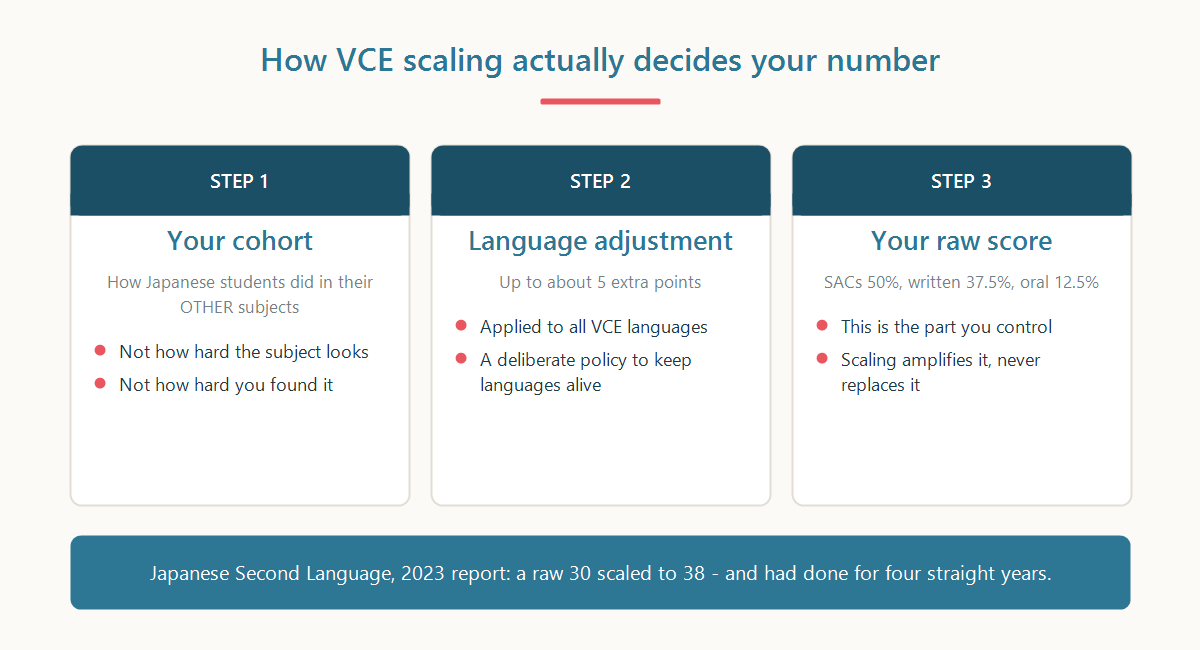
A subject is not scaled according to how hard someone at VCAA thinks it is. It is scaled according to how the students who took that subject performed across all of their other VCE subjects. If the cohort doing Japanese also tends to do well in Methods, English and Chemistry, then a study score in Japanese is judged to represent a stronger performance than the raw number suggests, and it moves up. That is the entire mechanism.
On top of that, VCE language studies receive an additional adjustment — commonly described as up to about five points — introduced as a deliberate policy to encourage students to keep studying languages. This is why languages sit near the top of the scaling tables almost every year, and why Japanese scales up even in years when the cohort is not exceptional.
Looking for a way to keep Japanese going from abroad?
TOMODACHI JAPAN is an online Japanese school for children growing up outside Japan. They talk with peers their own age in Japan every day, taught by teachers working at Japanese schools, in small classes of 8.
🎁 Register and we’ll email you our School Guide (PDF, in English) straight away. You’ll also be first to hear about tuition, scholarships and opening dates.
Free · takes about 30 seconds
Roughly what Japanese Second Language has been worth
Scaling figures move a little every year, because the cohort changes every year. But VCE Japanese Second Language has been unusually stable. The pattern below comes from the published scaling report for 2023, and a raw 30 had scaled to 38 for the four years to that point.
| Raw study score | Scaled study score | Gain |
|---|---|---|
| 30 | 38 | +8 |
| 35 | 43 | +8 |
| 40 | 47 | +7 |
| 45 | 49 | +4 |
| 50 | 51 | +1 |
VTAC scaling report (current year, PDF)
Read the shape of that table, not just the numbers
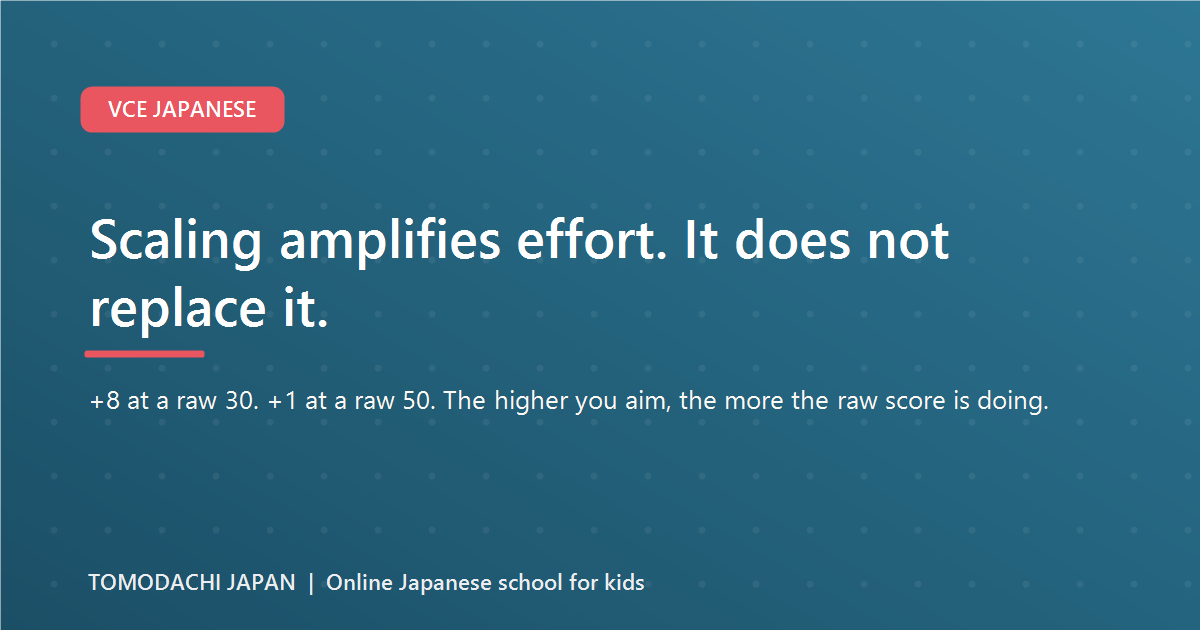
The most useful thing in the table is not the +8. It is the way the gain shrinks as the raw score climbs: +8 at a raw 30, +4 at a raw 45, +1 at a raw 50.
Two consequences follow, and they point in opposite directions from the advice students usually give each other.
- Scaling is most generous exactly where students panic. A student sitting on a raw 30 — the score that feels like failure — walks away with a 38. In ATAR terms that is a genuinely useful contribution, not a write-off. Students drop Japanese in Year 11 believing a mid-30s raw score is worthless. It is not.
- Scaling cannot manufacture a top score. If you are chasing a 45+, scaling adds four points, not fifteen. At the top of the range the raw mark is doing almost all of the work. “I’ll pick Japanese because it scales” is a strategy that works for a solid score and fails completely for a high one.
Where the raw score is actually decided
Since the raw score does the heavy lifting, it is worth knowing precisely where it comes from. For VCE Japanese Second Language Units 3 and 4:
- School-assessed coursework, Unit 3 — 25%
- School-assessed coursework, Unit 4 — 25%
- Written examination — 37.5%
- Oral examination — 12.5%
Half your score is decided in the classroom during the year, before you ever sit an external exam. That is the part most students under-manage: SACs are treated as practice, when in fact they are 50% of the study score that scaling will later act on. If you want scaling to do something impressive for you, the cheapest place to buy raw marks is a SAC in Term 1, not a cram in October.
The other detail worth staring at is the oral. It is 12.5% of your score, sat in a room with two assessors, and it is the component that students prepare least systematically because it cannot be rote-learned the night before. It is also, for a language, the single most improvable component — twelve and a half per cent that responds directly to how many hours you have spent actually speaking Japanese to a person. Our guides to the VCE Japanese oral exam and to choosing a Detailed Study subtopic you can defend go through both in detail.
Three things to get right before you decide
- Check you are eligible for the course you are counting on. Scaling differs between Japanese Second Language, Japanese First Language and Japanese Second Language Advanced, and eligibility is governed by VCAA rules about your prior schooling and background — not by preference. Confirm which course you can actually enter before building an ATAR plan around a scaling figure. We compare the levels in Continuers, Beginners or Background Speakers?
- Use the current-year report, not a forum post. VTAC publishes the scaling report each December. Numbers quoted on tutoring blogs are often two or three years old. If a subject decision hangs on it, open the actual PDF.
- Do not choose a subject you will not enjoy for a scaling bonus. The mechanism rewards cohorts that perform well across all their subjects. A student who resents the subject, disengages by Term 3 and hands in weak SACs does not get rescued by +8 — they get +8 applied to a low number. Scaling amplifies effort; it does not replace it.
The part nobody scales: whether you can actually speak
Everything above is arithmetic. Here is the thing the arithmetic hides. VCE Japanese is assessed as a language, and the students who find Units 3 and 4 comfortable are almost always the ones for whom Japanese is not only a school subject — who read something in Japanese for fun, who have had a conversation that was not marked. That is not a moral point. It is a practical one: 12.5% of your score is a live conversation, and a further chunk of the written exam rewards natural expression that textbook drilling does not produce.
TOMODACHI JAPAN is an online school run from Japan by qualified, practising Japanese teachers, where students join small groups — about eight, with a homeroom teacher — alongside children and teenagers who actually live in Japan. Attendance is unlimited for one flat monthly fee, and Melbourne’s time zone makes it straightforward: one or two hours ahead of Japan, so a Japanese late-afternoon session lands in your early evening. For a VCE student, the value is blunt — the oral exam stops being a performance you rehearse and becomes something you have already done a hundred times.

FAQ
Does VCE Japanese scale up more than other languages?
It sits in the same broad band as the other major VCE languages rather than standing out. All language studies receive the additional adjustment, and the year-to-year ordering between languages shifts with each cohort. If you are picking a language purely on scaling, the differences are small enough that you will do better choosing the one you will still be motivated by in October of Year 12.
Is a raw 30 in Japanese worth keeping?
On the published pattern, a raw 30 has scaled to 38 — which is not a subject to abandon in a panic. Before dropping, work out what the replacement subject would realistically score, scaled, and compare like with like. Students routinely trade a scaled 38 for an unscaled 32 in something they like less.
Will scaling be the same next year?
Close, but not identical. Japanese Second Language has been notably stable — a raw 30 scaling to 38 across four consecutive years — but scaling is recalculated annually from that year’s cohort, so treat any published figure as a strong indication rather than a guarantee, and check the December report.
I speak Japanese at home. Which course am I allowed to do?
That is decided by VCAA eligibility rules based on your education history and background, not by how well you speak. Ask your school’s languages coordinator early — in Year 10 if possible — because being moved to a different course late in the piece changes both your workload and the scaling figure you were planning around.
Scaling rewards students who finish the course properly, and a great deal of that work is reading. If characters are what slows you down, start from the VCE Japanese kanji list.
Practise the oral with people who actually live in Japan.
TOMODACHI JAPAN opens in December 2026. Get the free school guide by email — class times for your time zone, how the small-group classes work, plus tuition and scholarship details.