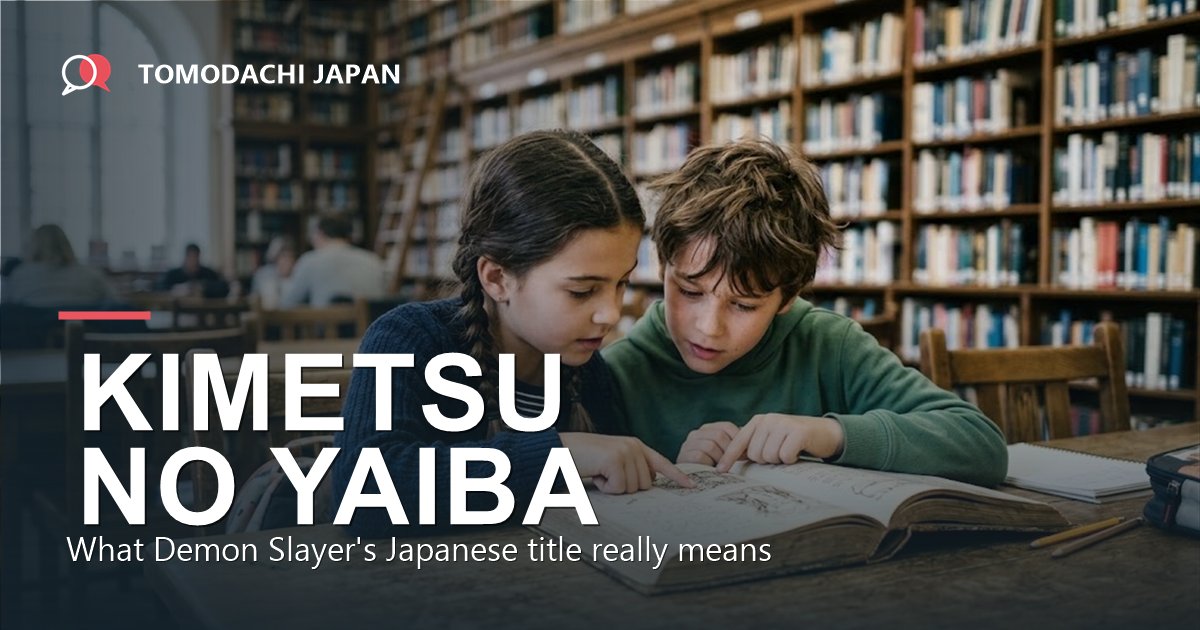
The English title is Demon Slayer. The Japanese title is 鬼滅の刃, and it says something the English can’t. Three kanji, one particle, and a word that Japanese audiences hear as strange and slightly archaic — because the author invented it. I’m a Japanese teacher, and this is what “Kimetsu no Yaiba” means, character by character, plus why the official English title had to be different and what that tells you about reading Japanese.
Can-you-use-it legend: ◎ = ordinary Japanese you’ll meet again · △ = literary or specialised · ✗ = title-only, don’t use in conversation.

鬼滅の刃, character by character
| Japanese | Rōmaji | Meaning | Use it? |
|---|---|---|---|
| 鬼 | ki / oni | Demon, ogre, malevolent spirit | ◎ Very common word |
| 滅 | metsu / horobiru | Destruction, annihilation, extinguishing | △ Formal/literary |
| 鬼滅 | kimetsu | “Demon-destruction” — a coined compound | ✗ Invented for the title |
| の | no | Possessive/linking particle: “of” | ◎ Essential grammar |
| 刃 | ha / yaiba | Blade — specifically the cutting edge | △ Literary word for a blade |
| 鬼滅の刃 | Kimetsu no Yaiba | “Blade of Demon Destruction” | ✗ It’s a title |
Teacher’s note — the title is a made-up word, and that’s the point: 鬼滅 (kimetsu) is not in the dictionary. Gotouge Koyoharu built it the way Japanese has built serious vocabulary for centuries: take two kanji read in their Chinese-derived on’yomi and weld them together. Japanese readers can parse it instantly — 鬼 “demon” + 滅 “annihilate” — while also hearing that it’s not a normal word. It sounds weighty, a little archaic, faintly like a term from a historical record. That’s a deliberate effect, and it’s the same technique behind formal compounds like 消滅 (shōmetsu, “vanishing”) or 全滅 (zenmetsu, “total destruction”).
Looking for a way to keep Japanese going from abroad?
TOMODACHI JAPAN is an online Japanese school for children growing up outside Japan. They talk with peers their own age in Japan every day, taught by teachers working at Japanese schools, in small classes of 8.
🎁 Register and we’ll email you our School Guide (PDF, in English) straight away. You’ll also be first to hear about tuition, scholarships and opening dates.
Free · takes about 30 seconds
Why 刃 is “yaiba” and not “ha”
Most kanji have at least two readings: an on’yomi borrowed from Chinese and a native Japanese kun’yomi. 刃 normally reads ha — the edge of a knife. In this title it’s read yaiba, an older, more poetic word for a blade, the kind you meet in samurai literature rather than a kitchen.
So the title mixes registers on purpose. Kimetsu is stiff and Sino-Japanese; yaiba is native and old-fashioned. Together they sound like something carved on a monument. Compare the flat, functional English Demon Slayer and you can feel what got lost — English simply doesn’t have a spare register that sounds ancient without sounding silly.
| Kanji | On’yomi | Kun’yomi | Everyday example |
|---|---|---|---|
| 鬼 | ki | oni | 鬼ごっこ (onigokko) — the game of tag |
| 滅 | metsu | horobiru | 全滅 (zenmetsu) — wiped out |
| 刃 | jin | ha / yaiba | 刃物 (hamono) — cutlery, edged tools |
| 柱 | chū | hashira | 柱 (hashira) — a pillar; the elite ranks |
| 呼吸 | kokyū | — | 呼吸 (kokyū) — breathing, literally |
Teacher’s note — 鬼 is everywhere in ordinary life: Don’t file oni away as a fantasy word. Japanese children play 鬼ごっこ (onigokko), tag, where the chaser is “the oni.” Every February families throw beans at a parent in an oni mask for 節分 (setsubun). And modern slang uses 鬼 as an intensifier — 鬼強い (oni tsuyoi), “monstrously strong.” One kanji from a title, and you’ve picked up a game, a festival and a slang pattern.
The other titles, same trick

| Japanese title | Rōmaji | Literal Japanese | Official English |
|---|---|---|---|
| 進撃の巨人 | Shingeki no Kyojin | “Advancing Giants” | Attack on Titan |
| 呪術廻戦 | Jujutsu Kaisen | “Sorcery Rotation-Battle” | Jujutsu Kaisen |
| 僕のヒーローアカデミア | Boku no Hero Academia | “My Hero Academia” | My Hero Academia |
| 葬送のフリーレン | Sōsō no Frieren | “Frieren of the Funeral” | Frieren: Beyond Journey’s End |
| 千と千尋の神隠し | Sen to Chihiro no Kamikakushi | “Sen and Chihiro’s Spiriting-Away” | Spirited Away |
Look at the pattern: [noun] の [noun] over and over. That single particle の is doing an enormous amount of work — it links two nouns and lets the reader decide the relationship. 鬼滅の刃 could be the blade that destroys demons, or the blade belonging to demon-destruction. Japanese leaves it open; English has to commit.
That openness is exactly why 葬送のフリーレン is so hard to translate. 葬送 means “conducting a funeral, seeing the dead off.” Is Frieren the one who buries, or the one who is buried, or the one who outlives everyone and must keep saying goodbye? The Japanese title holds all three at once. The English subtitle picks a mood and moves on. If you want more of this, our breakdown of Frieren’s language goes further into it.
Reading titles is a real skill — here’s how to practise it
Titles are the ideal first reading material for an anime fan, and I use them with students constantly. They’re short. You already know what the story is about, so you have context to lean on. And they’re almost always built from compound kanji plus の — which is the backbone of written Japanese.
The method: take one title, split it into single characters, look up each character’s meaning and both readings, then reassemble it yourself before checking the official English. You’ll be wrong sometimes, and being wrong is where the learning is — you’ll discover that 廻戦 in Jujutsu Kaisen isn’t a normal word either, and that 廻 (to revolve) carries a Buddhist echo of cycles and reincarnation that the untranslated English title quietly keeps.
What you can’t check alone is whether your reading is plausible to a Japanese ear — whether 鬼滅 sounds grand or clumsy, whether your guess at a compound is clever or nonsense. That judgement is the thing a native speaker gives you in about four seconds.
Frequently asked questions
What does “Kimetsu no Yaiba” mean in English?
Literally “Blade of Demon Destruction.” 鬼 (ki) means demon, 滅 (metsu) means annihilation, の links them, and 刃 (yaiba) is a poetic word for a blade. The official English title, Demon Slayer, keeps the idea but drops the weight of the original.
Is “kimetsu” a real Japanese word?
No — the author coined it for the title. It follows a standard Japanese pattern for building formal vocabulary by joining two kanji in their Chinese-derived readings, so Japanese readers understand it immediately while also hearing that it’s unusual and archaic-sounding.
Why is 刃 read “yaiba” instead of “ha”?
Yaiba is an older, more literary native Japanese reading for a blade, associated with swords rather than kitchen knives. Choosing it over the ordinary ha makes the title sound classical — the same reason an English writer might choose “blade” over “knife.”
Why are Japanese and English anime titles so different?
Japanese titles lean on compound kanji and the particle の, which links two nouns without specifying how they relate. English has to choose one interpretation and often a punchier phrasing for marketing. That’s why 進撃の巨人 (“Advancing Giants”) became Attack on Titan.
How can my child learn kanji this way?
Starting from titles they already love works remarkably well, because the meaning is already in their head. At TOMODACHI JAPAN, qualified Japanese teachers build on exactly that kind of interest in small-group classes with peers in Japan. See our plans and pricing, or read our Demon Slayer language guide.