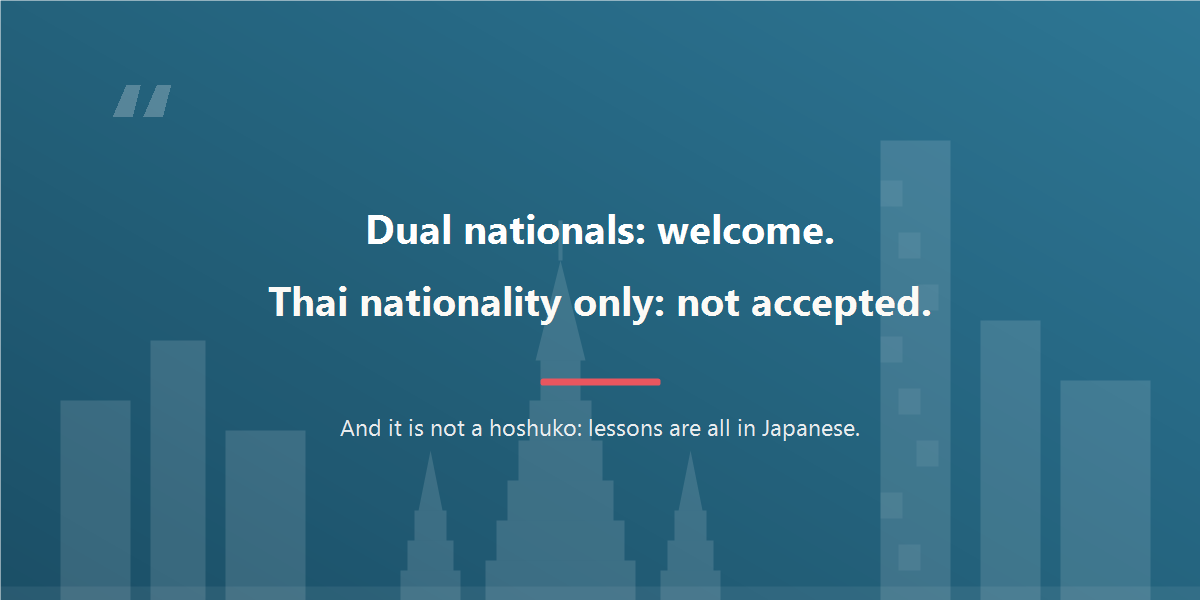
The Thai Japanese Association School charges 146,000 baht a year in tuition for the 2026–27 school year, paid in three term instalments of 58,400, 58,400 and 29,200 baht, plus a one-off entrance fee of 160,000 baht. The fees are the same at the Bangkok campus on Rama 9 and the Sriracha campus in Chonburi, because they are two campuses of one school. There is no donation, no debenture and no association membership to buy. The rule English pages get wrong is nationality: the school does not take only Japanese passport holders. Dual nationals are accepted without any nationality issue, other foreign nationals can be admitted with the school board’s approval, and the one firm exclusion is a child who holds Thai nationality only. The real gate is language — every lesson apart from English and Thai is taught in Japanese, and the school says plainly that it is not a supplementary school.
This page is the single-school deep dive: what the Thai Japanese Association School costs, who can actually enrol, how Bangkok and Sriracha relate to each other, and what English-language pages leave out. Everything comes from the school’s own Japanese-language site — its enrolment regulations, fee schedule, admissions pages and FAQ — read on 17 October 2026. Where something is not published, we say not published. You will also see the name written with a hyphen, “Thai-Japanese Association School”; the school itself writes it without one.
The short answer
| What it is | A full-time Japanese school (nihonjin gakko, 泰日協会学校) teaching Japan’s national curriculum in Japanese, Grades 1 to 9. Legally a Thai private school, founded by the Thai-Japanese Association, and certified by Japan’s education ministry as an overseas Japanese school |
| Two campuses | Bangkok (258 Soi 17, Rama 9 Road, Huai Khwang), known in Japanese as the Bangkok Japanese School, and Sriracha (312/10 Moo 5, Surasak, Sriracha, Chonburi), opened in 2009. Same operator, same regulations, same fees |
| Tuition, 2026–27 | 146,000 baht a year: 58,400 for Term 1 (April–August), 58,400 for Term 2 (September–December), 29,200 for Term 3 (January–March). Textbooks and materials included |
| One-off at entry | Entrance fee 160,000 baht. No donation, no building levy. A further 60,000 baht when a pupil moves up from the primary to the junior high section |
| Who it takes | Japanese nationals, dual nationals, and other foreign nationals with board approval — provided the child can follow lessons in Japanese and the family is legally in Thailand on a non-tourist visa. Thai-only nationals are not accepted |
| Size, April 2026 | Bangkok 1,962 pupils in 89 classes; Sriracha 399 pupils in 20 classes. No cap on places outside special-support classes |
| The real catch | Japanese at grade level, a Japanese-speaking parent who can handle every school message, and a Thai bank account to pay from. It stops at Grade 9 |
Looking for a way to keep Japanese going from abroad?
TOMODACHI JAPAN is an online Japanese school for children growing up outside Japan. They talk with peers their own age in Japan every day, taught by teachers working at Japanese schools, in small classes of 8.
🎁 Register and we’ll email you our School Guide (PDF, in English) straight away. You’ll also be first to hear about tuition, scholarships and opening dates.
Free · takes about 30 seconds
First, which school do you actually mean?
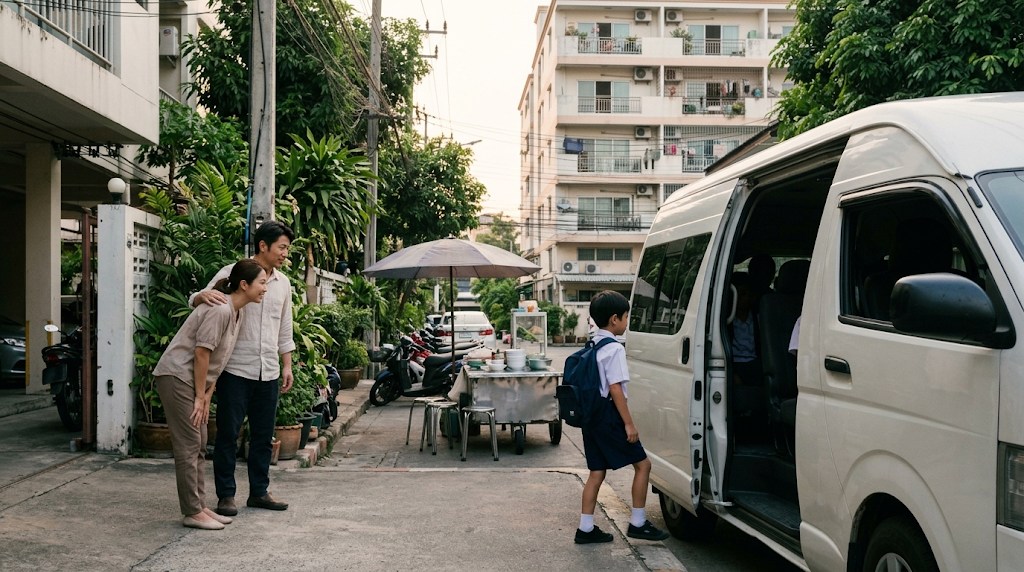
“Thai Japanese Association School” turns up in three or four forms, and search results treat them as if they were different institutions. They mostly are not. The two schools Japanese families in Thailand talk about — the Bangkok Japanese School and the Sriracha Japanese School — are the same school on two sites. The name also gets mixed up with two associations that have nothing to do with your application.
| Name you will see | What it actually is | Where |
|---|---|---|
| Thai Japanese Association School, 泰日協会学校, often called the Bangkok Japanese School (バンコク日本人学校) | The main campus. Full-time, Grades 1 to 9, taught in Japanese. Around ten classes in each primary year | Rama 9 Road, Huai Khwang, Bangkok |
| Thai Japanese Association School Sriracha, often called the Sriracha Japanese School (シラチャ日本人学校) | The second campus, opened in 2009 for families working in the Eastern Seaboard industrial estates. Its own principal and office, but the same operator, regulations and fees | Surasak, Sriracha, Chonburi |
| Thai-Japanese Association (泰日協会) | The Thai foundation that legally owns the school, because Thai law does not allow schools founded by foreign bodies. You do not join it yourself: 1,100 baht of the entrance fee is passed to it as a membership fee | Bangkok |
| Japanese Association in Thailand (タイ国日本人会) | A separate expatriate association. Membership is not a condition of entry | Bangkok |
Two practical things follow. First, if you are choosing between Bangkok and Sriracha, you are not choosing between two schools with different rules or prices — you are choosing where you live. Moving from one campus to the other counts as leaving and re-enrolling, but the entrance fee is waived. Second, unlike the Japanese school in some other Asian cities, there is no association to join before you apply. If you are comparing the region, our guide to the Japanese School of Kuala Lumpur shows how differently a neighbouring school handles entry money.
What it costs in 2026–27: 146,000 baht a year plus 160,000 baht to start
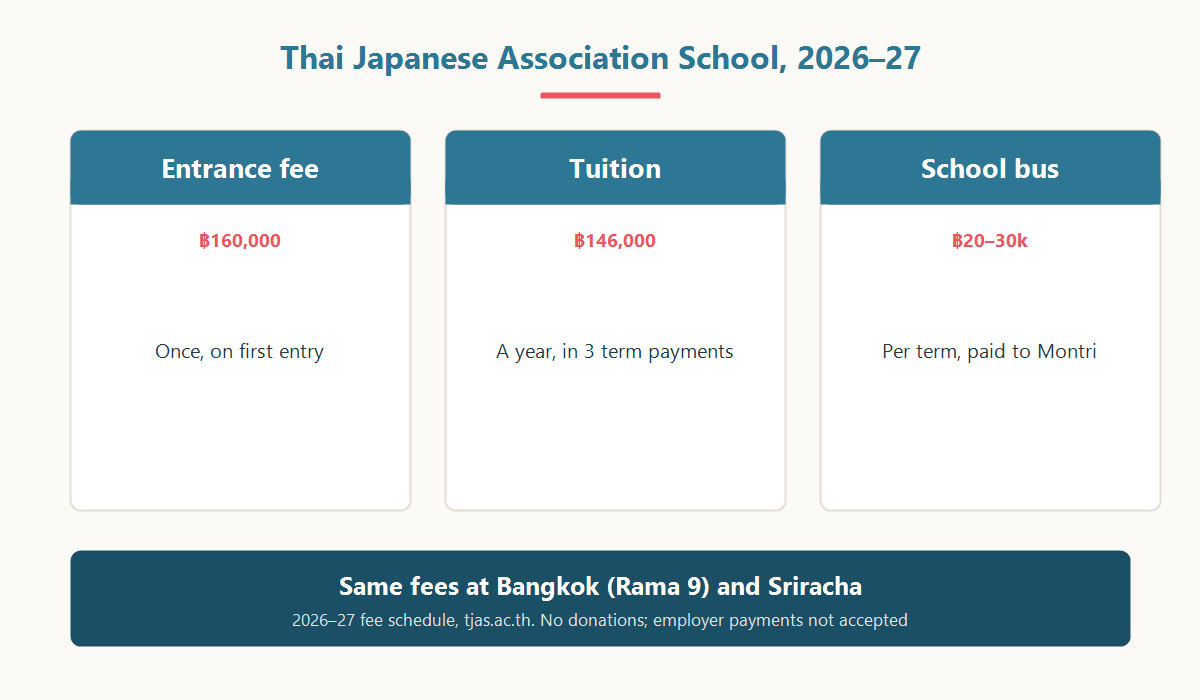
The fees are published — as a small table attached to the enrolment regulations on the school’s Japanese-language site, in Thai baht, per child. The school year runs from April 2026 to March 2027. Tuition is charged by term, not by month, and the three terms are uneven, so the third payment is half the size of the first two.
| Item | Amount (baht) | When it is paid |
|---|---|---|
| Entrance fee (once, on first entry) | 160,000 | About ten days before the reception day; receipt given on the day |
| Tuition, Term 1 (April–August) | 58,400 | In February, before the school year starts |
| Tuition, Term 2 (September–December) | 58,400 | Late June to late July |
| Tuition, Term 3 (January–March) | 29,200 | November |
| Tuition per year | 146,000 | — |
| PTA (Ikuyukai) fee | 300 / 240 / 180 per term (720 a year) | Collected by the school office |
| Entrance fee on moving up to junior high | 60,000 | For the school’s own Grade 6 leavers |
| School bus (Montri) | Roughly 20,000–30,000 per term | Invoiced by the bus operator, by route |
Put together, a child joining from outside Thailand in April costs about 306,720 baht in the first year without the bus (160,000 entrance fee, 146,000 tuition, 720 PTA), and roughly 367,000 to 397,000 baht with it. From the second year the entrance fee drops away, leaving about 146,720 baht plus transport. Spread over twelve months, tuition works out at a little over 12,000 baht a month — but the school never bills it that way.
Three payment rules catch families out. The school does not accept payment from a parent’s employer — no company cheques and no company transfers, even when the company is reimbursing you. It does not accept remittances from abroad; you pay by transfer from a Thai bank account (only two banks are accepted) or, if you do not have one yet, by personal cheque, with the PTA fee in cash. And tuition is not refunded for a term in which your child was enrolled, even if you leave halfway through.
The good news is what is missing. The regulations say the school does not collect donations, and there is no capital levy, debenture or building surcharge. Textbooks and teaching materials are inside the tuition; overnight trips are extra. If you move within Thailand, the waiver table is generous: a child who switches between Bangkok and Sriracha in the same section pays no new entrance fee, and a child who leaves and comes back within two terms pays nothing either. Other returning pupils pay 60,000 baht rather than the full 160,000.
Is 146,000 baht a year expensive? Not by Bangkok standards, where well-known international schools commonly charge several times as much. It has also been stable: the termly amounts are the ones set in the school’s fee revision for the 2020 school year. The number that surprises families is the entry bill, not the tuition.
Who can enrol: the nationality rule, and the language rule that matters more
Article 3 of the enrolment regulations, in force since April 2021, sets the conditions. They apply both at entry and for as long as the child stays.
- Japanese nationality, or board approval as equivalent. The child holds Japanese nationality, or the school board accepts the child as equivalent to a Japanese national.
- Legal stay on a non-tourist visa. Both the child and the parents must be in Thailand legally on something other than a tourist visa. If one parent holds a business visa or similar, the child can be provisionally accepted while the visa is processed.
- Japanese good enough for the school’s teaching. The school must judge that the child has the Japanese and the adaptability to cope.
- A parent who can deal with the school in Japanese. At least one accompanying parent must be able to handle all routine and urgent messages in Japanese. If only a non-Japanese parent lives with the child, that parent must have Japanese equal to a Japanese national.
- Fees paid in full, on time, and a pledge to support the school’s policies.
The FAQ then answers the questions mixed families actually ask. Dual nationals — a child with Japanese nationality plus another — face no nationality problem at all; they simply bring both passports. Children of other nationalities can be admitted by special approval of the board, which looks at whether a Japanese-curriculum education is necessary during the family’s time in Thailand. And a child who holds Thai nationality only cannot be accepted. For a Thai-Japanese family, then, the question is whether your child’s Japanese nationality has been registered: with it, the door is open; without it, it is closed.
Language is the practical gate. For new Grade 1 entrants the admissions page says it outright: the school is not a Japanese supplementary school, and children need Japanese good enough to follow normal lessons taught in Japanese. Families from international marriages have a pre-interview covering the child’s Japanese, the family’s education plans and whether the foreign parent can read school documents in Japanese. If the foreign parent’s Japanese is not sufficient, the family must promise to use mainly Japanese at home and to have the Japanese parent handle school communication.
Places are not the obstacle: apart from special-support classes, there is no cap. Entry is normally at the start of a term only, with Grade 9 pupils accepted up to Term 2. Applications open online; you then attend a reception day in person, with the child, bringing passports for the child and both parents, records from the previous school and the application form. Children already at a Thai kindergarten apply for Grade 1 from November; everyone else applies from January for an April start.
How it works: two campuses, one Japanese school year
The curriculum is Japan’s, taught with Japanese textbooks, under permission from Thailand’s Ministry of Education. What differs between the campuses is mostly scale.
| Bangkok (Rama 9) | Sriracha (Chonburi) | |
|---|---|---|
| Pupils, April 2026 | 1,962 (primary 1,534, junior high 428) | 399 (primary 313, junior high 86) |
| Classes | 89 — about 10 to 12 per primary year | 20 — two or three per primary year, one or two in junior high |
| Special support | Special-support class (Nakayoshi) | Resource room for primary pupils; no special-support class |
| Getting there | School bus; QR-code system for parents collecting by car | School bus; PICK UP card for drivers; walking allowed only for one residence via its footbridge |
The 2026–27 calendar follows the Japanese pattern of three terms:
| Term | Dates (2026–27) | Then |
|---|---|---|
| Term 1 | 17 April to 7 August 2026 (entrance ceremony 18 April) | Summer holidays through August |
| Term 2 | 1 September to 25 December 2026 | Winter holidays |
| Term 3 | 7 January to 11 March 2027 (graduation 6 March) | Spring holidays into April |
Other things the school publishes about daily life:
- English with native-speaker teachers. One to two hours a week in Grades 1 to 4, taught as a team; ability-grouped small classes from Grade 5. Junior high has three hours of regular English plus two hours of “Global English” with native teachers.
- Thai every week. One hour a week from Grade 1, as Thai law requires, taught by Thai teachers who speak Japanese, with a focus on conversation.
- No uniform at primary. Junior high pupils wear a white collared shirt with navy or black trousers or skirt.
- Bento every day. There is no school lunch service.
- Buses run by Montri. About nine in ten pupils ride them, under a contract between the PTA and the operator. Routes and pick-up times are arranged with Montri, not the school.
- Group tours only. Prospective families can join a group tour after applying; individual visits are declined.
The honest review: what the English pages leave out
People search for “Thai Japanese Association School reviews” to learn what it is like from the inside. We want to be straight: we found no body of verifiable parent reviews in English. The one review site that lists the school, International Schools Review, collects reviews from teaching staff, not parents, and keeps them behind a membership wall. We are not going to invent a consensus. What we can check is where English-language pages diverge from what the school publishes in Japanese.
1. “Only Japanese nationals.” Not quite
The English Wikipedia article says the school only allows students with Japanese nationality, a line tagged “citation needed”. The regulations add board approval for children treated as equivalent, the FAQ says dual nationals have no nationality issue, and foreign nationals can be admitted by special approval. The exclusion that actually exists is narrower: Thai-only nationals. For a Thai-Japanese family, that difference decides everything.
2. No fees at all
None of the top English results — the two Wikipedia articles and the teacher job boards — gives a figure for tuition or the entrance fee. The only fee numbers that surface are from the school’s 2019 notice about the 2020 fee revision, shown in search snippets without labels saying which column is old and which is new. The current schedule is 160,000 baht at entry and 146,000 baht a year, and the payment rules (Thai bank account, no employer payments) matter as much as the amounts.
3. Sriracha presented as a separate school
The Sriracha Wikipedia article calls it “affiliated” with the Bangkok school. In fact the enrolment regulations cover both campuses, the fees are identical, and switching between them waives the entrance fee. If your job is on the Eastern Seaboard, the choice is about commute and class size, not price.
4. Pupil numbers from 2018
Wikipedia gives 2,631 pupils in Bangkok and 456 in Sriracha, both from April 2018; teacher job ads say “around 2,500” or “nearly 3,000”. The school’s own April 2026 table shows 1,962 and 399. It is still one of the largest Japanese schools abroad — just noticeably smaller than older pages suggest.
5. The parent rule nobody mentions
No English page we found mentions that a parent must be able to handle school communication in Japanese, or that a non-Japanese parent living alone with the child needs native-level Japanese. For a Thai-Japanese family where the Japanese parent travels a lot, this can matter more than the child’s own level.
6. What to ask, since the reviews won’t tell you
- What exactly does the pre-interview check for an international family? The topics are published; the standard is not.
- How many children are in my child’s class? Class counts are published; we estimate about 20 to 22 per class at both campuses, but the school does not state a class size.
- What is the bus fare for our address? Only Montri can tell you; the school gives a range of 20,000 to 30,000 baht a term.
- How is Thai taught to a child who already speaks it at home? The weekly Thai lesson is aimed at Japanese children; it is not published whether native speakers are grouped differently.
- Which Thai bank accounts are accepted? Only two banks are, and you will need one before Term 1 is billed in February.
Other options in Bangkok
If your child cannot enrol — because they hold Thai nationality only, because their Japanese is not at grade level, or because you want them at an international school — these are the routes that remain.
| Option | Who it suits | What to know |
|---|---|---|
| International school, with Japanese as a subject | Children settled in Thailand long term | Several times the cost of the Japanese school. Japanese classes are often pitched far below a child who speaks it at home; in the IB years, see our guide to IB Japanese B |
| Weekend Japanese classes | Japanese-speaking children at Thai or international schools | Weekend supplementary schools teaching Japanese and maths have operated in Thailand; check current providers and entry rules with the Embassy of Japan |
| Private tutors and Japanese language schools | Anyone | Flexible but usually one-to-one or adult-oriented; quality varies widely |
| Online classes | Anyone, anywhere in Thailand | No commute, no bus, no nationality rule; check who the teachers are and whether children of the same age attend |
The gap is the same one we see in most Asian cities. Bangkok has a large, affordable Japanese school for children who can follow a Japanese school day — but a Thai-Japanese child who speaks Japanese at home and goes to a Thai or international school is outside it. Manila shows the same pattern; see our breakdown of Manila Japanese School tuition for a comparison.
How to choose, in four questions
- Does your child hold Japanese nationality? If yes — including alongside Thai nationality — nationality is not a problem. If they hold Thai nationality only, the school is closed. Other nationalities need board approval.
- Can your child follow a full day of lessons in Japanese? A child who chats in Japanese at home but reads two years behind may struggle; for international families there is a pre-interview, so ask what it covers.
- Can one parent handle the school in Japanese? Every notice, form and emergency call comes in Japanese. If the Japanese parent is often away, plan for that before you apply.
- Is your child going back into Japanese schooling? If a return to Japan is likely, this is the school built for it: same curriculum, same April start, Grade 9 ending in time for Japanese high-school entrance. If your family is settled in Thailand, weigh what a Japanese-medium day means for English and Thai.
Where TOMODACHI JAPAN fits
We are not a substitute for the Thai Japanese Association School, and if your child can follow a Japanese school day and is heading back to a school in Japan, we would point you there. We exist for the families the four questions above leave stuck — the Thai-national child who cannot enrol, the child at an international or Thai school whose Japanese reading is slipping, and the family that wants to keep Japanese going without moving to a bus route.
- Japanese friends of the same age, every day. Classes with children the same age in Japan — not only other learners in Thailand. The reason children keep going is usually the other children.
- Teachers working at Japan’s current classroom standard — not a syllabus written abroad and not a tutoring marketplace.
- Small classes of eight children. Enough to be a class, few enough that every child speaks every lesson.
- Bangkok is only two hours behind Japan. An evening slot in Japan is a late-afternoon slot in Bangkok, so lessons fit after a Thai or international school day. No nationality rule and no school bus.
- Unlimited classes for a flat monthly fee. Tuition, scholarships and opening dates are in our free school guide, which we email to everyone who registers, with no obligation.
If a weekend school is what you are weighing us against, our guide to online alternatives to a Japanese hoshuko sets out what an online class can and cannot replace.
Frequently asked questions
How much is the Thai Japanese Association School tuition fee?
For 2026–27, tuition is 146,000 baht a year, paid as 58,400 baht for Term 1 (April–August), 58,400 for Term 2 (September–December) and 29,200 for Term 3 (January–March). New pupils also pay a 160,000 baht entrance fee. The PTA fee is 720 baht a year and the school bus roughly 20,000 to 30,000 baht a term.
Are fees different at the Sriracha campus?
No. Bangkok and Sriracha are two campuses of the same school, under the same regulations and fee schedule. Moving between them in the same section waives the entrance fee.
Can a Thai-Japanese dual national enrol?
Yes. The school’s FAQ says dual nationals have no nationality issue for admission. A child with Thai nationality only cannot be accepted. In both cases the child needs Japanese good enough for lessons taught in Japanese, and international families have a pre-interview.
Do we need to join the Japanese Association?
No. Membership of the Japanese Association in Thailand is not an entry condition. The school’s owner is the Thai-Japanese Association, and 1,100 baht of the entrance fee is passed to it as a membership fee automatically.
What is the address of the Bangkok campus?
258 Soi 17, Rama 9 Road, Bangkapi, Huai Khwang, Bangkok 10310. The Sriracha campus is at 312/10 Moo 5, Surasak, Sriracha, Chonburi 20110.
Does the school hire English teachers?
Yes — native-speaker English teachers teach at both campuses, and vacancies appear on Thai teaching job boards. The school does not publish salaries on its own site; figures quoted in third-party job ads vary.
Sources
- Thai Japanese Association School (Japanese-language pages): portal, school overview, contacts and enrolment table, founding aims and enrolment regulations, with fee schedule, admissions, transfer procedures, Grade 1 entry, FAQ, education, school life and 2026–27 calendar
- Third-party pages checked: Wikipedia, Thai-Japanese Association School; Wikipedia, Thai-Japanese Association School Sriracha; International Schools Review; teacher job listings on ajarn.com and teast.co (seen via search results). All checked 17 October 2026.