The Taipei Japanese School (TJS) in Tianmu charges NT$10,200 a month for a primary pupil in the 2026–27 school year (NT$7,500 tuition plus a NT$2,700 facility-use fee), or NT$122,400 a year — roughly US$3,840. Junior high is NT$100 a month more. On top come NT$100,000 at entry (a NT$40,000 enrolment fee and a NT$60,000 facilities charge, neither refundable), NT$5,000 to NT$11,500 a year for teaching materials, and membership of the Taiwan Japanese Association for the parents. The biggest limit is not money, though: the school’s rules admit children who hold Japanese nationality. A child who holds only Taiwanese nationality cannot enrol — and a child of another nationality can, but only under a strict list of conditions that includes a NT$100,000 donation. Almost no English page mentions either rule.
This page is the single-school deep dive: what the Taipei Japanese School costs, who can actually enrol, how the Tianmu campus works, and what English-language listings get wrong. Everything comes from the school’s Japanese-language pages, its fee regulations and school rules as revised on 1 April 2026, and the Taiwan Japanese Association’s membership page, read on 10 October 2026. Where something is not published, we say not published. Dollar figures use about NT$31.9 to the US dollar, close to the Taipei closing rate on 8 October 2026 reported by Taiwan’s Central News Agency; treat them as rough.
The short answer
| What it is | A full-time Japanese school (nihonjin gakko, 台北日本人学校; officially 台北市日僑學校) teaching Japan’s national curriculum in Japanese, Grades 1 to 9. It dates itself to 1947. Founded by the Taiwan Japanese Association (台湾日本人会) and run by a school management committee chaired by the association’s head. Registered with the Taipei City Government as a private school for foreign residents |
| Where | One campus: No. 785, Section 6, Zhongshan North Road, Tianmu, Shilin District — on this site since 1983, in a new building finished in 2022 |
| Monthly cost, 2026–27 | Primary NT$10,200 (NT$7,500 tuition + NT$2,700 facility-use fee); junior high NT$10,300. Billed three times a year. Teaching materials NT$5,000 to NT$11,500 a year, PTA NT$300 |
| One-off at entry | NT$100,000 per child: NT$40,000 enrolment fee + NT$60,000 facilities charge, both non-refundable. Children of a nationality other than Japanese or Taiwanese, if admitted, also donate NT$100,000 |
| Who it takes | Children who hold Japanese nationality, whose parents belong to the Taiwan Japanese Association and live with them. Other foreign nationals only under strict conditions. Taiwanese nationals are not covered, apart from a short trial-entry scheme |
| Size | 728 pupils on 15 April 2026: 551 in primary, 177 in junior high, in 26 classes. 61 teachers, 35 of them sent by Japan’s education ministry |
| The real catch | The nationality rule, a NT$100,000 entry bill that has not moved in a decade, a school bus you may have to queue for — and it stops at Grade 9 |
Looking for a way to keep Japanese going from abroad?
TOMODACHI JAPAN is an online Japanese school for children growing up outside Japan. They talk with peers their own age in Japan every day, taught by teachers working at Japanese schools, in small classes of 8.
🎁 Register and we’ll email you our School Guide (PDF, in English) straight away. You’ll also be first to hear about tuition, scholarships and opening dates.
Free · takes about 30 seconds
First, which school do you actually mean?
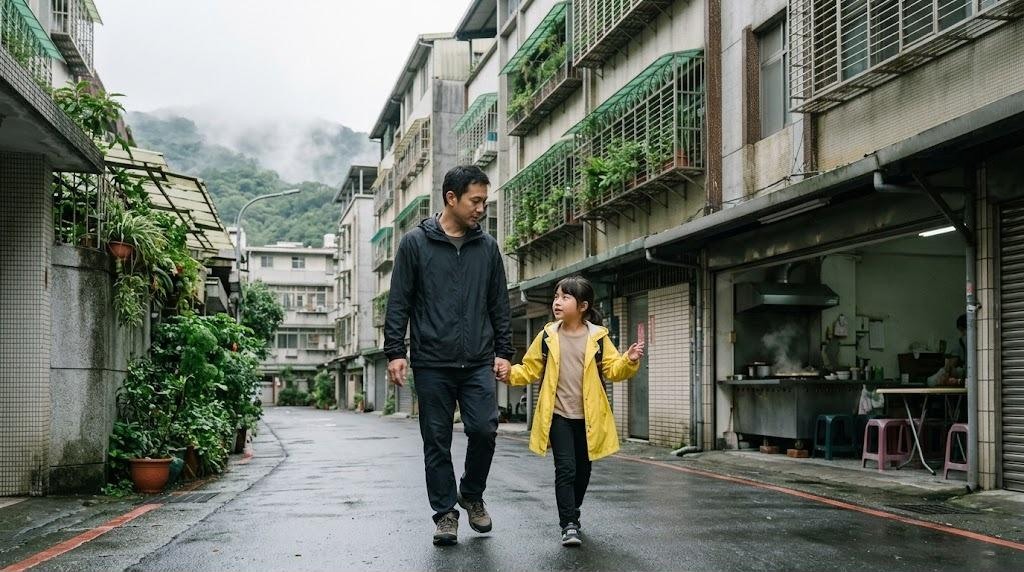
“Taipei Japanese School” gets mixed up with several other things in search results — two sister schools elsewhere in Taiwan, a Saturday school that borrows its classrooms, the American school across the road, and the many private Japanese-language kindergartens and cram schools in Taipei. The Taipei Japanese School is a weekday school that replaces a child’s local or international school. It is not a language course, and it has no kindergarten.
| Name you will see | What it actually is | Where |
|---|---|---|
| Taipei Japanese School (TJS), 台北日本人学校 / 台北市日僑學校, tjs.tp.edu.tw | Full-time Japanese school: Grades 1 to 9, Monday to Friday, taught in Japanese | Tianmu, Shilin District |
| Taichung Japanese School, 台中日本人学校 | A separate full-time Japanese school. It opened in 1977 as a branch of TJS and became independent in 1979. Its own fees and rules | Taichung |
| Kaohsiung Japanese School, 高雄日本人学校 | Another separate full-time Japanese school, for families in the south | Kaohsiung |
| Taipei Japanese Supplementary School (TJSS), 台北日本語授業校 | A Saturday-morning hoshuko run by parents, largely for children of Japanese-Taiwanese families: two hours of Japanese a week, from preschool to junior high, about 90 children in May 2023 according to an Osaka University study | Taipei; uses TJS classrooms on some Saturdays |
| Taiwan Japanese Association, 台湾日本人会 | The association that founded the school. Parents must be members before a child can enrol | Office in Zhongzheng District |
| Taipei American School (TAS) | An unrelated English-medium international school, across Zhongshan North Road from TJS | Tianmu |
| “Taipei Japanese School kindergarten” | There is none. The school rules provide for a primary division and a junior high division only. Japanese-language kindergartens in Taipei are separate private businesses | — |
Two points follow. First, the Taiwan Japanese Association — not your employer, and not the Japanese chamber of commerce — is the membership that matters for admission. Second, the Saturday school is a real option for families TJS cannot take, which we come back to below. If you are comparing Japanese schools around the region, our guide to Manila Japanese School tuition shows how differently a neighbouring school prices the same curriculum.
What it costs in 2026–27: NT$10,200 a month plus NT$100,000 to start
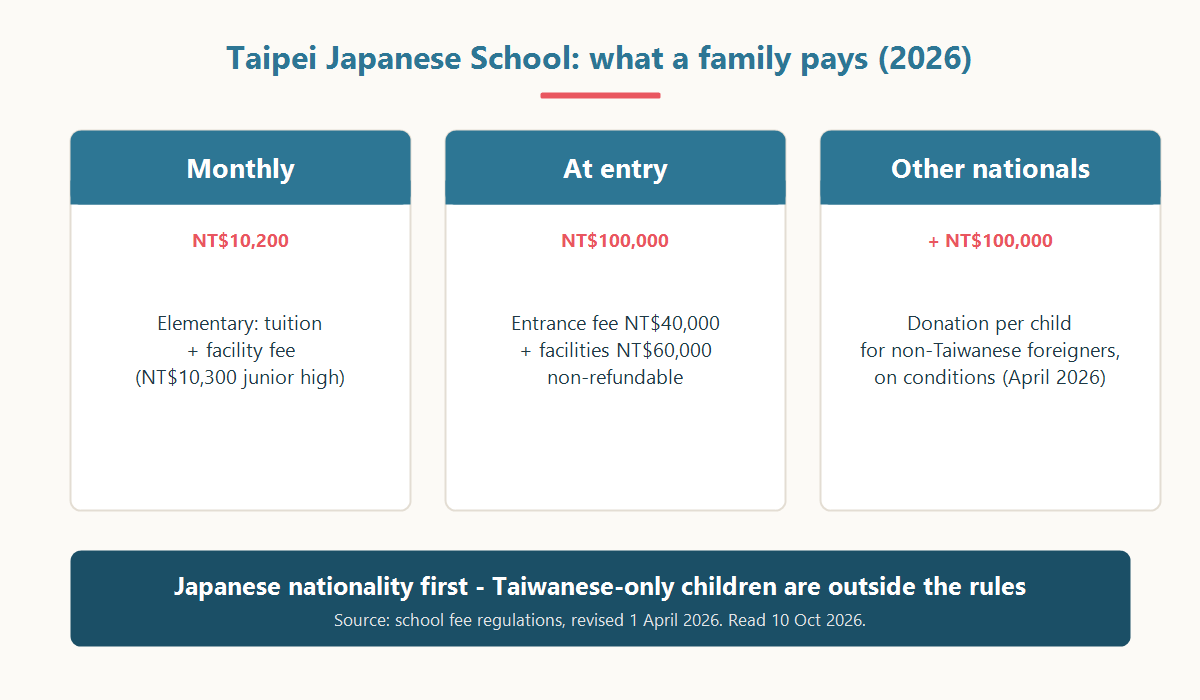
The fees are published — in the school’s fee regulations (校納金規定), revised on 1 April 2026, and on its Japanese-language transfer page. All amounts are per child, in New Taiwan dollars. The school year runs from April 2026 to March 2027.
| Item | Primary (Grades 1–6) | Junior high (Grades 7–9) |
|---|---|---|
| Enrolment fee (once, non-refundable) | NT$40,000 | NT$40,000 |
| Facilities charge (once, non-refundable) | NT$60,000 | NT$60,000 |
| Tuition (monthly) | NT$7,500 | NT$7,600 |
| Facility-use fee (monthly) | NT$2,700 | NT$2,700 |
| Monthly school charges | NT$10,200 (about US$320) | NT$10,300 (about US$320) |
| Per year, April to March | NT$122,400 (about US$3,840) | NT$123,600 (about US$3,870) |
| Teaching materials (yearly, non-refundable) | About NT$5,000 to NT$11,500, depending on grade; higher in upper grades | |
| PTA (yearly) | NT$300 | |
| School bus | Not published — run by a parents’ committee, with management outsourced from 2026–27 | |
| Trips and excursions | Collected each time | |
Tuition and the facility-use fee are invoiced three times a year, in April, August and January. On the school’s usual term split (April to July, August to December, January to March), a primary pupil’s three bills come to NT$40,800, NT$51,000 and NT$30,600, by our arithmetic. If a child leaves, both monthly charges are refunded for the unused months; the entry charges and the materials fee are not. A child who leaves and comes back within six months does not pay the NT$100,000 again.
One thing stands out when you compare years. The school’s fee sheet for 2016 lists exactly the same amounts — NT$40,000, NT$60,000, NT$7,500, NT$7,600 and NT$2,700. As far as the published figures show, the core fees have not risen in at least ten years. What did change in 2026 is the bus: the old regulations set a bus charge for users, and the 2026 version no longer does, because the parent-run bus committee has handed day-to-day management to an outside company.
Then come the memberships and donations, which is where families’ costs diverge:
- Taiwan Japanese Association — every family needs it. The school’s admissions page quotes a NT$1,000 joining fee plus NT$4,000 in dues for a couple, paid in cash, and says a couple living in Taiwan should join as a couple. The association waives the joining fee for staff of member companies. Joining requires a Taiwanese resident certificate (ARC).
- A NT$100,000 donation — required by the school rules, per child, for a child of a nationality other than Japanese or Taiwanese who is admitted under the exceptions. That is about US$3,130, on top of the NT$100,000 entry charges.
- Other donations — the new-pupil briefing includes an explanation of donations. Any amount expected from Japanese families is not published.
Put together, these are our additions of the published lines for one primary child in the first year, before the bus:
- Japanese family: entry charges, twelve months, PTA, materials and association membership come to about NT$233,000 to NT$239,000, roughly US$7,300 to US$7,500. Employers posting staff often cover some or all of it. From year two, about NT$132,000 to NT$138,000 a year.
- Child of another nationality admitted by exception: add the NT$100,000 donation — about NT$333,000 to NT$339,000 in year one, roughly US$10,400 to US$10,600.
Several things are not published: bus fares, any sibling discount, and the cost of school trips. Lunch is not a fee either — children bring a packed lunch, and a vendor lunch box can be ordered. Is NT$122,400 a year expensive? Not for Tianmu, where the international schools on the same road charge many times as much. For most families the real budget line is the NT$100,000 at the start.
Who can enrol: Japanese nationality, a Japanese Association member, and a narrow door for others
Article 5 of the school rules, and the school’s admission pages, set the conditions. In plain terms:
- The child holds Japanese nationality. The rule is about the child, not the parent’s job or passport.
- A parent belongs to the Taiwan Japanese Association — as a couple, in principle, if both parents live in Taiwan.
- The parent lives with the child in Taiwan.
- The child is not also enrolled elsewhere. Dual enrolment with an international or local school is not allowed.
- Children who have had special-needs support must go through a prior interview and a committee review, even if the parents feel no support is needed.
Then there is the exception clause, rewritten on 1 April 2026. It allows the principal, with the management committee’s approval, to admit a child of a foreign nationality other than Taiwanese if all of these hold: the child has already attended a Japanese school; their spoken and written Japanese is at grade level; the home provides a Japanese-language environment; one parent can communicate in Japanese; someone close can read the school’s letters; the family can pay the fees and the NT$100,000 donation; and the family will help with the PTA. The rules add that the child should be likely to live in Japan in the near future, or be preparing for Japanese schooling deliberately.
What this means for mixed families in Taipei:
- Japanese-Taiwanese child with both nationalities: the rules do not mention dual nationals at all. Such a child holds Japanese nationality, which is what the rule asks for. Ask the school to confirm, and have the child’s Japanese passport or family register ready.
- Child with Taiwanese nationality only — for example, a child whose Japanese birth registration was never filed: not covered by the rules or the exception. The only door is a trial entry of a few weeks in July, open to Taiwanese children who have previously attended a Japanese school.
- Child of a Japanese parent and, say, an American or Korean parent: eligible if the child’s Japanese nationality is registered.
- Child with no Japanese nationality and no Taiwanese nationality — a European or Korean family, for instance: possible only under the exception, with prior Japanese schooling, grade-level Japanese and the donation.
There is no published entrance exam, but transfers involve an interview, and every subject apart from English and Chinese is taught in Japanese. The school runs a weekly Japanese support lesson for children of international families who are behind in Japanese, and it says plainly that this has limits and that Japanese at home is essential. One timing rule matters for older children: Grade 9 entrants coming from an international or local school are accepted only until the end of September of that school year.
How it works: one Tianmu campus, two semesters, a Japanese school year
Everything happens on one site in Tianmu, in the north of the city. The school has been there since 1983; a new classroom building opened for lessons in June 2021 and the whole campus was finished in March 2022. Unlike most schools in Japan, TJS runs a two-semester year:
| Period | Dates in the school rules | What the school publishes |
|---|---|---|
| First semester | 1 April to late September | Entrance ceremony for new Grade 1 pupils on 11 April 2026. Summer holiday late July to late August |
| Second semester | Early October to 31 March | Winter break late December to early January, plus Lunar New Year. Ten Taiwanese public holidays are also days off, and the school closes when typhoon warnings close local schools |
Other things the school publishes about daily life:
- Class sizes. The trial-entry page implies caps of 30 in the first two grades and 35 from Grade 3. With 728 pupils in 26 classes, the average is about 28.
- English and Chinese from Grade 1, taught in small groups in dedicated language rooms. Everything else is in Japanese, from Japanese government textbooks that families moving from Japan collect before they fly.
- Buses are run by parents: the PTA bus committee is the operator, and from 2026–27 a management company handles routes, bookings and fares. You apply after the online enrolment. Existing riders and siblings get seats first, new families may be waitlisted, and the school asks every family to have another way of getting to school.
- No walking alone. Younger children must be taken to the gate and collected; the school bans pupils travelling to and from school by themselves.
- Photos of the campus — the school’s new-building pages show the classrooms, Japanese room with a tea room, pool, arena and bouldering wall, and include a 3D virtual tour.
- Turnover is high. The school says about a quarter of its pupils move in or out each year.
And junior high? TJS ends at Grade 9, with 177 pupils in its junior high division this year. There is no high school. The school does not publish where its leavers go; English Wikipedia says most return to Japan for high school and a minority move across the road to Taipei American School, but we could not find a source for that line.
The honest review: what the English pages leave out
People search for “Taipei Japanese School reviews” to learn what it is like from the inside. We want to be straight: we found no body of verifiable parent reviews, in English or Chinese. The school directory we tried blocked our request, and we found no forum threads with first-hand accounts. We are not going to invent a consensus. What we can check is where English pages diverge from what the school publishes in Japanese.
1. No fees anywhere — and the donation nobody mentions
None of the English pages we found gives a single fee figure; the search summaries we ran could not find them, and one offered Taichung’s figures instead. The school does publish them, in Japanese: NT$10,200 a month in primary and NT$100,000 at entry. And no English page mentions the NT$100,000 donation required of a child admitted under the foreign-national exception — for a European or Korean family, the single largest extra cost.
2. “Kindergarten through junior high.” There is no kindergarten
A widely shared guide on IPGCE says the school was “established in 1968” and serves students “from kindergarten through junior high school”. The school rules provide for a primary division and a junior high division only. The school itself dates its history to 1947; 1968 is when its junior high division reopened.
3. “Bilingual, pre-K to Grade 12.” It is neither
At least one expat schools listing that appears in English search results calls TJS a bilingual school for pre-kindergarten through Grade 12, accredited by Japan’s education ministry and WASC. The school teaches Grades 1 to 9, in Japanese, with English and Chinese as subjects. We found no mention of WASC accreditation anywhere on its site.
4. “For Japanese expatriates.” The rule is the child’s nationality
English pages, including Wikipedia and IPGCE, describe TJS as serving the children of Japanese expatriates. That reads as if a posting from a Japanese company is what counts. It is not: the rule is that the child holds Japanese nationality and the parents belong to the Taiwan Japanese Association, so locally settled Japanese families and Japanese-Taiwanese families with a Japanese child qualify. Equally, nothing in English warns that a Taiwanese-only child is outside the rules, or that other foreign children can be admitted with conditions.
5. Enrolment and principal from 2020
The Wikipedia infobox gives enrolment as 768 in April 2020 and names a principal who has since left. The school’s own count on 15 April 2026 was 728, and its current principal is Shinichi Kimura. The article says nothing about admission rules, fees or the association that runs the school.
6. What to ask, since the reviews won’t tell you
- My child is a Japanese-Taiwanese dual national — which documents do you need? The rules ask for Japanese nationality and say nothing about dual nationals; get it in writing.
- Is there a bus seat for our neighbourhood, and what does it cost? Fares are not published and new riders may be waitlisted. Ask before you sign a lease.
- Is a donation expected from us? The new-pupil briefing covers donations; amounts for Japanese families are not published.
- What support is there for a child whose Japanese is behind? There is a weekly Japanese support lesson; ask how long children usually stay in it.
- Where did last year’s Grade 9 leavers go? Not published.
Other options in Taipei
If your child cannot enrol at the Taipei Japanese School — because they hold only Taiwanese nationality, because they have no Japanese nationality, or because you want them at a local or international school — these are the routes that remain.
| Option | Who it takes | What to know |
|---|---|---|
| Taipei Japanese Supplementary School (TJSS) | Mainly children of Japanese-Taiwanese families attending local schools | Saturday mornings, two hours, Japanese school textbooks. Run by parents, who share the teaching and committee work. About 90 children in 2023, according to a university study — we found no official website, so confirm current details directly |
| TJS trial entry | Taiwanese children who once attended a Japanese school; Japanese children at local schools | A few weeks in July (1 to 17 July in 2026), at most two children per class, usually once only. You pay a month’s fees plus the year’s materials |
| International schools with Japanese as a subject | Pupils of that school, any nationality | Convenient, but often pitched far below a child who speaks Japanese at home, and fees are many times higher |
| Private Japanese-language kindergartens and cram schools (buxiban) | Varies; most take any nationality | Fees on inquiry. Many teach Japanese as a foreign language, not the Japanese school curriculum |
| Online classes | Anyone, anywhere in Taiwan | No commute or bus queue; quality varies widely |
Taipei is better served than many cities: a large, long-established full-time Japanese school, and a parent-run Saturday school besides. But the gap is still there. A Taiwanese-only child with a Japanese parent cannot enrol at TJS, and two hours on Saturday is a thin thread for keeping Japanese reading at grade level. For how families in that position keep two languages going at home, see our guide to raising a bilingual Japanese child abroad.
How to choose, in four questions
- Does your child hold Japanese nationality? If yes, including as a dual national, you meet the main rule. If your child is Taiwanese only, TJS is closed apart from trial entry. If your child holds another nationality, read the exception conditions closely — prior Japanese schooling and grade-level Japanese come first.
- Can your child follow a full day of lessons in Japanese? No entrance exam is published, but there is no English stream. A child who chats in Japanese at home but reads two years behind may struggle.
- Is your child going back into Japanese schooling? If a move to Japan is likely, this is the school built for it: same curriculum, same textbooks, same April start. If your family is settled in Taiwan, weigh what a Japanese-medium day means for Chinese and English, and for the step after Grade 9.
- Can you budget the start-up bill? NT$100,000 at entry, the association membership and a year of materials, before any bus fare — and NT$100,000 more if your child is admitted under the foreign-national exception.
Where TOMODACHI JAPAN fits
We are not a substitute for the Taipei Japanese School, and if your child holds Japanese nationality, can follow a Japanese school day and may move to Japan, we would point you there. We exist for the families the four questions above leave stuck — the Japanese-Taiwanese child who holds Taiwanese nationality only, the child at a local or international school whose Japanese reading is slipping, and the family for whom two hours on Saturday is not enough.
- Japanese friends of the same age, every day. Classes with children the same age in Japan — not only other learners in Taipei. The reason children keep going is usually the other children.
- Teachers working at Japan’s current classroom standard — not a syllabus written abroad and not a tutoring marketplace.
- Small classes of eight children. Enough to be a class, few enough that every child speaks every lesson.
- Taipei is only one hour behind Japan. An after-school slot in Japan lands in the late afternoon here, so lessons fit around a local or international school day — with no bus queue, no nationality rule and no association membership. Our guide to online Japanese classes across time zones shows how the timing works.
- Unlimited classes for a flat monthly fee. Tuition, scholarships and opening dates are in our free school guide, which we email to everyone who registers, with no obligation.
If you are weighing us against the Saturday school, our guide to online alternatives to a Japanese hoshuko sets out what an online class can and cannot replace — many families use both.
Frequently asked questions
How much is the Taipei Japanese School tuition?
For 2026–27, primary pupils pay NT$7,500 a month in tuition plus a NT$2,700 facility-use fee — NT$10,200 a month, or NT$122,400 a year. Junior high is NT$10,300 a month. Each child pays NT$100,000 once at entry (NT$40,000 enrolment fee and NT$60,000 facilities charge), plus NT$5,000 to NT$11,500 a year for materials and NT$300 for the PTA. Bus fares are not published.
Can Taiwanese children attend the Taipei Japanese School?
Not if they hold Taiwanese nationality only. The school rules require Japanese nationality, and the exception clause covers foreign nationals other than Taiwanese. A Taiwanese child who has previously attended a Japanese school may apply for a short trial entry in July. A child who holds both Japanese and Taiwanese nationality meets the nationality rule as written; confirm with the school.
Can a foreign child without Japanese nationality enrol?
Only under strict conditions: previous attendance at a Japanese school, grade-level Japanese, a Japanese-speaking parent and home environment, and a NT$100,000 donation per child, among others. Admission is decided by the principal with the management committee’s approval.
Are there reviews of Taipei Japanese School?
We found no verifiable parent reviews in English or Chinese. The school publishes its pupil numbers, staff numbers, fees, rules and photos of its new campus, including a 3D virtual tour, and it held briefings for new Grade 1 families in February and April 2026.
Does Taipei Japanese School have a junior high school or a high school?
It has a junior high division, Grades 7 to 9, with 177 pupils in April 2026. There is no high school; the school ends at Grade 9. Entrants to Grade 9 from international or local schools are accepted only until the end of September.
Does Taipei Japanese School have a kindergarten?
No. Its rules provide for a six-year primary division and a three-year junior high division only. Children join Grade 1 in the April after they turn six; for April 2026 entry, that meant children born from 2 April 2019 to 1 April 2020.
When do applications for April 2027 open?
The school says the guide for new Grade 1 pupils starting in April 2027 will be posted around November 2026. Last year the online application ran from 10 November to the following 2 April. Transfers into other grades are accepted all year, with no waiting list in principle.
Sources
- Taipei Japanese School (Japanese-language pages): Fee regulations, revised 1 April 2026 (PDF), School rules, revised 1 April 2026 (PDF), Transfer guide and 2026 fees, New Grade 1 admissions, Trial entry, School bus, 2026 bus application notice (PDF), School overview and pupil numbers, Principal’s greeting, History, New building and virtual tour, New-pupil briefing booklet, 2025 (PDF); 2016 fee sheet (PDF, for comparison), previous fee regulations (PDF)
- Taiwan Japanese Association: official site and membership guide
- Taipei Japanese Supplementary School: Osaka University study, PDF (2023 figures)
- Exchange rate: Taipei foreign exchange market close on 8 October 2026, reported by Central News Agency
- Third-party pages checked: Wikipedia, Taipei Japanese School; IPGCE, international schools in Taipei; IPGCE, hidden gem international schools in Taipei; an expat schools listing seen via search results; a school directory page (blocked). All checked 10 October 2026.