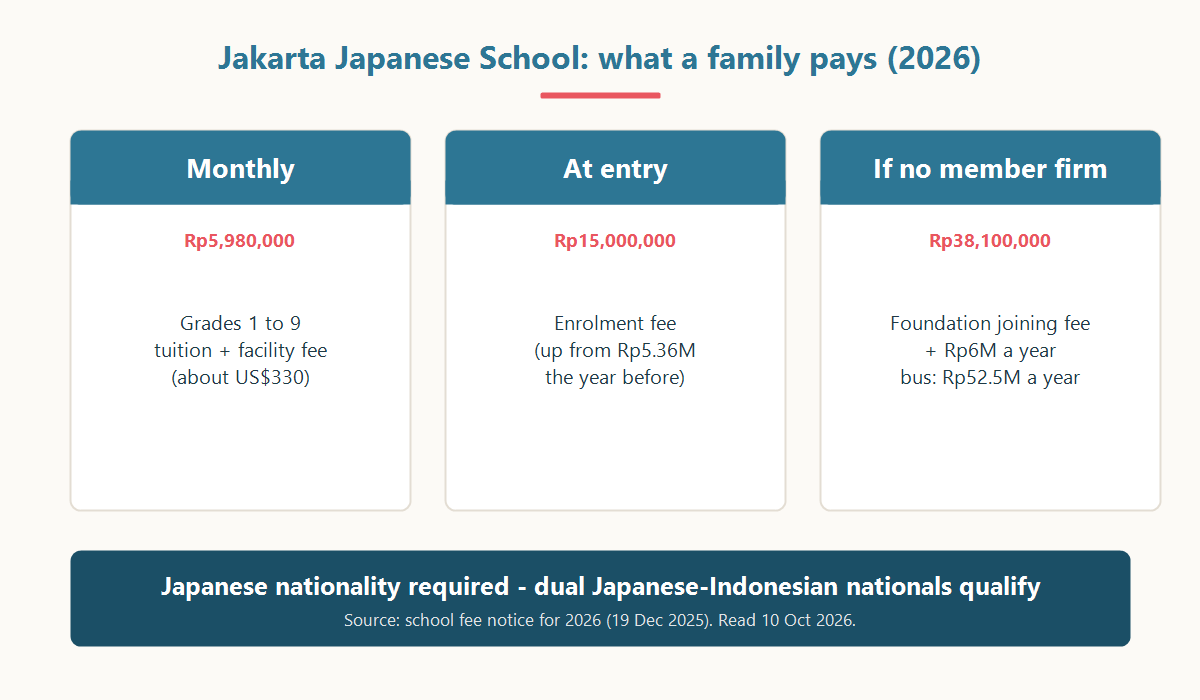
The Jakarta Japanese School (JJS) in Bintaro charges Rp5,980,000 a month for a child in Grades 1 to 9 in the 2026–27 school year (Rp4,700,000 tuition plus a Rp1,280,000 facility fee), or Rp71,760,000 a year — roughly US$4,000. On top come a Rp15,000,000 enrolment fee, nearly three times last year’s, the school bus at Rp52,493,000 a year, and membership of the school’s own foundation, which costs a family without a Japanese employer behind it Rp38,100,000 to join. The biggest limit is not money, though: the school only takes children who hold Japanese nationality. Indonesian citizens are excluded — with one exception that most English and Indonesian pages miss: a child who is a Japanese-Indonesian dual national is eligible.
This page is the single-school deep dive: what the Jakarta Japanese School costs, who can actually enrol, how the Bintaro campus works day to day, and what English-language listings get wrong. If you searched for the school’s biaya (tuition fee), the figures below are the 2026 ones — many search results still show older fee sheets. Everything comes from the school’s Japanese-language pages, its fee notice dated 19 December 2025, its 2026 enrolment guide and its foundation’s membership rules, read on 10 October 2026. Where something is not published, we say not published. Dollar figures use about Rp18,000 to the US dollar, close to Bank Indonesia’s JISDOR reference rate in the first week of October 2026; treat them as rough.
The short answer
| What it is | A full-time Japanese school (nihonjin gakko, ジャカルタ日本人学校) founded in 1969, teaching Japan’s national curriculum in Japanese: a two-year kindergarten, then Grades 1 to 9. Run by its own foundation, Yayasan Pemeliharaan Sekolah Jepang Jakarta, which also runs Cikarang Japanese School |
| Where | One campus: Jl. Titihan Raya, Bintaro Jaya Sektor 9, Pondok Aren, South Tangerang — on this site since 1996 |
| Monthly cost, 2026–27 | Grades 1–9 Rp5,980,000 (Rp4,700,000 tuition + Rp1,280,000 facility fee); kindergarten Rp6,140,000. Billed once a year or per term, in rupiah only, by bank transfer. School bus Rp52,493,000 a year on top |
| One-off at entry | Enrolment fee Rp15,000,000 per child (it was Rp5,360,000 for 2025–26). If no member company employs a parent, the family joins the foundation as an individual: Rp38,100,000 once, then annual dues of Rp6,000,000 |
| Who it takes | Children who hold Japanese nationality, live in or around Jakarta, and whose parent’s company — or the parent personally — belongs to the foundation. Indonesian nationals are not admitted, except Japanese-Indonesian dual nationals, who are |
| Size | 677 pupils on 20 April 2026: 530 in primary, 147 in junior high |
| The real catch | The Japanese-nationality rule, the foundation bill for families without a Japanese employer, and a long bus day. And it stops at Grade 9 |
Looking for a way to keep Japanese going from abroad?
TOMODACHI JAPAN is an online Japanese school for children growing up outside Japan. They talk with peers their own age in Japan every day, taught by teachers working at Japanese schools, in small classes of 8.
🎁 Register and we’ll email you our School Guide (PDF, in English) straight away. You’ll also be first to hear about tuition, scholarships and opening dates.
Free · takes about 30 seconds
First, which school do you actually mean?
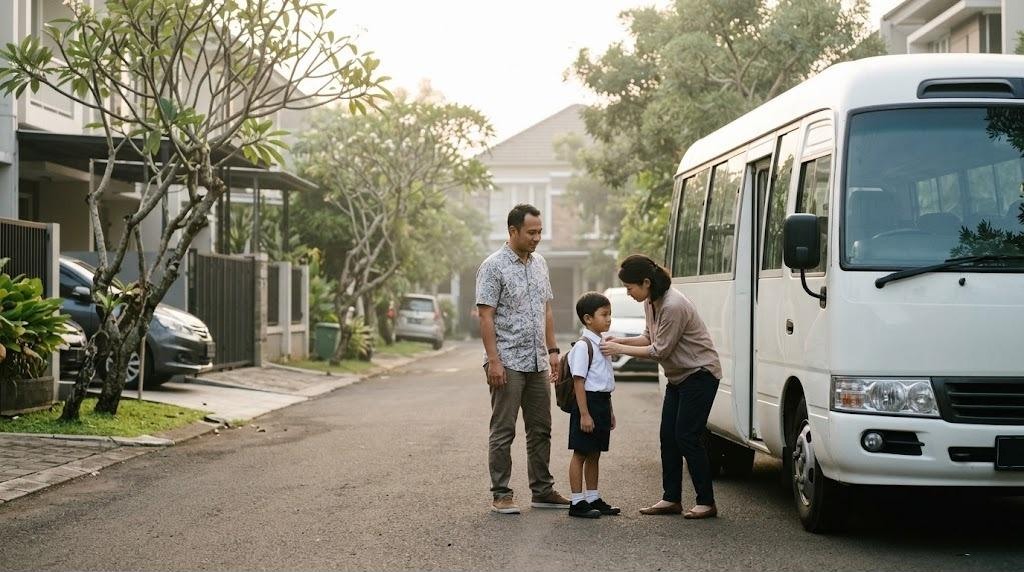
“Jakarta Japanese School” gets mixed up with several other things in search results — a second school run by the same foundation, a similar-sounding international school, and the many Japanese-language courses that Indonesian sites also call “Japanese schools”. The Jakarta Japanese School is a weekday school that replaces a child’s local or international school. It is not a language course, and it is not a Saturday school.
| Name you will see | What it actually is | Where |
|---|---|---|
| Jakarta Japanese School (JJS), ジャカルタ日本人学校, jjs.or.id | Full-time Japanese school: kindergarten plus Grades 1 to 9, Monday to Friday, taught in Japanese | Bintaro Jaya, South Tangerang |
| Cikarang Japanese School (CJS), チカラン日本人学校, cjs.or.id | A separate full-time Japanese school opened in April 2019 by the same foundation, for families in the Cikarang industrial belt. Same entry rules, its own fees | Kota Deltamas, Cikarang, Bekasi |
| Yayasan Pemeliharaan Sekolah Jepang Jakarta, ジャカルタ日本人学校維持会 | The foundation that runs both schools. A parent’s company, or the parent, must be a member before a child can enrol | Office at the school |
| Jakarta Intercultural School (JIS) | An unrelated English-medium international school. The JIS/JJS acronyms are a common mix-up | South Jakarta |
| A weekend Japanese hoshuko (補習授業校) | We found no Saturday supplementary school of the kind Japanese communities run elsewhere operating in Jakarta. JJS itself began as one, at the embassy, in 1968 | — |
Two points follow. First, the foundation — not the Jakarta Japan Club, the city’s Japanese business association — is the membership that matters for admission; the school’s pages do not list Japan Club membership as a condition. Second, if you live in the east of the metro area near the industrial estates, Cikarang may be your school, with the same nationality rule. If you are comparing Japanese schools around the region, our guide to Manila Japanese School tuition shows how differently a neighbouring school prices the same curriculum.
What it costs in 2026–27: Rp5.98 million a month plus Rp15 million to start
The fees are published — in a notice from the foundation’s chairman dated 19 December 2025, and in a one-page cost estimate, both on the school’s Japanese-language admissions pages. All amounts are per child, in rupiah. The school year runs from April 2026 to March 2027.
| Item | Grades 1–9 | Kindergarten |
|---|---|---|
| Enrolment fee (once) | Rp15,000,000 | Rp15,000,000 |
| Tuition (monthly) | Rp4,700,000 | Rp5,360,000 |
| Facility fee (monthly) | Rp1,280,000 | Rp780,000 |
| Monthly school charges | Rp5,980,000 (about US$330) | Rp6,140,000 (about US$340) |
| Paid in one sum, April to March | Rp71,760,000 | Rp73,680,000 |
| Term 1 (April to July) | Rp23,920,000 | Rp24,560,000 |
| Term 2 (August to December) | Rp29,900,000 | Rp30,700,000 |
| Term 3 (January to March) | Rp17,940,000 | Rp18,420,000 |
| PTA (yearly) | Rp150,000 | Rp250,000 |
| School bus, full year (optional) | Rp52,493,000 | Rp49,924,000 |
Tuition and the facility fee come to the same total whether you pay once or by term. The bus does not: paid term by term, the three Grades 1–9 instalments (Rp19,473,631, Rp22,608,197, Rp12,262,172) add up to Rp54,344,000 — Rp1,851,000 more than the full-year price, by our arithmetic. Tuition is charged by the month, and unused months after the month you leave are refunded. Bus fees are only pro-rated by the day once half a term has passed, and bus refunds are paid only if you leave JJS for another city or country.
Why did the enrolment fee jump? The school says so in writing. For five years it had raised tuition by 5% a year; from 2026 it is holding tuition almost flat and putting the whole enrolment fee into a reserve for rebuilding its ageing buildings. It adds that its entry costs were among the lowest of nine large Japanese schools in Asia. Cikarang raised its enrolment fee to the same Rp15,000,000. One rule got kinder: a child who leaves and comes back within a year no longer pays the fee again.
Then comes the foundation, which is where families’ costs really diverge. Every child’s place depends on a member:
- Corporate member — a Japanese company in or around Jakarta that wants to send its employees’ children must join. Its head office in Japan signs the contract, and the joining donation is set by its capital in Japan (from Rp21,980,000 up to Rp483,580,000) plus Rp43,960,000 for each Japanese expatriate. If your company is already a member, there is nothing new for you to pay.
- Individual member — if the parent’s employer is not a member, or there is no employer, the Japanese-national parent joins personally: Rp38,100,000 flat, about US$2,100. Membership is personal and cannot be passed to another family.
- Annual dues — every member pays each year between October and March, scaled by the number of its children enrolled on 1 October: Rp6,000,000 for one to four children, Rp3,000,000 with none, and upward for companies with more.
Put together, the same primary child costs very different amounts in year one depending on who stands behind the parent. These are our additions of the published lines, paying school fees in one sum:
- Posted by a Japanese company that is already a member: about Rp86,910,000 in the first year (enrolment fee, twelve months, PTA), roughly US$4,800 — or Rp139,403,000 with the bus. Usually met in part or in full by the employer.
- Japanese parent working for a local or non-member employer: add the Rp38,100,000 donation and Rp6,000,000 dues — about Rp131,010,000 in year one, roughly US$7,300; with the bus, Rp183,503,000. From year two, about Rp77,910,000 a year before the bus.
Several things are not published: any sibling discount, the cost of trips and materials, and what the foundation does when neither parent is a Japanese national (its rules frame individual membership around a Japanese parent). Nothing is paid on the day you register — invoices follow by email after your child starts, with 30 days to pay. Cash and foreign currency are not accepted; the school cites Bank Indonesia’s rule that domestic transactions be in rupiah.
Is Rp71.76 million a year expensive? Not for Jakarta, where international school fees commonly run several times higher. The real budget lines for a locally hired family are the foundation donation and the bus, which costs almost as much as tuition itself.
Who can enrol: a Japanese passport, a member behind you, and one exception
The school’s online application opens with its entry conditions, and you must tick that you agree before you can type anything else. There are four:
- The family lives in or around Jakarta, and the parent’s company or the parent personally is a member of the foundation.
- The child holds Japanese nationality. A Japanese parent alone is not enough; the child must be a Japanese national.
- The child is not an Indonesian national, which the school attributes to Indonesian government rules — but a child holding both Japanese and Indonesian nationality is eligible, and the page says so in as many words.
- The family accepts the school’s rules. The principal makes the final decision.
Condition three is the one that matters most for mixed families. Indonesian law lets a child of a Japanese-Indonesian marriage hold both citizenships until adulthood, and such a child qualifies. A child who holds Indonesian citizenship only does not — even with a Japanese parent and fluent Japanese. A child of a Japanese parent and, say, a Korean or Australian parent qualifies on nationality, provided the child’s Japanese nationality is registered. That fits the school’s status: since 2010 Indonesia has treated it as a school of the diplomatic community rather than an international school, according to the school’s own history.
What the school does not publish is an entrance exam. But every lesson apart from English is taught in Japanese, with Japanese government textbooks that families moving from Japan must collect before they fly. In practice a child needs grade-level Japanese to keep up. Two timing rules are published. Grade 9 entrants coming from anything other than a school in Japan or another recognised Japanese school are accepted only until 31 October of that school year. And children who need special support apply through the office directly, not the online form.
How it works: one Bintaro campus, one Japanese school year
Everything happens on one site in Bintaro Jaya, south-west of the city, including the kindergarten, which moved into its own building there in 2006. The school year follows Japan’s pattern, with three terms:
| Term | Months (2026–27) | What the school publishes |
|---|---|---|
| First term | April to July 2026 | Opening ceremony 9 April 2026. Summer holiday, per the office’s notice, 24 July to 26 August |
| Second term | August to December 2026 | Invoices for this term issued in early September |
| Third term | January to March 2027 | Invoices for this term issued in early December |
A typical day, as the school describes it:
| Time | What happens |
|---|---|
| 6:00–6:30 | School bus pick-up at apartments |
| 7:00–7:20 | Arrival |
| 7:25–7:45 | Morning activities, assembly, cleaning, homeroom |
| 7:50–11:20 | Periods 1 to 4 |
| 11:20–12:10 | Lunch — a packed lunch from home — and break |
| 12:15–13:55 | Periods 5 to 6 |
| 14:30 | More than 40 buses leave in order; club days run later |
Other things the school publishes about daily life:
- No uniform. The school says there is no set uniform, bag, PE kit, swimsuit or indoor shoes. About 80% of younger children use a randoseru backpack, but any bag is fine.
- Buses are contracted by the foundation and run by Big Bird, which has an office inside the school. The school recommends them for safety and traffic reasons, publishes a list of apartments the buses serve, and will check an unlisted address before you sign a lease. A parent must ride along at least once a year, and families who use their own car or an apartment bus file a notice.
- Chromebooks are used, with published guidance for 2026–27. Most supplies can be bought locally; the school suggests bringing dictionaries, a calligraphy set and carving tools from Japan, and a large water bottle every day.
- Closures happen. The school’s history lists closures for elections, unrest and security incidents, and in August 2026 it posted its response to demonstrations in Indonesia.
Where do pupils go next? There is no high school. Of the 45 junior high leavers in the 2025 school year, 34 went to high schools in Japan (29 of them private), 6 to Japanese senior-high programmes abroad, and 5 to international schools in Indonesia. Of the primary leavers, 43 stayed on for JJS junior high and 24 moved to schools in Japan.
The honest review: what the English pages leave out
People search for “Jakarta Japanese School reviews” to learn what it is like from the inside. We want to be straight: we found no body of verifiable parent reviews, in English or Indonesian. The directory pages we tried had none or blocked our request, and the expat forum threads we found were job advertisements. We are not going to invent a consensus. What we can check is where English and Indonesian pages diverge from what the school publishes in Japanese.
1. Fee figures from last year — and no foundation bill
Search for the school’s fees and the results that come up first are the school’s own older cost sheets, for 2023 through 2025. The 2025–26 sheet shows a Rp5,360,000 enrolment fee and Rp4,620,000 monthly tuition; the 2026–27 sheet has Rp15,000,000 to enrol, with tuition at Rp4,700,000. Summaries built on the old sheets understate the entry bill by almost Rp10 million per child. And none of the pages we found shows the foundation donation — Rp38,100,000 for a family that has to join personally — which is often the largest single payment. Budget from the 2026 notice, and from the foundation’s membership guide.
2. “Indonesians can’t attend.” Dual nationals can
An Indonesian-language piece on Terminal Mojok (February 2024) says Indonesian citizens cannot study at the school and only children with Japanese passports can join the kindergarten. The second half is right. The first is too broad: the school’s entry conditions say outright that Japanese-Indonesian dual nationals are eligible. Job advertisements, meanwhile, describe the school as catering for “the children of Japanese nationals”, which sounds like the parent’s passport is what counts. It is the child’s.
3. “Bilingual, Kindergarten to Grade 12.” It is neither
An expat guide on Expat Exchange, seen through search results because the page blocked us, quotes a contributor calling JJS a private school offering “a Japanese-English bilingual education from Kindergarten to Grade 12”. The school runs a kindergarten and Grades 1 to 9 only, and teaches in Japanese, with English as a subject.
4. Enrolment figures from another era
The English Wikipedia article cites a 2012 headline saying enrolment passed 1,000 for the first time in 14 years, and nothing more recent. The school’s own count on 20 April 2026 was 677. The article also says nothing about admission rules, the kindergarten or the foundation that runs the school.
5. “All Japanese schools have uniforms.” This one doesn’t
Uniforms are part of the Japanese school image, and a 2020 blog post from another Jakarta school states that they are required at all Japanese schools. That is a general claim about schools in Japan, and it does not hold here: the school’s FAQ says there is no set uniform, bag or PE kit.
6. What to ask, since the reviews won’t tell you
- Is my employer already a member of the foundation? Ask HR before you budget; it decides whether you pay Rp38,100,000.
- My child is a dual national — which passport do you need to see? The conditions allow dual nationals; ask what documents prove it.
- Does the bus serve our apartment, and how long is the ride? Check the published list before signing a lease.
- How many children are in my child’s class? Year-group totals are published; class sizes are not.
- What support is there for a child whose Japanese is behind? Not published. The school does hold a separate briefing for parents in international families after its new-pupil session.
Other options in Jakarta
If your child cannot enrol at the Jakarta Japanese School — because they hold only Indonesian citizenship, because they have no Japanese nationality, or because you want them at an international school — these are the routes that remain.
| Option | Who it takes | What to know |
|---|---|---|
| Cikarang Japanese School | Same rules as JJS: Japanese nationality, Japanese-Indonesian dual nationals allowed, foundation membership | For families living in Cikarang, Jababeka or Deltamas. 2026 fees: Rp15,000,000 to enrol, Rp4,400,000 tuition plus Rp1,230,000 facility fee a month, plus a Rp350,000 monthly computer fee |
| International schools with Japanese as a subject | Pupils of that school, any nationality | Convenient, but often pitched far below a child who speaks Japanese at home, and fees are usually several times higher |
| Private juku and Japanese-language courses | Varies; most take any nationality | Evening or weekend, fees on inquiry. Courses for Indonesian learners teach Japanese as a foreign language, not the Japanese school curriculum |
| A weekend hoshuko | — | We found none operating in Jakarta |
| Online classes | Anyone, anywhere in the metro area | No commute or bus; quality varies widely |
The gap is the same one we see in most cities, but sharper here. Jakarta has a large, well-run full-time Japanese school for children with Japanese nationality — and no Saturday school at all. So an Indonesian-citizen child with a Japanese parent, or a Japanese child at an international school, has no Japanese-curriculum option of any kind. For how families in that position keep two languages going at home, see our guide to raising a bilingual Japanese child abroad.
How to choose, in four questions
- Does your child hold Japanese nationality? If not, the school is closed. If they hold Japanese and Indonesian nationality, they qualify; if Indonesian only, they do not.
- Can your child follow a full day of lessons in Japanese? No entrance exam is published, but there is no English stream either. A child who chats in Japanese at home but reads two years behind may struggle.
- Is your child going back into Japanese schooling? If a return to Japan is likely, this is the school built for it: same curriculum, same textbooks, same April start — and most leavers do go on to high schools in Japan. If your family is settled in Indonesia, weigh what a Japanese-medium day means for English and Indonesian, and for the step after Grade 9.
- Who pays the entry bill? With a member company behind you, it is Rp15,000,000 and paperwork. Without one, add about Rp59 million in one-off and membership charges — roughly Rp131 million in year one before the bus.
Where TOMODACHI JAPAN fits
We are not a substitute for the Jakarta Japanese School, and if your child holds Japanese nationality, can follow a Japanese school day and is heading back to a school in Japan, we would point you there. We exist for the families the four questions above leave stuck — the Japanese-Indonesian child who holds Indonesian citizenship only, the child at an international school whose Japanese reading is slipping, and the family that cannot justify the foundation bill or a 6 a.m. bus.
- Japanese friends of the same age, every day. Classes with children the same age in Japan — not only other learners in Jakarta. The reason children keep going is usually the other children.
- Teachers working at Japan’s current classroom standard — not a syllabus written abroad and not a tutoring marketplace.
- Small classes of eight children. Enough to be a class, few enough that every child speaks every lesson.
- Jakarta is only two hours behind Japan. An after-school slot in Japan lands in the late afternoon here, so lessons fit around a local or international school day — with no bus, no nationality rule and no foundation membership. Our guide to online Japanese classes across time zones shows how the timing works.
- Unlimited classes for a flat monthly fee. Tuition, scholarships and opening dates are in our free school guide, which we email to everyone who registers, with no obligation.
Since Jakarta has no weekend school to weigh us against, our guide to online alternatives to a Japanese hoshuko sets out what an online class can and cannot replace.
Frequently asked questions
How much is the Jakarta Japanese School tuition fee?
For 2026–27, Grades 1 to 9 pay Rp4,700,000 a month in tuition plus a Rp1,280,000 facility fee — Rp5,980,000 a month, or Rp71,760,000 for the year paid in one sum. Kindergarten is Rp6,140,000 a month. Each child pays a Rp15,000,000 enrolment fee once. Families whose employer is not a foundation member also pay a Rp38,100,000 joining donation and Rp6,000,000 a year in dues. The bus is Rp52,493,000 a year.
How is the monthly fee paid?
By bank transfer in rupiah to a virtual account on the invoice, either once for the year or term by term; invoices go out in early May, early September and early December. Cash, US dollars and yen are not accepted. Nothing is due on the day you register.
Can Indonesian children attend?
Not if they hold Indonesian citizenship only. The school requires Japanese nationality and excludes Indonesian nationals under Indonesian government rules, but it states that Japanese-Indonesian dual nationals are eligible.
Are there reviews of Jakarta Japanese School?
We found no verifiable parent reviews in English or Indonesian. The school publishes its pupil numbers, fees, daily timetable and where leavers go next, and it holds information sessions each January and February that outside families can join, partly online.
Is there a uniform?
No. The school says it has no set uniform, bag, PE kit, swimsuit or indoor shoes. Children wear practical clothes.
Does Jakarta Japanese School have a high school?
No. It ends at Grade 9, the last year of Japanese junior high. Most of its 2025 leavers went on to high schools in Japan; a few joined Japanese senior-high programmes abroad or international schools in Indonesia.
Is the Jakarta Japanese School the same as Cikarang Japanese School?
No. They are two schools run by the same foundation, with the same entry rules. JJS is in Bintaro, south-west of Jakarta; Cikarang Japanese School opened in 2019 in Kota Deltamas, east of the city, for families in the industrial belt.
Sources
- Jakarta Japanese School (Japanese-language pages): Admission conditions and online application, Enrolment fee and tuition, 2026 fee notice (PDF), 2026 cost estimate including bus (PDF), 2026 enrolment guide (PDF), School foundation, Foundation membership guide (PDF), School bus, What to bring and FAQ, Pupil numbers, History, Flow of the day, After graduation, Information sessions; 2025 cost estimate (PDF, for comparison)
- Cikarang Japanese School: official site, Fees page and 2026 fee notice, Admission conditions
- Exchange rate: Bank Indonesia JISDOR reference rate as reported by Kontan, early October 2026
- Third-party pages checked: Wikipedia, Jakarta Japanese School; Terminal Mojok, February 2024; SIS South Jakarta blog, January 2020; an Expat Exchange schools guide (blocked, seen via search result); Expatindo job threads. All checked 10 October 2026.