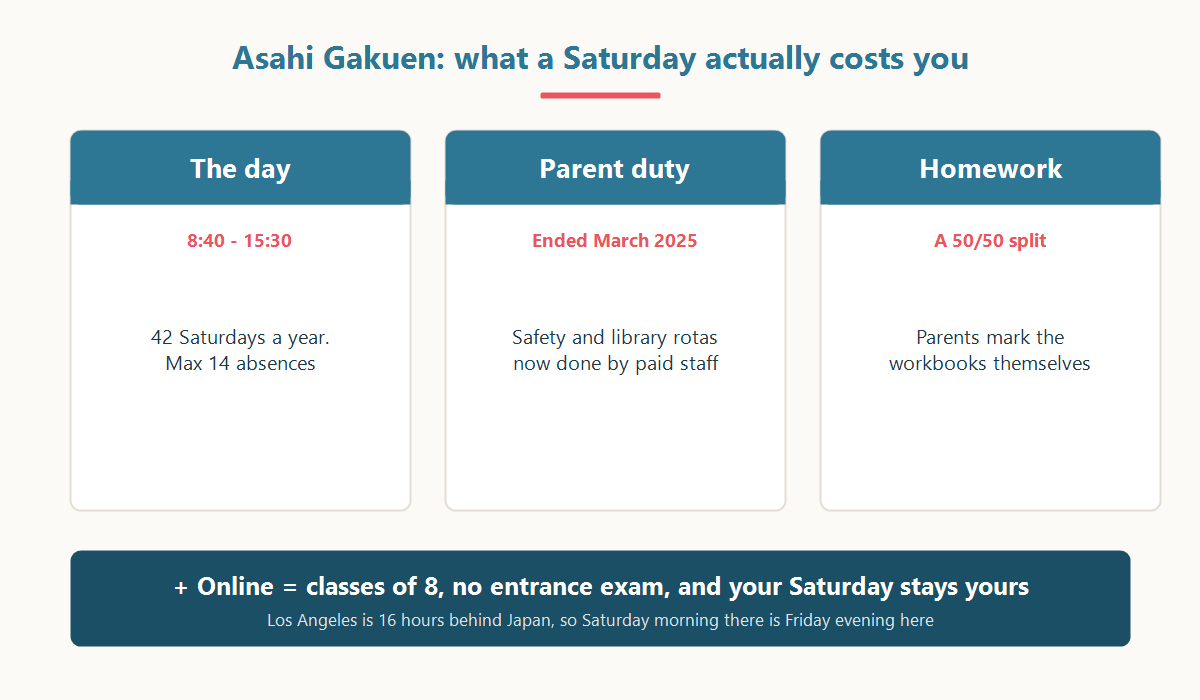
The Asahi Gakuen schedule is simple to state and almost impossible to find in English: every Saturday, 8:40am to 3:30pm, 42 Saturdays a year, April to March. English Wikipedia — the page that ranks first for this search — says classes start at 9:00am. It is citing a 1997 source, and a parent who follows it arrives fifteen minutes after the morning meeting has begun. The same page lists a Santa Monica campus the school left in September 2025, and tuition from 1986. This page gives you the real 2026–27 calendar, all four campuses with the addresses the school itself publishes, the current fee schedule, and the one change to parent obligations that every English page on the internet has missed.
The short answer
| When | Every Saturday, 8:40–15:30 (arrival from 8:40; morning meeting 8:45) |
| How many | 42 class Saturdays a year — 40 for kindergarten, 41 for entry and exit grades |
| Year runs | April to March, on the Japanese school calendar |
| 2026–27 | Opens 4 April 2026 · Sports Day 17 October · graduation 6 March 2027 · closing 13 March 2027 |
| Summer break | 27 June – 25 July 2026 (five Saturdays). Back on 1 August |
| Early finishes | Seven “minimum days” dismiss at 14:40; kindergarten at 14:00 |
| Campuses | Four. No catchment area — you choose |
Looking for a way to keep Japanese going from abroad?
TOMODACHI JAPAN is an online Japanese school for children growing up outside Japan. They talk with peers their own age in Japan every day, taught by teachers working at Japanese schools, in small classes of 8.
🎁 Register and we’ll email you our School Guide (PDF, in English) straight away. You’ll also be first to hear about tuition, scholarships and opening dates.
Free · takes about 30 seconds
The four campuses — and two names that mislead
Asahi Gakuen owns no buildings. All four campuses are rented rooms inside American public schools, on leases the school’s own handbook describes as renewed annually with no long-term guarantee. That is why the campuses keep moving, and why so many addresses online are wrong.
| Option | Where it actually is | When | Divisions | Enrolment (Apr 2026) | Notes |
|---|---|---|---|---|---|
| Torrance campus | South High School, 4801 Pacific Coast Highway, Torrance 90505 | Sat 8:40–15:30 | Kindergarten → high school | 358 — the largest | One of two campuses with the new 4-year-old class |
| Orange campus | La Quinta High School, 10372 W. McFadden Ave, Westminster 92683 — not the City of Orange | Sat 8:40–15:30 | Kindergarten → high school | 294 | The Orange County campus. Closed Sat 6 Feb 2027; class runs Sunday 7 Feb instead |
| Santa Monica campus | Marina Del Rey Middle School, 12500 Braddock Drive, Los Angeles 90066 — not in Santa Monica, and no longer Daniel Webster | Sat 8:40–15:30 | Kindergarten → high school (Global Course only) | 182 | Moved here September 2025. Global Course finishes 12:50 weekly |
| San Gabriel campus | South El Monte High School, 1001 N. Durfee Ave, South El Monte 91733 | Sat 8:40–15:30 | Kindergarten → middle school | 141 | No high school here |
| TOMODACHI JAPAN | Online, from anywhere in Southern California | Weekday and Fri/Sat evening slots, Pacific time | Ages 5–18 | Classes of 8 | No entrance exam, no Saturday, no campus run |
Two naming traps are worth stating plainly, because they send parents to the wrong place. The “Santa Monica” campus is not in Santa Monica — Marina Del Rey Middle School is in the Del Rey area of the City of Los Angeles. And the “Orange” campus is not in the City of Orange — La Quinta High School is in Westminster, in the Garden Grove Unified School District. If you searched “asahi gakuen orange county” and landed on an address on Trask Avenue in Garden Grove, that is Santiago High School, which the campus left in 2021.
The bell schedule: three different Saturdays
“Saturday, 8:40 to 3:30” is true on 25 of the 42 days. The school actually runs three timetables plus two half-day variants, and knowing which one your child has is the difference between a full day and a 14:40 pickup.
| A schedule (six 45-min periods) | B schedule (seven 40-min periods) | |
|---|---|---|
| Arrival | 8:40–8:45 | 8:40–8:45 |
| Morning meeting | 8:45–8:55 | 8:45–8:55 |
| Silent reading | 8:55–9:05 | 8:55–9:05 |
| Period 1 | 9:05–9:50 | 9:05–9:45 |
| Period 2 | 10:00–10:45 | 9:55–10:35 |
| Period 3 | 11:00–11:45 | 10:50–11:30 |
| Period 4 | 11:55–12:40 | 11:40–12:20 |
| Lunch | 12:40–13:25 | 12:20–13:00 |
| Period 5 | 13:25–14:10 | 13:00–13:40 |
| Period 6 | 14:20–15:05 | 13:50–14:30 |
| Period 7 | — | 14:40–15:20 |
| Kanji period | 15:05–15:20 | — |
| Dismissal | 15:30 | 15:30 |
Kindergarten runs its own day: arrival 8:40–8:50, four activity blocks, home at 15:00 — and the new 4-year-old class goes home at 14:00.
The 42 Saturdays: which ones you actually lose
The school numbers its class days 1 to 42. Between 4 April 2026 and 27 March 2027 there are 52 Saturdays; 42 are class days and 10 are free. Here is where the free ones fall.
| Period | Saturdays off |
|---|---|
| Summer | 27 June, 4, 11, 18 and 25 July 2026 — five Saturdays |
| Thanksgiving weekend | 28 November 2026 |
| Winter | 26 December 2026 and 2 January 2027 |
| After the closing ceremony | The two March Saturdays following 13 March 2027 |
Note the summer break carefully, because it catches families every year. It runs from late June to the end of July, and school resumes on Saturday 1 August 2026 — while local American schools are still on vacation. If you are planning a trip to Japan around the American summer, the Asahi calendar does not line up with it.
A few campus-specific differences that no third-party page lists. Orange is closed on Saturday 6 February 2027 and holds class on Sunday 7 February instead, because its host school has its own event — the only Sunday class day of the year. Orange also has a cultural festival on 23 January 2027 that the other three campuses do not. High-school speech contests fall on three different Saturdays by campus in November, and the hyakunin-isshu competitions split between 16 and 23 January. The school states in its handbook that events are subject to change and depend on the host school, so the live monthly calendar is always the authority.
Fees for 2026–27
English Wikipedia quotes $49.50 a month. That figure is from 1986. Here is what the school publishes today, from its 2026 handbook and its fee page.
| Item | Amount |
|---|---|
| Application fee | $120 per applicant — non-refundable for any reason |
| Entrance fee | $500, or $250 for JBA members. Half price from the second sibling |
| Tuition — kindergarten, elementary, middle | $270 / month × 11 months |
| Tuition — high school | $280 / month × 11 months |
| Sibling discount | −$10/month for the 2nd and 3rd child; −$20/month from the 4th |
| Facility fee | $20 / month × 11 months, all divisions |
| Supplementary materials | Not published — billed as needed, twice a year for elementary |
| Textbooks | Free for Japanese nationals in kindergarten, elementary and middle school. Charged for all high-school students and for elementary and middle students who are not Japanese nationals |
| PTA dues | None — see below |
Four mechanics worth knowing before you sign. Tuition is an annual figure split into 11 equal payments with July skipped, auto-debited on the second Thursday of each month — you pay the same whether the month has three class Saturdays or five, and regardless of attendance. Tuition includes accident insurance, with a $150 deductible on an approved claim. There is no refund of the final month’s tuition on withdrawal, ever. And unpaid tuition at year end blocks promotion and graduation.
One caution on a number you may find. Two of the school’s own admissions pages still show a $110 application fee; those pages describe the previous entry cycle. The $120 figure appears in the April 2026 handbook and on the transfer page updated on 25 August 2026. Use $120.
The thing every English page still gets wrong: parent duty
If you have read a forum thread or a blog post about what a Japanese Saturday school demands of parents, you will have been told about the rotating duty roster: safety duty, library duty, kindergarten helper shifts, officer posts, committee meetings. Everyone repeats it.
It stopped being true in March 2025.
The 2026 handbook records that the parents’ association moved to voluntary membership from the 2025 school year. Until then every parent was automatically a member and volunteering was an obligation. That system was abolished. All seven officer posts were eliminated — chair, vice-chair, treasurer, publicity, safety, library, events. The safety and library duty rotas and the kindergarten helper role were taken over by the school, which now employs paid staff to do them: each campus lists three safety staff and two or three library staff in its 2026 staffing tables. The class-representative role was folded into the homeroom teacher’s job, and the whole stack of associated meetings was abolished. The remaining bodies were even renamed.
This matters because parent workload is the single most common reason families talk themselves out of a Saturday school. The reason they cite is no longer the reason that applies.
But the harder obligation never went away
Here is the honest counterpoint, and it is the more important half. Asahi Gakuen removed the volunteer shift and kept the homework contract.
The school’s own teaching policy puts classroom study and home study at a literal 50/50 split. Homework arrives on a printed weekly plan. Parents are required to look at every piece and correct sloppy writing and mis-written characters; for elementary, parents mark the supplementary workbooks themselves from the answer key; and homework submission can affect promotion and graduation. On top of that:
- You must escort your child to and from the classroom door through grade 6 — so you are on campus at 8:40 and again at 15:30. Orange bans drop-off entirely and assigns parking by grade; Santa Monica requires a named dashboard permit for the youngest grades.
- You must read Japanese-language notices on the website every week. Paper is used only when something must be returned.
- You must be reachable all day Saturday, on a US phone number.
- Absences are capped: promotion requires missing no more than a third of the 42 days, which comes to a hard ceiling of 14. The teacher must contact you after three consecutive absences. Repeating a year is allowed once only, across the child’s entire school career.
- There is no school lunch — bring a bento. Juice is not allowed. There is no trial attendance, and no grade skipping.
So the fair summary is this: the price of admission is not four hours of library duty a year. It is one parent, every week, at the kitchen table, working in Japanese. Families who can do that get a great deal. Families who cannot should know it before they enrol, not in November.
Who can get in
There is no nationality requirement. This surprises people, and no English page says it. The published conditions are about capability, not passports: the child must be able to understand lessons conducted in Japanese and have basic daily-living habits established, and the parents must understand that a supplementary school supplements local schooling rather than replacing it — which in practice means reading Japanese and supervising the homework.
Citizenship does change one thing: textbooks are free for Japanese nationals in kindergarten, elementary and middle school, because Japan’s education ministry supplies them. Everyone else is billed.
New entry is only possible at three points — kindergarten, grade 1, and high school year 1 — with the exam in early February and briefings in October and December. Everything else, including entry into middle school year 1, is a transfer, and transfer exams run roughly every two weeks all year on a published schedule. Applications are online only. Campus choice is free: there is no catchment area, and you can move between campuses mid-year.
Two things the school offers that are worth knowing and are invisible in English. It provides a school counsellor at the school’s expense, and it issues Japanese 1 to Japanese 4 certificates carrying its WASC accreditation for students who have completed middle school year 2 through high school year 2 — which some American high schools accept for foreign-language credit. It costs $20 a certificate, and the school is careful to say credit is not guaranteed; confirm with your own school’s counsellor first.
Two corrections we owe you
The school is written あさひ学園, in hiragana. You will see 旭学園 written online; that is not the school’s own spelling.
And it is widely described as the largest supplementary Japanese school in the world. We were going to write that too, until we read the school’s own overview page, which says it has the second-largest enrolment — and then, in a different paragraph on the same page, says it competes for first or second. The school contradicts itself, so we will not state a rank. What we can state is the number: the handbook projects 975 students for April 2026, across Torrance 358, Orange 294, Santa Monica 182 and San Gabriel 141.
That number is worth sitting with. Enrolment was around 2,500 in 1988 and 1,009 in the tax year ending March 2025. This is a school that has been contracting for a generation, on annually renewed leases inside American public schools — which is precisely why the Santa Monica campus moved in 2025 and the Orange campus has moved five times since 1983. It is not a criticism of the school; it is context for a family deciding where the next ten years of Saturdays go.
How to decide, in three questions
1. Is your child going back into school in Japan? If yes, this is the right building and there is little to debate. Asahi Gakuen teaches the Japanese national curriculum on approved textbooks, with teachers dispatched from Japan, and it administers the same standardised tests used inside Japan. Nothing online replaces that.
2. Can your household actually give up 42 Saturdays? Not “would we like to” — can you, including the 8:40 drop-off and the 15:30 pickup at both ends, with a 14-absence ceiling, from April through March. Add the drive: for many Orange County and South Bay families this is the real cost, not the $270.
3. Can your child already follow a full day of lessons in Japanese? This is the entry condition, and it is the one that quietly excludes the most families. A child who speaks Japanese at home but has never studied it formally may sit below the line — and there is no trial attendance to find out.
If the answer to question 2 or 3 is no
This is where we come in, and we would rather be straight about the boundary than sell past it.
TOMODACHI JAPAN is an online Japanese school for children living outside Japan. We teach in classes of eight with a homeroom teacher, grouped by the level your child is actually at rather than by age, taught by teachers working to the standard of Japan’s current classrooms. There is no entrance exam, no requirement that a parent read Japanese correspondence, and no Saturday.
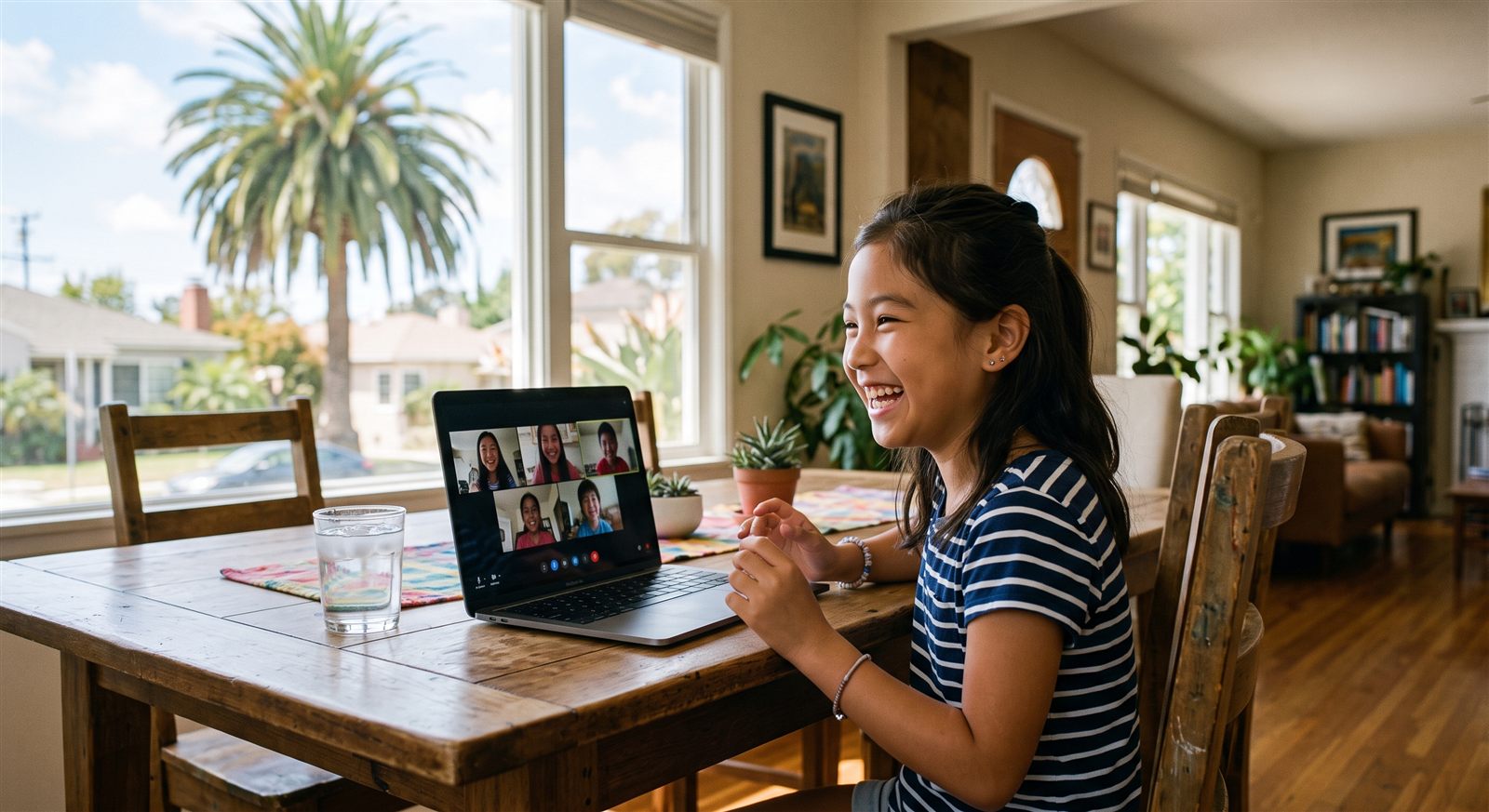
The time difference works in Southern California’s favour. Los Angeles runs 16 hours behind Japan, so Saturday morning in Japan is Friday evening here — Japanese children are awake and free at exactly the hour your child is finished for the week. Your Saturday stays yours.
What we do not do: we are not a supplementary school on Japan’s ministry list, and we do not issue the curriculum a child needs in order to slot back into a Japanese classroom. If your child is repatriating, Asahi Gakuen is the right answer and we will tell you so. What we are built for is the case Asahi is not designed to take: the child who is not going back to Japan but should not lose the language either, the child who sits below the entrance bar today, and the family for whom 42 Saturdays is simply not available.
Tuition, scholarships and the opening timetable are all in our school guide, which we send free to anyone who registers.
Frequently asked questions
What time does Asahi Gakuen start and finish?
Arrival is 8:40 and the morning meeting begins at 8:45. Dismissal is 15:30 on a normal day, 14:40 on the seven minimum days, and 14:00 for kindergarten on those days. Santa Monica’s high-school Global Course finishes at 12:50 every week. The widely quoted 9:00am start is from a 1997 source and is wrong.
How many Saturdays a year is it?
42 class days, all Saturdays except one Sunday at the Orange campus in February 2027. Kindergarten attends 40; entry and exit grades attend 41, because they go to either the entrance ceremony or the graduation, not both.
When is the summer break?
27 June to 25 July 2026 — five Saturdays — with school back in session on 1 August. It does not match the American school summer, which is the single most common planning mistake families make.
How much does Asahi Gakuen cost?
$270 a month for kindergarten through middle school, $280 for high school, billed over 11 months with July skipped, plus a $20 monthly facility fee. Add a $120 application fee and a $500 entrance fee ($250 for JBA members) in year one. Materials fees are not published. A first elementary year comes to about $3,810 on the published components.
Do we have to be Japanese citizens?
No. There is no nationality requirement. Your child must be able to follow lessons given in Japanese, and you must be able to read Japanese school communications and supervise the homework. Citizenship affects only textbooks, which are free for Japanese nationals in kindergarten through middle school.
Do parents still have to do volunteer duty?
No. Compulsory parent volunteering was abolished in March 2025; officer posts were eliminated and the safety and library rotas are now done by paid school staff. Weekly homework supervision, however, is still required, and the school treats home study as half of the programme.
Can we try a day before enrolling?
No. Trial attendance is explicitly refused; the school arranges visits instead. New entry is limited to kindergarten, grade 1 and high school year 1 with a February exam — everything else, including middle school year 1, goes through the transfer route, which runs roughly fortnightly all year.