“How long until I can watch anime without subtitles?” is one of the most-asked questions in Japanese learning, and almost every answer you will find online is either a made-up number of months or a shrug. Here is a more useful answer: a staircase of milestones you can actually test yourself against, a genre difficulty table that explains why one show feels impossible and another feels almost easy, and the one technique that moves you up a step faster than anything else.
First, why nobody can give you a number
Watching native adult media unaided is a genuinely high bar — higher than holding a conversation, and much higher than passing a beginner exam. Three variables move the finish line so much that any single figure is meaningless:
- Hours per week, and whether they are active. Four hours of shows with English subtitles is not four hours of study. Twenty minutes of shadowing is.
- Whether you also speak. Learners who talk to people build a faster ear, because conversation forces real-time processing that passive watching never does.
- Whether you can read. Japanese subtitles are a bridge to no subtitles. Learners who avoid kana stay stuck at the bottom of the staircase for years.
Vocabulary-count targets are shakier than people assume, too. It is worth knowing that the Japan Foundation stopped publishing official JLPT vocabulary lists after the 2010 revision; the test is described as measuring general communicative competence rather than a fixed word list. Every “N3 = 3,750 words” figure you see online is a community estimate reconstructed from textbooks and past papers, not an official specification. Use those numbers as a rough compass, never as a finish line.
Looking for a way to keep Japanese going from abroad?
TOMODACHI JAPAN is an online Japanese school for children growing up outside Japan. They talk with peers their own age in Japan every day, taught by teachers working at Japanese schools, in small classes of 8.
🎁 Register and we’ll email you our School Guide (PDF, in English) straight away. You’ll also be first to hear about tuition, scholarships and opening dates.
Free · takes about 30 seconds
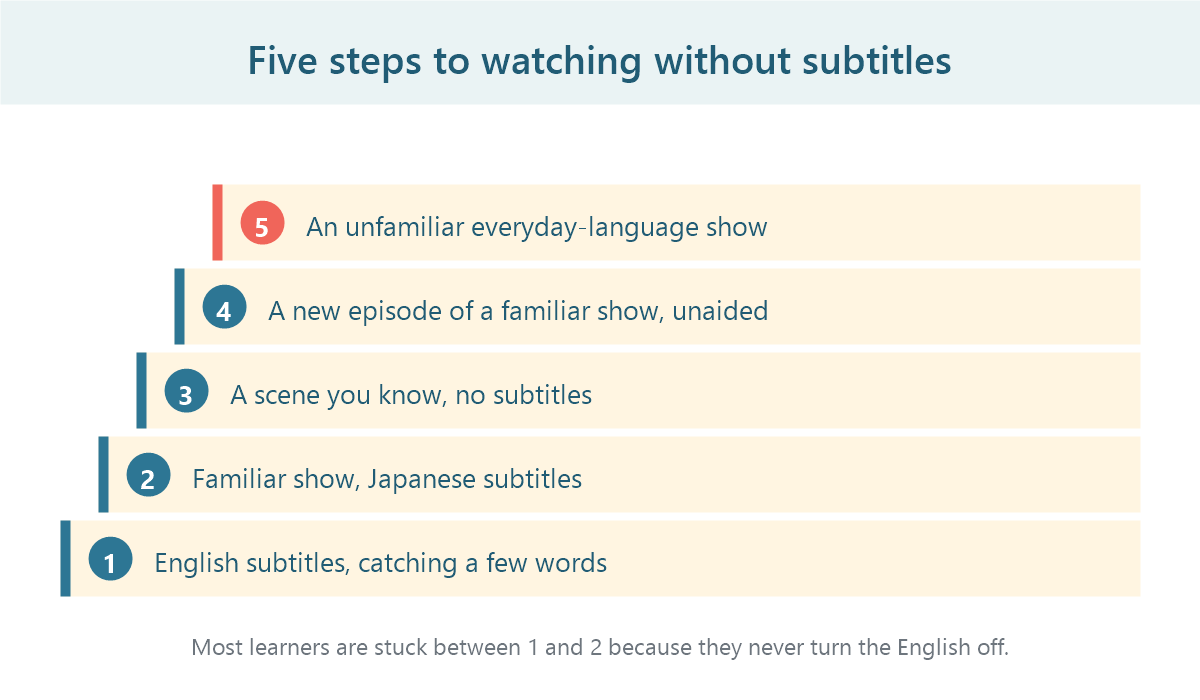
The staircase: five steps you can test today
Forget months. Find which step you are on, then work on the next one.
| Step | You can… | The drill that gets you to the next step |
|---|---|---|
| 1 | Follow a show with English subtitles and catch a handful of words | Switch to Japanese subtitles on a show you have already seen. Accept that you will understand less at first. |
| 2 | Follow a familiar show with Japanese subtitles | Rewatch one scene with subtitles off. Two minutes, not an episode. |
| 3 | Follow a scene you already know with no subtitles | Watch a new episode of the same familiar show with no subtitles, then check yourself with subtitles on. |
| 4 | Follow a new episode of a familiar, everyday-language show unaided | Move genre, not difficulty: a different slice-of-life show, same register. |
| 5 | Pick up an unfamiliar everyday-language show and follow the plot | Now widen: fantasy, historical, comedy — each brings its own vocabulary problem. |
An honest note on step 5: fluent adult learners often still miss jokes, wordplay, dialect and regional accents. “Watching without subtitles” is not a binary that switches on one day. It arrives genre by genre.
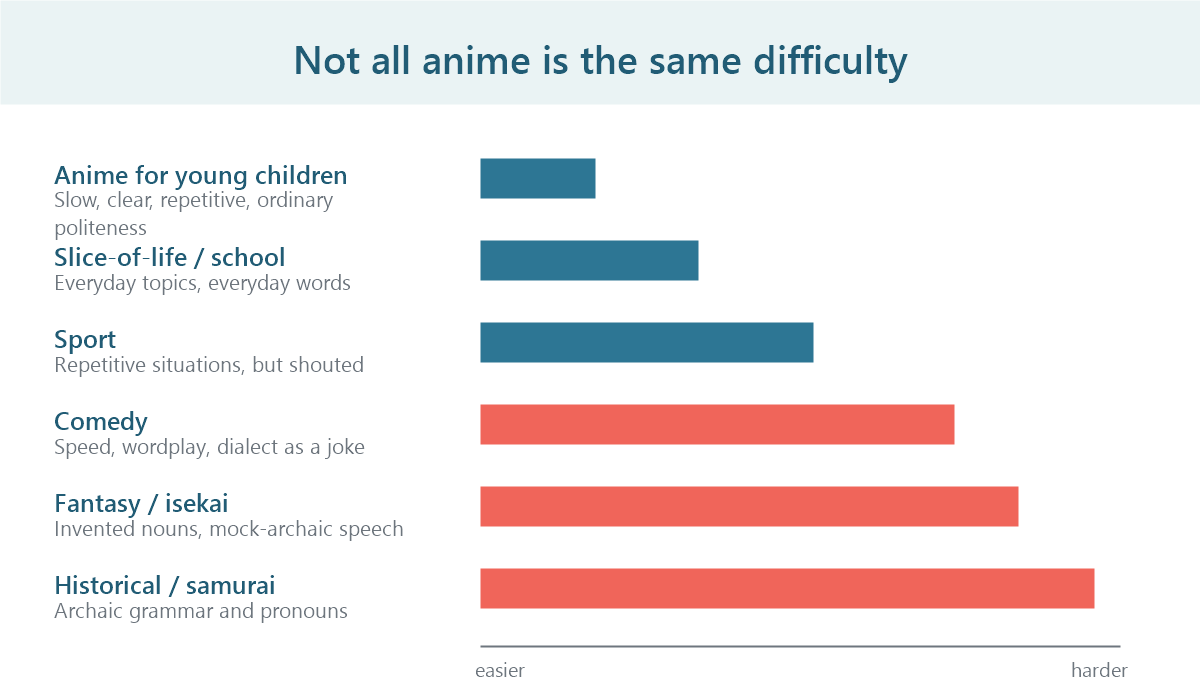
Not all anime is the same difficulty — not remotely
| Type of show | Difficulty | Why |
|---|---|---|
| Anime made for young Japanese children | Easiest | Slow, clear, repetitive, high-frequency vocabulary, ordinary politeness levels |
| Slice-of-life / school | Easy–moderate | Everyday topics and everyday words — the register you would actually use |
| Sport | Moderate | Repetitive situations, but shouted dialogue and specialist terms |
| Comedy | Hard | Speed, wordplay, cultural references, dialect used as a joke |
| Fantasy / isekai | Hard | Invented nouns you cannot look up, plus mock-archaic speech |
| Historical / samurai | Hardest | Archaic grammar and pronouns nobody has used for a century |
This matters for children especially. A child who is told to “watch anime in Japanese” and picks a battle series will hear an hour of shouted, invented and rude language and learn almost nothing usable. Children’s anime made for the Japanese domestic market is the single most underrated resource for a learner at steps 1–3.
The rewatch method
If you take one technique from this article, take this one. Learners try to move up the staircase by watching more shows. It works far better to watch the same material at decreasing levels of support.
One scene, four passes, about twelve minutes
- Pass 1 — English subtitles. Understand what happens. Once only.
- Pass 2 — Japanese subtitles. Now attach the words to the meaning you already have.
- Pass 3 — no subtitles. You will hear far more than you expect, because you are no longer decoding meaning and sound at the same time.
- Pass 4 — no subtitles, one week later. This is the pass that tells you whether it stuck.
Two-to-three-minute scenes. A whole episode four times is a chore; one scene four times is a Tuesday.
Pass 2 depends on the Japanese subtitles actually being available, which is not a given — we explained why, and how to fix it, in Japanese subtitles on Netflix. If you want to squeeze more out of pass 3, add a shadowing pass: the method is in shadowing Japanese.
What to do when you understand about 60%
Sixty per cent is the frustrating plateau where most learners stall: enough to follow the plot, not enough to feel comfortable, and no obvious next move. Three things break it.
- Stop watching new shows for a fortnight. Depth, not breadth. Rewatch what you nearly understand.
- Mine the gaps, do not mine everything. Note the three or four words per scene that blocked comprehension — not every unknown word. The blockers are usually common words you half-know.
- Start speaking, if you have not. The 60% plateau is very often a processing-speed problem rather than a vocabulary problem, and processing speed is built by conversation, not by more input.
That third point is the one people resist and the one that works. Listening comprehension climbs quickly with input alone and then flattens; learners who add real conversation start hearing faster because their brain is now doing the same job under time pressure in both directions.
For parents: is this a good goal for a child?
It is an excellent motivator and a poor target. “Watch anime without subtitles” sits years away for most children, and a goal that far off does not sustain a nine-year-old. Give them the staircase instead: this week we watch one scene with Japanese subtitles is a goal a child can win on Thursday. Children work for wins they can see.
And the honest caveat we give every family: no amount of watching makes a child speak. Input builds the ear; only output builds the voice. At TOMODACHI JAPAN, children learn in small groups with qualified Japanese teachers and with children who actually live in Japan — so the Japanese they absorb from a screen gets used on someone who answers back. Request the school guide here, or start with learning Japanese through anime.
FAQ
Realistically, how long does it take?
For an everyday-language show, learners who study consistently and speak regularly usually reach step 4 in a few years, not a few months — and reach it earlier for children’s anime than for anything aimed at adults. Anyone giving you a precise month count is guessing. Track your step, not the calendar.
Should I turn subtitles off completely to force myself?
Not as a permanent setting. Understanding almost nothing for an hour trains very little except frustration. Turn them off for short, familiar passages where you have a real chance, and back on when you do not.
Do English subtitles actively hurt?
They do not damage you, but they mostly stop the exercise being practice: the eye reads the English and the ear switches off. Use them for pass 1 to establish meaning, then get off them for the rest.
Is anime a bad way to learn because of the rude language?
It is a fine way to build listening and a risky way to build speech. The register problem is real — a lot of anime dialogue would be rude or bizarre in an actual conversation. Watch widely; copy selectively; have somebody who can tell you which lines are safe to use.