
Shadowing is the most recommended and most badly executed technique in Japanese learning. Almost every guide describes it as “listen and repeat” — which is not what shadowing is, and the difference is the whole point. This is how the method actually works, the staircase we take students up, a 15-minute routine you can start today, and an honest account of the one thing shadowing will never fix.
Shadowing is not repeating
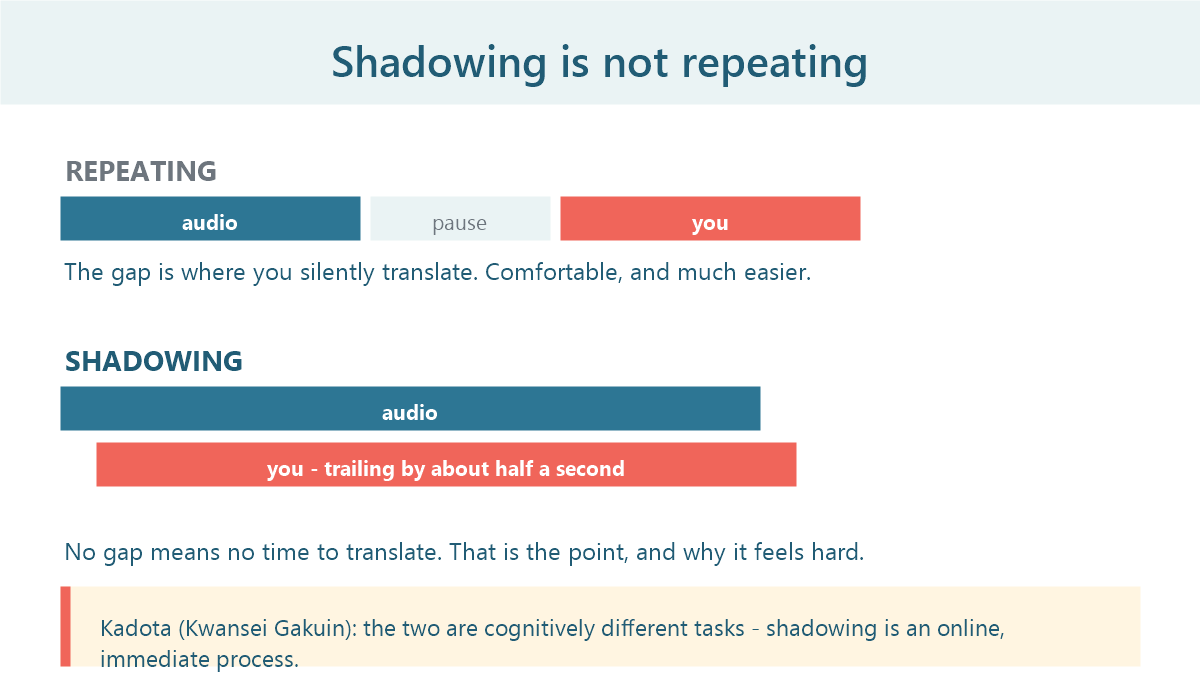
Repeating means you listen to a phrase, wait for a pause, then say it back. Shadowing means you speak while the audio is still playing, trailing it by a fraction of a second, with no pause to think in.
That sounds like a small difference. It is not. Shuhei Kadota, Professor Emeritus of Applied Linguistics at Kwansei Gakuin University and the author of Shadowing as a Practice in Second Language Acquisition: Connecting Inputs and Outputs (Routledge), argues that although repeating and shadowing look alike, they are cognitively different tasks: shadowing is an “online”, immediate process, while repeating happens after the fact, in a gap. Remove the gap and you remove the place where a learner silently translates. That is where the work happens.
Looking for a way to keep Japanese going from abroad?
TOMODACHI JAPAN is an online Japanese school for children growing up outside Japan. They talk with peers their own age in Japan every day, taught by teachers working at Japanese schools, in small classes of 8.
🎁 Register and we’ll email you our School Guide (PDF, in English) straight away. You’ll also be first to hear about tuition, scholarships and opening dates.
Free · takes about 30 seconds
The four things it trains at once
Kadota’s research describes shadowing as producing several distinct effects. In plain language, one exercise is doing four jobs:
| Effect | What it means when you are doing it |
|---|---|
| Input | Your listening comprehension improves, because you cannot shadow what you did not hear precisely. |
| Practice | It strengthens the subvocal rehearsal loop in phonological working memory — the mechanism that lets new words and set phrases stick. |
| Output | It simulates stages of real speech production, so your mouth learns the sequence before you have to invent one. |
| Monitoring | You start noticing your own errors while speaking, which is the skill that separates fluent learners from fast ones. |
The staircase: do not start at the top
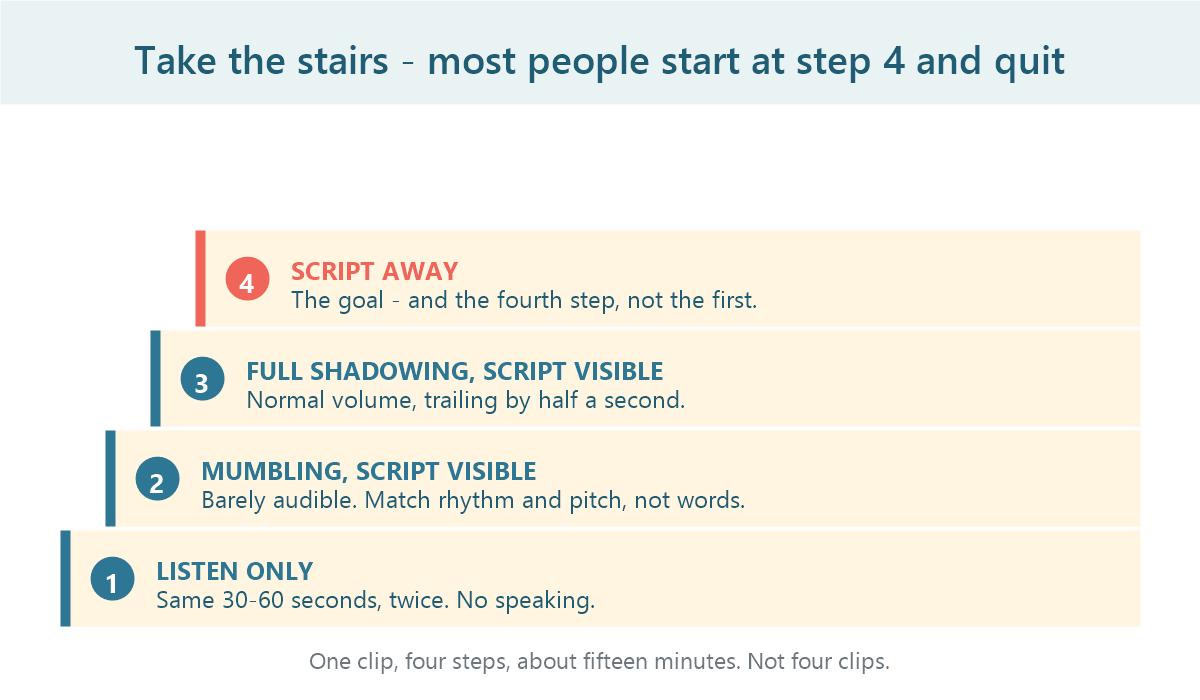
Most people who “tried shadowing and it didn’t work” started at step 4 with material that was too hard, could not keep up, felt stupid, and stopped. Take the stairs.
Four steps, in order
- Listen only. Same 30–60 seconds of audio, twice. No speaking. You are mapping the shape of it.
- Mumbling with the script. Script in front of you, voice barely above a whisper, matching the rhythm and pitch rather than the words. Ugly on purpose.
- Full shadowing with the script. Normal volume, script still visible, trailing the speaker by about half a second.
- Shadowing without the script. Script away. This is the goal, and it is the fourth step, not the first.
One clip, four steps, roughly fifteen minutes. Not four clips.
A 15-minute routine that fits a school night
| Minutes | What you do | Why |
|---|---|---|
| 0–2 | Play the clip twice, listening only | You cannot shadow what you cannot hear |
| 2–5 | Mumbling pass with the script | Rhythm and pitch before words |
| 5–10 | Two or three full passes with the script | Getting the mouth up to speed |
| 10–13 | One pass with the script hidden | The actual test |
| 13–15 | Record the last pass and listen back once | The step everyone skips, and the one that fixes pronunciation |
Use the same clip for about a week. It should feel boring by day four. Boring means it is becoming automatic, which is exactly what you paid for.
What to shadow — and the anime trap
| Material | Good for | Watch out for |
|---|---|---|
| Textbook shadowing audio | Clean speed, graded difficulty, a printed script | Can feel lifeless; pair it with something you enjoy |
| Anime and drama | Motivation, natural rhythm, real emotion | Register. A lot of anime speech is rough or archaic. Shadow it and you learn to sound like a swordsman. |
| NHK Easy news audio | Standard polite Japanese, current vocabulary | Formal register; not how you talk to a friend |
| YouTube vlogs by Japanese creators | Genuine casual speech at real speed | Often too fast for a first clip, and no script |
The register problem deserves a warning, because shadowing makes things automatic and automatic is hard to undo. If you shadow a character who says “omae”, drops every particle and barks commands, you are not learning Japanese; you are learning one character’s Japanese, at speed, into your muscle memory. Choose scenes where someone is talking to a friend, a teacher or a shopkeeper — ordinary registers you will actually need. If anime is your material of choice, get the subtitles set up properly first: we covered that in Japanese subtitles on Netflix, and picked shows worth using in anime with Japanese subtitles.
Five mistakes we see constantly
- Material that is too hard. If you do not already understand roughly 90% of the clip, you are not shadowing, you are guessing noises. Drop a level; nobody is watching.
- Shadowing silently. In your head does not count. The mouth is the muscle being trained. If you are somewhere you cannot speak, do the mumbling step instead.
- Never recording yourself. Learners are astonishingly bad at hearing their own pitch. Thirty seconds of playback finds errors that thirty minutes of practice will not.
- Changing clip every day. Variety feels productive and prevents automaticity. Repetition is the mechanism.
- Chasing accuracy over rhythm at the start. Japanese is pitch-accented and mora-timed; get the music right and the consonants follow. Perfect syllables in the wrong rhythm still sound foreign.
Shadowing with children
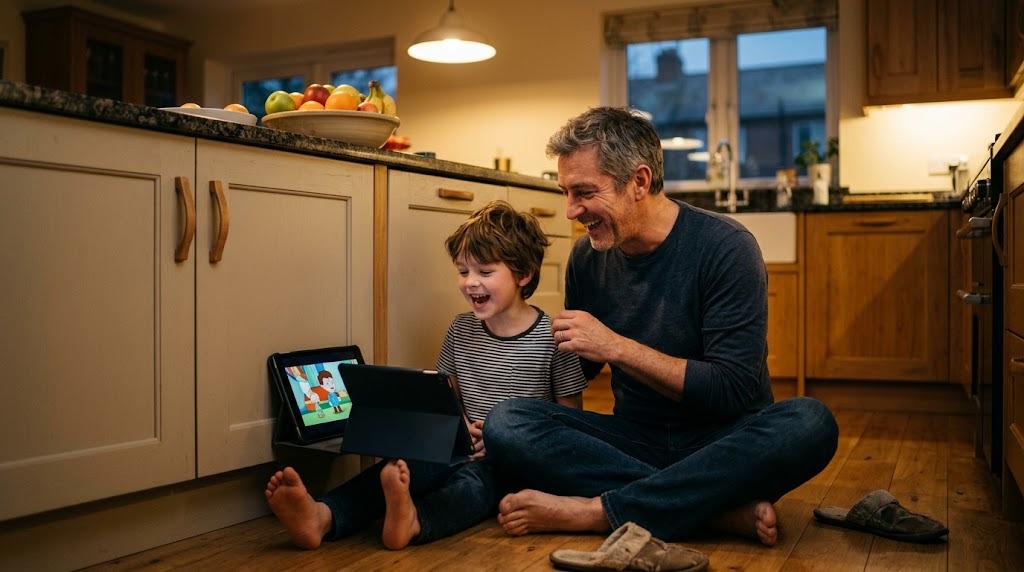
It works with children, with three modifications. Keep it to five minutes, not fifteen — attention, not stamina, is the limit. Use clips with visible faces, because children copy mouths as much as sounds. And make it a game with a scoreboard rather than an exercise: “can you say it at the same time as her?” beats “now we are going to practise shadowing.” A child who thinks they are winning something will do six repetitions without noticing.
The one thing shadowing will not fix
Shadowing builds a mouth that can produce Japanese quickly and accurately. It does not build the ability to decide what to say when a real person asks you something you did not prepare for. Every sentence you have shadowed was written by somebody else. Conversation is the part where you have to write it yourself, in a second, while someone waits.
That is why we treat shadowing as the warm-up, not the workout. At TOMODACHI JAPAN, children practise in small groups with qualified Japanese teachers and with children who actually live in Japan — so the rhythm they built alone this week gets spent on someone who answers back. Shadow on Monday, use it on Thursday. Request the school guide here. If your child is coming to Japanese through anime, this is the fuller path.
FAQ
How long before shadowing shows results?
Rhythm and listening usually shift within two to three weeks of daily 15-minute sessions, because those are the effects shadowing hits first. Vocabulary and confidence in conversation move more slowly, and depend on whether you are also speaking to people.
Is a shadowing app better than a book?
Whichever gives you a script, a playback speed control and a recorder. Those three features are the method; the packaging is not. A book with an audio download and your phone’s voice memo app is a complete setup.
Should I shadow with Japanese subtitles on?
For steps 2 and 3, yes — that is your script. For step 4, no. If the text is on screen you are reading aloud, which is a different and much easier task.
Can I shadow before I can read kana?
Yes, and young children often do it best, because they are not tempted to read. Skip the script steps and work purely by ear with very short clips. Ten seconds repeated ten times beats a minute heard once.