
The VCE Japanese study design is the document that governs everything: what your teacher must cover, what a SAC may ask, how your study score is built. It is written for teachers, so students rarely read it — which is a shame, because four facts inside it explain almost every result in this subject. Here they are, without the curriculum vocabulary.
Which study design applies to you
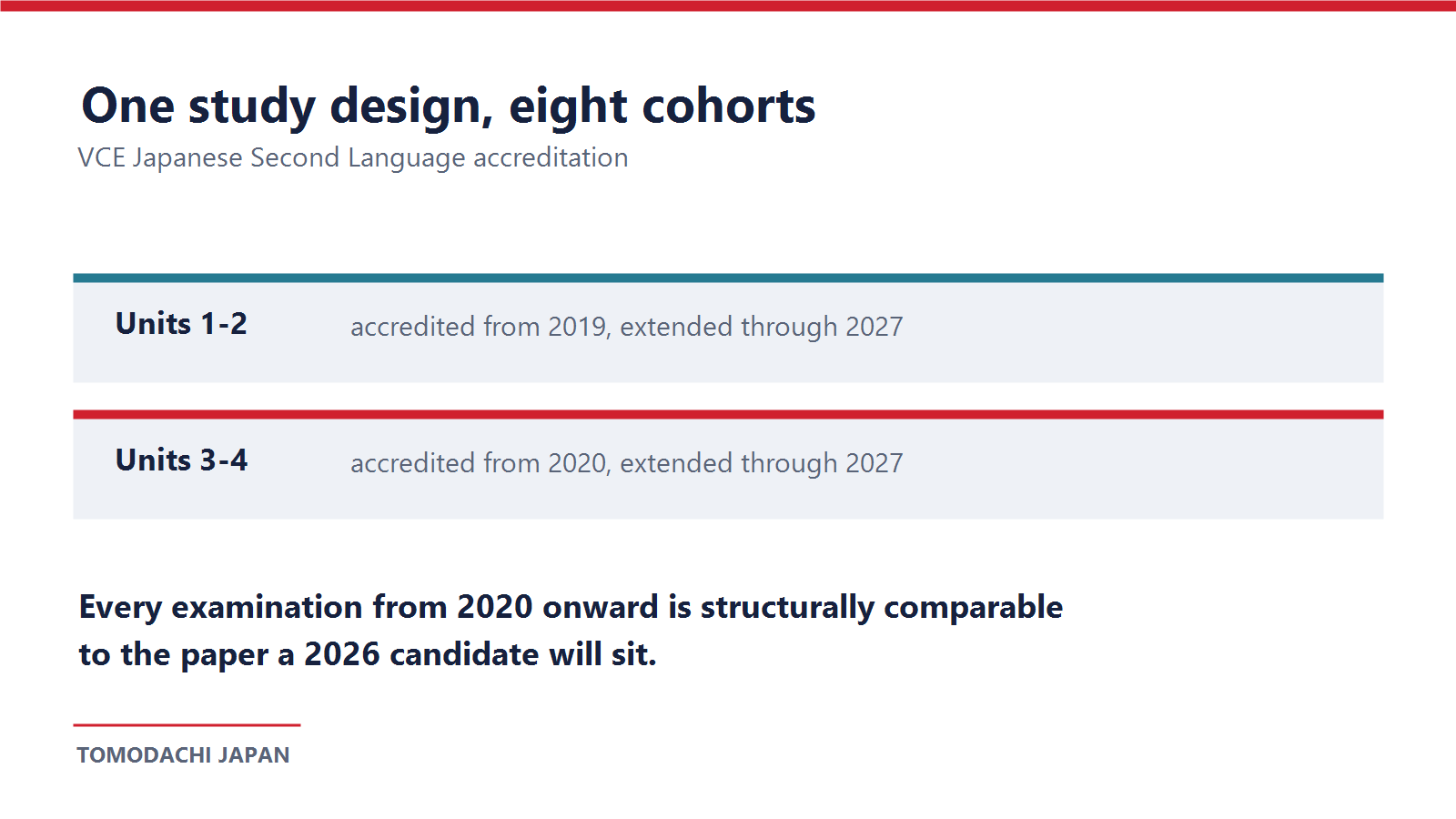
For VCE Japanese Second Language, the accreditation runs long: Units 1–2 from 2019, Units 3–4 from 2020, both extended through 2027. In practice that means a Year 12 student in 2026 is working under the same design as the 2020 cohort — so every examination from 2020 onward is structurally comparable to the one you will sit. That is unusually generous, as language study designs go, and it is the reason the recent past-paper archive is so useful.
Looking for a way to keep Japanese going from abroad?
TOMODACHI JAPAN is an online Japanese school for children growing up outside Japan. They talk with peers their own age in Japan every day, taught by teachers working at Japanese schools, in small classes of 8.
🎁 Register and we’ll email you our School Guide (PDF, in English) straight away. You’ll also be first to hear about tuition, scholarships and opening dates.
Free · takes about 30 seconds
Fact one: the themes decide everything
Content is organised under three prescribed themes — The Individual, The Japanese-Speaking Communities, plus The World Around Us. Every text you study, every SAC, every exam question grows from one of them.
The practical consequence: the oral examination’s general conversation draws on The Individual, meaning your own life is examinable material. Students who can describe their part-time job, their family’s routine, or why they chose their subjects will always outperform students who memorised a paragraph about Japanese festivals.
Fact two: there are five macro skills, not four
Language study in VCE rests on listening, speaking, reading, writing, plus viewing. Viewing is the one people skip. It is why authentic video — interviews, news segments, ordinary conversation on screen — counts as study rather than procrastination, provided you engage with it actively.
Fact three: how your study score is actually assembled
This is the number every family asks about, so here it is in one block:
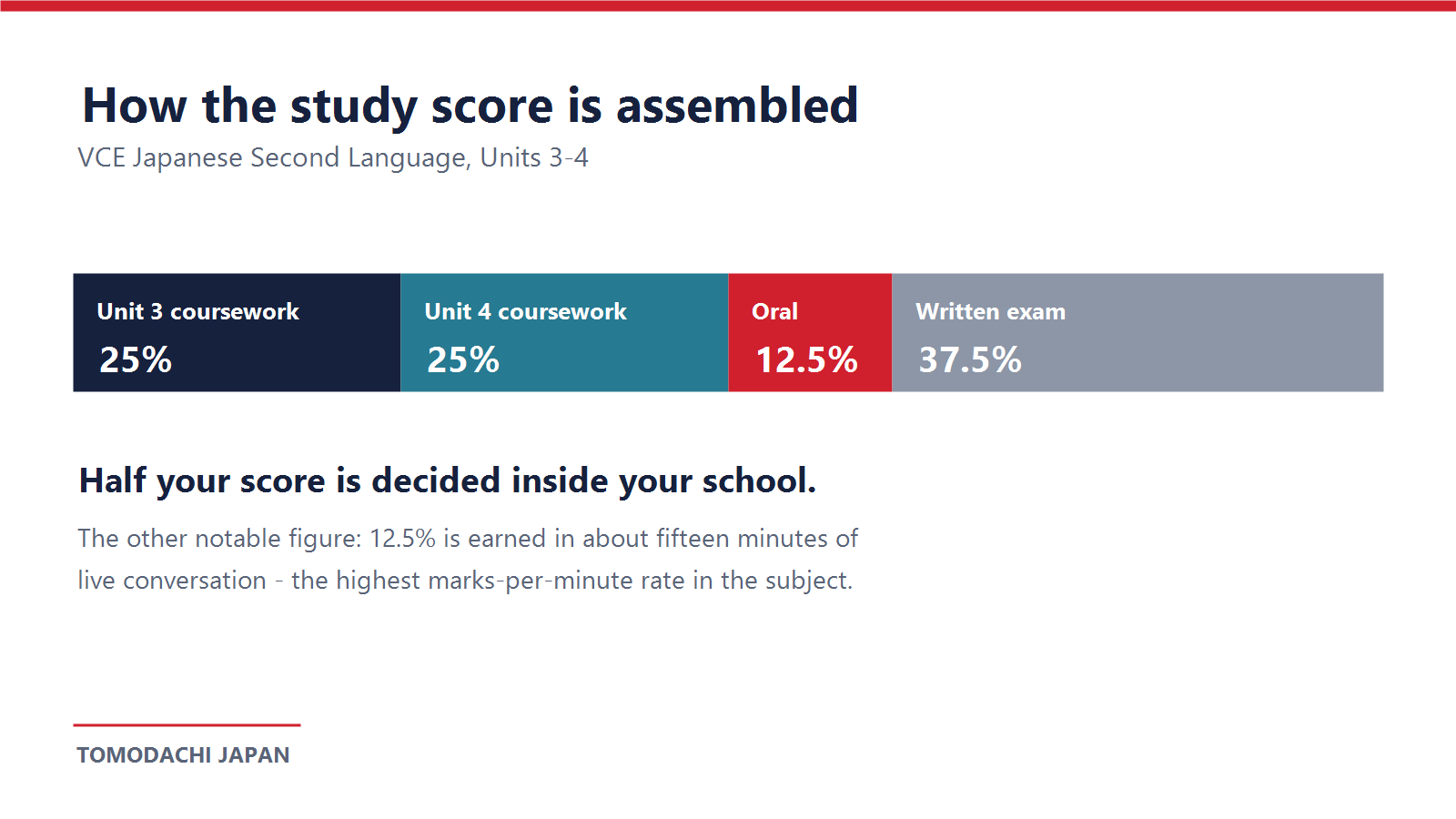
| Component | Contribution to study score |
|---|---|
| Unit 3 School-assessed Coursework | 25% |
| Unit 4 School-assessed Coursework | 25% |
| Oral examination | 12.5% |
| Written examination | 37.5% |
Two readings of that table are worth having. First, half your score is decided inside your school, across Units 3–4 coursework — so a weak first semester is expensive, not recoverable by a strong exam alone. Second, the oral is 12.5% earned in roughly fifteen minutes, which is the highest marks-per-minute rate anywhere in the subject.
Fact four: the hours are thinner than they look
Each unit involves at least 50 hours of scheduled classroom instruction. Across Units 3–4 that is around 100 hours in your final year, shared with a full class. Inside those hours sits the Detailed Study, itself around fifteen hours of work, which then supplies roughly eight minutes of your oral examination.
Do the division honestly and the conclusion is uncomfortable: a VCE Japanese student’s individual speaking time in class amounts to a few minutes a week, always with the same teacher’s voice. The study design assumes the rest happens somewhere. For most families, it does not — unless they arrange it.
Reading the study design as a study plan
- Pick your Detailed Study subtopic for talkability, not for interest alone. You will discuss it live for about eight minutes in October. Our guide to choosing a Detailed Study subtopic covers the trade-off.
- Treat the general conversation as examinable autobiography. Build vocabulary about your actual life, not about topics you will never be asked.
- Front-load coursework. Half the score is settled before the exam period begins.
- Convert viewing into speaking. Watch, then describe what you watched to a person. Passive input alone does not produce output.
That last point is where TOMODACHI JAPAN fits. Classes are small groups taught by teachers currently working in Japanese schools, alongside students in Japan of the same age — so the unfamiliar voices, the natural pace, plus the unscripted follow-up questions that the oral examination is built on become ordinary weekday practice rather than a once-a-term event.
Frequently asked questions
Where do I download the VCE Japanese study design?
From VCAA, on the Japanese Second Language study design page, together with advice for teachers plus examination specifications. Use VCAA directly rather than a school copy, which may be an earlier version.
Is Japanese First Language a different study design?
Yes — First Language is a separate study with its own design, aimed at a different cohort. Which one you may enrol in depends on your schooling history. See choosing between course levels.
How does scaling interact with this?
Scaling is applied after your study score is calculated, so it changes nothing about how you prepare. We cover what it means in practice in VCE Japanese scaling.
What should I read next?
The VCE Japanese oral exam, part by part, then the kanji list. Everything sits together on our HSC plus VCE Japanese hub.
Once you know what the study design asks for, the next step is seeing how it is actually examined. We walk through that in the VCE Japanese past exams.
Speaking practice, every weekday
TOMODACHI JAPAN opens in December 2026. Tell us your exam year — we’ll send opening news, class times for your state, plus trial-session details first.