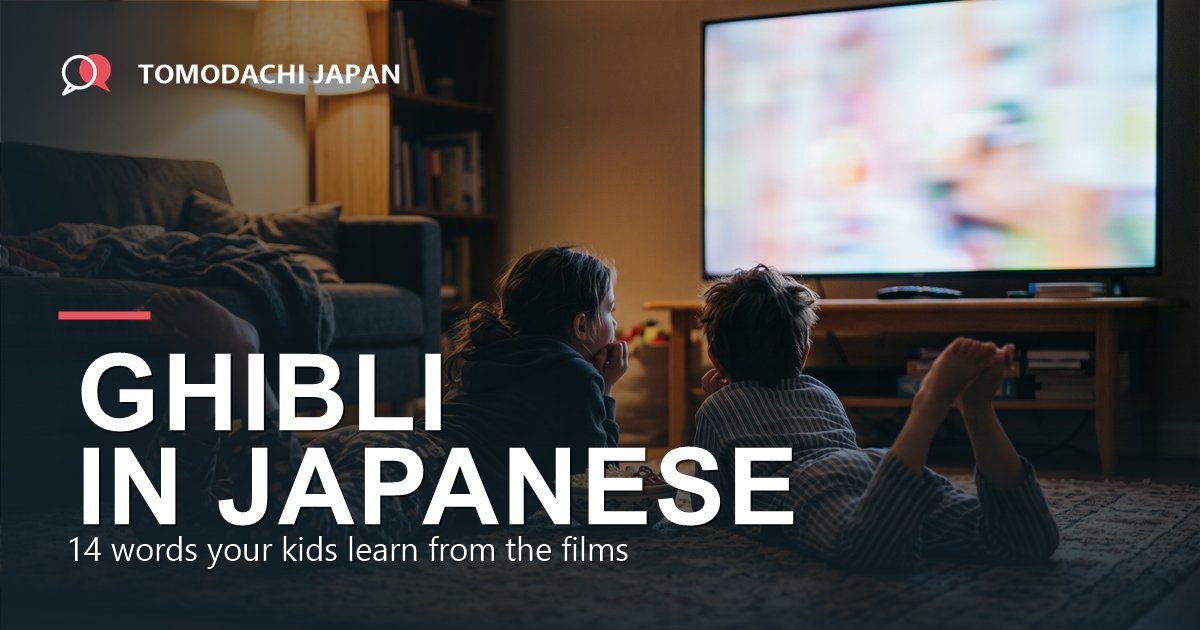
Ghibli films are the rare thing that a five-year-old and a fifteen-year-old will both sit through, and the Japanese in them is unusually clean — no shouting, no invented slang, mostly ordinary people speaking to each other. That makes them one of the best sources of real Japanese a child will ever enjoy. I’m a Japanese teacher, and this is Ghibli in Japanese: how the studio’s name is actually pronounced, what each film title literally says, and the fourteen words your child picks up without noticing.
Can-you-use-it legend: ◎ = safe, natural Japanese anyone can say · △ = fine in the right situation, or mostly literary · ✗ = don’t copy it.
How “Ghibli” is pronounced in Japanese
In Japanese it is ジブリ — ji-bu-ri, three flat beats. Not “gib-lee”, not “jib-lee” with a long first syllable. And the studio’s full name is スタジオジブリ (Sutajio Jiburi).
There’s a good story behind the mismatch. The word is Italian — ghibli, the hot wind that blows off the Sahara, later borrowed as the name of an Italian aircraft. Hayao Miyazaki, a lifelong aviation enthusiast, took the name from the plane. In Italian the “gh” is a hard g, so it should be “gibli”; the studio adopted the softer Japanese reading ジブリ and has kept it ever since. Both the studio and Miyazaki have acknowledged the mispronunciation and simply never changed it.
The teaching point for a learner: ジブリ is written in katakana because it’s a foreign word. Every time your child sees katakana, that’s the signal — this came from outside Japanese.
Looking for a way to keep Japanese going from abroad?
TOMODACHI JAPAN is an online Japanese school for children growing up outside Japan. They talk with peers their own age in Japan every day, taught by teachers working at Japanese schools, in small classes of 8.
🎁 Register and we’ll email you our School Guide (PDF, in English) straight away. You’ll also be first to hear about tuition, scholarships and opening dates.
Free · takes about 30 seconds
What the film titles actually say in Japanese
English release titles are marketing; the Japanese originals are usually plain description. Reading them side by side is one of the easiest ways to show a child that kanji are just words.
| Japanese title | Romaji | English release | Literally |
|---|---|---|---|
| となりのトトロ | Tonari no Totoro | My Neighbour Totoro | “The Totoro next door” — となり = next door |
| 千と千尋の神隠し | Sen to Chihiro no Kamikakushi | Spirited Away | “Sen and Chihiro’s spiriting-away” — 神隠し = “hidden by the gods” |
| 魔女の宅急便 | Majo no Takkyūbin | Kiki’s Delivery Service | “The witch’s home-delivery service” |
| 天空の城ラピュタ | Tenkū no Shiro Rapyuta | Castle in the Sky | “Laputa, the castle in the heavens” |
| 風の谷のナウシカ | Kaze no Tani no Naushika | Nausicaä of the Valley of the Wind | “Nausicaä of the valley of the wind” — a rare exact match |
| もののけ姫 | Mononoke-hime | Princess Mononoke | “Vengeful-spirit princess” — もののけ is not a name |
| ハウルの動く城 | Hauru no Ugoku Shiro | Howl’s Moving Castle | “Howl’s castle that moves” |
| 崖の上のポニョ | Gake no Ue no Ponyo | Ponyo | “Ponyo on top of the cliff” |
| 借りぐらしのアリエッティ | Karigurashi no Arietti | The Secret World of Arrietty | “Arrietty, who lives by borrowing” |
| 火垂るの墓 | Hotaru no Haka | Grave of the Fireflies | “Grave of the fireflies” — 火垂る is a deliberate, unusual spelling of hotaru |
| 君たちはどう生きるか | Kimitachi wa Dō Ikiru ka | The Boy and the Heron | “How do you all live?” — a question, not a description |
Notice how many of them are just [something] の [something]. That particle の is the single most useful thing in this table: it links two nouns, right to left. となりのトトロ is “next-door’s Totoro”. 崖の上のポニョ is “cliff’s-top’s Ponyo”. A child who reads five Ghibli titles has met の about a dozen times in its most natural form.
Two titles are worth a second look. 魔女の宅急便 uses 宅急便, which is a registered trademark of a real Japanese courier company — the everyday word is 宅配便 (takuhaibin). And もののけ姫 is routinely misread as a name: もののけ is a common noun for a vengeful spirit, so the title means “the spirit princess”, not “Princess Mononoke”.
14 words your child learns from the films
| Japanese | Romaji | English | Teacher’s note |
|---|---|---|---|
| となり | tonari | next door, next to | Everyday word. となりの席 = “the seat next to me”. |
| 風 | kaze | wind | Same kanji as 風邪 (a cold) — an old idea that illness rides the wind. |
| 谷 | tani | valley | The kanji is a picture of a valley mouth. |
| 空 | sora | sky | Also read kū meaning “empty” — same character, two ideas. |
| 城 | shiro | castle | Read -jō in place names: 大阪城 = Ōsaka-jō. |
| 崖 | gake | cliff | 山 (mountain) sitting on top of the shape — the kanji is the picture. |
| 海 | umi | sea | One of the first kanji Japanese children learn, in year 2. |
| 魔女 | majo | witch | 魔 (demon/magic) + 女 (woman). |
| 姫 | hime | princess | Attaches after a name: かぐや姫. |
| 神 | kami | god, spirit | Not a single god — Japanese kami are countless and local. |
| もののけ | mononoke | vengeful spirit | 物 (thing) + の + 怪 (mysterious). “The mysterious thing.” |
| 墓 | haka | grave | お墓参り (ohaka-mairi), visiting family graves, is a real annual custom. |
| 動く | ugoku | to move | Intransitive: the thing moves by itself. 動かす = to move something. |
| 引っ越し | hikkoshi | moving house | How both Totoro and Kiki begin. Genuinely useful for a family abroad. |
Can you actually use it?
| Japanese | Romaji | English | Can you use it? |
|---|---|---|---|
| いってきます | ittekimasu | I’m off (and I’ll be back) | ◎ Said every single morning in every Japanese home. Learn this one first. |
| いってらっしゃい | itterasshai | Off you go, come back safe | ◎ The reply to the above. A pair, always. |
| ただいま | tadaima | I’m home | ◎ Universal. Answered with おかえり. |
| ありがとう | arigatō | Thank you | ◎ Add ございます for adults. |
| だいじょうぶ | daijōbu | It’s OK / I’m fine | ◎ Probably the most useful word on this page. |
| がんばって | ganbatte | Do your best / good luck | ◎ Said constantly, at every age. |
| すごい | sugoi | Amazing | ◎ Safe in any company. |
| おのれ | onore | Curse you | △ Archaic and dramatic. Understand it; don’t say it. |
| 〜じゃ / 〜のう | -ja / -nō | (old person’s speech endings) | △ Used by elderly characters and witches. Nobody under 70 speaks this way. |
| だまれ | damare | Be silent | ✗ A command, and a harsh one. Never to a real person. |
Why Ghibli is a better politeness model than most anime
Most anime hands a learner one register — casual speech between friends of the same age. Ghibli films are full of adults, and children who have to talk to them. Kiki’s Delivery Service is the clearest case: Kiki is thirteen, living away from home, and speaking to shopkeepers, customers and landladies. So she uses the polite -masu forms all the way through, and switches to plain speech only with people her own age. That is precisely the distinction overseas learners get wrong, and here it’s demonstrated for ninety minutes without a single grammar explanation.
The counterweight: period films like Princess Mononoke use deliberately archaic Japanese. It’s beautiful, and a child who copies it will sound like they’ve walked out of a samurai drama. Watch it — just don’t treat it as a speaking model.
Frequently asked questions
How do you say Ghibli in Japanese?
ジブリ, pronounced ji-bu-ri — three even beats, no stressed syllable. The studio is スタジオジブリ (Sutajio Jiburi). The name is Italian in origin, where it would be “gibli” with a hard g; the Japanese reading has always been the softer ジ.
What does Ghibli mean?
It’s the Italian word for the hot wind that blows off the Sahara, later used as the name of an Italian aircraft. Miyazaki, an aviation enthusiast, borrowed it — the idea being a new wind blowing through Japanese animation. It has no meaning in Japanese at all, which is why it’s written in katakana.
Which Ghibli film is best for learning Japanese?
My Neighbour Totoro for ages four to nine — slow, domestic, and the vocabulary is family life. Kiki’s Delivery Service for ages six and up, and especially for anyone who needs to hear polite Japanese modelled properly. Save Spirited Away and Princess Mononoke for later; the speech is faster and, in Mononoke’s case, deliberately old-fashioned.
Should we watch Ghibli in Japanese or English?
Japanese audio, always, if the goal is language — the English dubs are well made but contain no Japanese input whatsoever. Use English subtitles at first, then Japanese subtitles once your child reads kana comfortably. We cover where to find them in anime with Japanese subtitles.
Can a child learn Japanese from Ghibli films alone?
They’ll build listening, vocabulary and a real feel for how Japanese sounds. What films cannot give is speaking, because nothing on screen replies. This is the gap parents describe to us most often — a child who understands a great deal and says almost nothing. At TOMODACHI JAPAN, children join small-group classes with qualified Japanese teachers and peers their own age living in Japan, so the words they absorbed on the sofa get used in an actual conversation. See our plans and pricing.