

Search “Japanese Saturday school London” and you get a confusing mix: a full-time Japanese day school, a Saturday supplementary school, three different campus addresses, and a handful of private tutors. Here is the short version. London has one established Japanese Saturday school — The Japanese Saturday School in London (ロンドン補習授業校) — and it runs across three campuses: Acton, Brent and Croydon. It is for children who attend a British or international school during the week and need to keep their Japanese moving at Japanese grade level. This guide covers where each campus is, who the school is really designed for, the honest limits of one morning a week, and what to do if the nearest campus is still an hour away.
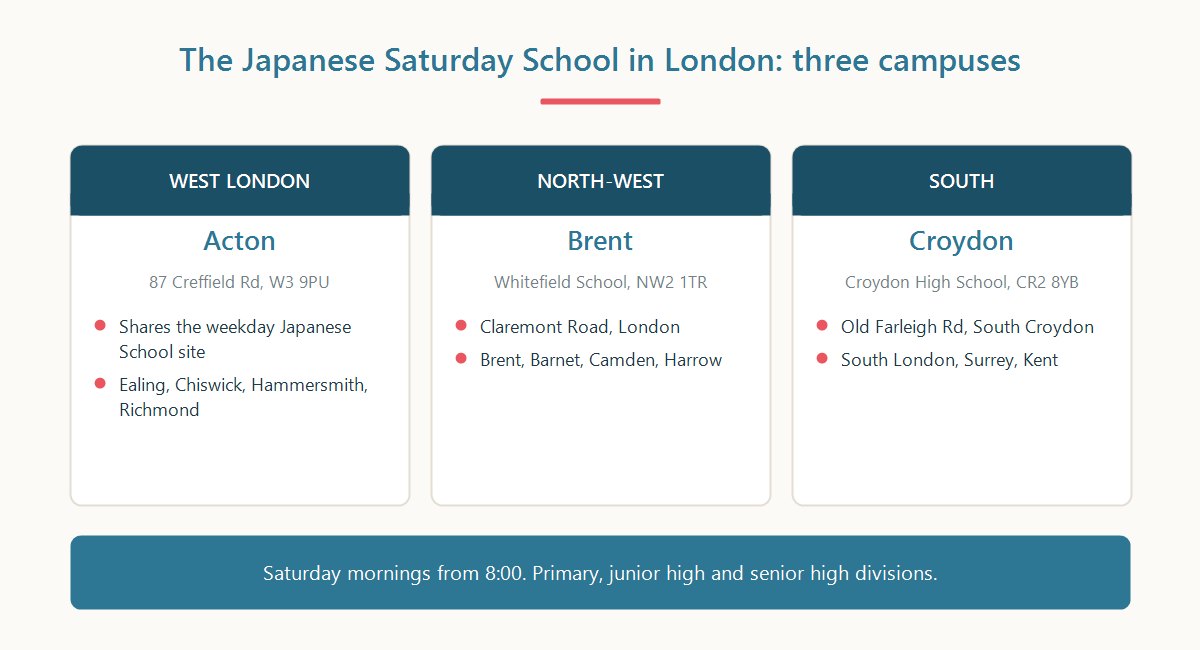
The three London campuses
| Campus | Host site | Address | Natural catchment |
|---|---|---|---|
| Acton | The Japanese School in London | 87 Creffield Rd, London W3 9PU | West London: Ealing, Acton, Chiswick, Hammersmith, Richmond |
| Brent | Whitefield School | Claremont Rd, London NW2 1TR | North & north-west London: Brent, Barnet, Camden, Harrow |
| Croydon | Croydon High School | Old Farleigh Rd, South Croydon CR2 8YB | South London & the south-east: Croydon, Bromley, Surrey, Kent |
All three run on Saturday mornings, with classes starting early — the day begins at 8:00 and secondary classes run from 9:25. The school has primary, junior high and senior high divisions, so it is possible for a child to stay with it right through to Year 13. General enquiries go to sat-london@thejapaneseschool.ltd.uk.
The Japanese Saturday School in London — official site
Looking for a way to keep Japanese going from abroad?
TOMODACHI JAPAN is an online Japanese school for children growing up outside Japan. They talk with peers their own age in Japan every day, taught by teachers working at Japanese schools, in small classes of 8.
🎁 Register and we’ll email you our School Guide (PDF, in English) straight away. You’ll also be first to hear about tuition, scholarships and opening dates.
Free · takes about 30 seconds
What a hoshuko is actually for — and what it is not
The word people search for is “Japanese Saturday school”, but the word the school itself uses is hoshuko — supplementary school. The distinction matters more than it sounds.
A hoshuko is not a Japanese class for beginners. It teaches Japan’s national curriculum, in Japanese, to children who are expected to keep pace with their peers in Japan. The core subject is kokugo — Japanese as a first language: kanji, reading comprehension, composition, the same textbooks used in Tokyo. Its unspoken purpose is to make it possible for a child to walk back into a Japanese classroom without falling behind.
That makes it superb for one kind of family and difficult for another. If your child was schooled in Japan, or has strong Japanese literacy at home, a hoshuko is the gold standard and nothing else comes close. If your child was born in London, speaks Japanese only with one parent, and has never written a composition in their life, they can find the pace punishing — and, more importantly, they can conclude that Japanese is the hard, unfun thing that eats their Saturday. Plenty of British-Japanese teenagers stopped speaking Japanese for exactly that reason.

Three London-specific things to plan around
- Three campuses do not cover London. Acton, Brent and Croydon are West, North-West and South. If you live in East London, Essex, Hertfordshire or the far side of the M25, the nearest campus can be an hour each way on a Saturday morning that begins at 8:00 — which means leaving the house before seven. For families in Reading, Milton Keynes, Cambridge or Brighton it is simply not viable weekly, and those families are the ones who most often write to us.
- The 8:00 start is not a typo. Saturday school in London genuinely starts early. Add the commute and it takes the whole morning. Weigh it against the other things a nine-year-old does on a Saturday — football, swimming, birthday parties — because the resentment that builds when Japanese is the reason a child misses everything is real, and it is corrosive.
- One morning a week is not the same as an environment. A hoshuko gives roughly three hours a week of Japanese. A child in Japan gets thirty. That gap is closed by homework and by the language spoken at home — not by the Saturday itself. The families who succeed treat the Saturday as the exam and the rest of the week as the study.
If the Saturday school does not fit: the honest alternatives
There are three real answers when the hoshuko is out of reach — too far, too full, too demanding, or simply making your child miserable.
- Private tutoring. Flexible, and excellent for exam preparation, but expensive in London and inherently one-to-one. A child who will not speak Japanese because they are self-conscious rarely loosens up in a room with one adult.
- GCSE and A-Level Japanese. A serious goal for older students, and worth planning years ahead because both reward literacy heavily. Not a solution for a seven-year-old.
- An online school based in Japan. This is the option that has changed most in the last few years, and it is the one that solves the London problem specifically — distance.
The online option: no Saturday, no drive, actual friends
The awkward truth about the UK is the time difference: Japan is nine hours ahead of London (eight in British Summer Time). A Japanese school afternoon is a British morning. But that cuts both ways — a class in Japan’s evening lands in the late London morning or early afternoon, and a Saturday session in Japan is a Saturday breakfast-time session in London. TOMODACHI JAPAN runs three daily time bands with timezone adjustment precisely so that European families can find one that works, rather than being told to be awake at four in the morning.
- The other children live in Japan. This is the difference that matters. In a London classroom, every child in the room also speaks English — so the moment the teacher turns away, the class reverts to English. Online with children in Japan, there is no shared fallback language. Japanese is simply how you take part.
- Unlimited attendance, one flat fee. One flat monthly fee for as many sessions as your child wants, in small groups of about eight with a homeroom teacher, taught by qualified, practising Japanese teachers. No per-hour arithmetic and no Saturday-only ceiling.
- Grouped by conversation level, not school year. A twelve-year-old with the Japanese of an eight-year-old is not put in front of twelve-year-old kokugo and asked to cope. That single design choice is why quiet children tend to start talking.

If you can reach Acton, Brent or Croydon, go and look at the school — a good hoshuko is a genuinely valuable thing and worth the early alarm. If you cannot, or if your child needs to enjoy Japanese again before they will work at it, an online school with children in Japan is not a consolation prize. For many London families it is the thing that keeps the language alive between Saturdays.
More guides for families in London and the UK
FAQ from London families
Is the Japanese Saturday School in London the same as the Japanese School in London?
No, although they are connected and share the Acton site. The Japanese School in London is a full-time weekday day school for children following the Japanese curriculum as their main education. The Japanese Saturday School is the supplementary school for children who attend a British or international school Monday to Friday and come in on Saturdays for Japanese. Most heritage families in London want the second one.
Does my child need to be a Japanese citizen to attend?
Ask the school directly — admission criteria at supplementary schools generally centre on the child’s ability to follow lessons conducted entirely in Japanese rather than on nationality. The practical filter is language level, not passport. Email sat-london@thejapaneseschool.ltd.uk with your child’s age and Japanese background and they will tell you what is realistic.
We live in East London. Is there anything closer than Acton?
Not within the London hoshuko itself — the three campuses are Acton, Brent and Croydon. From East London, Brent is usually the least bad option, but you should plan for an early start. This is the classic case where families run online lessons on weeknights and treat Saturday school as optional rather than the spine of the plan. Our guide to Japanese schools for kids in London compares every route in more detail.
My child says Saturday school is boring and wants to stop. What now?
Take it seriously rather than pushing through. In our experience the complaint is almost never about Japanese — it is about being the worst in the room, or missing every social thing their friends do on Saturdays. Both are fixable. Grouping by conversation level rather than school year removes the first; moving some of the load to weeknights removes the second. A child who quits at eleven usually does not come back; a child who finds Japanese friends their own age usually does not want to quit. We wrote about this in what to do when Japanese Saturday school is not working.
Japanese friends without the Saturday drive.
TOMODACHI JAPAN opens in December 2026. Get the free school guide by email — class times for your time zone, how the small-group classes work, plus tuition and scholarship details.