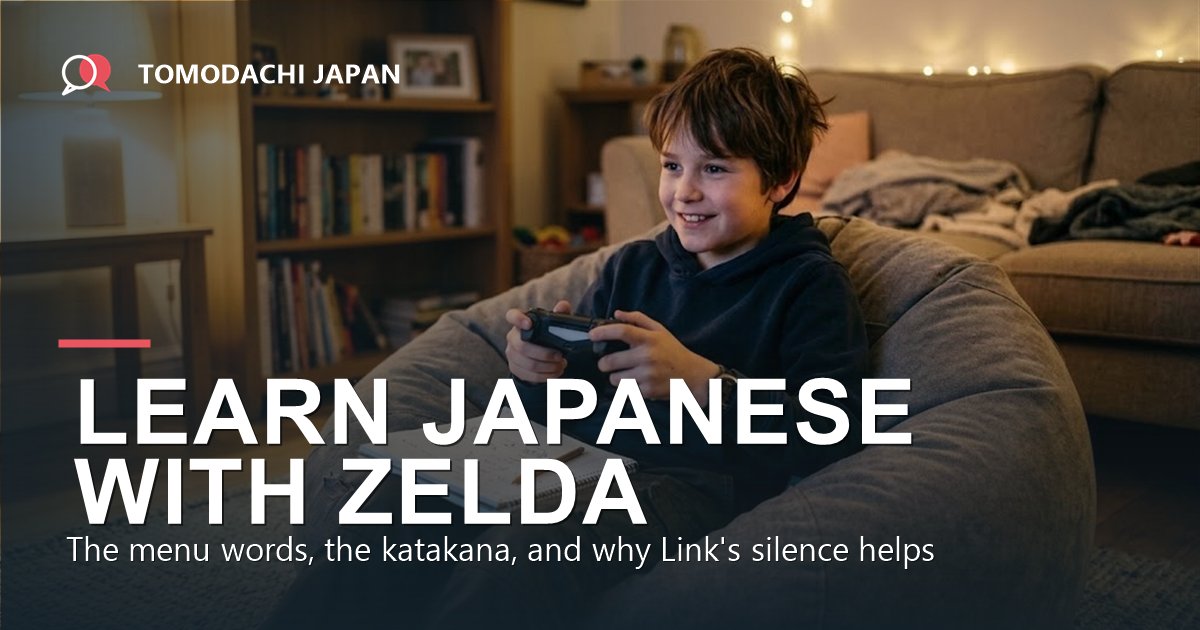
Here’s something most Japanese learners never try: switch The Legend of Zelda into Japanese and keep playing. You already know the map, the items and roughly what every menu does — which means the Japanese stops being a wall and starts being a puzzle you have most of the answers to. That’s an unusually good position to learn from. I’m a Japanese teacher, and this guide shows you how to learn Japanese with Zelda: what the game is actually called in Japan, the menu words you’ll meet in the first five minutes, and why Link’s silence turns out to be a gift.
Can-you-use-it legend: ◎ = real Japanese you’ll use outside the game · △ = game/fantasy vocabulary · ✗ = don’t say this to a person.
What Zelda is called in Japanese
| Japanese | Rōmaji | English | Note |
|---|---|---|---|
| ゼルダの伝説 | Zeruda no Densetsu | The Legend of Zelda | 伝説 = legend, lore |
| ブレス オブ ザ ワイルド | Buresu obu za Wairudo | Breath of the Wild | English, written in katakana |
| ティアーズ オブ ザ キングダム | Tiāzu obu za Kingudamu | Tears of the Kingdom | Same — pure katakana |
| 時のオカリナ | Toki no Okarina | Ocarina of Time | 時 = time |
| 神々のトライフォース | Kamigami no Toraifōsu | A Link to the Past | 神々 = the gods |
| 夢をみる島 | Yume o Miru Shima | Link’s Awakening | “The island that dreams” |
Teacher’s note — katakana practice, for free: Look at how many Zelda subtitles are English words written in katakana. Sounding out ブレス オブ ザ ワイルド is genuinely useful drilling, because katakana is where learners stay weak longest — hiragana gets practised constantly, katakana doesn’t. And you have to learn the Japanese sound system to decode it: there’s no “th,” so the becomes ザ; every consonant needs a vowel, so wild stretches into ワイルド. Getting fast at this unlocks menus in every Japanese game you’ll ever play.
Looking for a way to keep Japanese going from abroad?
TOMODACHI JAPAN is an online Japanese school for children growing up outside Japan. They talk with peers their own age in Japan every day, taught by teachers working at Japanese schools, in small classes of 8.
🎁 Register and we’ll email you our School Guide (PDF, in English) straight away. You’ll also be first to hear about tuition, scholarships and opening dates.
Free · takes about 30 seconds
The menu words you’ll see in every Japanese game
| Japanese | Rōmaji | English | Use it? |
|---|---|---|---|
| はじめる | hajimeru | Start / begin | ◎ Everyday verb |
| つづきから | tsuzuki kara | Continue (from where you left off) | ◎ 続き = continuation |
| ぼうけん | bōken (冒険) | Adventure | ◎ Common word |
| もちもの | mochimono (持ち物) | Inventory, belongings | ◎ Used in real life |
| そうび | sōbi (装備) | Equipment / to equip | △ Game & gear contexts |
| たいりょく | tairyoku (体力) | Stamina, physical strength | ◎ Very common word |
| こうげき | kōgeki (攻撃) | Attack | △ Games and news |
| ぼうぎょ | bōgyo (防御) | Defence | △ Games and sport |
| ほぞん | hozon (保存) | Save | ◎ Also “to preserve food” |
| せってい | settei (設定) | Settings | ◎ Every phone and app |
| ちず | chizu (地図) | Map | ◎ Everyday word |
| ほこら | hokora (祠) | Small shrine | △ Real word, niche |
Notice how many of these are ◎. 設定 is the settings menu on your phone. 保存 is the save button in every piece of software in Japan. 体力 is what a Japanese PE teacher measures. Game menus are unusually honest vocabulary — they’re the same nouns adults use all day, just attached to swords.
Why a silent protagonist is perfect for a learner
Teacher’s note: Link never speaks, and that turns out to be a real pedagogical advantage. In most anime you’re hearing a hero’s dramatic, rough, stylised speech — the kind you shouldn’t copy. In Zelda, everyone talks to you: villagers, shopkeepers, children, elders. So the Japanese you’re exposed to is people addressing a stranger politely, which is exactly the register a visitor to Japan needs.
You also get a free politeness lesson from the cast itself. Shopkeepers use ですます polite forms and shop keigo like いらっしゃいませ. Children speak casually. Ancient beings use archaic, ceremonial Japanese. Same game, three registers, clearly separated by who’s talking — the contrast that makes politeness levels finally click.
| Japanese | Rōmaji | English | Use it? |
|---|---|---|---|
| いらっしゃいませ。 | Irasshaimase. | Welcome (to a shop). | ◎ You’ll hear it everywhere in Japan |
| ありがとうございます。 | Arigatō gozaimasu. | Thank you (polite). | ◎ Essential |
| 気をつけて。 | Ki o tsukete. | Take care / be careful. | ◎ Said constantly |
| 手伝ってくれない? | Tetsudatte kurenai? | Could you help me? | ◎ Real request form |
| 行ってらっしゃい。 | Itterasshai. | Off you go / see you. | ◎ Daily household phrase |
| 危ない! | Abunai! | Look out! / Dangerous! | ◎ Genuinely useful |
How to actually do it without ruining the game
The mistake is switching a brand-new game to Japanese and getting stuck at the tutorial. Do it the other way round: replay something you’ve already finished. You know where to go, so you’re free to read. That single change is the difference between a fun experiment and a frustrating evening.
- Start with the menus, not the story. One session just reading 設定, もちもの, そうび until they’re instant.
- Set the system language, not just the game. On Switch, the console language drives most games’ text.
- Keep a five-word list per session. The same rule as anime: five words, written down, said out loud.
- Read shopkeepers carefully. They’re your politeness models — ですます forms in short, clear sentences.
- Don’t look everything up. Guessing from context is a skill, and games give you pictures to guess from.
Zelda pairs especially well with Pokémon, which is the other great katakana trainer — see our guide to learning Japanese with Pokémon — and with Genshin Impact, covered in our Genshin Japanese guide. Between them you’ll cover fantasy vocabulary, everyday nouns and a lot of katakana.
The limit is the same one every solo method hits. A game will show you a thousand sentences and never once ask you to produce one. Reading 手伝ってくれない? on screen and saying it to a friend who answers いいよ! are different skills, and only the second one is speaking Japanese.
Frequently asked questions
Can you really learn Japanese by playing Zelda?
You can build a lot of reading ability and vocabulary, especially katakana and everyday menu words like 設定 and 保存. What games can’t build is speaking, since nothing asks you to respond. Treat it as excellent reading practice attached to something you already enjoy.
What is Zelda called in Japanese?
ゼルダの伝説 (Zeruda no Densetsu) — “The Legend of Zelda.” 伝説 means legend or lore. Modern subtitles like Breath of the Wild are simply written in katakana as ブレス オブ ザ ワイルド, which makes them great pronunciation practice.
Is Zelda too hard for a beginner in Japanese?
Not if you replay a game you’ve already completed. Knowing the story removes the pressure to understand every line, so you can read at your own pace. Starting a brand-new game in Japanese is where beginners usually give up.
Which is better for learning Japanese, Zelda or Pokémon?
Pokémon is better for absolute beginners — shorter sentences, heavy katakana, lots of repetition. Zelda is better once you can read kana comfortably, because its NPCs use full polite sentences and several distinct speech registers.
How do we turn game Japanese into speaking ability?
The words need a listener. At TOMODACHI JAPAN, children join small-group classes with qualified Japanese teachers and peers living in Japan — so the vocabulary they picked up from a favourite game gets used out loud, in conversation. See our plans and pricing.