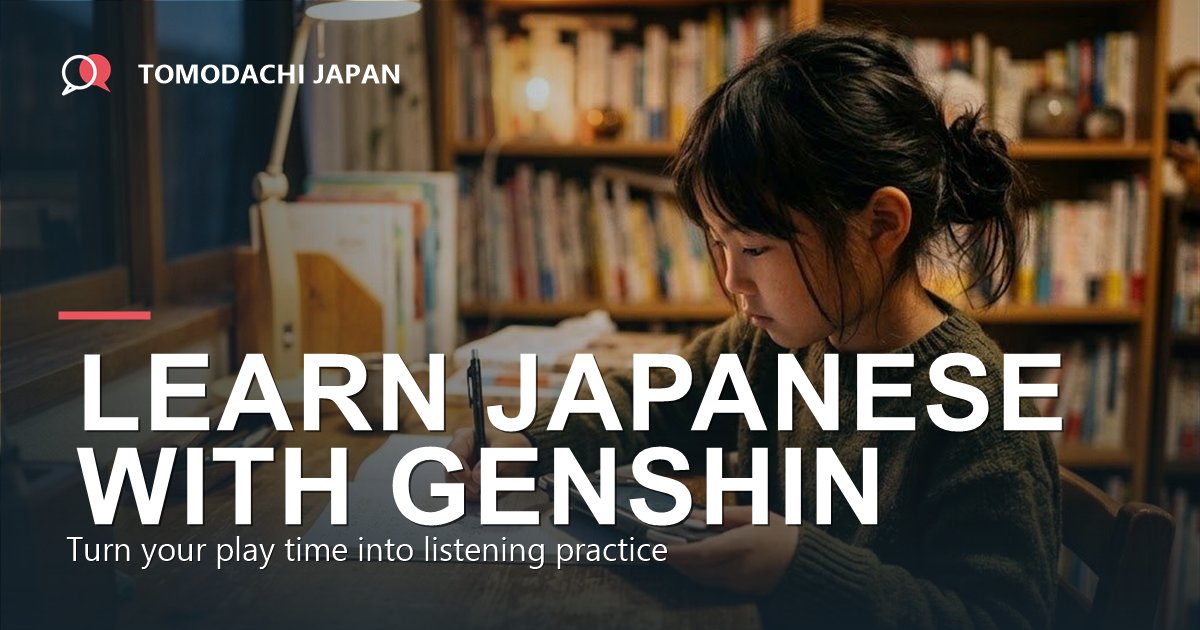
Genshin Impact has one of the best Japanese dubs in gaming — and if your child already plays for hours, that’s hours of listening practice hiding in plain sight. I’m a Japanese teacher, and in this guide I’ll show you how to learn Japanese with Genshin Impact: switch the voices to Japanese, and use Paimon’s catchphrases, everyday battle lines and katakana character names to actually build real vocabulary — with accurate original text, rōmaji and English.
Can-you-use-it legend: ◎ = natural everyday Japanese · △ = casual, friends only · ✗ = game only, odd in real life.

Paimon & the Traveler: phrases you’ll hear every session
| Japanese | Rōmaji | English | Use it? |
|---|---|---|---|
| いくよ! | Iku yo! | Let’s go! | ◎ Everyday |
| やったー! | Yattā! | We did it! / Yay! | ◎ Everyday joy |
| おなかすいた… | Onaka suita… | I’m hungry… (Paimon, always) | ◎ Essential |
| エヘヘってなんだよ! | Ehe tte nan da yo! | What do you mean, “ehe”?! | △ Casual — Paimon’s catchphrase |
| ありがとう! | Arigatō! | Thanks! | ◎ Essential |
Teacher’s note — Paimon’s catchphrase teaches a real particle: エヘヘってなんだよ! looks silly, but it hides one of the most useful particles in Japanese: って (tte), the casual quotation marker meaning “the thing called / when you say ~.” So エヘヘって = “this ‘ehe’ thing you keep saying.” You’ll use って constantly: 田中さんって優しいね (“Tanaka is kind, isn’t she”), 「無理」ってどういう意味? (“what does ‘muri’ mean?”). Genshin drops it into your ears every single session.
The everyday winners: いくよ! (iku yo, “let’s go”), やったー! (yattā, “we did it”), and Paimon’s eternal おなかすいた (onaka suita, “I’m hungry”) are all ◎ real Japanese you can use the moment you leave the game. The little particle よ (yo) on いくよ adds a friendly “hey, let’s” nudge — soft, natural, everywhere in spoken Japanese.
Looking for a way to keep Japanese going from abroad?
TOMODACHI JAPAN is an online Japanese school for children growing up outside Japan. They talk with peers their own age in Japan every day, taught by teachers working at Japanese schools, in small classes of 8.
🎁 Register and we’ll email you our School Guide (PDF, in English) straight away. You’ll also be first to hear about tuition, scholarships and opening dates.
Free · takes about 30 seconds
Katakana & game words: built-in reading practice
| Japanese | Rōmaji | English | Use it? |
|---|---|---|---|
| 冒険 | Bōken | adventure | ◎ Real word |
| 元素 | Genso | element | ◎ (game + science class!) |
| 任務 | Ninmu | quest / mission | ◎ Real word |
| 宝箱 | Takarabako | treasure chest | ◎ Fun compound |
| パイモン・旅人 | Paimon / Tabibito | Paimon / Traveler | ◎ Name + katakana practice |
Teacher’s note — names are your katakana workbook: Genshin’s character names are written in katakana (パイモン Paimon, ディルック Diluc, ウェンティ Venti) or kanji (神里綾華 Kamisato Ayaka, 鍾離 Zhongli). Reading those names as you play is painless katakana practice — the same skill you build with Pokémon names in katakana. And the menu words are real vocabulary you’ll meet outside the game too: 冒険 (bōken, adventure), 元素 (genso, element — yes, the one from chemistry), 宝箱 (takarabako = 宝 treasure + 箱 box). Kanji compounds are just Lego; learn the pieces and you can read new words on sight.
How to set it up: In Genshin’s settings, set the voice language to Japanese and keep the on-screen text in English (or Japanese, if your child is ready). Now every quest is listening practice: hear いくよ, read “Let’s go,” and the connection sticks — immersion, built right into a game they already love.
Game Japanese vs. real Japanese

Genshin’s dialogue is friendlier for learners than most action anime — lots of polite ~です/~ます, warm party banter, and clear voice acting. The main thing to watch is fantasy vocabulary (元素爆発 “elemental burst,” Stand-in-the-world lore words) that’s ✗ for real life. But the core — greetings, いくよ, やったー, ありがとう, おなかすいた, and the って particle — is genuinely usable. Play in Japanese for the listening; then take the words somewhere you can actually say them.
Because that’s the catch every gamer hits: you can understand hours of Japanese and still freeze when it’s your turn to speak. Listening is half the skill — the other half is using the words with a real person who answers back.
Frequently asked questions
Can you actually learn Japanese with Genshin Impact?
Yes, for listening and vocabulary. Set the voice language to Japanese and you’ll absorb greetings, everyday phrases and katakana names during play. It won’t teach you to speak on its own — for that you need to use the words with people — but it’s excellent, motivating input.
How do I switch Genshin to Japanese audio?
In Settings → Language, change the Voice Language to Japanese while leaving the text in English (or Japanese). This gives you Japanese listening with English support — one of the easiest immersion setups there is.
What does Paimon’s “ehe tte nan da yo” mean?
Roughly “What do you mean, ‘ehe’?!” The key part is って (tte), a casual quotation particle meaning “this thing you said.” It’s a genuinely useful piece of grammar. For more game-based learning, see our guide to learning Japanese with Pokémon.
Where can my child practise speaking what they hear in Genshin?
At TOMODACHI JAPAN, kids join small-group classes with peers who live in Japan and real Japanese teachers — so game phrases like いくよ and やったー become real, spoken conversation. See our plans and pricing.