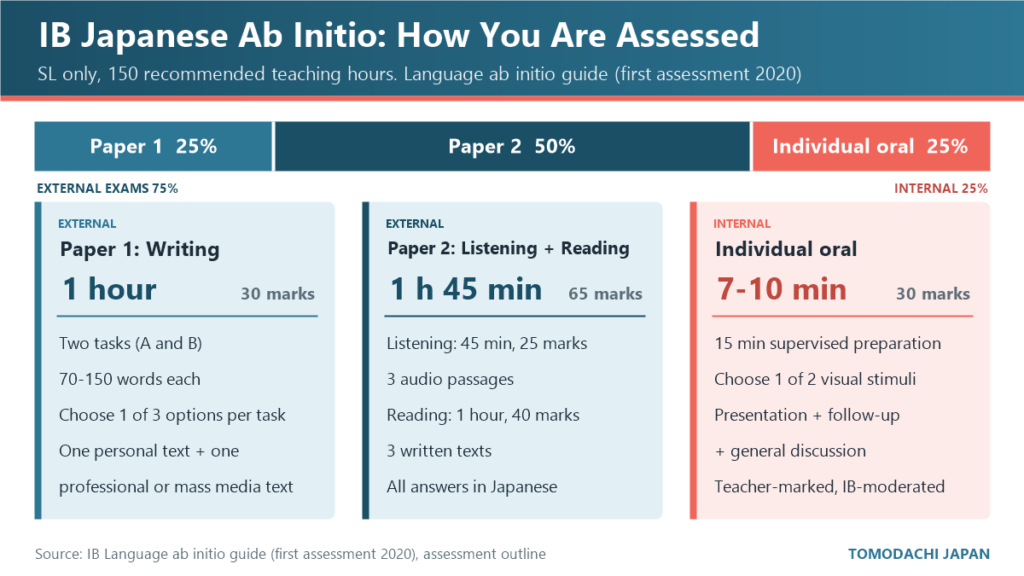
IB Japanese ab initio is the IB Diploma Programme course for genuine beginners in Japanese, and it is offered at Standard Level only. You are assessed three ways: Paper 1 (writing, 1 hour, 25%), Paper 2 (listening and reading, 1 hour 45 minutes, 50%) and an individual oral with your teacher (7–10 minutes, 25%). Everything is built around five prescribed themes and 20 prescribed topics.
This guide is checked against the IB’s own Language ab initio guide (first assessment 2020) and the IB’s announcement of the revised course first assessed in 2029. You’ll find the exact assessment structure, who may and may not take ab initio, a topic-by-topic Japanese vocabulary list, Paper 1 openings and sign-offs by text type, an individual oral question bank, and the legal places to get past papers and grade boundaries. Where the IB keeps details inside documents that only schools can open, we say so instead of guessing.

IB Japanese ab initio at a glance
The IB recommends 150 teaching hours for the course. Three quarters of your grade comes from the two exams at the end of the course, and one quarter from the oral, which your teacher conducts and marks at school before the IB moderates it.
| Component | What you do | Time | Marks | Weight |
|---|---|---|---|---|
| Paper 1 (writing, external) | Two tasks, A and B, each 70–150 words. For each task you choose one of three options, each from a different theme, and a text type from the list given. | 1 hour | 30 | 25% |
| Paper 2 (listening, external) | Comprehension questions on three audio passages | 45 minutes | 25 | 50% for Paper 2 as a whole |
| Paper 2 (reading, external) | Comprehension questions on three written texts | 1 hour | 40 | |
| Individual oral (internal) | A conversation with your teacher based on a visual stimulus and at least one additional theme | 15 minutes preparation, then 7–10 minutes | 30 | 25% |
Three rules from the guide shape how you should prepare:
- Paper 2 answers are in Japanese. The guide states that all audio and written passages are in the target language and all answers must be provided in the target language. Practice answering comprehension questions in Japanese from the start, not only in English.
- No dictionaries in Paper 1 or Paper 2.
- One personal text, one other text in Paper 1. The IB tells schools to expect one task to require a personal text (an email or a diary entry, for example) and the other a professional or mass media text (a notice, a brochure or an article, for example).
Looking for a way to keep Japanese going from abroad?
TOMODACHI JAPAN is an online Japanese school for children growing up outside Japan. They talk with peers their own age in Japan every day, taught by teachers working at Japanese schools, in small classes of 8.
🎁 Register and we’ll email you our School Guide (PDF, in English) straight away. You’ll also be first to hear about tuition, scholarships and opening dates.
Free · takes about 30 seconds
Which syllabus are you on? 2020 guide vs the course first assessed in 2029
The current Language ab initio guide was first assessed in 2020, and it is the one this article follows. The IB has also announced a revised language ab initio course: according to its curriculum updates page, the new course launches in February 2027 for first teaching in August 2027, with first assessment in May 2029. The IB says the review does not change the assessment model or the assessed components, and the five themes with four topics each remain.
In practice: if you sit your final exams in 2027 or 2028, you are on the 2020 guide. If you start the two-year course in August 2027, you will be on the revised course, which should feel very familiar. Your DP coordinator can confirm which applies to your session.
Japanese ab initio or Japanese B: who should take which?
This is the question most families ask first, and the IB is unusually firm about it. The guide describes ab initio as a course for students with no prior experience of the target language, or very limited previous exposure. It then adds that any student who is already able to understand and respond to spoken and written language on a range of common topics is not to be placed in ab initio, because it would not be an appropriate challenge and would not be fair to genuine beginners.
| Japanese ab initio | Japanese B | |
|---|---|---|
| Who it is for | Beginners with no or very limited previous exposure to Japanese | Students with some previous experience of Japanese |
| Levels | SL only (150 recommended hours) | SL (150 hours) or HL (240 hours) |
| Themes | Same five themes, with 20 prescribed topics | Same five themes, with recommended (not prescribed) topics |
| Paper 1 | Two tasks of 70–150 words, 1 hour | One task, 1 hour 15 minutes (SL) or 1 hour 30 minutes (HL) |
| Oral stimulus | A visual stimulus (photo, poster, illustration or advertisement) | A visual image (SL) or a literary extract (HL) |
| Literature | Not assessed | Two literary works at HL |
Can a student with Japanese heritage take ab initio?
The guide does not ban any nationality or family background. The test is ability, not ancestry. The IB says it is not possible to list specific conditions such as hours of previous study, so placement is the school’s decision, made against the rule above. A student with a Japanese parent who has never really used the language may genuinely be a beginner. A student who chats with grandparents in Japanese about school and food can already understand and respond on common topics, and under the guide should not be in ab initio. For that student, Japanese B, or a Japanese course in Group 1 if their skills are strong, is the intended route. If you are unsure, ask your DP coordinator early, before course choices are locked.
The five themes and 20 topics, with a Japanese vocabulary list
Unlike Japanese B, ab initio prescribes its topics: four for each theme, 20 in total, and the course must cover all of them. That makes vocabulary planning simple. The table below lists the prescribed topics exactly as the IB groups them, with core words our teachers would expect a strong ab initio student to know for each one. It is our teaching list, not an IB list; your school’s language-specific syllabus is the official reference for structures and scope.
| Theme / prescribed topic | Japanese | Kana reading | Romaji | English |
|---|---|---|---|---|
| Identities | ||||
| Personal attributes | 性格 | せいかく | seikaku | personality |
| Personal attributes | 優しい | やさしい | yasashii | kind, gentle |
| Personal relationships | 家族 | かぞく | kazoku | family |
| Personal relationships | 兄弟 | きょうだい | kyōdai | siblings |
| Eating and drinking | 朝ご飯 | あさごはん | asagohan | breakfast |
| Eating and drinking | 野菜 | やさい | yasai | vegetables |
| Physical well-being | 健康 | けんこう | kenkō | health |
| Physical well-being | 運動する | うんどうする | undō suru | to exercise |
| Experiences | ||||
| Daily routine | 起きる | おきる | okiru | to get up |
| Daily routine | 毎日 | まいにち | mainichi | every day |
| Leisure | 趣味 | しゅみ | shumi | hobby |
| Leisure | 部活 | ぶかつ | bukatsu | school club activities |
| Holidays | 夏休み | なつやすみ | natsuyasumi | summer vacation |
| Holidays | 旅行 | りょこう | ryokō | trip, travel |
| Festivals and celebrations | お正月 | おしょうがつ | oshōgatsu | New Year |
| Festivals and celebrations | お祭り | おまつり | omatsuri | festival |
| Human ingenuity | ||||
| Transport | 電車 | でんしゃ | densha | train |
| Transport | 自転車 | じてんしゃ | jitensha | bicycle |
| Entertainment | 映画 | えいが | eiga | movie |
| Entertainment | 音楽 | おんがく | ongaku | music |
| Media | 新聞 | しんぶん | shinbun | newspaper |
| Media | ニュース | ニュース | nyūsu | news |
| Technology | スマホ | スマホ | sumaho | smartphone |
| Technology | 便利 | べんり | benri | convenient |
| Social organization | ||||
| Neighborhood | 近所 | きんじょ | kinjo | neighborhood |
| Neighborhood | 公園 | こうえん | kōen | park |
| Education | 授業 | じゅぎょう | jugyō | class, lesson |
| Education | 宿題 | しゅくだい | shukudai | homework |
| The workplace | 仕事 | しごと | shigoto | work, job |
| The workplace | アルバイト | アルバイト | arubaito | part-time job |
| Social issues | 問題 | もんだい | mondai | problem, issue |
| Social issues | ボランティア | ボランティア | borantia | volunteering |
| Sharing the planet | ||||
| Climate | 天気 | てんき | tenki | weather |
| Climate | 季節 | きせつ | kisetsu | season |
| Physical geography | 山 | やま | yama | mountain |
| Physical geography | 島 | しま | shima | island |
| The environment | 環境 | かんきょう | kankyō | environment |
| The environment | ごみ | ごみ | gomi | garbage, trash |
| Global issues | 世界 | せかい | sekai | world |
| Global issues | 平和 | へいわ | heiwa | peace |
Forty words is a starting set, not the finish line. Two tips for growing it: learn each word with one short sentence you could actually say in the oral (毎日七時に起きます), and keep a page per topic so that when Paper 1 gives you a theme, you can see your whole word bank at once.
Paper 1: writing, with openings and sign-offs by text type
Paper 1 gives you one hour for two tasks. Each is marked out of 15 using three criteria from the guide: A, Language (6 marks), B, Message (6 marks) and C, Conceptual understanding (3 marks), which looks at whether the text type, register and tone fit the audience and purpose. Criterion C is where Japanese is different from most ab initio languages, because the right format and politeness level is visible in the very first line.
The text types below all appear in the guide’s lists of personal, professional and mass media texts. The openings and closings are the ones we teach for ab initio level.
| Text type (IB category) | Style | Opening | Closing |
|---|---|---|---|
| Email to a friend (personal) | です/ます is safe; plain form only if you can keep it up | ゆいさんへ お元気ですか。 Yui-san e. Ogenki desu ka. (To Yui: How are you?) | また、メールをください。 エマより Mata, mēru o kudasai. Ema yori. (Write again soon. From Emma) |
| Diary (personal) | Plain form, written to yourself | 10月19日(月)晴れ 今日は学校でテストがあった。 (Monday, October 19, sunny. Today there was a test at school.) | 明日もがんばろう。 Ashita mo ganbarō. (I’ll keep going tomorrow too.) |
| Postcard (personal) | です/ます, short sentences | けんさんへ 今、京都にいます。 Ken-san e. Ima, Kyōto ni imasu. (To Ken: I’m in Kyoto now.) | じゃあ、また。 ルーカスより Jā, mata. Rūkasu yori. (See you. From Lucas) |
| Blog (personal or mass media) | です/ます, friendly | みなさん、こんにちは。今日は私の町についてしょうかいします。 (Hi, everyone. Today I’ll introduce my town.) | 読んでくださって、ありがとうございます。コメントを待っています。 (Thank you for reading. I look forward to your comments.) |
| Invitation (personal or professional) | です/ます | パーティーのお知らせ 土曜日にパーティーをします。いっしょに来ませんか。 (Party notice. We’re having a party on Saturday. Would you like to come?) | 金曜日までに、へんじをください。 (Please reply by Friday.) |
| Email to a host family (personal, polite) | です/ます throughout | はじめまして。エマ・ブラウンです。 Hajimemashite. Ema Buraun desu. (Nice to meet you. I’m Emma Brown.) | どうぞよろしくおねがいします。 Dōzo yoroshiku onegai shimasu. (I look forward to meeting you.) |
| Poster or flyer (mass media) | です/ます, key facts in lines | 日本文化の日 日時:5月10日(日)午前10時~午後3時 場所:学校の体育館 (Japanese Culture Day. Date and time: Sunday, May 10, 10 a.m. to 3 p.m. Place: school gym.) | みなさん、ぜひ来てください! Minasan, zehi kite kudasai! (Everyone, please come!) |
| School newsletter article (mass media) | です/ます at ab initio level; a headline first | 日本の高校生が来ました! 先週、東京から高校生が十人来ました。 (Students from Japan visited! Last week, ten high school students came from Tokyo.) | みなさんも、日本語で話してみませんか。 (Why don’t you try speaking Japanese too?) |
A model answer at ab initio level
Task: write an email to a Japanese friend about your weekend. This model stays in です/ます, uses past tense throughout, gives reasons and feelings, and ends by asking the friend a question.
ゆいさんへ
お元気ですか。先週の土曜日、家族と海に行きました。天気がよくて、とても暑かったです。私は弟と泳ぎました。お昼ご飯に、すしを食べました。おいしかったです!日曜日は、友だちと映画を見に行きました。日本のアニメの映画でした。少しむずかしかったですが、おもしろかったです。ゆいさんの週末はどうでしたか。また、メールをください。
エマより
Translation: To Yui. How are you? Last Saturday I went to the beach with my family. The weather was nice and it was very hot. I swam with my little brother. For lunch we ate sushi. It was delicious! On Sunday I went to see a movie with friends. It was a Japanese anime film. It was a little difficult, but it was interesting. How was your weekend? Write to me again. From Emma.
From a Japanese teacher: The single habit that lifts ab initio writing fastest is keeping です/ます from the first sentence to the last. When a student writes 楽しかったです and then 楽しかった in the next line, a Japanese reader feels the writer suddenly changed who they are talking to. That is exactly what Criterion C checks. The one place we teach plain form at this level is the diary, and there is a reason: in Japan, children write 日記 for themselves, starting with the date and the weather (10月19日 晴れ) and no greeting at all, because nobody is being addressed. A letter or email is the opposite. It opens by naming the person (ゆいさんへ) and asking after them (お元気ですか), and it closes with your name and より. If your diary starts with a greeting or your email has no greeting, the examiner can see you have not thought about the audience before reading a single verb.

Paper 2: listening and reading
Paper 2 is half of your grade, so it deserves half of your revision time. Listening (45 minutes, 25 marks) is based on three audio passages and reading (1 hour, 40 marks) on three written texts, drawn from the five themes. The guide notes that passages may include linguistic variation and regional accents, while remaining comprehensible to ab initio students. Your teacher will have the exact listening procedure from the paper’s instructions.
- Learn the question words cold. 何 (what), だれ (who), どこ (where), いつ (when), どうして / なぜ (why), どうやって (how), いくら (how much), 何時 (what time). A misread question word loses the mark even if you understood the text.
- Numbers, times and days are free marks. Prices (三百円), times (四時半) and days of the week appear constantly in listening. Drill them until they are automatic.
- Answer in Japanese, briefly and exactly. Because answers must be in Japanese, practice writing short answers that lift the right word or phrase from the text.
- Read the text type first. A text that begins with a date and weather is a diary; one with 日時 and 場所 is a notice. Knowing the type tells you where the key facts will be.
The individual oral: structure and a question bank
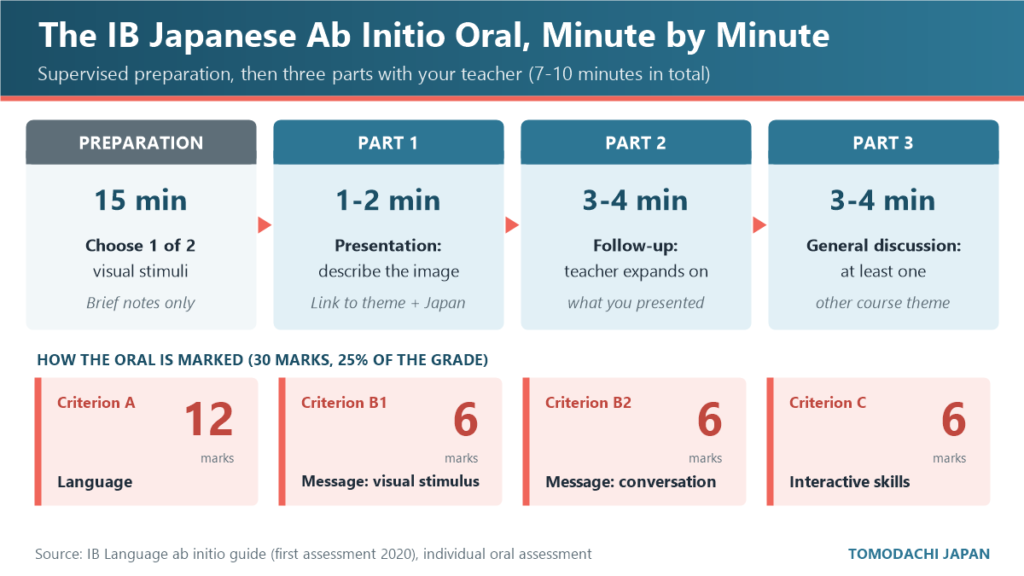
The oral is your teacher’s assessment, done at school and moderated by the IB. During 15 minutes of supervised preparation, you are shown two visual stimuli, each labeled in Japanese with a different theme. You choose one and may make brief working notes. You must not have seen the stimuli before the exam.
| Part | What happens | Time |
|---|---|---|
| Preparation | Choose one of two visual stimuli and make brief notes | 15 minutes |
| Part 1: Presentation | Describe the stimulus and relate it to its theme and to Japanese-speaking culture | 1–2 minutes |
| Part 2: Follow-up discussion | Your teacher expands on what you presented | 3–4 minutes |
| Part 3: General discussion | Conversation on at least one additional theme from the course | 3–4 minutes |
Part 3 is where students go blank, because the theme can be any of the others. The fix is a bank of likely questions with a ready answer pattern. Here are questions our teachers ask at this level, one or two per theme, with a shape for the answer: answer, reason, one detail.
| Theme | Likely question | Answer pattern (answer + reason + detail) |
|---|---|---|
| Identities | あなたはどんな人ですか。 (What kind of person are you?) | 私は明るい人だと思います。友だちとよく話すからです。でも、ちょっとはずかしがりやです。 (I think I’m cheerful, because I often talk with friends. But I’m a bit shy.) |
| Identities | 健康のために、何をしていますか。 (What do you do for your health?) | 毎朝、三十分ぐらい走っています。走ると、気分がいいからです。野菜もたくさん食べます。 (I run for about 30 minutes every morning, because I feel good when I run. I eat lots of vegetables too.) |
| Experiences | 週末は、たいてい何をしますか。 (What do you usually do on weekends?) | たいてい友だちとサッカーをします。サッカーが大好きだからです。日曜日は家で宿題をします。 (I usually play soccer with friends, because I love soccer. On Sundays I do homework at home.) |
| Experiences | 日本に行ったことがありますか。 (Have you been to Japan?) | いいえ、ありません。でも、いつか京都に行ってみたいです。お寺が見たいからです。 (No, I haven’t. But I’d like to visit Kyoto someday, because I want to see the temples.) |
| Human ingenuity | スマホを一日にどのぐらい使いますか。 (How long do you use your phone a day?) | 三時間ぐらい使います。友だちとメッセージをするからです。でも、ちょっと使いすぎだと思います。 (About three hours, because I message friends. But I think it’s a bit too much.) |
| Social organization | あなたの学校について話してください。 (Tell me about your school.) | 私の学校は大きくて、学生が千人ぐらいいます。いろいろな国の学生がいるから、楽しいです。制服はありません。 (My school is big, with about 1,000 students. It’s fun because there are students from many countries. There’s no uniform.) |
| Social organization | しょうらい、どんな仕事がしたいですか。 (What job would you like in the future?) | 医者になりたいです。人を助けたいからです。そのために、科学をがんばっています。 (I want to be a doctor, because I want to help people. For that, I’m working hard at science.) |
| Sharing the planet | かんきょうのために、何ができると思いますか。 (What can you do for the environment?) | ごみを分けたほうがいいと思います。リサイクルができるからです。私はいつもマイボトルを使っています。 (I think we should sort our trash, because then it can be recycled. I always use my own water bottle.) |
From a Japanese teacher: In Part 1, students often list objects in the picture and stop: 人がいます。木があります。That is description, not a presentation. Use three moves instead. First, place things: 写真の左に、女の人がいます. Second, guess what is happening, which shows you can go beyond what is visible: お祭りに行くところだと思います, or more simply, たぶんお祭りです. Third, connect it to Japan and to your own life, because Criterion B1 asks how well your ideas link to the target culture: 日本では、夏にお祭りがたくさんあります。私の町にもお祭りがあります. Two or three sentences for each move is enough to fill the 1–2 minutes, and it hands your teacher natural follow-up questions for Part 2.
For more speaking drills that work across exam systems, see our Japanese oral exam guide.
Hiragana, katakana and kanji: what the IB says, and what it doesn’t
Students search for an IB Japanese ab initio kanji list constantly, so here is the honest answer. The general Language ab initio guide does not contain a Japanese kanji list. It says that language-specific syllabuses, which set out the grammatical structures for each language, are provided to schools on the IB’s programme resource centre, and teachers must use both documents to plan the course. We have not seen a kanji list published by the IB on its public website. If your school’s Japanese syllabus includes script expectations, your teacher is the person who can show you.
You will find teacher-made lists online. The UK site Japanese4Schools, for example, offers a free kanji book for the ab initio course with a numbered kanji list, and many Quizlet sets copy similar lists. These can be useful study tools, but they are not IB publications, so check them against what your teacher uses.
What every ab initio student needs, whatever the list:
- All 46 hiragana and 46 katakana, early. Two-year courses move quickly, and reading speed in Paper 2 depends on kana being automatic. If you are starting from zero, our Hiragana Quest review looks at one popular way to learn them.
- Everyday kanji in words. Numbers, days of the week, family, school and time words (今日, 学校, 先生, 毎日, 時間) appear in almost every text at this level.
- Kana when unsure. In writing, a word in correct hiragana communicates; a wrong kanji can block the meaning, which affects Criterion A.
IB Japanese ab initio past papers and grade boundaries
Past papers are the best practice you can do, and there are legitimate ways to get them:
- Your school first. The guide states that specimen papers, markschemes, subject reports and grade descriptors are on the programme resource centre for teachers, and that past papers and markschemes are sold through the IB store. Your Japanese teacher or DP coordinator very likely has recent Japanese ab initio papers and the Paper 2 audio.
- The Follett IB Store. The IB moved its store to Follett, which is now its exclusive worldwide distributor for IB materials. Families can buy past papers and markscheme packs at follettibstore.com. Check the specific Japanese ab initio listing for the session you want.
- Free IB samples. The IB’s Sample exam papers page offers free specimen materials for some subjects. They help you understand task wording, even if they are not in Japanese.
Be careful with websites that post full IB papers for free. They are usually shared without permission, and they often mix up sessions and the pre-2020 and post-2020 formats. Before 2020, ab initio had a different structure, with a written assignment and a separate text-handling paper, so an old paper can teach you the wrong exam.
Grade boundaries
IB grades run from 1 to 7. The raw marks needed for each grade are set after every exam session, so they move from session to session. We are not printing boundary numbers here because we could not verify them from an IB source open to the public, and third-party tables are often copied without dates or components. The reliable route is your teacher: subject reports and related assessment documents for each session are available to schools on the programme resource centre. When you get boundaries, make sure they are for Japanese ab initio, for the right session, and for the whole subject or the specific component you are looking at.
Comparing exam systems? Our guides to the AP Japanese exam, GCSE Japanese past papers and the HSC Japanese Beginners syllabus cover the US, UK and Australian courses that sit at a similar level.
Textbooks and resources worth using, and where a class fits
We could not find a dedicated IB Japanese ab initio coursebook from a major IB publisher, the way Cambridge publishes ab initio coursebooks for Spanish and French. In practice, schools build the course from general Japanese textbooks and their own materials. These are good, honest options:
- Genki (The Japan Times). A widely used beginner textbook with clear grammar explanations and audio. Some schools, such as Taipei American School, list Genki 2 as a text for their IB Japanese ab initio course. Its topics map well onto daily routine, leisure, food and school.
- Marugoto (The Japan Foundation). A topic-based course whose free companion website adds lots of everyday listening. Its can-do approach suits the IB’s theme-and-text-type structure.
- NHK NEWS WEB EASY. Simplified news with furigana. Useful in the second year for Sharing the planet and Social organization reading.
- Your school’s IB materials. Past papers, markschemes and your teacher’s oral stimuli practice are worth more than any commercial book, because they are built for this exact exam.
What a textbook can’t give you is a real conversation in Japanese with someone your own age, which is exactly what Part 3 of the oral rewards. TOMODACHI JAPAN runs small-group online classes taught by teachers from Japan, where students also talk with peers in Japan. If you’d like a pen-pal style start, our guide to finding a Japanese pen pal safely covers the options.
To be clear about fit: we are not an IB tutoring service. We don’t mark work against IB criteria, and your oral is assessed only by your school. If you need targeted help with a specific Paper 1 or oral weakness before an exam, your Japanese teacher or an IB-specialist tutor is the better choice. If you want Japanese to grow beyond the exam, details are in our school guide.
IB Japanese ab initio FAQ
Is IB Japanese ab initio offered at HL?
No. The IB offers language ab initio at Standard Level only, with 150 recommended teaching hours. Students who want Japanese at Higher Level take Japanese B HL, which requires previous experience of the language.
How is IB Japanese ab initio assessed?
Paper 1 (writing, two tasks of 70–150 words, 1 hour) is 25%. Paper 2 (listening 45 minutes and reading 1 hour, answered in Japanese) is 50%. The individual oral (15 minutes preparation, then 7–10 minutes with your teacher) is 25%.
Is there an official IB Japanese ab initio kanji list?
The IB does not publish one on its public website, and the general ab initio guide does not include one. Language-specific syllabuses are provided to schools through the IB’s programme resource centre, so ask your teacher what your school uses. Lists found online are made by teachers or students, not by the IB.
Can I take Japanese ab initio if my parent is Japanese?
It depends on your Japanese, not your family. The IB says any student who can already understand and respond to spoken and written Japanese on a range of common topics must not be placed in ab initio. Your school makes the placement decision.
Where can I get IB Japanese ab initio past papers legally?
Ask your school first. Otherwise, official papers and markschemes are sold through the Follett IB Store, the IB’s exclusive distributor. Avoid unofficial download sites, which often mix up sessions and the pre-2020 format.
Is the IB Japanese ab initio syllabus changing?
A revised course is due for first teaching in August 2027 and first assessment in May 2029. The IB says the assessment model and components are not changing, and the five themes and 20 topics remain.
Sources
- International Baccalaureate, Language ab initio guide, first assessment 2020 (published 2018): assessment outline, external and internal assessment details and criteria, syllabus content, prescribed themes and topics, text types
- International Baccalaureate, Language ab initio updates (curriculum updates page): ibo.org
- International Baccalaureate, Language ab initio course page: ibo.org
- International Baccalaureate, The IB store has moved: ibo.org
- Follett IB Store, About Follett IB Store: follettibstore.com
- Taipei American School, IBSL Japanese Ab Initio course description (texts used)
- Japanese4Schools, IB ab initio Kanji Book (2020), a teacher-made resource, not an IB publication