The Japanese School of Kuala Lumpur (JSKL) charges RM1,670 a month in tuition for an elementary child in the 2026 school year, rising to RM2,048 a month once the compulsory maintenance levy and PTA fee are added — plus RM9,000 at entry, a school bus at RM409.50 a month, and the Japan Club of Kuala Lumpur membership every family must hold. That is cheap by the standards of Kuala Lumpur’s international schools. The catch is not the price. It is that the school only admits children who hold Japanese nationality, whose parent is a member of the Japan Club and who live in Malaysia on a long-term visa. For a Malaysian family, or a mixed family whose child has only a non-Japanese passport, there is no route in.
This page is the single-school deep dive: what the Japanese School of Kuala Lumpur costs, who can actually enrol, how a school year there runs, and what English-language listings get wrong. Everything comes from the school’s own Japanese-language pages and the Japan Club of Kuala Lumpur’s site, read on 4 October 2026. Where something is not published, we say not published. For the wider map of every Japanese option for children in the city, see our overview of Japanese classes for kids in Kuala Lumpur — and note that this page corrects what it says about JSKL fees and eligibility.
The short answer
| What it is | A full-time Japanese school (nihonjin gakko, クアラルンプール日本人学校) founded in 1966 and run under the Japan Club of Kuala Lumpur. Recognised by Japan’s Ministry of Education (MEXT) as teaching a curriculum equivalent to elementary and junior high school in Japan. Registered as a private school with Malaysia’s Ministry of Education, according to the Japan Club |
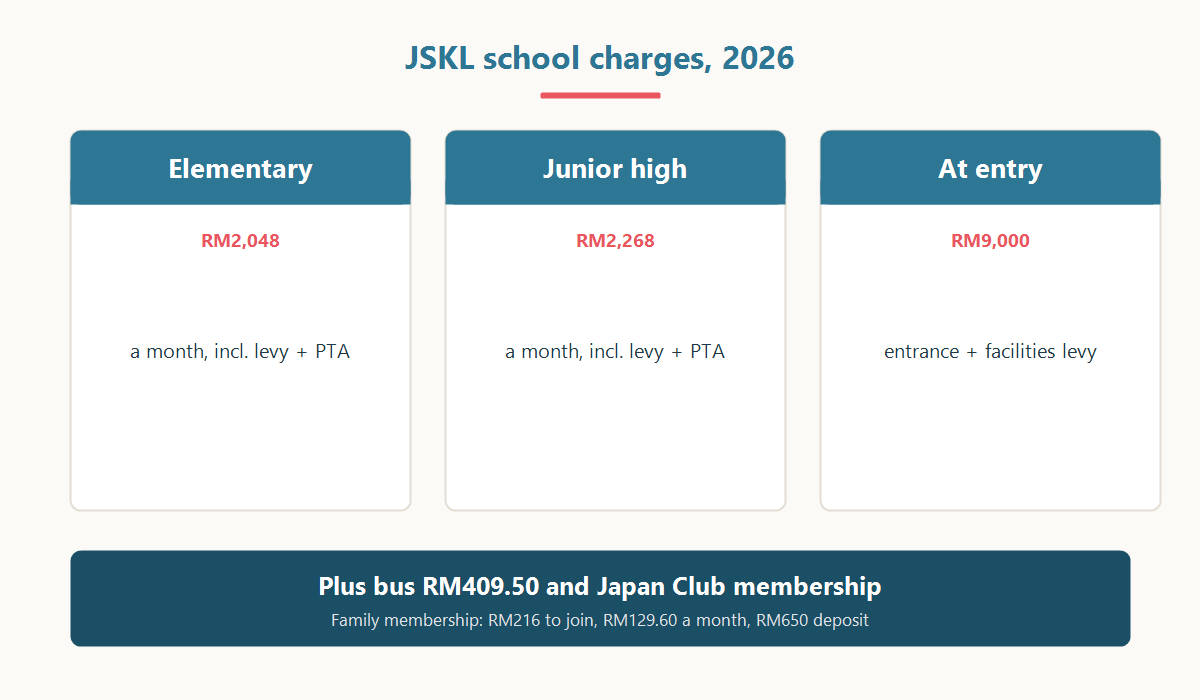
| Monthly cost, 2026 | Tuition RM1,670 (elementary) or RM1,890 (junior high), plus RM370 maintenance levy and RM8 PTA fee: RM2,048 a month for elementary, RM2,268 for junior high. School bus RM409.50 a month on top |
| One-off at entry | RM4,000 entrance fee plus RM5,000 building and facilities levy per child: RM9,000. Kindergarten entry is RM2,630 |
| Who it takes | Children with Japanese nationality, living with their parents on a Malaysian long-term visa, whose parent is an Individual or Associate member of the Japan Club and who are themselves registered as family members. Kindergarten to Grade 9 (ages 3 to 15) |
| Where | Saujana Resort, Seksyen U2, 40150 Shah Alam, Selangor — not in central Kuala Lumpur. About 75,000 m² of campus with two gyms and two pools |
| Size | 544 children on 13 April 2026: 66 kindergarten, 367 elementary, 111 junior high |
| The real catch | Nationality. There is no published route for a child without a Japanese passport, however good their Japanese. And it stops at Grade 9 |
Looking for a way to keep Japanese going from abroad?
TOMODACHI JAPAN is an online Japanese school for children growing up outside Japan. They talk with peers their own age in Japan every day, taught by teachers working at Japanese schools, in small classes of 8.
🎁 Register and we’ll email you our School Guide (PDF, in English) straight away. You’ll also be first to hear about tuition, scholarships and opening dates.
Free · takes about 30 seconds
First, which school do you actually mean?
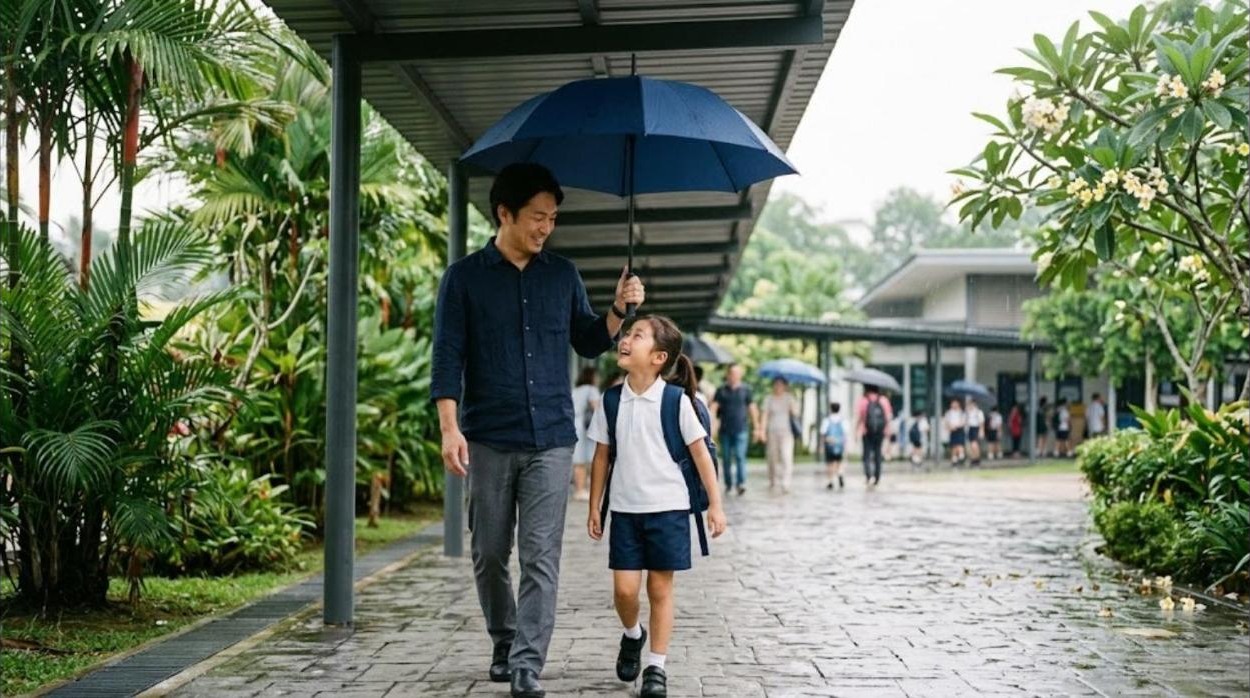
“Japanese school Kuala Lumpur” can mean several different things, and search results mix them up. The Japanese School of Kuala Lumpur is a weekday school that replaces a child’s local or international school. A hoshuko (補習授業校, supplementary school) is a Saturday school that sits on top of one. They are built for different children and almost never interchangeable.
| Name you will see | What it actually is | Where |
|---|---|---|
| Japanese School of Kuala Lumpur (JSKL), クアラルンプール日本人学校, sometimes “KL Japanese School” | Full-time MEXT-recognised school, kindergarten to junior high, Monday to Friday, taught in Japanese | Saujana Resort, Shah Alam (Subang side), Selangor |
| Japan Club of Kuala Lumpur (JCKL), クアラルンプール日本人会 | The members’ association that founded the school. Membership is a condition of enrolment. Runs its own Japanese course for members aged over 12 | Clubhouse in Taman Seputeh, Kuala Lumpur |
| Japanese Kindergarten of Kuala Lumpur (JKKL) | A separate Montessori kindergarten, founded in 1997, inside the JCKL clubhouse. Also members only | Taman Seputeh, Kuala Lumpur |
| “KL Japanese Saturday School” | A name that circulates for a community Saturday group. We could find only a Facebook group, with no published fees, address or curriculum we could verify | Not published |
| A MEXT-listed hoshuko in Kuala Lumpur | We found none in any source we could read. Public summaries list four full-time Japanese schools in Malaysia — Kuala Lumpur, Penang, Johor Bahru, Kota Kinabalu | — |
Two practical points follow. First, the school is not where the Japan Club is. JSKL sat in Taman Seputeh from 1976 until 1993, then moved to the present Saujana campus near Subang — opened, the school notes, with both the Japanese and Malaysian prime ministers attending. Older directory entries and taxi drivers sometimes still send people to the clubhouse. Second, because there is no verifiable Saturday hoshuko, a Japanese-speaking child who attends an international school in Kuala Lumpur has no obvious weekend equivalent of the kind families in Singapore, Bangkok or Sydney take for granted. That gap matters for the families JSKL cannot admit.
What it costs in 2026: RM2,048 a month plus RM9,000 to start
Unlike many English listings suggest, the fees are published — on the school’s Japanese-language admission pages, in ringgit, per child. The 2026 school year began in April 2026.
| Item | Elementary (Grades 1–6) | Junior high (Grades 7–9) | Kindergarten |
|---|---|---|---|
| Entrance fee (once) | RM4,000 | RM4,000 | RM2,630 |
| Building and facilities levy (once) | RM5,000 | RM5,000 | None listed |
| Tuition (monthly) | RM1,670 | RM1,890 | RM2,330 (childcare fee, materials included) |
| School maintenance levy (monthly) | RM370 | RM370 | RM370 |
| PTA fee (monthly) | RM8 | RM8 | RM8 |
| Monthly school charges | RM2,048 | RM2,268 | RM2,708 |
| School bus, Pandu Jaya (monthly, optional) | RM409.50 | RM409.50 | RM439.50 |
| Monthly with bus | RM2,457.50 | RM2,677.50 | RM3,147.50 |
Then there is the Japan Club. Every family needs a parent in membership, with the child registered as a family member. The Club’s How to Join page lists, for a family membership:
- Admission fee: RM216.00, once.
- Monthly subscription: RM129.60 for a family (RM91.80 single).
- Deposit: RM650.00, refundable without interest when you resign.
Put together, an elementary child who rides the bus costs RM2,587.10 a month in school, bus and club charges, and the family pays RM9,866 in one-off entry charges and deposit before the first monthly bill. Each additional child adds another RM9,000 at entry and another set of monthly charges; no sibling discount is published.
Several things are not published: how many months a year the monthly fees are billed, whether any part of the entrance fee or facilities levy is refunded if you leave early, and how fees are split when an employer pays. The Club’s own FAQ also gives lower membership figures (RM200 admission, RM120 a month for a family) than its How to Join page — exactly 8% lower in each case. The page does not explain the difference; budget on the higher set. Lunch is not included either: children bring a bento or order one from the school’s two approved suppliers.
Is RM2,048 a month expensive? Not for Kuala Lumpur. It is in the same range as Malaysia’s other Japanese schools — our Penang Japanese School fee guide found a single tuition rate of RM1,390 a month there — and well below the fees of the large international schools. Many families on assignment also have the school costs met by an employer. For a locally hired family paying its own way, the RM9,000 entry charge is the line to plan for.
Who can enrol: the six conditions
The Japanese-language admission page sets out six conditions for elementary and junior high. All six must be met.
- The child holds Japanese nationality, checked against the passport.
- The child’s grade follows Japan’s rules, set by date of birth (the Japanese school year starts in April, so a child born between April and the following March is in one year group).
- A parent is an Individual Member (個人会員) or Associate Member (賛助会員) of the Japan Club of Kuala Lumpur, and the child is registered as a family member (家族会員).
- The child lives with their parents or guardian.
- Parent and child both hold a Malaysian long-term visa when the application is submitted.
- The child can take part in group or individual lessons, in a regular class or the special-needs class, without an assistant.
Read condition 3 carefully if yours is a mixed family. The Japan Club defines Individual Members as Japanese nationals aged 20 or over, and Associate Members as non-Japanese nationals aged 20 or over living in or near Kuala Lumpur. Because the school accepts either type, a child with a Japanese passport whose Japanese parent is not the one in Malaysia — or whose family has chosen the non-Japanese parent as the member — is not excluded on that ground. What does not move is condition 1: the child must hold Japanese nationality. A child of a Japanese-Malaysian marriage who holds only a Malaysian passport cannot enrol, whatever their Japanese.
Two further hurdles sit in the Club’s rules, not the school’s. Joining requires an introducer: an Individual Member who has belonged to the Club for at least six months and has no disciplinary record. For a family arriving through a Japanese employer this is routine. For a family with no Japanese corporate connection, finding one is a real step to plan for.
What about Japanese ability? No language test is published. But every lesson apart from English is taught in Japanese, to Japan’s curriculum, with Japanese textbooks, and condition 6 requires a child to follow lessons without an assistant. In practice a child needs grade-level Japanese to keep up. Places are not the obstacle: the school says there is no cap on numbers and transfers are taken through the year. For the final year of junior high, the transfer must be complete by 31 May so the child is on the roll on 1 June. The kindergarten is different: it does say children may have to wait once it is full.
How it works: a Japanese school year in Shah Alam
Day to day, JSKL runs like a public school in Japan, with a Malaysian setting. The 2026 school year is three terms:
| Term | Dates (2026 school year) | Notes |
|---|---|---|
| First term | 13 April to 24 July 2026 | Orientation for transferring families 9 April. Sports days in June |
| Second term | 24 August to 24 December 2026 | Transfer orientation 20 August. Saturday open classes in September. 60th anniversary ceremony 21 November |
| Third term | 7 January to 12 March 2027 | Junior high graduation 3 March; elementary and kindergarten graduation 5 March |
What the school publishes about its own programme:
- English Communication twice a week, taught entirely in English by local native-speaker teachers, in small classes by level.
- Immersion Swimming through the year, coached in English by Malaysian coaches, two per class, in the 50 m or 25 m pool.
- Exchange with Malaysian schools for every grade from 1 to 9, plus Hari Raya, Deepavali and Chinese New Year activities, and a kampung homestay from Grade 5.
- Chromebooks and iPads, with Google Classroom for assignments and messages.
- School bus by Pandu Jaya, managed by the PTA — most families use it. Private cars and condominium shuttles are allowed; cycling to school is not.
- Uniform, and a bento lunch from home or from an approved supplier.
Daily start and finish times are in PDF timetables on the school life page rather than in the page text. Visits are strictly controlled: entry needs prior permission, is in principle for parents and relatives, and the school turns away requests framed as tourism. Prospective families should use the contact form; weekday visits run 9:00 to 15:00. Teachers include staff dispatched from Japan — the school opened in 1966 with two dispatched teachers and 14 pupils — but the current staff count is not published.
The honest review: what the English pages leave out
People search for “Japanese School of Kuala Lumpur reviews” to learn what it is like from the inside. We want to be straight about what we found: no body of verifiable parent reviews. Google reviews could not be read reliably, one school-search site blocked our request, and we found no forum threads from current parents. We are not going to invent a consensus. What we can check is where English-language listings — including our own — diverge from what the school publishes in Japanese.
1. “Fees on inquiry.” No longer true
Our July overview listed JSKL as “Community rate (on inquiry)”. That is wrong: the 2026 fees, line by line, are on the school’s admission pages, as set out above. The English side of the internet has simply not caught up with the Japanese pages.
2. A price range that does not match the fee sheet
One school-comparison site, WhereNext, gives a “$3,000–$6,000/yr published annual range” for 2025–26 and calls its data verified in April 2026. The school publishes no annual figure and no US-dollar figure, and a range that wide hides the RM9,000 entry charges entirely. The same listing gives the age range as 6 to 15, leaving out the kindergarten, which takes children from 3. Use the ringgit figures from the school itself.
3. “The only Japanese school in Malaysia.” It is not
A school-directory description that appears in search results calls JSKL the only Japanese school in Malaysia. There are full-time Japanese schools in Penang, Johor Bahru and Kota Kinabalu too. JSKL is the oldest and the largest, not the only one — which matters if your posting could be outside the Klang Valley.
4. The English eligibility line is shorter than the real one
The Japan Club’s English page sums up eligibility in one line: membership, Japanese nationality, a valid permit to live in Malaysia. The school’s Japanese page adds three more conditions — living with parents, Japan’s grade rules, and following lessons without an assistant — and makes clear that an Associate member, who by the Club’s rules is non-Japanese, is acceptable as the parent member. Our own overview said only “a parent’s Japan Club of KL (JCKL) membership”. For a mixed family, the Japanese-language version is the one to read.
5. Older information lingers
JSKL is still a large school by overseas standards, with 544 children in April 2026, and it marks its 60th year this November. But much of what is written about it in English is old. The English Wikipedia article carries a citation warning, gives no enrolment figure, and names a previous headmaster; the school’s site now carries a message from principal Hisashi Aoki.
6. What to ask, since the reviews won’t tell you
- How many months a year are the monthly fees billed? Not published.
- Is any of the RM9,000 refundable if we are transferred away within a year? Not published.
- How many children are in my child’s class? Total enrolment is published; class sizes are not.
- Which bus route serves our condominium, and how long is the ride? Routes are not published.
- What support exists for a child whose Japanese is behind grade level? Not published; condition 6 suggests none that requires an assistant.
- What do families do after Grade 9? There is no senior high section.
Other options in Kuala Lumpur
If your child does not qualify for the Japanese School of Kuala Lumpur — or does, but you want them in an international school — the published alternatives for children are thin.
| Option | Who it takes | Published cost |
|---|---|---|
| Japan Foundation, Kuala Lumpur — Japanese General Course | Anyone in Malaysia aged 16 and over. Weekday evening classes from Starter (A1) to Pre-intermediate. No children’s course listed | Starter RM300–600 per part; Elementary to Pre-intermediate RM420–510 per part (2026–27) |
| Japan Club of Kuala Lumpur — Japanese Course | JCKL members and corporate-member staff aged over 12 only. One-year levels, 18 lessons a term | Not published. The Club says 2026 applications are closed and the next intake starts in October 2027 |
| Japanese Kindergarten of Kuala Lumpur (Montessori) | Children of JCKL members, in the clubhouse in Taman Seputeh | Not published on the Club’s English page |
| Penang Japanese School | Full-time school in Penang; also Japanese-nationality based | RM1,390 a month tuition — see our Penang guide |
| “KL Japanese Saturday School” | A community Saturday group known mainly through Facebook | Not verifiable. The figures in our July overview could not be confirmed from any published source |
| Private tutors and language schools | Varies | Varies; most quote on inquiry |
The pattern is clear. Kuala Lumpur has a well-resourced full-time school for Japanese-passport children, an adult language scene for learners aged 16 and up, and very little in between — especially for a child who already speaks Japanese at home and attends an international or Malaysian school on weekdays. In cities with a hoshuko, that child goes on Saturdays. For what a Saturday school does, and what an online one can and cannot replace, see our guide to online alternatives to a Japanese hoshuko and our checklist for finding a Japanese Saturday school near you.
How to choose, in four questions
- Does your child hold a Japanese passport? If not, the Japanese School of Kuala Lumpur is closed to you, and the rest of this list is about what to do instead. If yes, read on.
- Is your child going back into Japanese schooling? If a return to Japan is likely within a few years, JSKL is the school built for that: same curriculum, same textbooks, same school year. If your family is settled in Malaysia for good, weigh what a Japanese-only weekday education means for English, Malay and the next school after Grade 9.
- Can your family meet the membership step? A parent in the Japan Club, an introducer of six months’ standing, a long-term visa, and RM9,866 up front for one child. For a corporate family these are paperwork. For a locally based mixed family they are the real decision.
- Can your child follow a full day of lessons in Japanese? No test is published, but there is no assistant either. A child who chats in Japanese at home but reads two years behind may struggle; ask before you apply.
Where TOMODACHI JAPAN fits
We are not a substitute for the Japanese School of Kuala Lumpur, and if your child holds a Japanese passport and is heading back to a school in Japan, we would point you there. We exist for the families the four questions above leave stuck — the child without a Japanese passport who speaks Japanese at home, the child at an international school whose reading in Japanese is slipping, and the family for whom a daily drive to Saujana is not realistic.
- Japanese friends of the same age. Classes with children the same age in Japan — not only other learners in Kuala Lumpur. The reason children keep going is usually the other children.
- Teachers working at Japan’s current classroom standard — not a syllabus written abroad and not a tutoring marketplace.
- Small classes of eight children. Enough to be a class, few enough that every child speaks every lesson.
- Japan is only one hour ahead of Kuala Lumpur. An after-school slot in Japan is an after-school slot in KL, so lessons fit around an international school day. No commute, no nationality rule and no club membership.
- A flat monthly membership. Tuition, scholarships and opening dates are in our free school guide, which we email to everyone who registers, with no obligation.
If you are still mapping the whole city, our Kuala Lumpur overview lays out every type of programme side by side.

Frequently asked questions
How much are the Japanese School of Kuala Lumpur fees?
For the 2026 school year, monthly tuition is RM1,670 for elementary and RM1,890 for junior high, plus a RM370 maintenance levy and a RM8 PTA fee: RM2,048 a month for elementary, RM2,268 for junior high. At entry each child pays RM4,000 plus a RM5,000 facilities levy. The bus is RM409.50 a month, and the family also pays Japan Club membership.
Can a non-Japanese child attend JSKL?
No. The school requires the child to hold Japanese nationality. A child of a mixed marriage who holds a Japanese passport can apply, and the parent member of the Japan Club may be the non-Japanese parent, as an Associate Member.
Do we have to join the Japan Club of Kuala Lumpur?
Yes. A parent must be an Individual or Associate member and the child a family member. The Club lists RM216 admission, RM129.60 a month for a family membership and a RM650 refundable deposit, and new members need an introducer who has been an Individual Member for at least six months.
Where is the Japanese School of Kuala Lumpur?
Saujana Resort, Seksyen U2, 40150 Shah Alam, Selangor, near Subang — not at the Japan Club’s clubhouse in Taman Seputeh, where the school was until 1993. Telephone +60 3-7846-5939.
Are there vacancies?
For elementary and junior high, the school says there is no limit on numbers and transfers are accepted through the year, as long as the conditions are met. The kindergarten may ask families to wait once it is full.
Is there a Japanese Saturday school (hoshuko) in Kuala Lumpur?
We could not find a MEXT-listed hoshuko in Kuala Lumpur in any source we could read on 4 October 2026. A community Saturday group circulates on Facebook, but its fees and curriculum are not published in a form we could verify.
Sources
- Japanese School of Kuala Lumpur (Japanese-language pages): School guide (address, enrolment), Elementary and junior high admission (conditions, 2026 fees), Kindergarten admission, Annual events, Special programmes, School life, History, Principal’s message, Visits
- Japan Club of Kuala Lumpur: Japanese School, How to Join (fees), FAQ, Japanese Course
- Japan Foundation Kuala Lumpur, 2026 Japanese course pamphlet
- Third-party pages checked: Wikipedia, Japanese School of Kuala Lumpur; WhereNext school profile; a doris.school listing (blocked, seen via search result). All checked 4 October 2026.