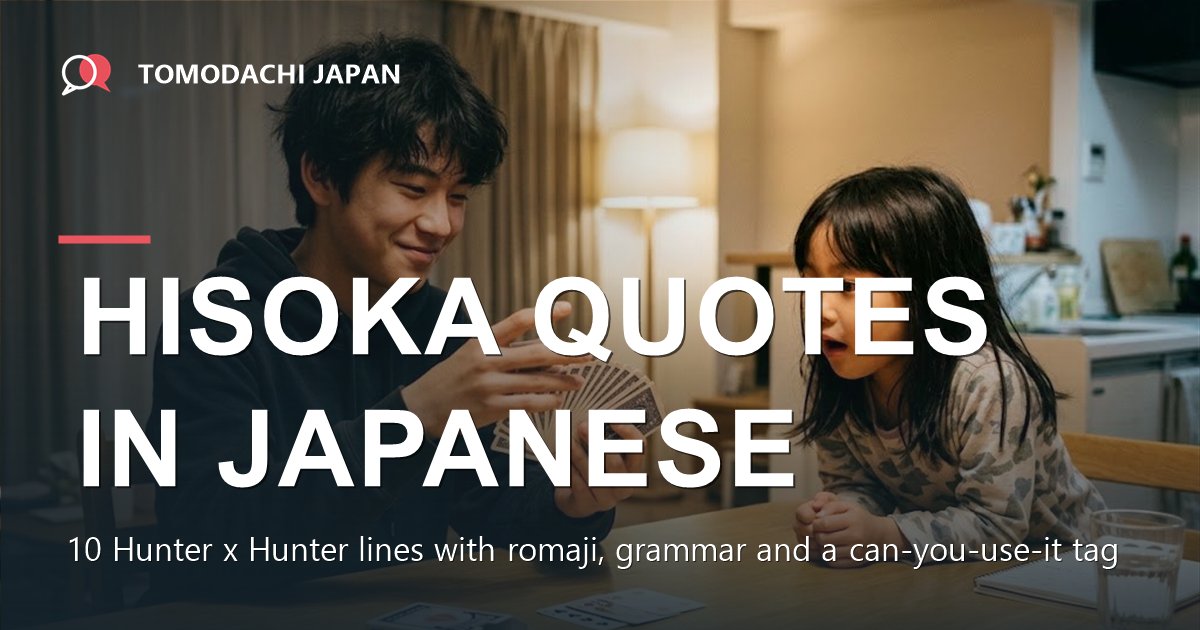
Hisoka is the only anime character I know who ends his sentences with playing-card suits. In the Japanese manga of Hunter x Hunter, his speech bubbles finish with ♠ ♥ ♣ and ♦, and readers in Japan learn to “hear” his mood from the symbol before they even read the words. I teach Japanese, and below are ten Hisoka quotes in Japanese, taken from the original Japanese text, with rōmaji, a translation and the grammar underneath — plus an honest note on which lines a real person could say, and which belong only to a magician who enjoys a good fight a little too much.
Can-you-use-it legend: ◎ = safe in real conversation · △ = fine in anime, odd in life · ✗ = don’t say this to a person.
Hisoka quotes in Japanese
| Japanese | Rōmaji | English | Use it? |
|---|---|---|---|
| “伸縮自在の愛(バンジーガム)”は ガムとゴム両方の性質を持つ♣ | “Shinshuku jizai no ai (banjī gamu)” wa gamu to gomu ryōhō no seishitsu o motsu | “Bungee Gum” has the properties of both gum and rubber | ◎ Great pattern |
| うん!君も合格♥いいハンターになりなよ♣ | Un! Kimi mo gōkaku. Ii hantā ni nari na yo | Yep! You pass too. Become a good Hunter | ◎ Swap ハンター for any goal |
| カンペキに勝つ♣だろ?ゴン♥ | Kanpeki ni katsu, daro? Gon | We win perfectly, right, Gon? | ◎ Swap in a friend’s name |
| みんなの力があったからだよ 全員の勝利ってやつさ | Minna no chikara ga atta kara da yo. Zen’in no shōri tte yatsu sa | It’s thanks to everyone’s strength. A win for all of us, you might say | ◎ Perfect after a team game |
| ちなみにボクは変化系♦気まぐれでウソつき♠ | Chinami ni boku wa henkakei. Kimagure de usotsuki | By the way, I’m a Transmuter. Fickle, and a liar | △ Fun, but don’t call yourself a liar |
| 君達まとめてこれ一枚で十分かな♣ | Kimitachi matomete kore ichimai de jūbun ka na | For all of you together, I think this one card is enough | △ Cocky |
| なんだ◇思ったよりカンタンなんだ♣ 無駄な努力 御苦労様♠ | Nanda, omotta yori kantan nanda. Muda na doryoku, gokurōsama | Oh, it’s easier than I thought. Thanks for all your wasted effort | ✗ Sarcastic |
| 玩具は多い程楽しいじゃない?♦ | Omocha wa ōi hodo tanoshii ja nai? | The more toys, the more fun, right? | △ Keep the 程 pattern |
| キミの敗因は容量(メモリ)のムダ使い♥ | Kimi no haiin wa memori no mudazukai | The reason you lost: you wasted your memory | △ Rude to a loser |
| 今のキミはボクに生かされている。 | Ima no kimi wa boku ni ikasarete iru. | Right now, you are alive only because I let you be | ✗ A threat |
Want to go from quoting anime to actually talking with friends in Japan?
TOMODACHI JAPAN is an online Japanese school for children growing up outside Japan. They talk with peers their own age in Japan every day, taught by teachers working at Japanese schools, in small classes of 8.
🎁 Register and we’ll email you our School Guide (PDF, in English) straight away. You’ll also be first to hear about tuition, scholarships and opening dates.
Free · takes about 30 seconds
The grammar underneath each line
伸縮自在の愛 — kanji on top, katakana underneath
Hisoka’s signature ability is written 伸縮自在の愛, literally “love that stretches and shrinks at will,” but the manga prints the reading バンジーガム (“Bungee Gum”) above it. This trick is everywhere in manga: the kanji give the meaning, the small katakana give the sound. Hisoka does it again with 容量 (“capacity”) read as メモリ (“memory”). If you see a word in brackets after kanji in a quote list, it is usually this special reading, not a translation.
Break the kanji apart and you learn four useful pieces at once: 伸 (stretch), 縮 (shrink), 自在 (freely, at will) and 愛 (love). The second half of the line is a pattern you can use in any science class: A と B 両方の性質を持つ, “has the properties of both A and B.” Try it: ペンギンは鳥と魚、両方の性質を持つ? (“Do penguins have the properties of both birds and fish?”). 両方 (ryōhō) means “both,” and 性質 (seishitsu) means “nature, property.” Fans in Japan joke with this exact frame about everything from cats to coffee, which is a good sign that it is natural, everyday grammar.
♠ ♥ ♣ ♦ — reading the mood from the symbol
Japanese writing has no strict rule for these marks, and the author is said to use them by feel. Still, Japanese fans read them roughly like this:
| Mark | Fans’ reading | Like an English… |
|---|---|---|
| ♥ | 好意 — he likes it, he’s excited | “hehe” or a heart emoji |
| ♠ | 敵意 — hostility, a sharp edge | a cold smile |
| ♣ | 無関心 — he doesn’t care much | a shrug |
| ♦ / ◇ | neutral, just stating a fact | a plain full stop |
Teacher’s note: this is the same job that emoji, stickers and 〜ね or 〜よ do in real Japanese messages. Japanese is a language in which the end of the sentence carries the feeling. Look at カンペキに勝つ♣だろ?ゴン♥ — a shrug for the game, a heart for Gon. Notice how the same words would feel different with a ♠. That instinct is exactly what you need for sentence-final particles.
いいハンターになりなよ — the soft command 〜なよ
During the Hunter Exam, Hisoka lets Gon pass with うん!君も合格♥いいハンターになりなよ♣ The ending なりなよ comes from なる (“to become”): verb stem なり + な + よ. This 〜な is not the “don’t” な (行くな, “don’t go”). Attached to the stem, it is a casual, friendly suggestion — shortened from 〜なさい. With よ on the end it sounds like an older friend giving advice: 早く寝なよ (“go to bed early, OK?”), これ食べなよ (“have some of this”).
Watch the stem carefully, because it decides the meaning. 食べなよ = “go on, eat.” 食べるなよ = “don’t eat it.” One extra る flips the sentence. 合格 (gōkaku) is also worth stealing: it is the word on every exam result in Japan, from a piano grade to a university entrance test.
全員の勝利ってやつさ — ってやつ and the reason ending からだ
After the dodgeball match on Greed Island, Hisoka plays modest: みんなの力があったからだよ 全員の勝利ってやつさ. The first half is the reason pattern 〜からだ, “it’s because…” — みんなの力があった, “everyone’s strength was there.” The second half adds 〜ってやつ, a very spoken way to say “the thing people call…” or “what you might call…” やつ literally means “guy” or “thing,” and って is the casual quotation marker.
Hisoka’s version ends in さ, a relaxed, slightly showy “you know.” Kids use the pattern all the time: これが友情ってやつだね (“so this is what they call friendship”). After a football match, 全員の勝利だね! is a lovely thing to say to your team — this is the most useful Hisoka line on the list.
気まぐれでウソつき — joining descriptions with で
Hisoka introduces himself to Gon with ちなみにボクは変化系♦気まぐれでウソつき♠ ちなみに means “by the way” and is great for adding an extra fact in class: ちなみに私の好きな食べ物はラーメンです. 気まぐれ (“fickle, moody”) is a な-adjective, and to link it to the next description you use で: 気まぐれでウソつき, “fickle and a liar.” The same で joins nouns and な-adjectives: 静かで優しい人 (“a quiet, kind person”), 元気で明るい (“lively and cheerful”).
Notice also ボク in katakana. Like Eren’s オレ, the spelling is part of the voice: 僕 in katakana makes a soft, polite-sounding “I” feel slightly odd and theatrical — perfect for a magician who smiles while he lies. Two small words to remember: 変化系 is the Transmuter category in the Nen system, and ウソつき (嘘つき) is “liar,” a word children in Japan shout at each other in every playground.
無駄な努力 御苦労様 — a polite phrase used as a weapon
御苦労様 (gokurōsama) looks polite: “thank you for your trouble.” But Japanese has a hidden rule here. ご苦労様 is said by someone higher to someone lower — a boss to a worker. To a teacher or an older person, it sounds rude, and お疲れ様です is the safe choice. Hisoka uses the “higher” phrase on purpose, and puts 無駄な努力 (“wasted effort”) in front of it. Polite words plus an insult make sarcasm, and Japanese readers feel the sting right away.
The first half is safe to borrow: 思ったより簡単だった (“it was easier than I thought”) uses 〜より for comparisons and works after any test. Keep the comparison, lose the sarcasm.
今のキミはボクに生かされている — the passive with a dark twist
This is Hisoka’s most famous line to Gon, and the content is a threat, so it stays a ✗. The grammar is worth seeing, though. 生きる is “to live.” 生かす is “to let live, to keep alive.” Make it passive and you get 生かされる, “to be kept alive (by someone).” The person doing it is marked with に: ボクに生かされている, “being kept alive by me.” The everyday version of the same passive is gentle: 先生にほめられた (“I was praised by my teacher”), 友達に助けられた (“I was helped by a friend”). If you want something kind with the same shape, try みんなに支えられている — “I am supported by everyone.”
One more pattern from the list: 玩具は多い程楽しいじゃない? uses 〜ほど, “the more…, the more…” In daily life it is usually 人は多いほど楽しい, “the more people, the more fun” — a great line for inviting a friend to a party. Note that 玩具 is read おもちゃ here, another manga-style special reading.
Is Hisoka good for learning Japanese?
Honestly, half yes. Hisoka dialogue in Japanese is full of clean, useful patterns — 両方の性質を持つ, 〜なよ, ってやつ, 〜で for joining descriptions — and the card symbols are a fun way to understand how much feeling sits at the end of a Japanese sentence. But his tone is teasing, sarcastic and often threatening. He calls people キミ, which can feel cold or superior, and he uses polite words like 御苦労様 to look down on people. Copying his attitude would make a child sound strange at best.
So keep the pattern and change the clothes: 全員の勝利ってやつさ becomes 全員の勝利だね!, いいハンターになりなよ becomes いい先生になってね, and 御苦労様 becomes お疲れ様です. The fastest way to learn which version fits which person is to try them on people your own age — a real friend’s face tells you in one second whether you sounded friendly or like a creepy magician.
Keep going with the same method: our Hunter x Hunter quotes in Japanese guide covers Gon, Killua and the other main characters, and anime villain quotes in Japanese shows how other villains build menace with grammar. For another fighter who lives for battle, see Toji quotes in Japanese. If you are starting from zero, our guide to learning Japanese with anime sets out a weekly routine, and our tuition page explains how live classes with Japanese friends work.
FAQ
What is Hisoka’s most famous quote in Japanese?
Two lines compete. Among fans in Japan, “伸縮自在の愛(バンジーガム)”は ガムとゴム両方の性質を持つ♣ (“Bungee Gum has the properties of both gum and rubber”) is so well known that people copy its frame as a meme. In the story itself, 今のキミはボクに生かされている (“right now, you are alive only because I let you be”), said to Gon during the Hunter Exam, is the line that sets up their whole rivalry.
What do Hisoka’s card symbols mean?
There is no official key. Japanese fans usually read ♥ as liking or excitement, ♠ as hostility, ♣ as not caring, and ♦ as neutral. They work like emoji: they add tone, not meaning. You won’t hear them in the anime, so reading the manga in Japanese is the only way to see them.
How do you say “Bungee Gum” in Japanese?
The ability is written 伸縮自在の愛 (“love that stretches and shrinks freely”) and read バンジーガム (banjī gamu). The kanji carry the poetic meaning; the katakana reading is the name characters actually say.
Why does Hisoka say ボク instead of 俺?
ボク (boku) is a softer, more polite-sounding “I” than 俺. Coming from a dangerous fighter, the gentle word feels unsettling, which is the point. For learners, 僕 is a perfectly normal choice for boys and young men in everyday life.
My child loves Hunter x Hunter. How do they practise with real Japanese speakers?
Tomodachi Japan is an online Japanese school for children living outside Japan, taught by Japanese school teachers in small classes of eight, with classmates their own age in Japan. Parents don’t need to speak Japanese — we guide you in English. The free school guide below has the timetable, tuition and scholarship details.