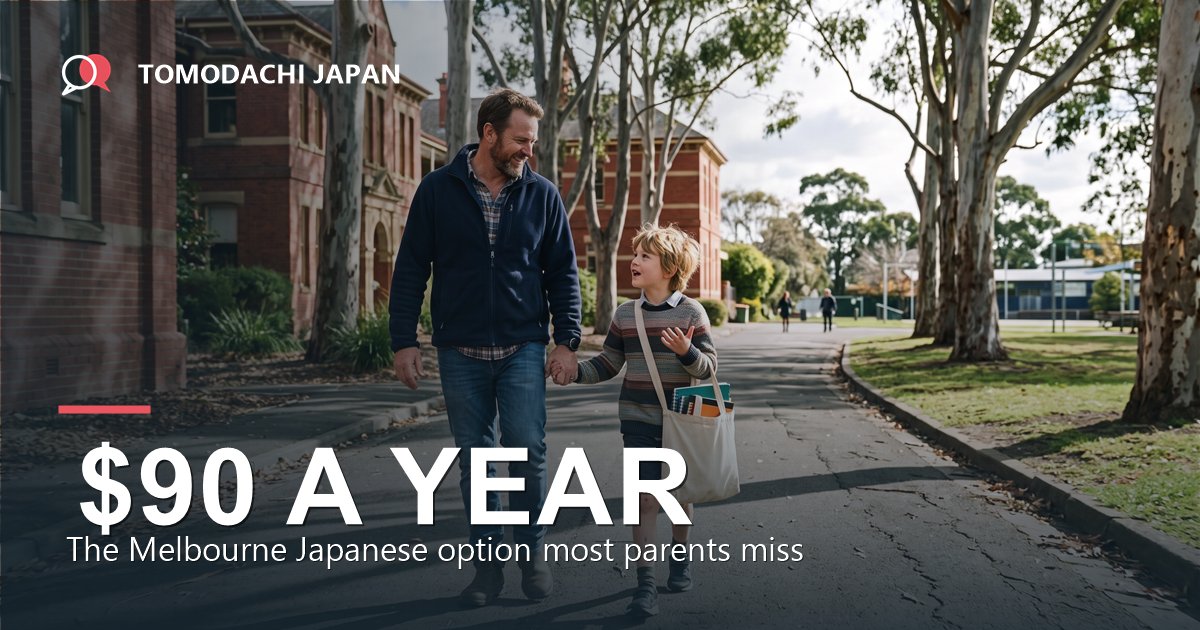
Search “Japanese school Melbourne” and you get a strange mix: a full-time international school in Caulfield South, a few private language centres, some tutoring listings, and a government school most Melbourne parents have never heard of that teaches Japanese on Saturday mornings for $90 a year.
That last one is the buried lead, so let us put it up front. This guide lays out the four real routes for a child learning Japanese in Melbourne, with the actual centres, the actual 2026 fees, and the actual enrolment timing — taken from each provider’s own published material rather than from directory sites.
The four routes, at a glance
| Route | Who it suits | Cost signal | Main catch |
|---|---|---|---|
| Victorian School of Languages (VSL) | Any Victorian student F–12 whose own school does not offer Japanese | $90/yr (F–10), $110/yr (Yr 11–12) | Eligibility rule; 2026 intake has closed |
| The Japanese School of Melbourne (JSM) | Japanese families on a posting, Prep–Year 9 | AU$800 application fee; AU$500 refundable bond | Full-time, Japanese curriculum — a whole schooling decision |
| Private classes / tutors | Families wanting flexible timing or a specific fix | Market rates, per hour | Usually one-to-one; no peer group |
| Online school with classes in Japan | Heritage and non-heritage kids wanting weekday continuity | Flat monthly rate | Time zone — though Melbourne is close to JST |
Looking for a way to keep Japanese going from Australia?
TOMODACHI JAPAN is an online Japanese school for children growing up outside Japan. They talk with peers their own age in Japan every day, taught by teachers working at Japanese schools, in small classes of 8.
🎁 Register and we’ll email you our School Guide (PDF, in English) straight away. You’ll also be first to hear about tuition, scholarships and opening dates.
Free · takes about 30 seconds
1. The Victorian School of Languages — the option most parents miss
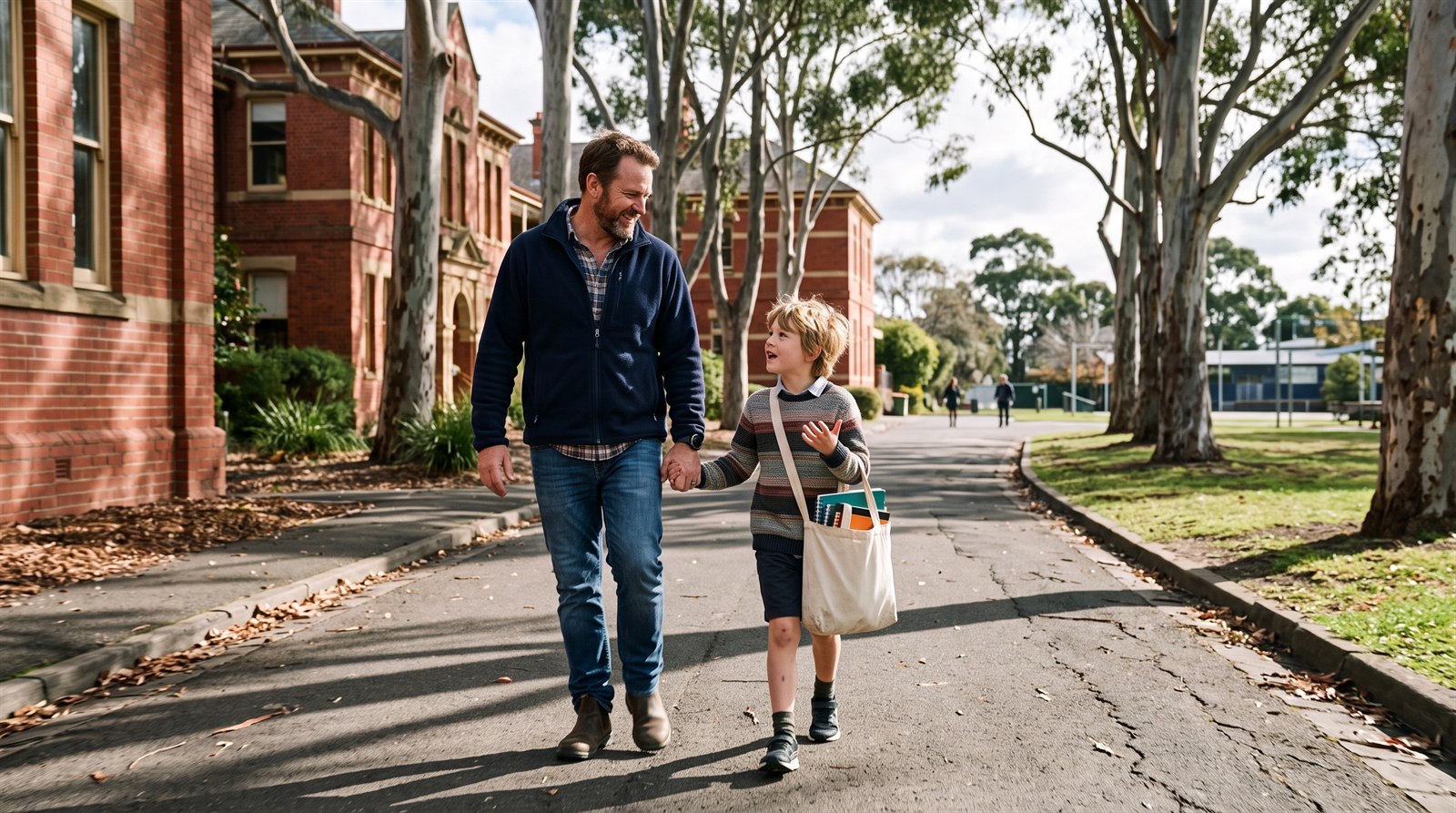
The VSL is a Victorian government school. It has been running since 1935, and — a nice piece of trivia — it opened with Saturday classes in exactly two languages: Italian and Japanese. Today it teaches more than 50 languages to over 16,000 students at more than 40 centres across Melbourne, Geelong and regional Victoria.
Most classes run on Saturday, 9:00am to 12:20pm. This is the single cheapest legitimate route to sustained Japanese instruction in Melbourne, and it is a real school with registered teachers, not a community club.
Where Japanese is actually taught
From the VSL’s own 2026 Languages Program — Centre Classes brochure, Japanese is offered at these centres:
| Centre | Day | Note |
|---|---|---|
| Altona North (Bayside P–12 SC) | Saturday | |
| Ballarat (Ballarat High School) | Saturday | Regional |
| Blackburn (Blackburn High School) | Saturday | |
| Brentwood | Saturday | First and Second Language streams available |
| Doncaster (Doncaster Secondary College) | Thursday | Weeknight, not Saturday |
| Glen Waverley | Tuesday | Weeknight, not Saturday |
| Hampton Park | Saturday | |
| Lalor | Saturday | |
| University High School | Saturday | Inner north |
| Distance Education | — | Japanese offered as both Second and First Language |
Two things in that table are easy to miss. First, Doncaster is Thursday and Glen Waverley is Tuesday — if you live near either and Saturdays are already gone to sport, a weeknight class may be the reason this works for you at all. Second, Distance Education carries Japanese as both First and Second Language, which matters enormously for a heritage child: the First Language stream is pitched at children who already speak Japanese at home, not at beginners.
The 2026 fees, and the eligibility rule
The VSL describes its charge as “a small annual contribution” toward notes, class sets, photocopying and administration. For 2026:
- Students in Years F–10 — $90
- Students in Years 11–12 — $110
- Tuition Students (VCE) — $250
Now the rule that decides whether you can use any of this. The VSL states it “enrols students from Years F to 12 (VCE) who are unable to study their language of choice at their home school.” Students from all sectors — Government, Independent and Catholic — are eligible.
Read that carefully, because it cuts both ways in Melbourne. Japanese is one of the most commonly taught languages in Victorian schools. If your child’s school already runs a Japanese program, you may not qualify for VSL — even if the school program is one period a week and far below your child’s level. That mismatch is the single most common reason Melbourne heritage families end up looking elsewhere: the box is ticked at school, so the cheap option is closed, but the actual learning is not happening.
Timing: this is the part that will bite you
2026 enrolments at the VSL have closed. Enrolments for 2027 open in Term 4 of this year. If you are reading this partway through 2026, the practical answer is: put a reminder in your calendar for October, and use one of the other three routes in the meantime rather than losing a year.
For reference, the published 2026 Saturday teaching dates run in four terms — Term 1 from 7 February, Term 2 from 2 May, Term 3 from 18 July, and Term 4 from 10 October, with the final day for Years F–10 on 28 November. Classes do not usually run during school holidays, on public holidays, or on long weekends.
2. The Japanese School of Melbourne — a different decision entirely
The Japanese School of Melbourne (JSM) sits at 6 Ellington Street, Caulfield South, and serves Prep to Year 9. It teaches the Japanese national curriculum, using Japanese textbooks, with teachers dispatched through Japan’s Ministry of Education (MEXT).
Be clear about what this is: JSM is a full-time weekday school, not a Saturday supplement. Choosing it is choosing your child’s entire schooling, not their Japanese. It is built for families on a posting — most students attend for around two to five years — whose children will re-enter the Japanese system.
On costs, JSM publishes an application (entrance) fee of AU$800 and a school bond of AU$500 per student, payable on enrolment and refunded when the student leaves. Annual tuition varies substantially by year level and circumstance, so treat any single headline figure with suspicion and ask the school for the schedule that applies to your child.
If your family is not returning to Japan, JSM is usually the wrong tool — a child who will sit VCE in Melbourne does not need a Japanese Year 9 curriculum. If you are going back, it may be exactly right.
3. Private classes and tutors
Melbourne has a healthy private market: language centres running children’s group classes, and independent tutors working one-to-one, in person or over video. The advantages are real — you pick the time, you pick the focus, and you can start next week rather than next October.
The honest limitation is structural rather than about quality. One-to-one tutoring is excellent for fixing a specific thing: a kanji backlog, a VCE oral, a grammar point that never landed. It is much weaker at the thing most children actually need, which is a reason to speak. A ten-year-old will work hard for a friend who is waiting for a reply. A ten-year-old will not work hard for a worksheet, however well designed.
If you go this route, ask a tutor one question before you book: who will my child talk to besides you? A good tutor will have a serious answer.
4. Online classes with children in Japan
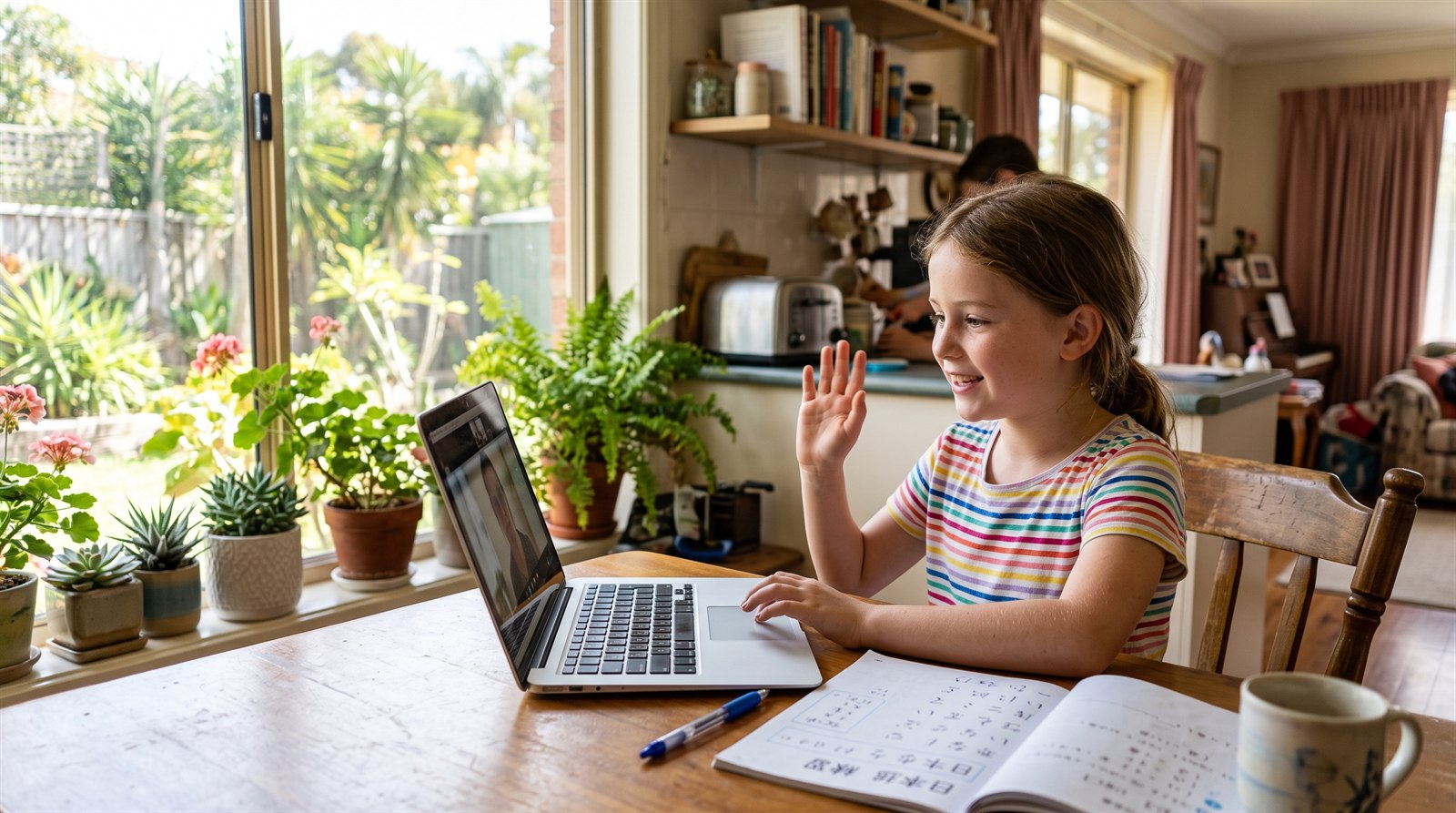
Melbourne is unusually well placed for this and most parents underrate it. Victoria sits one to two hours ahead of Japan Standard Time depending on daylight saving. A late-afternoon class in Japan lands in the Melbourne early evening — after school, before dinner. Compare that with London, where the same class is the middle of the night.
What an online school with classes in Japan adds is the missing ingredient from routes 1 to 3: peers. Not a teacher asking questions, but children the same age who are going to reply, tease, and talk about the same games. That is what converts Japanese from a subject into a language.
A note from a Japanese classroom teacher
Melbourne throws up one problem more than any other city we work with, and it is worth naming because the fix is not more study.
Children in Australian schools who speak Japanese at home very often arrive at around age nine or ten able to speak fluently and read almost nothing. In Japanese this gap widens faster than in English, because the writing system carries so much of the load: by Year 4 a child in Japan has met roughly 640 kanji, and each new one is used immediately in every other subject. Miss two years and you are not two years behind in reading — you are locked out of the textbooks that would let you catch up.
The other half is register. A child raised on family Japanese and anime will often speak to an adult exactly as they speak to a parent — お前 instead of あなた, plain forms where です/ます belongs. Nobody in the family corrects it because it sounds affectionate at home. In a classroom in Japan it lands as rude, and the child has no idea why the room went quiet. Fixing that takes practice with peers and a teacher who will actually say so — not a worksheet.
So which one?
- Your child’s school has no Japanese, and Saturday mornings are free — VSL, at $90 a year, is unbeatable value. Diarise Term 4 for the 2027 intake.
- You are on a posting and going back to Japan within a few years — look seriously at JSM.
- You need one specific gap closed before an exam — a tutor is the efficient tool.
- Your child speaks Japanese but will not read, write, or use it — the missing thing is peers, not lessons.
Related reading: Japanese classes for kids in Australia and New Zealand, our guide to choosing a Japanese tutor for kids, and online Japanese lessons for kids.
Frequently asked questions
Can my child do VSL if their school already teaches Japanese?
The stated rule is that VSL enrols students unable to study their language of choice at their home school. If your school runs Japanese, ask VSL directly about your circumstances rather than assuming either way — particularly where a First Language stream is involved and the school program is a beginner Second Language one.
Is there a Japanese Saturday school in Melbourne for heritage children?
Yes — between VSL Saturday centres (including a First Language stream) and community-run supplementary schooling, Melbourne is better served than most Australian cities. Note that supplementary schools run for Japanese nationals typically require Japanese nationality, whereas VSL does not.
Does VSL Japanese count toward the ATAR?
VSL notes that Victorian students receive a bonus toward their ATAR for successful completion of a VCE accredited language, and Japanese is VCE accredited at VSL. VCE students must ensure their enrolment is confirmed through their home school.
What if we live regionally?
Ballarat has a Japanese centre, and VSL Distance Education carries Japanese as both First and Second Language. Beyond that, online classes remove the geography problem entirely — which is often the deciding factor outside metropolitan Melbourne.
My child is four. Is it too early?
VSL starts at Foundation. Before that, the most valuable thing is not a class at all — it is volume of spoken Japanese at home, and someone other than a parent to speak it with, so the language does not become “the thing only Mum says.”