Makima almost never raises her voice. She smiles, she speaks in perfectly polite Japanese, and somehow every sentence still sounds like a command. That makes her a wonderful teacher of one thing textbooks rarely explain: politeness and kindness are not the same. I teach Japanese, and below are eight of the most-quoted Makima quotes in Japanese from Chainsaw Man, in the original Japanese, with rōmaji, a translation, and the grammar underneath — plus an honest note on which lines a real person could say, and which belong only to the head of Public Safety Devil Hunters.
Can-you-use-it legend: ◎ = safe in real conversation · △ = fine in anime, odd in life · ✗ = don’t say this to a person.

Makima quotes in Japanese
| Japanese | Rōmaji | English | Use it? |
|---|---|---|---|
| 私も田舎のネズミが好き | Watashi mo inaka no nezumi ga suki | I like the country mouse too | ◎ Great も pattern |
| 私は彼のファンです 地獄のヒーロー チェンソーマン | Watashi wa kare no fan desu. Jigoku no hīrō, Chensōman | I’m his fan. The hero of Hell, Chainsaw Man | ◎ Swap in your hero |
| でもその一本に人生を変えられた事があるんだ | Demo sono ippon ni jinsei o kaerareta koto ga aru n da | But one of those films once changed my life | ◎ Perfect for film talk |
| 食パンにバターとジャム塗って……サラダ コーヒー あと…デザートかな… | Shokupan ni batā to jamu nutte…… sarada, kōhī, ato… dezāto ka na… | Toast with butter and jam… salad, coffee, and… dessert, maybe… | ◎ Everyday food words |
| 一緒にたくさん食べて寝て 幸せな生活をしましょう | Issho ni takusan tabete nete shiawase na seikatsu o shimashō | Let’s eat lots, rest well, and live a happy life together | △ Sweet words, unsettling scene |
| 必要な悪というのは常に国家が首輪をつけて支配しているものです | Hitsuyō na aku to iu no wa tsune ni kokka ga kubiwa o tsukete shihai shite iru mono desu | A necessary evil is always something the state keeps on a collar and controls | △ Villain philosophy |
| これは命令です | Kore wa meirei desu | This is a command | ✗ Controlling — say お願いします |
| 返事は「はい」か「ワン」だけ いいえなんて言う犬はいらない | Henji wa “hai” ka “wan” dake. Iie nante iu inu wa iranai | Your only answers are “yes” and “woof.” I have no use for a dog that says “no.” | ✗ Never to a person |
Want to go from quoting anime to actually talking with friends in Japan?
TOMODACHI JAPAN is an online Japanese school for children growing up outside Japan. They talk with peers their own age in Japan every day, taught by teachers working at Japanese schools, in small classes of 8.
🎁 Register and we’ll email you our School Guide (PDF, in English) straight away. You’ll also be first to hear about tuition, scholarships and opening dates.
Free · takes about 30 seconds
The grammar underneath each line
これは命令です — polite grammar, controlling meaning
Look closely at the grammar of これは命令です. It ends in です, the polite copula you learn in your first week. There is no rough word anywhere. Yet everyone in the room hears a threat, because 命令 (meirei) means “a command from above.” Makima speaks to her subordinates in です/ます the whole series, and that calm politeness is exactly what makes her frightening: she doesn’t need to shout, because she has already decided you will obey.
This is the most useful lesson in her dialogue. Japanese has a ladder of ways to ask someone to do something, and the polite ending alone doesn’t make a request gentle. What matters is whether the other person is allowed to say no. Here is the ladder, using 手伝う (“to help”):
| Form | Example | How it feels |
|---|---|---|
| Plain imperative | 手伝え | a barked command — anime only |
| て-form | 手伝って | casual request to a friend or sibling |
| 〜てください | 手伝ってください | polite, but still a direct instruction |
| 〜てもらえますか | 手伝ってもらえますか | a real question — “could you help me?” |
| 〜ていただけませんか | 手伝っていただけませんか | very polite, for teachers and adults |
Teacher’s note: many learners think 〜てください is the “please” form and stop there. It is polite, but it still tells someone what to do. If you are asking a favour, the question form 〜てもらえますか leaves room for the other person to refuse, and Japanese listeners notice that. Makima never leaves that room. If you ever need to say “this is important” in a kind way, try 大事なお願いです (“this is an important favour”) instead of 命令です.
返事は「はい」か「ワン」だけ — か, だけ and the dismissive なんて
Makima calls the devil hunters under her “dogs,” and this line spells the idea out. It is cruel as a way to treat a person, so it is tagged ✗, but the grammar inside is everyday Japanese. 返事 (henji) is “a reply.” か joining two nouns means “either A or B”: 「はい」か「ワン」. だけ means “only.” And ワン is simply the Japanese sound a dog makes — Japanese dogs say wan wan, not “woof.”
The second half has a small word with a big attitude: なんて. Put after a word, it looks down on it — いいえなんて言う means something like “saying a thing like ‘no’.” Kids use it to complain: 宿題なんて嫌い! (“I hate homework and stuff!”). The polite version of the whole idea, for a real classroom, is 「はい」か「いいえ」で答えてください — “please answer yes or no.” Same か, same structure, and nobody is treated like a pet.
私も田舎のネズミが好き — the little particle も
This line comes after Denji tells Makima about Aesop’s fable of the town mouse and the country mouse — a story Reze had asked him about. He prefers the quiet country life, and Makima answers 私も田舎のネズミが好き, “I like the country mouse too.” Fans later read the line very differently, but the sentence itself is one of the most useful in the series.
も replaces は and means “also.” Notice the position: 私も means “I, too, like it.” Move it and the meaning moves with it — 私は猫も好き means “I like cats as well (as other things).” And 好き is technically an adjective, so the thing you like takes が, not を: 犬が好き, アニメが好き. Two friends discovering they share a hobby is exactly the moment you will want this: 「チェンソーマンが好き!」「私も!」
一緒に〜しましょう — chaining verbs and inviting with ましょう
一緒にたくさん食べて寝て 幸せな生活をしましょう sounds warm on paper. In the story, it is a deeply unsettling moment, because Makima is describing a life in which Denji has no choice at all. Read it as a grammar sentence, though, and it is gold.
食べて and 寝て are て-forms, which link actions like “and”: eat, and sleep, and… The last verb carries the ending for all of them. 〜ましょう is the polite “let’s”: 行きましょう (“let’s go”), 始めましょう (“let’s begin”). Put 一緒に (“together”) in front and you have the most friendly invitation in Japanese: 一緒に勉強しましょう! With close friends, the casual version is 一緒に勉強しよう.
人生を変えられた事がある — passive plus たことがある
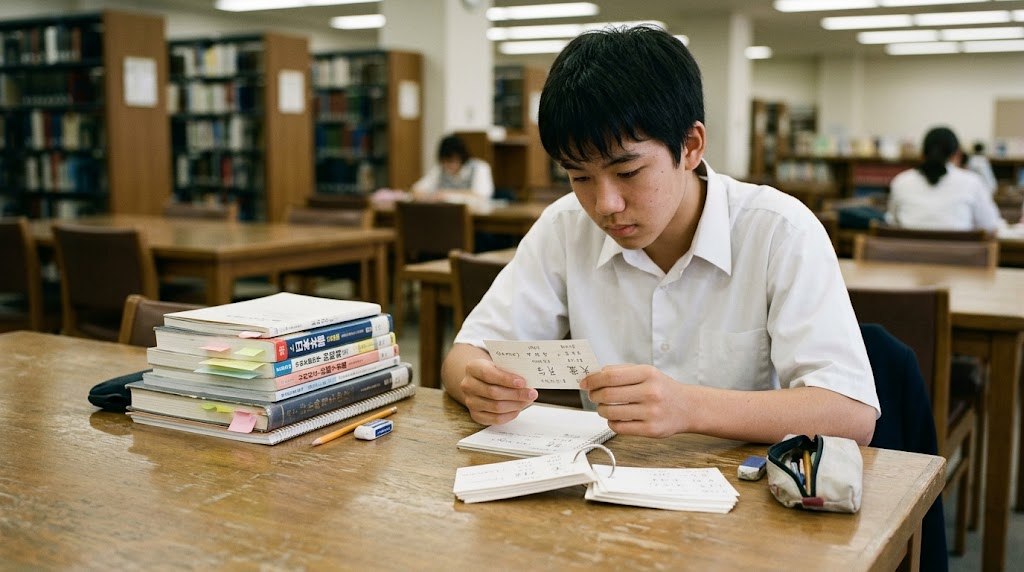
On her cinema day with Denji, Makima admits that most films bore her — でもその一本に人生を変えられた事があるんだ, “but one of them once changed my life.” This single sentence holds three points of grammar that intermediate learners struggle with.
First, 一本 (ippon): 本 is the classifier for long, thin things like pens and bottles, and also for films, because films used to come on long reels. Second, 変えられた is the passive of 変える (“to change something”), so 一本に人生を変えられた is literally “had my life changed by one film” — the film is marked with に as the doer. Third, past tense + ことがある means “I have had the experience of…”: 日本に行ったことがある (“I have been to Japan”). Students can borrow the whole frame: この本に人生を変えられたことがあります — a lovely sentence for a book report.
私は彼のファンです / 〜というのは〜ものです — stating and defining
私は彼のファンです is the simplest sentence in this list and the easiest to reuse. Swap in any name: 私はこの歌手のファンです, 私は大谷選手のファンです. Makima follows it with 地獄のヒーロー チェンソーマン, “the hero of Hell, Chainsaw Man” — の linking two nouns, like “the hero of Hell.”
Her line about the necessary evil shows a more advanced pattern for giving definitions. 〜というのは means “the thing called…” and introduces the topic; 〜ものです at the end means “that is the nature of it.” Teachers use exactly this frame: 友達というのは助け合うものです, “friends are people who help each other.” The vocabulary in her sentence — 首輪 (kubiwa, a dog collar) and 支配 (shihai, control) — is a strong hint about who she really is, which we will leave for you to discover in the story.
Is Makima good for learning Japanese?
Surprisingly, yes — more than most anime characters. Makima speaks in standard, polite Japanese with 私 for “I” and です/ます endings, so her sentence shapes are close to what you would hear from a teacher or a colleague. Her food words, her film talk and her “I like it too” are all things a learner can say tomorrow. The catch is her intent. Many of her polite sentences are commands in disguise, and a few of her lines (including several we left out for younger readers) are far too dark to repeat.
So keep the pattern and change the clothes: これは命令です becomes 大事なお願いです, 「はい」か「ワン」だけ becomes 「はい」か「いいえ」で答えてください. The real skill hiding in her dialogue is hearing how a request differs from a command, and the only way to train that ear is to talk with real people your own age — a friend’s reaction teaches you more about tone than any quote list can.
Keep going with the same method: our Chainsaw Man quotes in Japanese guide covers Denji, Power and Aki, so you can hear how rough their speech is next to Makima’s calm です/ます. For more calm, polite antagonists, see anime villain quotes in Japanese, and the way she calls people デンジ君 and パワーちゃん is explained in our guide to Japanese honorifics in anime. If you are starting from zero, our guide to learning Japanese with anime sets out a weekly routine, and our tuition page explains how live classes with Japanese friends work.
FAQ
What is Makima’s most famous quote in Japanese?
Among fans, 返事は「はい」か「ワン」だけ (Henji wa “hai” ka “wan” dake) — “your only answers are yes and woof” — is probably the best known, because it sums up how she treats the people under her. For learners, 私も田舎のネズミが好き is the more useful one, since the も pattern works in everyday conversation.
Why does Makima sound polite but scary?
Because the politeness is in her grammar, not in her meaning. She uses です/ます and 〜てください, but she never asks a real question that allows the answer “no.” Japanese listeners feel that gap immediately. A truly gentle request sounds like 〜てもらえますか, which invites the other person to choose.
What does “wan” mean in Makima’s line?
ワン (wan) is the Japanese sound for a dog’s bark, like “woof” in English. Cats say ニャー (nyā), and pigs say ブーブー (būbū). Animal sounds are a fun way for children to start reading katakana.
Is Makima dialogue in Japanese good for beginners?
Yes, for listening. Makima dialogue in Japanese is slow, clear and polite, with standard pronunciation, so beginners can often pick out です, ましょう and familiar words. Just remember that the polite form doesn’t make her words kind, and choose the gentle versions shown above for real conversations.
My child loves Chainsaw Man. How do they practise with real Japanese speakers?
Tomodachi Japan is an online Japanese school for children living outside Japan, taught by Japanese school teachers in small classes of eight, with classmates their own age in Japan. Parents don’t need to speak Japanese — we guide you in English. The free school guide below has the timetable, tuition and scholarship details.