The Hong Kong Japanese School — 香港日本人学校, which now calls itself the Japanese International School (Japanese Section) in English — charges HK$5,735 a month for a primary child in the 2026–27 school year (HK$5,710 tuition plus HK$25 PTA dues), and HK$6,776 for junior high. On top comes a new Annual Capital Levy of HK$15,960 per child, paid in full on entry and again every April, and the school bus at HK$2,132 to HK$2,613 a month. There is no entrance fee this year. That puts a primary year at about HK$84,780 before the bus. The bigger news is where: since April 2026 the Happy Valley campus and the Tai Po campus have been merged, so every pupil, Grade 1 to Grade 9, now goes to school at 4663 Tai Po Road. And contrary to most English listings, the school says it has no nationality restriction — the real gate is whether your child can learn in Japanese.
This page is the single-school deep dive: what the Hong Kong Japanese School costs, who can actually enrol, what the 2026 merger changed, and what English-language pages still get wrong. Everything comes from the school’s own Japanese-language pages, its 2026–27 fee sheet and the Education Bureau’s international schools directory, read on 17 October 2026. Where something is not published, we say not published. For every other Japanese option for children in the city — the Saturday school, kids’ classes and online — see our overview of Japanese classes for kids in Hong Kong, and note that this page updates what it says about the school’s campus and fees.
The short answer
| What it is | A full-time Japanese school (nihonjin gakko) opened in 1966, teaching Japan’s national curriculum in Japanese, Grades 1 to 9. A Hong Kong government-registered private school run by Hong Kong Japanese School Limited, with an English-medium IB section on the same campus |
| One campus, since April 2026 | 4663 Tai Po Road, Tai Po Kau, New Territories. The former Hong Kong campus in Happy Valley, which housed the primary section and, from 2018, the junior high, has been merged into Tai Po |
| Monthly cost, 2026–27 | Primary HK$5,735; junior high HK$6,776; primary Global Class (Grades 4–6) HK$9,995. Billed in three four-month blocks by auto-debit. Bus HK$2,132 to HK$2,613 a month on top |
| The levy | HK$15,960 Annual Capital Levy per child — in full on entry, then at the start of every school year. Non-refundable. No entrance fee is charged in 2026 |
| Who it takes | Children of Japanese school age living in Hong Kong with the right of abode or a valid visa, who can follow lessons in Japanese. No nationality restriction is published. Every applicant sits an aptitude test |
| Size | Current enrolment is not published. The Education Bureau lists 350 to 450 places and an average class of 30 |
| The real catch | Japanese ability, the Dependant visa (it must be issued before the first day) and, for Hong Kong Island families, a daily trip to Tai Po. And it stops at Grade 9 |
Looking for a way to keep Japanese going from abroad?
TOMODACHI JAPAN is an online Japanese school for children growing up outside Japan. They talk with peers their own age in Japan every day, taught by teachers working at Japanese schools, in small classes of 8.
🎁 Register and we’ll email you our School Guide (PDF, in English) straight away. You’ll also be first to hear about tuition, scholarships and opening dates.
Free · takes about 30 seconds
First, which school do you actually mean?
Search for “Hong Kong Japanese School” and you will meet at least four names, two old addresses and a website that redirects. Since the 2026 merger the school’s English name is Japanese International School, and hkjs.edu.hk now forwards to jis.edu.hk. That is why so many parents — and so many listings — assume there are two separate schools. There is one school with two sections, and a separate Saturday school with a confusingly similar name.
| Name you will see | What it actually is | Language and ages | Where |
|---|---|---|---|
| Hong Kong Japanese School / Japanese International School (Japanese Section), 香港日本人学校, jis.edu.hk | The full-time Japanese school this page is about. Japan’s national curriculum and textbooks, Monday to Friday | Japanese; Grades 1–9 (ages 6–15) | Tai Po Kau, since April 2026 |
| Japanese International School (International Section), es.jis.edu.hk | The same school’s English-medium section, an IB World School teaching the Primary Years Programme. Not a Japanese-curriculum school | English, with Japanese as a subject; Reception to Year 6 | Same Tai Po campus |
| Hong Kong Japanese Supplementary School (HKJSS), 香港日本人補習授業校, hkjss.hk | A Saturday hoshuko for Japanese children who attend local or international schools on weekdays. A separate organisation | Japanese; kindergarten to junior high levels, plus heritage classes | Separate venue |
| “Primary Section Happy Valley”, 157 Blue Pool Road | The former Hong Kong campus. Still on many directory pages, but no longer where the school teaches | — | Merged into Tai Po, April 2026 |
Two practical consequences follow. First, if you searched for “Japanese International School Hong Kong fees”, check which section you are pricing: the Education Bureau lists the Japanese Section at HK$68,520 to HK$81,240 a year in tuition, and the IB International Section at HK$119,640 to HK$147,483. Directory pages that quote a single range from HK$68,520 to HK$147,483 are mixing the two. Second, if your child attends an international school on weekdays and you want Saturday kokugo, you want HKJSS, not this school. If you want a full Japanese school day, read on.
What it costs in 2026–27: HK$5,735 a month plus HK$15,960 to start
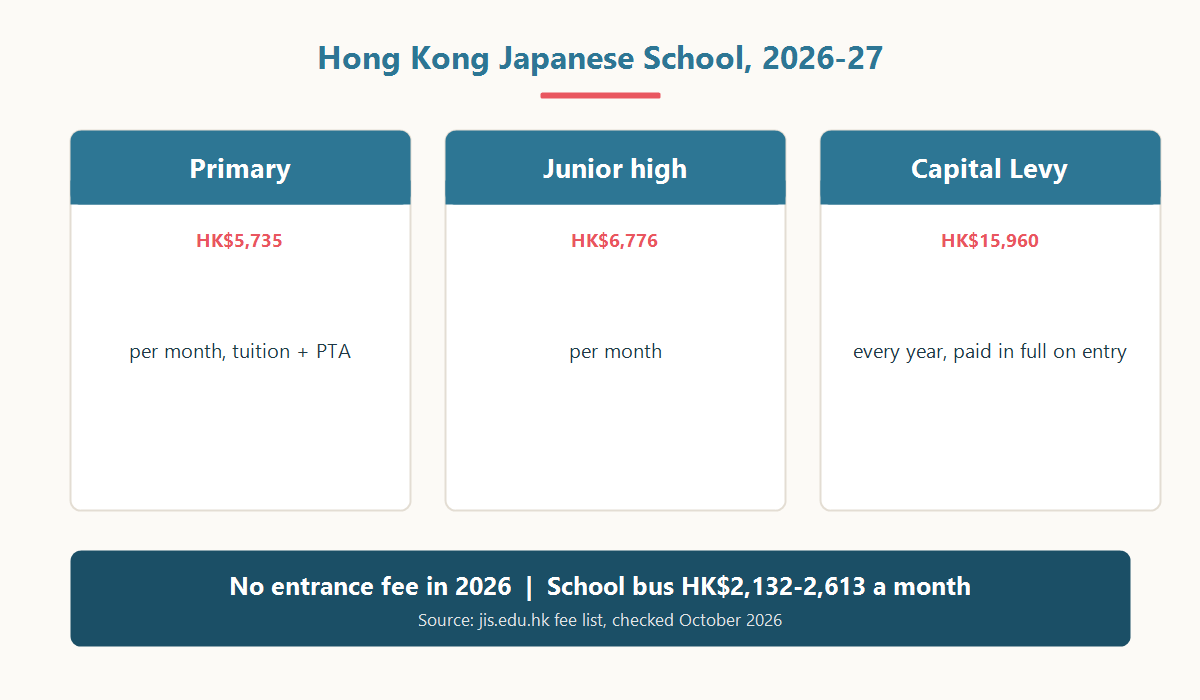
The fees are published on the Japanese-language “fee list” page and as a one-page PDF, in Hong Kong dollars, per child. The school year runs from April 2026 to March 2027. The annual amount is split into twelve monthly charges, collected in three four-month blocks by auto-debit on 1 April, 1 August and 1 December.
| Item | Primary (Grades 1–6) | Primary Global Class (Grades 4–6) | Junior high (Grades 7–9) |
|---|---|---|---|
| Entrance fee | Not charged in 2026 — the school cites an instruction from the Hong Kong government | ||
| Annual Capital Levy (on entry, then every April) | HK$15,960 | HK$15,960 | HK$15,960 |
| Tuition (monthly) | HK$5,710 | HK$9,970 | HK$6,770 |
| PTA dues (monthly) | HK$25 | HK$25 | HK$6 |
| Monthly school charges | HK$5,735 | HK$9,995 | HK$6,776 |
| Per four-month block | HK$22,940 | HK$39,980 | HK$27,104 |
| School bus, Hong Kong Island (monthly) | HK$2,350 | HK$2,350 | HK$2,613 |
| School bus, Kowloon and New Territories (monthly) | HK$2,132 | HK$2,132 | HK$2,613 |
| Per year, levy included, no bus | HK$84,780 | HK$135,900 | HK$97,272 |
| Per year, levy and Hong Kong Island bus | HK$112,980 | HK$164,100 | HK$128,628 |
In US dollars, at Hong Kong’s pegged rate of about 7.8, a primary year comes to roughly US$10,900 before the bus, and junior high to about US$12,500. An April entrant in primary pays HK$38,900 up front — the first four-month block plus the levy — or HK$48,300 with the Hong Kong Island bus. A child joining mid-year pays the full levy on admission, and tuition for the whole month of entry, whatever the start date.
Three things are worth knowing about how these numbers have moved:
- Tuition rose about 2%. The school’s earlier notice shows the 2025–26 rates: HK$67,200 a year for primary (HK$5,600 a month), HK$79,680 for junior high (HK$6,640) and HK$117,360 for the Global Class. Those are the figures most English pages still quote.
- The levy is new, and it is annual. The school announced the Annual Capital Levy in October 2025, to fund a facilities plan running into the 2030s, subject to Education Bureau approval. It is not a one-off: it is charged at the start of every school year, so over six years of primary it adds up to HK$95,760 per child.
- No entrance fee — for now. The 2026 fee list says the entrance fee is not being collected this year on the Hong Kong government’s instruction. Whether it returns is not published.
Tuition does not cover everything. The school lists English materials, Grade 1 supplies, Grade 7 supplementary materials, overnight camps and Hong Kong field trips as separate costs, alongside the uniform. Several things are not published: any sibling discount, whether a Japanese employer is billed directly (many are, in practice, but the school does not say), the cost of the uniform, and the amounts for those extras.
Is HK$84,780 a year expensive? Not by Hong Kong standards. Its own International Section, an IB primary school on the same campus, runs at HK$119,640 to HK$147,483 a year in tuition alone, and many international schools charge more. The budget question for most families is the bus and the levy, not the monthly bill.
Who can enrol: no nationality rule, but a real language test
The Japanese-language admissions pages for transfers (Grades 2 to 9) and for new Grade 1 pupils set out the same conditions. They are shorter than most people expect.
- Japanese school age. Year groups follow Japan’s April-to-March cohorts, set by date of birth. For the April 2026 Grade 1, that meant children born between 2 April 2019 and 1 April 2020. The school does not let children skip a year or drop down one.
- The right to live in Hong Kong. The child needs Hong Kong right of abode or a valid visa — for most families, a Dependant visa — and it must be issued before the first day. The school warns that applying after you arrive is too late.
- The family lives in Hong Kong. The FAQ is explicit that a child living in Shenzhen or elsewhere in mainland China cannot commute to the school.
- The child can learn in Japanese. Every applicant sits an aptitude test on the orientation day, and the principal makes the final decision.
What the pages do not say matters just as much. They state plainly that nationality is not a factor — “国籍は問いません” — and the FAQ adds that there are no restrictions based on the nationality of either parents or children. Nor do they require membership of the Japanese Club of Hong Kong or any other association, a condition several other Japanese schools in Asia impose. A Hong Kong permanent resident child with one Japanese parent, or with no Japanese parent at all, is not shut out by the rules.
Language is the practical gate. The FAQ says the school will judge whether a child has the Japanese to keep up with lessons, and every subject except English is taught in Japanese with Japanese textbooks. In practice a child needs grade-level Japanese. There is no published waiting list: transfers in the middle of a term are taken on a rolling basis, and a child can start the day after the paperwork is done. Registration is online only; a parent then brings the child, the previous school’s records and the visa documents to an orientation session. Trial enrolment is not offered at present, and children with special educational needs follow separate rules — contact the office first.
How it works: one Tai Po campus, a Japanese school year
The school’s management board announced on 19 February 2025 that the Hong Kong campus in Happy Valley and the Tai Po campus would merge by April 2026 on the Tai Po site, citing the quality of education and the school’s long-term sustainability. The principal’s message confirms the merged school began in the 2026 school year. The Grade 1 information sessions were held in Tai Po, and the FAQ now refers to the junior high there too.
| What | What the school publishes |
|---|---|
| Campus | 4663 Tai Po Road, Tai Po Kau, New Territories — opened in 1997, now shared by the Japanese Section and the International Section |
| Structure | A nine-year programme, Grades 1 to 9, taught as early, middle and late phases with cross-grade group activities |
| English | At least five hours a week in every grade, partly with native-speaker teachers; art and crafts (Grades 2–6) and swimming taught in English |
| Global Class | Grades 4–6: five hours of advanced English a week plus inquiry-based Global Studies. Extending to Grades 7–8 in 2027 and Grade 9 in 2028. Separate transfer exam (HK$1,000 fee) |
| Teachers | Teachers seconded from prefectures in Japan, plus teachers hired by the school |
| Class size | The Education Bureau lists 1 to 5 classes per grade and an average class of 30 |
The year follows Japan’s three-term pattern. Term 1 started with the entrance ceremony on 21 April 2026, Term 2 transfers were tested on 28 August, and Term 3 begins in January 2027. A full holiday calendar was not on the public pages we checked. Other things the school publishes about daily life:
- A uniform. Unlike some Japanese schools in Asia, this one has one, sold by Uniform Station in Lai Chi Kok, online, and at school on Wednesdays. Prices are not published.
- No school lunch. The FAQ says simply that there are no school lunches in Hong Kong; children bring their own.
- Buses run by parents. A voluntary bus users’ association, with elected parent representatives, sets the routes and fees; operations are contracted to the school office. New stops open only if enough families in an area qualify.
- Supervision rules. The school reminds parents that in Hong Kong children aged 11 and under should not be left alone or travel alone, so an adult or helper must take them to the bus stop.
- Typhoons and rainstorms. The school closes or sends children home early under its published severe-weather rules.
The move matters most for families on Hong Kong Island. Before 2026, a child in Happy Valley, Mid-Levels or Pok Fu Lam had a short ride to Blue Pool Road. Now the same child rides to Tai Po Kau, beyond Sha Tin. The school does not publish journey times, so ask the bus association about your stop before you sign a lease.
The honest review: what the English pages leave out
People search for “Hong Kong Japanese School reviews” to learn what it is like from the inside. We want to be straight: we found no body of verifiable parent reviews. One major school directory blocked our request, the others we checked carry no reviews at all, and we found no current parent threads we could verify. We are not going to invent a consensus. What we can check is where English-language pages — including our own — diverge from what the school publishes in Japanese.
1. “Primary and junior high in Happy Valley.” Not any more
The English Wikipedia article, edited as recently as September 2026, still places the Japanese primary and junior high sections at 157 Blue Pool Road, Happy Valley, with only the international section in Tai Po. So does the Schooland profile. Our own July overview made the same mistake. None of them mentions the merger. Since April 2026, every Japanese Section pupil studies in Tai Po — a difference of an hour a day for some families.
2. “HKJS and JIS are two different schools.” They are one
Guides such as ITS Education Asia present the Hong Kong Japanese School “on Hong Kong Island” and the Japanese International School in Tai Po as separate entries. Both sections are run by the same company, Hong Kong Japanese School Limited, under one management board, and since the merger they share one campus and one English name. What differs is the curriculum: Japanese national curriculum in the Japanese Section, IB PYP in English in the International Section.
3. Fee figures that are a year old — and miss the levy
Search summaries and directory pages still quote HK$67,200 to HK$117,360 a year — the 2025–26 rates. The Education Bureau directory’s HK$68,520 to HK$81,240 matches 2026 tuition, but tuition only. None of them shows the HK$15,960 Annual Capital Levy, charged every year, or a bus that adds up to HK$31,356 a year for junior high. Schooland’s single range of HK$68,520 to HK$147,483 blends the Japanese Section with the IB section. Budget from the school’s own fee list.
4. “Only for Japanese nationals.” The school says otherwise
English pages describe the school as being for “native Japanese speakers” or, like our own overview, as in practice for Japanese-national and expat families. The school’s own wording is that nationality is not a condition at all. The real filter is Japanese ability, tested on the day, plus a valid Hong Kong visa. For a Hong Kong-born child of a mixed family who speaks Japanese well at home, that difference is everything.
5. Enrolment figures nobody can date
Wikipedia’s enrolment figures stop in 1966. Directories offer “places” — 350 to 450 in the Education Bureau listing, 300 to 400 in older snapshots — without a year. The school does not publish a current headcount, before or after the merger. Treat any precise number you see as unverified.
6. What to ask, since the reviews won’t tell you
- How long is the bus ride from our stop to Tai Po? Not published, and the answer may decide where you live.
- Does my employer pay the fees and the levy directly? Not stated on the web pages.
- What does the aptitude test cover for a child coming from an international or local school? Not published.
- How many children are in my child’s class now? Only an average of 30 is listed.
- Is the levy refunded if we leave in June? The school says it is non-refundable — check before a short posting.
- Will the entrance fee come back in 2027? Not published.
Other options in Hong Kong
If your child cannot follow a full Japanese school day, or you want them at a local or international school, these are the routes that remain.
| Option | Who it takes | What to know |
|---|---|---|
| Hong Kong Japanese Supplementary School (HKJSS) | Japanese children at local or international schools | Saturdays, Japanese curriculum and textbooks; kindergarten, level classes and heritage classes. Fees and entry rules in our Hong Kong overview |
| The International Section (IB PYP) | Reception to Year 6, by interview and assessment | Same campus, but taught in English, with Japanese as a subject. A different curriculum, not a route back into Japanese schooling |
| Kids’ Japanese classes | Mostly beginners | Weekly, around an hour; useful for a start, not for keeping pace with Japan |
| Online classes | Anyone, anywhere in the territory | No commute; quality varies widely |
The gap is the same one we see across Asia — compare our pages on the Japanese School of Kuala Lumpur and the Manila Japanese School. A full-time Japanese school serves children who can follow a Japanese school day, and a Saturday school serves Japanese children at other schools. The Hong Kong-born child at an international school whose Japanese is slipping, or who lives in Discovery Bay and cannot face the trip to Tai Po, falls between them.
How to choose, in four questions
- Can your child follow a full day of lessons in Japanese? Every applicant is tested. A child who chats in Japanese at home but reads two years behind may struggle; ask what the aptitude test covers before you apply.
- Is your child going back into Japanese schooling? If a return to Japan is likely, this is the school built for it: same curriculum, same textbooks, same April start. If your family is settled here, weigh what a Japanese-medium day means for English, Chinese and the step after Grade 9.
- Where will you live? Everything is in Tai Po now. From Kowloon Tong or Sha Tin it is a short ride; from the south side of Hong Kong Island it is a long one, every day.
- Who pays? With a Japanese employer behind you, the HK$84,780 a year may be covered. Without one, budget for the levy every April, not just once.
Where TOMODACHI JAPAN fits
We are not a substitute for the Hong Kong Japanese School, and if your child can follow a Japanese school day and is heading back to a school in Japan, we would point you there. We exist for the families the four questions above leave stuck — the child at a local or international school whose Japanese reading is slipping, the family that will not move house for a bus route to Tai Po, and the child who has never had Japanese friends of their own age.
- Japanese friends of the same age, every day. Classes with children the same age in Japan — not only other learners in Hong Kong. The reason children keep going is usually the other children.
- Teachers working at Japan’s current classroom standard — not a syllabus written abroad and not a tutoring marketplace.
- Small classes of eight children. Enough to be a class, few enough that every child speaks every lesson.
- Hong Kong is only one hour behind Japan. An after-school slot in Japan is an after-school slot here, so lessons fit around a local or international school day. No commute, no visa condition and no aptitude test.
- Unlimited classes for a flat monthly fee. Our free school guide covers fees and scholarships, along with opening dates. We email it to everyone who registers, with no obligation.
If a Saturday school is what you are weighing us against, our guide to online alternatives to a Japanese hoshuko sets out what an online class can and cannot replace.
Frequently asked questions
How much are the Hong Kong Japanese School fees?
For 2026–27, primary is HK$5,735 a month (HK$5,710 tuition plus HK$25 PTA dues), junior high HK$6,776 and the primary Global Class HK$9,995. Every child also pays a HK$15,960 Annual Capital Levy, on entry and then every April. A primary year comes to about HK$84,780 before the school bus, which costs HK$2,132 to HK$2,613 a month. No entrance fee is charged in 2026.
Is the Hong Kong Japanese School still in Happy Valley?
No. The Happy Valley campus and the Tai Po campus were merged from the 2026 school year. The Japanese Section, Grades 1 to 9, now operates at 4663 Tai Po Road, Tai Po Kau, alongside the International Section.
Are the Hong Kong Japanese School and the Japanese International School the same?
Yes, in the sense that both are run by Hong Kong Japanese School Limited and share one campus. “Japanese International School” is now the English name of the whole school. Its Japanese Section teaches Japan’s national curriculum in Japanese; its International Section is an English-medium IB primary school with separate admissions and higher fees.
Does my child need a Japanese passport?
No. The school states that nationality is not a condition of entry, for parents or children. Your child does need Japanese school age, Hong Kong right of abode or a valid visa issued before the first day, a home in Hong Kong, and Japanese good enough to pass the aptitude test and follow lessons.
Can we join in the middle of the year?
Yes. Transfers are taken through the year on a rolling basis, with orientation and aptitude-test days at the start of each term. You pay the full annual levy on admission and tuition for the whole month of entry.
Is there a uniform and school lunch?
There is a uniform, sold through the school’s supplier. There is no school lunch; children bring their own.
Sources
- Hong Kong Japanese School / Japanese International School, Japanese Section (Japanese-language pages): School profile, Principal’s message, Consolidation notice (19 February 2025), Fee list 2026–27, Fee sheet (PDF), 2026 fee notice with 2025 rates, Transfer admissions, Grade 1 admissions, FAQ, Uniform, School bus, Parent responsibilities
- International Section: Find us. Education Bureau international schools directory: Japanese Section, International Section
- Hong Kong Japanese Supplementary School: official site
- Third-party pages checked: Wikipedia, Hong Kong Japanese School; Schooland profile; ITS Education Asia; a doris.school listing (blocked, seen via search results). All checked 17 October 2026.