The Singapore Japanese School — officially The Japanese School Singapore — charges S$817.50 a month for a primary child in the 2026 school year (tuition plus facility fee, GST included), or S$9,810 a year. Secondary is S$893.80 a month. On top come S$3,815 at entry for most families, a further S$3,270 donation if no Japanese company is paying, the school bus at S$305.20 a month, and membership of the Japanese Association, Singapore for at least one parent. The surprise is the rule English pages usually get wrong: the school does not ask for a Japanese passport. Its real limits are different — a child who holds Singapore citizenship is generally not admitted, and every lesson apart from English is taught in Japanese.
This page is the single-school deep dive: what the Singapore Japanese School costs, who can actually enrol, how the Clementi, Changi and West Coast campuses divide the work, and what English-language listings get wrong. Everything comes from the school’s own Japanese-language pages, its 2026 fee sheet and the Japanese Association’s fee table, read on 10 October 2026. Where something is not published, we say not published. For every other Japanese option for children in the city, see our overview of Japanese classes for kids in Singapore — and note that this page corrects what it says about the Japanese School’s eligibility.
The short answer
| What it is | A full-time Japanese school (nihonjin gakko, シンガポール日本人学校) founded in 1966, teaching Japan’s national curriculum in Japanese, Grades 1 to 9. Run in connection with the Japanese Association, Singapore, whose membership is a condition of entry |
| Three campuses | Clementi (primary, 95 Clementi Road, opposite NUS) and Changi (primary, 11 Upper Changi Road North) — you do not choose; your home address decides. All secondary pupils go to West Coast (201 West Coast Road) |
| Monthly cost, 2026 | Primary S$817.50 (S$675.80 tuition + S$141.70 facility fee); secondary S$893.80. GST included. Billed quarterly by GIRO. Bus S$305.20 a month on top |
| One-off at entry | Entrance fee S$1,090 (S$3,924 on the fee sheet’s “Non JA Corporate Membership” line) plus a S$2,725 building surcharge per child — charged again on moving up to secondary. Families whose employer is not a Japanese company add a S$3,000 + GST personal donation, once per household |
| Who it takes | Children of school age under Japanese law, living in Singapore, with at least one parent in the Japanese Association. No Japanese nationality rule is published. Singapore citizens are generally not admitted |
| Size | Current enrolment is not published by the school. Mainstream classes have no cap |
| The real catch | Singapore citizenship, the language of instruction, and the address-based campus rule. And it stops at Grade 9 |
Looking for a way to keep Japanese going from abroad?
TOMODACHI JAPAN is an online Japanese school for children growing up outside Japan. They talk with peers their own age in Japan every day, taught by teachers working at Japanese schools, in small classes of 8.
🎁 Register and we’ll email you our School Guide (PDF, in English) straight away. You’ll also be first to hear about tuition, scholarships and opening dates.
Free · takes about 30 seconds
First, which school do you actually mean?
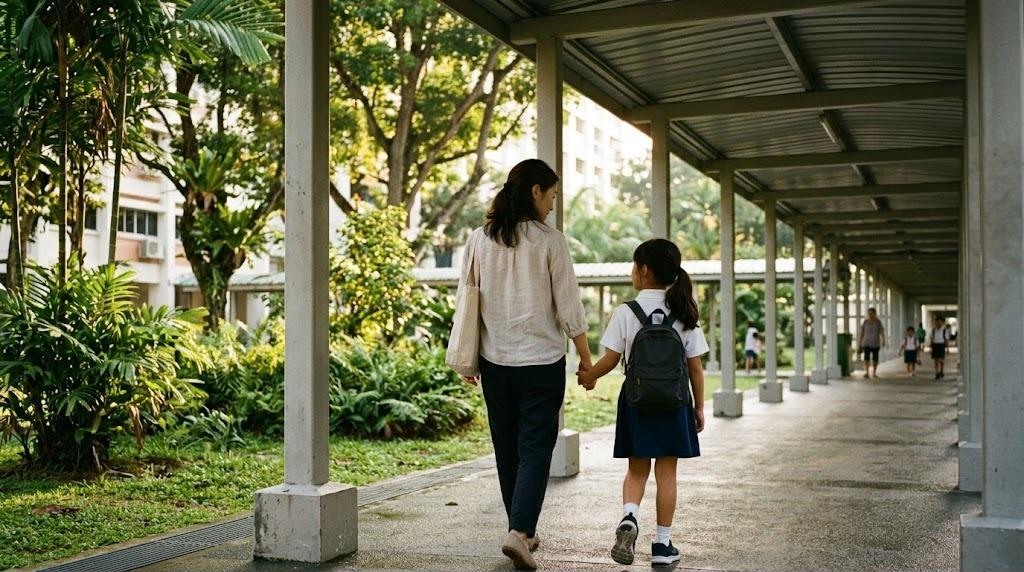
“Singapore Japanese School” is used for at least four different things, and search results blur them. Two of them share the same Clementi buildings, which is where most of the confusion starts. The Japanese School Singapore is a weekday school that replaces a child’s local or international school. A hoshuko (補習授業校, supplementary school) is a Saturday school that sits on top of one.
| Name you will see | What it actually is | Where |
|---|---|---|
| The Japanese School Singapore, シンガポール日本人学校, sjs.edu.sg | Full-time school, Grades 1 to 9, Monday to Friday, taught in Japanese. Two primary campuses and one secondary campus | Clementi, Changi, West Coast |
| Japanese Supplementary School Singapore (JSS), シンガポール日本語補習授業校, jss.edu.sg | A Saturday hoshuko for children with Japanese nationality who attend local or international schools on weekdays. Entrance exam and parent interview. Pupils of the Japanese School cannot use it | Uses the Clementi campus on Saturdays |
| Japanese Association, Singapore (JAS), シンガポール日本人会 | The members’ association. A parent must belong before the child can enrol at the Japanese School | Clubhouse, separate from the school |
| Waseda Shibuya Senior High School in Singapore | A private, MEXT-certified Japanese senior high school, opened in 1991 — the usual next step after Grade 9, with its own exams and fees | 57 West Coast Road |
The two easiest mistakes follow from that table. First, the nationality rule people remember belongs to JSS, not the Japanese School: the Saturday school requires Japanese nationality; the weekday school does not publish any such rule. Second, “the Japanese school in Clementi” can mean either. If your child is at an international school and you want Saturday kokugo, you want JSS — our guide to the Japanese Supplementary School Singapore covers its entry rules. If you want a full Japanese school day, read on.
What it costs in 2026–27: S$817.50 a month plus S$3,815 to start
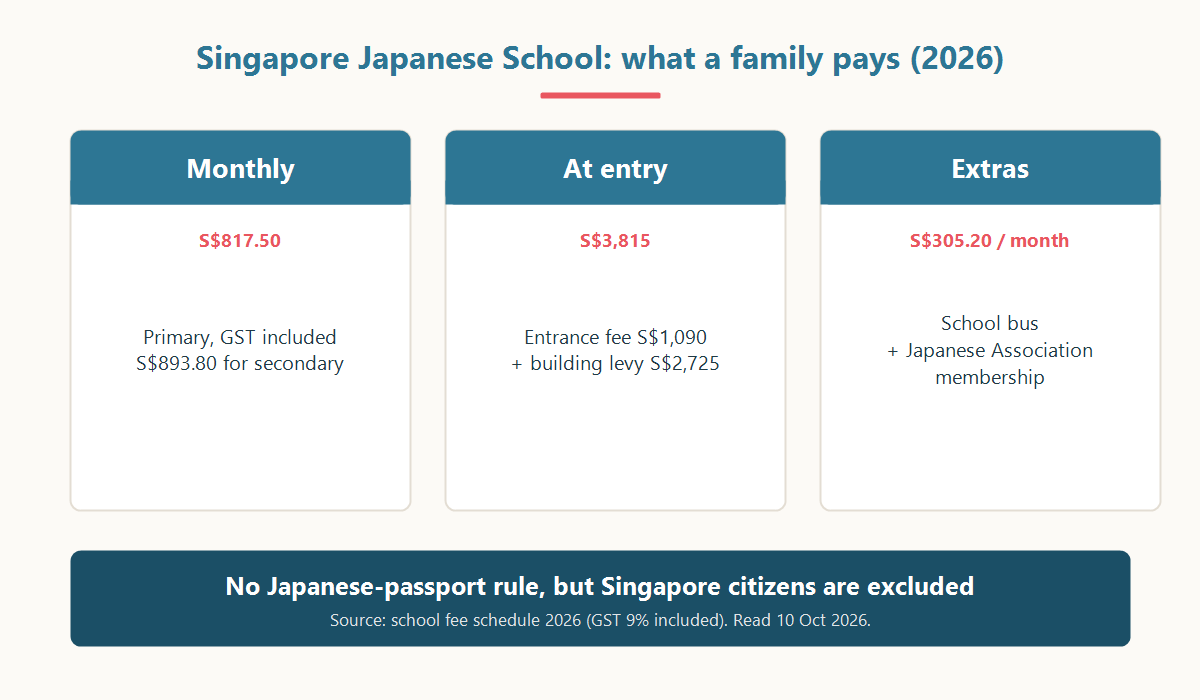
The fees are published — as a one-page PDF on the school’s Japanese-language admissions section, in Singapore dollars, per child. The 2026 school year runs from April 2026 to March 2027. Every figure on the sheet is a round sum plus Singapore’s 9% GST, and the sheet carries a GST 9% note, so the amounts below already include it.
| Item | Primary (Grades 1–6) | Secondary (Grades 7–9) |
|---|---|---|
| Entrance fee (once, on acceptance) | S$1,090 (S$3,924 on the “Non JA Corporate Membership” line) | Same again at Secondary One |
| Building surcharge (once) | S$2,725 | Same again at Secondary One |
| Tuition (monthly) | S$675.80 | S$752.10 |
| Facility fee (monthly) | S$141.70 | S$141.70 |
| Monthly school charges | S$817.50 | S$893.80 |
| Per quarter (three months, by GIRO) | S$2,452.50 | S$2,681.40 |
| Per year (twelve months) | S$9,810 | S$10,725.60 |
| School bus (monthly, optional) | S$305.20 | S$305.20 |
| Bus cooperative, once per household | S$10.90 joining fee + S$100 refundable share | Same |
The first payment is made by bank transfer before your child starts, and covers anywhere from two to four months depending on the month of entry; after that, fees go quarterly by GIRO. Tuition is not pro-rated for a part month. Cash and cards are not accepted.
Then comes the donation, which is where families’ costs really diverge. The school asks for one of three:
- Corporate donation — if a parent works for a Japanese company (including Singapore-registered firms with Japanese capital or management). The company pays, on a scale set by its capital and the number of Japanese staff it has in Singapore. If the company has already paid, there is nothing new to pay.
- Personal donation — if a parent works for a non-Japanese employer, is self-employed or is a foreign national: S$3,000 + GST (S$3,270), once per household.
- Special donation — for diplomatic and official passport holders and government staff: S$1,000 + GST, once per household.
And the Japanese Association. At least one parent must be a member. Its published fee table (all amounts plus GST, deposits excepted) splits members four ways:
| Membership type | Who | Entrance fee | Monthly (family) |
|---|---|---|---|
| Nominee member | Japanese staff aged 21+ nominated by a corporate member | Waived | S$25 |
| Individual member (個人正会員) | Other Japanese nationals aged 21+ | S$1,000 | S$25 + S$30 facility levy |
| Nominee associate | Singaporean or foreign staff nominated by a corporate member | Waived | S$25 |
| Individual associate (会友) | Singaporeans and foreign nationals | S$5,000 | S$25 + S$30 facility levy |
Put together, the same primary child costs very different amounts depending on who employs the parent. These are our additions of the published lines, with GST at 9%:
- Posted by a Japanese company that is a corporate member and has paid its donation: S$3,815 at entry, then S$817.50 a month — or S$1,122.70 with the bus. Often met by the employer.
- Japanese parent working for a local or non-Japanese employer: about S$8,375 before the first day (S$3,270 donation, S$3,815 school entry charges, S$1,090 association entrance fee, S$200 deposit), then about S$877.45 a month including association dues, or S$1,182.65 with the bus.
- Same family, but the only parent who can join is non-Japanese: the association entrance fee becomes S$5,450 instead of S$1,090, so about S$12,735 at entry.
Several things are not published: which families fall under the S$3,924 entrance-fee line (the explanatory Japanese text on the sheet did not survive extraction, and the school’s web pages do not say), whether any one-off charge is refunded if you leave early, and any sibling discount. The sheet also shows a second, higher secondary tuition figure in brackets — S$1,057.30 a month, or S$1,199 with the facility fee. Its label is likewise unreadable; the school runs an English-medium Global Class at secondary level, and the bracketed rate may belong to it, but confirm with the office before you budget.
Is S$9,810 a year expensive? Not for Singapore, where international school fees commonly run several times higher. The real budget line for a locally hired family is the entry bill, not the monthly one.
Who can enrol: four conditions, and one exclusion
The Japanese-language admissions page sets out the conditions for transferring in. They are shorter than most people expect.
- School age under Japanese law. Year groups follow Japan’s April-to-March cohorts, set by date of birth.
- The child lives in Singapore. A temporary address is accepted at application.
- At least one parent is a member of the Japanese Association, Singapore. The page does not restrict which membership type.
- The right donation has been paid — corporate, personal or special, as above.
The exclusion: children with Singapore nationality are, in principle, not admitted, unless the Singapore government approves. That is the line that matters most for mixed families. A child of a Japanese-Singaporean marriage who holds Singapore citizenship — even alongside a Japanese passport — falls under it. A child of a Japanese parent and, say, a British or Indian parent, living here on a Dependant’s Pass, does not.
What the page does not say is just as important. It does not require Japanese nationality. And the Japanese Association’s own categories include associate membership for Singaporeans and foreign nationals, so a family without a Japanese parent is not shut out by the membership rule either — only by cost and by language.
Language is the practical gate. No Japanese test is published for families arriving from Japan. But a child transferring from a local, international or third-country school in Singapore must sit an entrance exam, and every lesson apart from English is taught in Japanese, with Japanese textbooks. In practice a child needs grade-level Japanese to keep up. Places are not the obstacle: the school says mainstream primary and secondary classes have no cap, and transfers are taken through the year. Apply online at least a month before the start date; a parent must then hand in the forms in person, with their Employment Pass card, association membership card, the child’s passport and proof of the Dependant’s Pass application. The child can start three business days after the paperwork is complete.
How it works: three campuses, one Japanese school year
Primary is split by address. The school publishes a catchment map dividing the island between Clementi in the west and Changi in the east, and states plainly that crossing catchments is not allowed — the principal can approve a short exception, nothing more. So the condominium you choose decides your child’s campus, and your bus route. At secondary level everyone goes to West Coast, which typically takes the school’s own Grade 6 leavers.
| Campus | Grades | What the school publishes |
|---|---|---|
| Clementi, 95 Clementi Road | 1–6 | Headquarters since the primary school split in 1998. Opposite the National University of Singapore. Pool, gym, auditorium, two libraries, heritage rooms. Class ratios from 1:26 up to 1:34 |
| Changi, 11 Upper Changi Road North | 1–6 | Site of about 44,100 m², the largest of the three. Two pools, tennis court, multi-purpose hall. Class ratios from 1:25 up to 1:31 |
| West Coast, 201 West Coast Road | 7–9 | English immersion since 1995. Mainstream classes, plus a Global Class of about 30 per grade taught largely in English (Eiken Grade 3 or higher needed to apply for Grade 7) |
The 2026 school year has three terms, on the Japanese pattern:
| Term | Months (2026 school year) | Holidays published |
|---|---|---|
| First term | April to July 2026 | Summer holiday listed as 1 to 31 August 2026 |
| Second term | August to December 2026 | Winter holiday 24 December 2026 to 6 January 2027 |
| Third term | January to March 2027 (transfers start 7 January) | Spring holiday from 13 March 2027 into April |
Other things the school publishes about daily life:
- No uniform. Neither primary nor secondary has a set uniform; children wear practical, suitable clothes, and secondary pupils need formal wear for ceremonies.
- English with native-speaker teachers in small groups, and English immersion in music, PE and swimming at primary level.
- Buses run by volunteer groups under the Japanese School Cooperative (日本人学校協同組合), which riders must join. Some Clementi stops are full with a waiting list.
- Lunch is from home or ordered through each campus’s lunch page.
- No school visits. The school says it does not accept visits, for security reasons. You learn about it from the prospectus, which is handed out at the office, not posted.
- No double enrolment. A child cannot stay on the roll of a school in Japan while attending.
The honest review: what the English pages leave out
People search for “Singapore Japanese School reviews” to learn what it is like from the inside. We want to be straight: we found no body of verifiable parent reviews. One school directory says outright that it has none, another blocked our request, and we found no current parent threads we could check. We are not going to invent a consensus. What we can check is where English-language listings — including our own — diverge from what the school publishes in Japanese.
1. “Japanese nationality required.” It is not
Our own July overview said the Japanese School requires Japanese nationality. That is wrong, and we have corrected it here. One comparison site, WhereNext, similarly frames it as a school for “Japanese-passport families”. The school’s actual rule is association membership plus residence in Singapore, with one exclusion — Singapore citizens. The nationality rule belongs to the Saturday school, JSS. For a mixed family where neither child nor parent is Singaporean, that difference decides everything.
2. Fee figures that are a year old — and miss the entry bill
The International Schools lists S$8,960 a year for Grades 1 to 6, with S$9,875 for Grades 7 to 9, for 2025–26. The 2026 sheet works out at S$9,810 for primary, with S$10,725.60 for secondary. A Doris listing, seen through search results, shows S$6,660 to S$7,500 for primary; WhereNext gives US$6,000 to US$10,000 a year and, on the same page, two different all-in estimates. None of them shows the one-off charges — S$3,815 in entry fees per child, repeated at Secondary One, and a S$3,270 personal donation for families without a Japanese employer behind them. Budget from the school’s own sheet.
3. Wrong founding year, wrong languages
The same International Schools listing gives the school as founded in 1971 and answers “No” to foreign languages taught. The school dates itself to 1966; 1971 is when it moved to West Coast Road. And English is taught throughout, by native speakers, with immersion lessons at every campus and an English-medium Global Class at secondary.
4. Enrolment figures from another era
The English Wikipedia article gives enrolment for April 1998 — 2,445 pupils — and calls it the largest overseas Japanese school “as of 2013”. The school’s website does not publish a current total. A Japanese-language blog cites roughly 1,760 pupils across the three campuses in October 2025, which we could not verify against a primary source. It is still a very large school by overseas standards; just not the size older pages suggest.
5. “Fixed intake.” Not for mainstream classes
WhereNext describes admissions as a fixed intake. The school says mainstream classes have no cap and transfers run all year, with only long holidays excluded. The limited-place exceptions are the Global Class and places for children who need special support, where the school asks families to contact it first.
6. What to ask, since the reviews won’t tell you
- Which entrance fee applies to us — the S$1,090 rate, or the S$3,924 one? The sheet does not explain this in a form we could read.
- Is the bracketed S$1,057.30 secondary rate for the Global Class? Not stated on the web pages.
- Which campus does our address fall under? Check the catchment map before signing a lease.
- What does the entrance exam cover for a child coming from an international school? Not published.
- How many children are in my child’s class? Ratios are published; current class sizes are not.
- Is any of the entry money refunded if we leave within a year? Not published.
Other options in Singapore
If your child cannot enrol at the Singapore Japanese School — because of Singapore citizenship, because their Japanese is not at grade level, or because you want them at an international school — these are the routes that remain.
| Option | Who it takes | What to know |
|---|---|---|
| Japanese Supplementary School Singapore (JSS) | Children with Japanese nationality at local or international schools, with grade-level Japanese | Saturdays at the Clementi campus. Entrance exam, parent duties, intakes in April, June and October. See our JSS guide |
| Heritage-language schools and private juku | Varies; several take children without Japanese nationality | Weekend or after-school, mostly fees on inquiry. Compared in our Singapore overview |
| Japanese as a subject at an international school | Pupils of that school | Convenient, but often pitched far below a child who speaks Japanese at home |
| Waseda Shibuya Senior High School in Singapore | Students after Grade 9 | Private Japanese senior high school with its own exams and published fees |
| Online classes | Anyone, anywhere on the island | No commute or catchment; quality varies widely |
The gap is the same one we see in most cities. Singapore has an excellent full-time school for children who can follow a Japanese school day, and a strong Saturday school for Japanese nationals — but a Singaporean-Japanese child who speaks Japanese at home is outside both. For how families in that position keep the language going, see our piece on keeping your child’s Japanese alive in Singapore.
How to choose, in four questions
- Does your child hold Singapore citizenship? If yes, the Japanese School is closed in principle, and so is JSS unless they also hold a Japanese passport. If no, read on — a Japanese passport is not required.
- Can your child follow a full day of lessons in Japanese? Coming from an international school here means an entrance exam. A child who chats in Japanese at home but reads two years behind may struggle; ask about the exam before you apply.
- Is your child going back into Japanese schooling? If a return to Japan is likely, this is the school built for it: same curriculum, same textbooks, same April start. If your family is settled here, weigh what a Japanese-medium day means for English and for the step after Grade 9.
- Who pays the entry bill? With a Japanese employer behind you, it is S$3,815 and paperwork. Without one, plan for S$8,000 to S$13,000 before the first day.
Where TOMODACHI JAPAN fits
We are not a substitute for the Singapore Japanese School, and if your child can follow a Japanese school day and is heading back to a school in Japan, we would point you there. We exist for the families the four questions above leave stuck — the Singaporean-Japanese child who cannot enrol, the child at an international school whose Japanese reading is slipping, and the family that does not want to give up Saturdays or move house for a catchment.
- Japanese friends of the same age, every day. Classes with children the same age in Japan — not only other learners in Singapore. The reason children keep going is usually the other children.
- Teachers working at Japan’s current classroom standard — not a syllabus written abroad and not a tutoring marketplace.
- Small classes of eight children. Enough to be a class, few enough that every child speaks every lesson.
- Japan is only one hour ahead of Singapore. An after-school slot in Japan is an after-school slot here, so lessons fit around a local or international school day. No catchment, no citizenship rule and no association membership.
- Unlimited classes for a flat monthly fee. Tuition, scholarships and opening dates are in our free school guide, which we email to everyone who registers, with no obligation.
If a weekend school is what you are weighing us against, our guide to online alternatives to a Japanese hoshuko sets out what an online class can and cannot replace.
Frequently asked questions
How much are the Singapore Japanese School fees?
For the 2026 school year, primary is S$817.50 a month (S$675.80 tuition plus a S$141.70 facility fee) and secondary S$893.80, GST included — S$9,810 a year for primary, S$10,725.60 for secondary. At entry each child pays a S$1,090 entrance fee (S$3,924 in some cases) and a S$2,725 building surcharge, again at Secondary One. Families without a Japanese employer add a S$3,000 + GST personal donation. The bus is S$305.20 a month.
Does my child need a Japanese passport?
No nationality requirement is published. The conditions are school age, living in Singapore, a parent in the Japanese Association and the relevant donation. Children with Singapore citizenship are generally not admitted unless the Singapore government approves. In practice your child also needs Japanese good enough for lessons taught in Japanese.
Clementi or Changi — can we choose?
No. Primary places are allocated by home address, using the school’s catchment map, and attending outside your catchment is not allowed. Secondary pupils all attend the West Coast campus.
Is there a uniform?
No. The school says neither primary nor secondary has a set uniform. Children wear suitable, practical clothes, and secondary pupils need formal wear for ceremonies.
When are the school holidays?
The school year starts in April. For 2026–27 the school lists summer holidays in August 2026, winter holidays from 24 December 2026 to 6 January 2027, and spring holidays from 13 March 2027. Singapore public holidays are observed too.
Is the Singapore Japanese School the same as the Japanese Supplementary School?
No. The Japanese School is a full-time weekday school. The Japanese Supplementary School Singapore (JSS) is a Saturday school for Japanese nationals who attend other schools on weekdays; it uses the Clementi campus, which is why the two are often confused.
Sources
- The Japanese School Singapore (Japanese-language pages unless noted): Eligibility, conditions and catchments, Donations and school fees, 2026 fee sheet (PDF), Transfer procedures, School bus, FAQ, School profile, Global Class, Admission (English), Our Campuses (English), School Calendar (English)
- Japanese Association, Singapore: Membership fees, How to join
- Japanese Supplementary School Singapore: Admission conditions. Waseda Shibuya Senior High School in Singapore: official site
- Third-party pages checked: Wikipedia, Japanese School Singapore; The International Schools profile; WhereNext school profile; a doris.school listing (blocked, seen via search result). All checked 10 October 2026.
Comparing Asian posts? See Taipei Japanese School fees and admission.
Moving to Indonesia instead? See Jakarta Japanese School tuition fees.