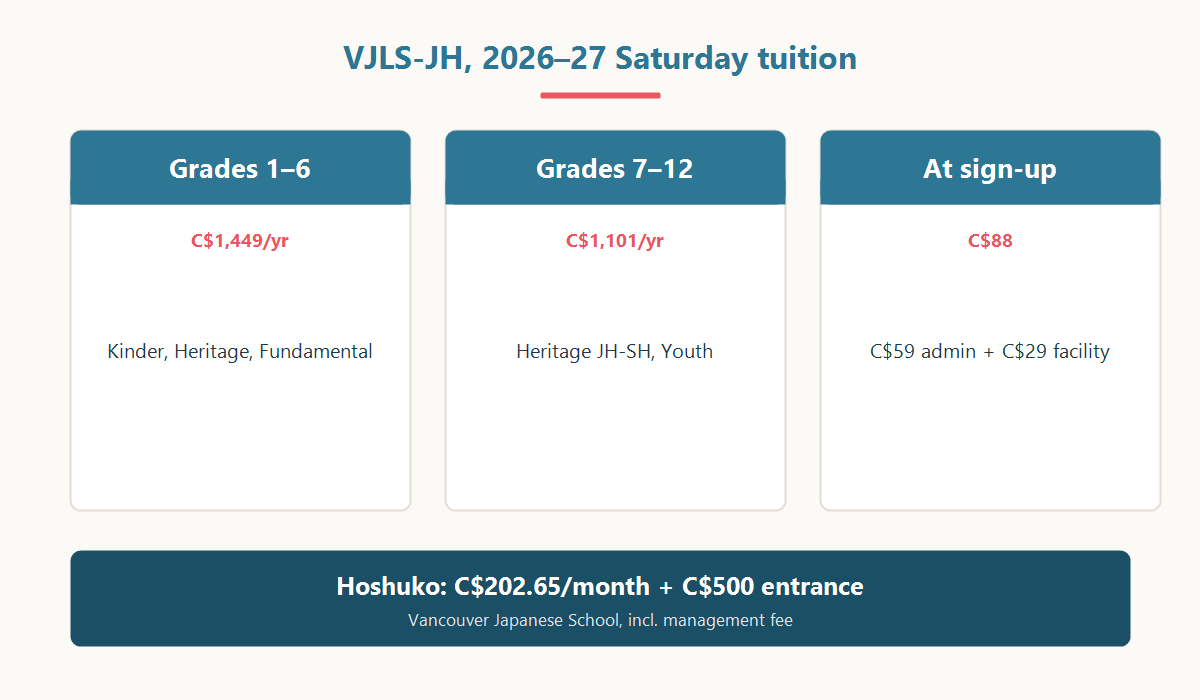
The Vancouver Japanese Language School charges C$1,449 a year in 2026–27 for its three-hour Saturday morning classes for children in Grades 1 to 6 — Kinder, the heritage programme for children who speak Japanese at home, and the Fundamental programme for beginners all cost the same — plus C$88 in fees at registration. Teenagers pay C$1,101 for a two-hour Saturday afternoon. That buys 36 Saturdays in the historic school building at 487 Alexander Street in Vancouver’s old Japantown, run by the Vancouver Japanese Language School & Japanese Hall (VJLS-JH) since 1906. The catch is not the price. It is the calendar: registration for this school year opened in March, the classes that Japanese-speaking families want most — Kinder mornings and heritage Grades 1 to 2 — were already on a wait list, and the school year started on 12 September.
This page is the single-school deep dive: what the Vancouver Japanese Language School costs, how its programmes are split, how it differs from the government-recognised hoshuko with a confusingly similar name, and what the public record gets wrong. Everything comes from the schools’ own English and Japanese pages, read on 4 October 2026. Where something is not published, we say not published. For the wider map of every option in the city, see our guide to Japanese schools in Vancouver — and note that this page corrects its fee column, which listed both schools as “on inquiry”.
The short answer
| What it is | A non-profit community school founded in 1906, the oldest Japanese language school in Canada, in a building designated a National Historic Site in 2019. Japanese name: バンクーバー日本語学校. Not a MEXT school, not a hoshuko |
| Children’s tuition, 2026–27 | C$1,449 a year (or C$150.70 a month for ten months) for Kinder, Heritage Grades 1 to 6 and Fundamental. C$1,101 (or C$114.50 a month) for Heritage Grades 7 to 12 and Youth. Plus a C$59 administration fee and a C$29 facility improvement fee |
| When and where | Saturdays, in person at 487 Alexander Street, Vancouver. Grades 1 to 6: 9:00 to 12:00. Grades 7 to 12: 13:00 to 15:00. 12 September 2026 to 12 June 2027, 36 Saturdays |
| Who it takes | Kinder (born in 2021), then Grades 1 to 12 in two streams: Heritage for children who speak Japanese at home, Fundamental (Grades 1 to 6) and Youth (Grades 7 to 12) for those who do not. Also a toddler group, preschool and daycare on weekdays |
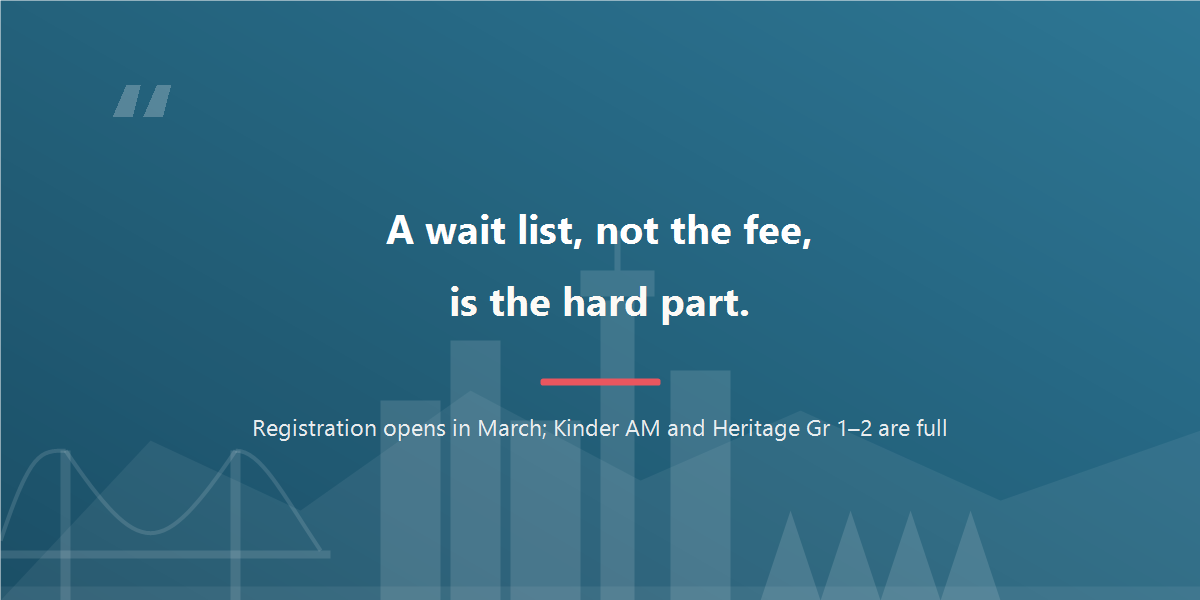
| The real catch | Registration for September opens in March. In 2026–27, Kinder mornings and Heritage Grades 1 to 2 were marked wait list. Class sizes are not published |
| What it is not | Not the Vancouver Japanese School (バンクーバー補習授業校), the hoshuko that teaches Japan’s national curriculum at Sir Charles Tupper Secondary. No online option for children’s Saturday classes |
Looking for a way to keep Japanese going from abroad?
TOMODACHI JAPAN is an online Japanese school for children growing up outside Japan. They talk with peers their own age in Japan every day, taught by teachers working at Japanese schools, in small classes of 8.
🎁 Register and we’ll email you our School Guide (PDF, in English) straight away. You’ll also be first to hear about tuition, scholarships and opening dates.
Free · takes about 30 seconds
First, which school do you actually mean?
Vancouver has two long-established Japanese Saturday schools whose English names differ by a single word, plus a namesake city in Washington State that sends its own searches into the mix. Before you read any review, fee or schedule, check which one it is about.
| Name you will see | What it actually is | Where |
|---|---|---|
| Vancouver Japanese Language School & Japanese Hall (VJLS-JH), also “VJLS” or “the Alexander Street school”. バンクーバー日本語学校 | Community school founded 1906. Heritage and beginner streams on Saturdays, adult classes, weekday childcare | 487 Alexander St., Vancouver (historic Powell Street / Japantown) |
| Vancouver Japanese School (VJS), バンクーバー補習授業校 | The hoshuko: opened in 1973, describing itself as the only supplementary school in British Columbia recognised by Japan’s foreign and education ministries. Japanese textbooks for kokugo, maths and social studies | Rents Sir Charles Tupper Secondary School, East Vancouver |
| Burnaby Japanese Language School (BJLS) | Non-profit founded in 1983 with a Heritage course and a Fundamental course | Lochdale Community School, North Burnaby |
| Steveston Japanese Language School | Community school at the Steveston Japanese Canadian Cultural Centre | 4111 Moncton St., Richmond |
| “Japanese school Vancouver WA” | Vancouver, Washington, is a different city. The nearest hoshuko is the Portland Japanese School, which holds classes in Tualatin, Oregon | Portland area, USA |
The confusion has history behind it. The Alexander Street school opened in January 1906 as the Vancouver Kyoritsu Nihon Kokumin Gakko, teaching Japan’s full curriculum to the children of immigrants — in other words, it began life doing much of what a hoshuko does today. In 1919 it dropped general subjects and became a language school. It closed after Pearl Harbor, when Japanese Canadians were uprooted from the coast in 1942, and reopened in 1952; its building was one of the rare properties returned to the community after internment. The hoshuko came much later, in 1973, for the children of Japanese company and government staff posted to the city. So an older Vancouver parent who says “my kids went to the Japanese language school” usually means Alexander Street — but a newly arrived Japanese family asking the same question usually means Tupper.
What it costs in 2026–27
| Programme | Paid in one go | Paid monthly (ten payments) |
|---|---|---|
| Kinder (born 2021, Saturday morning 9:00–12:00, afternoon 13:00–16:00) | C$1,449 | C$150.70 × 10 = C$1,507 |
| Heritage, Grades 1 to 6 (Saturday 9:00–12:00) | C$1,449 | C$150.70 × 10 = C$1,507 |
| Fundamental A–F, Grades 1 to 6 (Saturday 9:00–12:00) | C$1,449 | C$150.70 × 10 = C$1,507 |
| Heritage, Grades 7 to 12 (Saturday 13:00–15:00) | C$1,101 | C$114.50 × 10 = C$1,145 |
| Youth A–E, Grades 7 to 12 (Saturday 13:00–15:00) | C$1,101 | C$114.50 × 10 = C$1,145 |
| Administration fee | C$59, every student, non-refundable unless the class is cancelled | |
| Facility improvement fee | C$29 (the registration page shows the two together as C$88) | |
| Extracurricular hour (Saturday 15:10–16:10) | C$47 a month on the Fundamental page; calligraphy or theatre for Grades 7 to 12 on the Japanese heritage page | |
| Textbooks | Bought through a separate form. Youth uses Genki and Quartet; heritage uses Japanese kokugo textbooks. Prices not published on the pages we read | |
| Sibling discount, class size, volunteer duties, membership requirement | None published | |
So the real first-year bill for a child in Grades 1 to 6 is C$1,537 if you pay the year up front, or C$1,595 on the monthly card plan — the convenience of spreading it costs C$58. For a teenager it is C$1,189 up front or C$1,233 monthly. Textbooks come on top.
What does C$1,449 buy? Thirty-six Saturdays of three hours each is 108 hours of class, which works out at about C$13.40 an hour before fees and books. The two-hour teen classes come to about C$15.30 an hour. For a structured, in-person class with a teacher, that is low for Metro Vancouver, where the private tutors listed in our city overview charge two to three times as much per hour for one-to-one lessons.
The payment rules matter more than the price:
- Billing is monthly on the first. The policy page says fees are calculated on a school-year basis and billed on the first of each month; a late payment after the first class day may draw a C$25 charge, and a declined payment another C$25.
- Leaving costs notice. Withdrawal needs 14 days’ notice through an online form, with a C$25 processing fee (waived for valid medical reasons) and no partial refund for the month you leave.
- Cancelling before the first class gets a full refund minus C$25 — but the C$88 administration and facility fees stay with the school.
- An early-bird code existed. The Kinder and heritage pages mention a code for registrations by 31 May. The amount of the discount is not published.
How does that sit against the hoshuko? The Vancouver Japanese School’s 2026 admissions page lists elementary and junior-high tuition of C$135.45 a month plus a C$67.20 monthly management fee, a C$500 entrance fee for a first child (C$750 for high school), and a C$21 exam fee, all including GST. Its rules bill tuition by the calendar month, paid every six months, so C$202.65 a month comes to roughly C$2,432 over a full year — before the entrance fee. The Alexander Street school is the cheaper Saturday option by a wide margin, and it asks for no entrance exam. But, as the next sections show, its heritage class and the hoshuko are not doing quite the same job.
How it works: two streams, one Saturday
Unlike many community schools, VJLS-JH splits children by what language they hear at home, not just by age. That single design choice is the most important thing to understand before you register.
| Programme | Who it is for | Time | What they use |
|---|---|---|---|
| Kinder | Born in 2021; taught mainly in Japanese, but open whatever the child’s level | Sat morning 9:00–12:00, afternoon 13:00–16:00 | Games, activities, cultural experiences; reading and writing hiragana |
| Heritage (普通科), Grades 1 to 6 | Children who speak Japanese at home | Sat 9:00–12:00 | Japanese kokugo textbooks (Mitsumura Tosho, per the Japanese page), kanji by grade |
| Heritage, Grades 7 to 9 | Same | Sat 13:00–15:00 | Includes classical poetry such as Hyakunin Isshu, tanka and haiku |
| Heritage, Grades 10 to 12 | Same | Sat 13:00–15:00 | Aims at JLPT N3 to N2; current social issues |
| Fundamental A–F | Grades 1 to 6 (about ages 6 to 12) who do not speak Japanese at home; one level per year of age | Sat 9:00–12:00 | Not published |
| Youth A–E | Grades 7 to 12 who do not speak Japanese at home; beginners welcome | Sat 13:00–15:00 | Genki 1, Genki 2, then Quartet 1 |
The year runs from 12 September 2026 to 12 June 2027 in two semesters, the first ending on 23 January and the second starting on 30 January. The programme pages count 36 class Saturdays out of the 40 in that span; the closed dates are shown only as colours on the PDF calendar. Weekday programmes run separately: a toddler group for two-year-olds (born 2024) on two mornings a week at C$295 a month, a Japanese-immersion preschool for ages 3 to 4, and English or Japanese daycare for ages 3 to 5, which was taking wait-list applications. Preschool and daycare fees were not published on the pages we read.
Getting in: the registration calendar
- Early March: priority registration. For 2026–27 it opened on 7 March at 10am Pacific for Kinder, Heritage Grade 1 and Fundamental A — the entry years.
- Mid-March: public registration for everyone else, 14 March in 2026.
- By 31 May: the early-bird code window closed.
- 12 September: first class. Payment by the first class day avoids a late charge.
On 4 October the registration page said 2026–27 registration was “currently not open”, while the Kinder page still showed the afternoon class as open. Whether a family can join mid-year, how long the wait lists are and whether a placement test exists are not published. If your child is moving to Vancouver this autumn, email the office rather than waiting for March.
Vancouver Japanese Language School vs the Vancouver hoshuko
Both schools teach Japanese-speaking children on Saturdays from Japanese textbooks, which is why parents compare them. They are still built for different futures. The clearest way to choose is to ask whether your child will sit in a Japanese classroom again.
| Vancouver Japanese Language School (VJLS-JH) | Vancouver Japanese School (バンクーバー補習授業校) | |
|---|---|---|
| Purpose | Keep Japanese and culture alive for local families; a beginner stream for everyone else | Keep pace with Japan’s national curriculum for children who will return |
| Recognition | Community non-profit. No MEXT status | Recognised by Japan’s foreign and education ministries |
| Subjects | Japanese only (kokugo in the heritage stream) | Kokugo, maths and social studies |
| Who gets priority | Not published; first come, first served at registration | Children of Japanese company and government staff posted to Vancouver; others if places remain, with Japanese ability and plans for Japanese schooling |
| Entry test | None published | Document screening, written test in Japanese and maths, interview with a parent |
| Weekly time | 3 hours (Grades 1 to 6) or 2 hours (Grades 7 to 12) | 8:50 to 15:10 (kindergarten 9:15 to 14:15) |
| Year | September to June | April to March, the Japanese school year |
| Size | Not published (about 250 children in 2020) | 204 pupils on its current student page; 185 in April 2024 by its own earlier count |
| Tuition | C$1,449 a year (Grades 1 to 6) + C$88 | C$202.65 a month incl. management fee + C$500 entrance |
| Wait lists in 2026 | Kinder mornings, Heritage Grades 1 to 2 | Kindergarten, Grades 1 to 3, Grade 6, junior high Year 1 |
If your child will return to a Japanese school or sit Japanese entrance exams, the hoshuko’s six-hour day with maths and social studies is built for that, and the heritage class on Alexander Street is not a substitute. If your family is here to stay and the aim is a child who reads, writes and feels at home in Japanese, the VJLS-JH heritage stream does something the hoshuko does not promise: it is open to you whatever your employer, it costs well under the hoshuko’s fee, and it takes half the Saturday instead of all of it. The hard case is the family in the middle — a long-term resident whose child might go back. Both schools ended up with wait lists for the youngest grades this year, which is the gap we discuss in our guide to what an online school can and cannot replace about a hoshuko.
The honest review: what the English pages leave out
People search for “Vancouver Japanese Language School reviews” and “VJLS reddit” because they want to know what it is like from the inside. We want to be straight about what we found. Yelp blocked our request, Reddit could not be read by our tools, and Google reviews could not be read reliably. We are not going to invent a consensus. If you read reviews yourself, check they are about the Saturday children’s classes, not adult classes, events or the daycare. What we can check is where the public record, including our own, diverges from what the school publishes.
1. “Fees on inquiry.” Not any more
Our July overview, like most directory pages, listed tuition for both VJLS-JH and the hoshuko as “on inquiry” and said community schools rarely publish fees. Both schools now publish theirs: C$1,449 a year for the younger grades and C$1,101 for teenagers, on each VJLS-JH programme page, and the monthly tuition, management fee and entrance fee on the hoshuko’s admissions page. This page replaces those entries.
2. The Japanese pages tell you more than the English ones
The English heritage page says only “Japanese Kokugo textbook”. The Japanese page names the publisher, Mitsumura Tosho — one of the textbook series used in schools in Japan — and sets out what each stage covers, from kanji by grade to classical poetry in junior high and a JLPT N3 to N2 target in senior high. The Japanese page also calls the C$29 facility fee a one-time charge and the C$59 a registration fee; the English pages call the C$59 an administration fee and the policy page says it is due at each registration. If you only read English, you are reading the thinner version.
3. Small inconsistencies on the school’s own pages
The annual-classes overview says classes run on “Saturdays & Sundays”; only one adult class meets on Sunday, and every children’s class is on Saturday. The registration page lists one C$88 fee where the programme pages list two fees adding up to C$88. The Japanese heritage page gives the senior-high ages as 15 to 17 while the grades run to 12. Wikipedia places the 1953 reopening at 475 Alexander Street; the school’s address today is 487. Trust the individual programme page, and email when in doubt.
4. The size figures are old
The figures most often repeated — around 250 children aged 6 to 18, 135 in childcare, 300 or more adults — come from a June 2020 Discover Nikkei interview, in which the school also said most of its students then were not of mainly Japanese descent. The school’s own pages do not publish current enrolment or class sizes. The hoshuko has the opposite problem: its pages give two different totals, 185 in April 2024, versus 204 on an undated student page.
5. What to ask other parents, since the reviews won’t tell you
- How many children are in my child’s class? No cap or average is published.
- Can we join mid-year, and how long is the wait list? Neither is stated.
- Who decides heritage or Fundamental? The rule is “Japanese at home”; no placement test is published. A bilingual child who understands but rarely speaks may fit either.
- What is the total for books? Textbook prices are on a separate form.
- Are parents expected to volunteer? No duties are published, but many community schools rely on families for events — ask.
Other options in Vancouver
| Option | Who it takes | Published cost |
|---|---|---|
| Vancouver Japanese School (hoshuko), East Vancouver | Kindergarten to high school; priority to families on postings; written test and interview | C$135.45 a month elementary + C$67.20 management fee; C$500 entrance fee (C$250 for a second child) |
| Burnaby Japanese Language School | Heritage course for children who speak Japanese at home; Fundamental course for those who do not | Not published on the pages we read |
| Steveston Japanese Language School, Richmond | Community classes at the Steveston Japanese Canadian Cultural Centre | Not published; the centre gives a phone number for inquiries |
| VJLS-JH toddler group, Alexander Street | Two-year-olds with a caregiver, two weekday mornings | C$295 a month |
Burnaby is worth a call if you live east of Boundary Road: it has the same heritage-versus-fundamental split as Alexander Street, closer to home. For a fuller method of searching beyond these, see our guide to finding a Japanese Saturday school near you. Families moving on to Ontario will find the same choices laid out in our Toronto guide.
How to choose, in four questions
- Is your child going back into Japanese schooling? If yes, apply to the hoshuko first, and the higher fee buys maths and social studies too. If no, the VJLS-JH heritage stream is the strongest Japanese-at-home class in the city for the price.
- Does your child speak Japanese at home? If yes, it is Heritage; if not, Fundamental or Youth. If you are not sure — a child who understands but answers in English — ask the office before March.
- Is it already past March? Then the entry years at both schools may be full. Get on the wait list anyway, and plan what your child does in the meantime.
- Can your family give up Saturday, every week, for years? Thirty-six Saturdays, the trip to Alexander Street and practice in between. The programme that lasts is the one that fits the family, not the one that looked best on paper.
Where TOMODACHI JAPAN fits
We are not a substitute for the hoshuko, and if your child is returning to a Japanese school we would point you there. Nor are we trying to replace a community school with 120 years of history in Japantown. We exist for the families the four questions above leave stuck — the ones who found the heritage class full in March, the ones in Surrey or on the North Shore for whom Alexander Street is a long Saturday drive, and the child who needs Japanese more than once a week.
- Japanese friends of the same age. Classes with children the same age in Japan — not only other learners in Vancouver. The reason children keep going is usually the other children.
- Teachers working at Japan’s current classroom standard — not a syllabus written abroad and not a tutoring marketplace.
- Small classes of eight children. Enough to be a class, few enough that every child speaks every lesson.
- Japan is 16 hours ahead of Vancouver (17 in winter, on PST). A Japanese Saturday morning is Friday late afternoon in Vancouver, and weekend slots work too. No commute, no entrance test and no March deadline.
- A flat monthly membership. Tuition, scholarships and opening dates are in our free school guide, which we email to everyone who registers, with no obligation.
If you are still mapping the whole city, our Vancouver overview lays out every type of programme side by side.
Frequently asked questions
How much does the Vancouver Japanese Language School cost?
For 2026–27, Kinder, Heritage Grades 1 to 6 and Fundamental cost C$1,449 a year paid in one go, or C$150.70 a month for ten months. Heritage Grades 7 to 12 and Youth cost C$1,101 (C$114.50 a month). Every student also pays a C$59 administration fee and a C$29 facility improvement fee. Textbooks are extra.
Is it the same as the Vancouver Japanese School?
No. The Vancouver Japanese School (バンクーバー補習授業校) is the hoshuko that teaches Japan’s national curriculum at Sir Charles Tupper Secondary. The Vancouver Japanese Language School (バンクーバー日本語学校) is the community school at 487 Alexander Street, founded in 1906.
Does it have a class for children who already speak Japanese?
Yes. The Heritage stream (普通科) is for children who speak Japanese at home, from Grade 1 to Grade 12, using Japanese kokugo textbooks. Children who do not speak Japanese at home go into Fundamental (Grades 1 to 6) or Youth (Grades 7 to 12).
When does registration open?
In March for the following September. For 2026–27, priority registration for the entry years opened on 7 March and public registration on 14 March. On 4 October 2026 the registration page said registration was not open, and Kinder mornings and Heritage Grades 1 to 2 were wait-listed.
Is there a preschool or daycare?
Yes. Children’s World, in the same building, runs a toddler group for two-year-olds (C$295 a month), a preschool for ages 3 to 4, and English or Japanese daycare for ages 3 to 5. Preschool and daycare fees were not published on the pages we read.
Sources
- Vancouver Japanese Language School & Japanese Hall: Annual Japanese Classes, Kinder, Heritage, Heritage (Japanese), Fundamental, Youth, 2026–27 registration, Policies, 2026–27 calendar, Children’s World, Toddler
- Vancouver Japanese School (hoshuko): Admission (2026 fees), School information, Student numbers, Rules
- Burnaby Japanese Language School, About; Richmond Museum, Steveston Japanese Language School
- Third-party pages checked: Wikipedia, Vancouver Japanese Language School; Discover Nikkei, June 2020; Wikipedia, Portland Japanese School. All checked 4 October 2026.