Toronto Japanese Language School costs C$620 a year for a child who registers early in 2026–27. That is about a quarter of what a first year at the Toronto hoshuko costs, it is published to the dollar on the school’s own website, and most English pages about TJLS still tell you it is not. The catch is not the price. It is that the children’s programme has had a wait list for several years running, the 2026–27 list opened on 13 February, and a family that starts looking in August is, in practice, looking at next year.
This page is the TJLS-specific deep dive: what it costs, how the heritage and non-heritage tracks actually work, how it differs from the MEXT-recognised Saturday school it is constantly confused with, and what the English-language “reviews” get wrong. Everything comes from the school’s own pages, read on 26 September 2026. Where something is not published, we say not published. For the wider map of every Japanese option in the city, see our overview of Japanese schools in Toronto.
The short answer
| What it is | A volunteer-governed, not-for-profit community school founded in 1949 by Japanese Canadians resettling after wartime internment. Not a MEXT school, not a hoshuko |
| Children’s tuition, 2026–27 | C$620 if registered before the early cutoff (30 June), C$660 after. Both include a C$50 deposit. Textbooks are extra |
| When and where | Saturdays, 9:30 to 11:50, September to June on the Toronto District School Board calendar. In person at Orde Street Public School, near University and College. Classes began 19 September 2026 |
| Who it takes | JK to Grade 8, in two tracks: heritage (child already uses Japanese daily) and JFL (Japanese as a foreign language, open to complete beginners). Adults separately |
| The real hurdle | A wait list. Current students and their siblings go first; new families hear about places in early to mid-May |
| What it is not | No Ontario high school credit, no JLPT preparation, no class observation, no summer term — all stated in the school’s own FAQ |
Looking for a way to keep Japanese going from abroad?
TOMODACHI JAPAN is an online Japanese school for children growing up outside Japan. They talk with peers their own age in Japan every day, taught by teachers working at Japanese schools, in small classes of 8.
🎁 Register and we’ll email you our School Guide (PDF, in English) straight away. You’ll also be first to hear about tuition, scholarships and opening dates.
Free · takes about 30 seconds
First, which school do you actually mean?
Toronto has several Japanese Saturday programmes with near-identical English names, and parents mix them up constantly — on forums, in WhatsApp groups and in search results. Before anything else, check which one you are reading about.
| Name you will see | What it actually is | Where |
|---|---|---|
| Toronto Japanese Language School (TJLS), トロント日本語学校 | Community heritage-and-language school, 1949, children and adults | Orde Street P.S., downtown |
| Toronto Japanese School / The Japanese School of Toronto Shokokai Inc., トロント補習授業校 | The MEXT-recognised hoshuko, run by the Toronto Japanese chamber of commerce. Japanese national curriculum, kindergarten to Grade 12 | Winona Drive, midtown |
| Toronto Kokugo Kyoshitsu, トロント国語教室 | Heritage kokugo school; requires Japanese at home. Began in 1976 as a division inside TJLS | Bowmore P.S., east end |
| Nikka Gakuen, 日加学園 | Heritage school, 1978, ages 4 to 16 | Scarborough |
The detail almost nobody mentions in English is the third row. Toronto Kokugo Kyoshitsu describes itself as having been founded in 1976 as the kokugo department within the Toronto Japanese Language School; it now runs as a separate school with more than 180 pupils. So when an older Toronto parent says “my kids went to the Japanese school on Saturdays”, they may mean any of the three — and they may be describing a TJLS that included what is now a different institution.
What TJLS costs in 2026–27
| Programme | Registered before early cutoff | Registered after early cutoff |
|---|---|---|
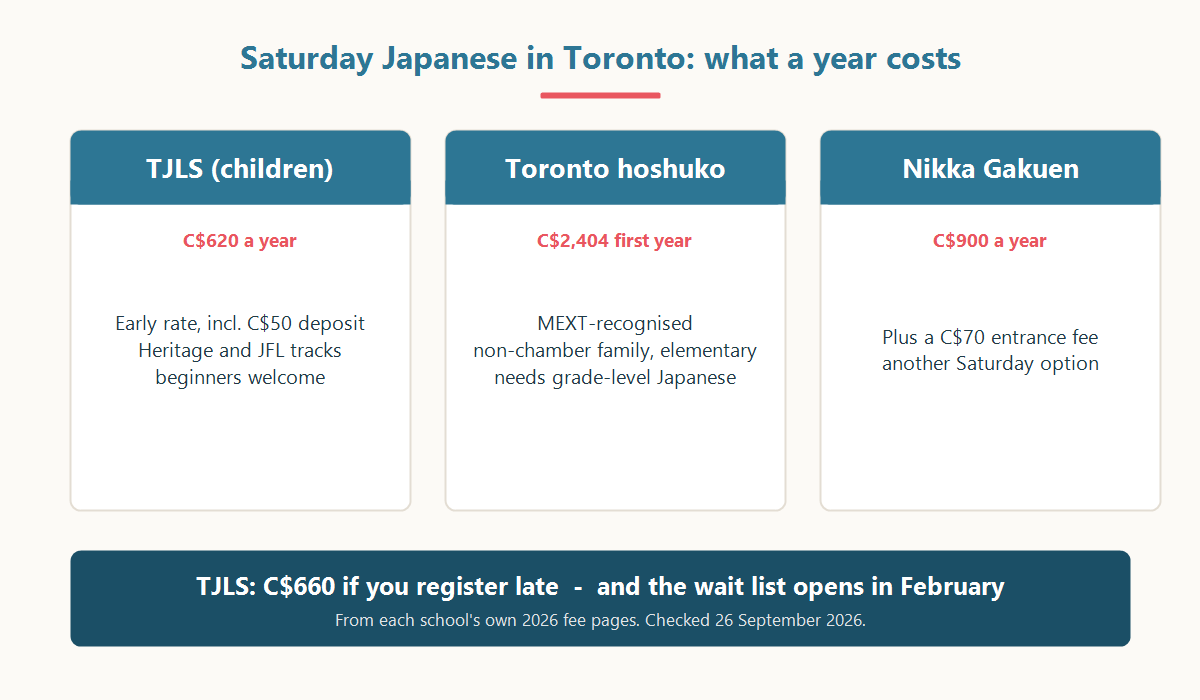
| Children’s Program (JK–Grade 8) | C$620 (C$50 deposit + C$570 balance) | C$660 (C$50 deposit + C$610 balance) |
| Adult Program, “Student rate” (under 18 on 31 December) | C$720 | C$770 |
| Adult Program, adult rate | C$820 | C$880 |
| Textbooks and materials | Extra, bought by the family. Amount not published for children’s classes | |
| Registration fee, activity fee, parent-duty deposit, fundraising levy | None published. The C$50 deposit is part of tuition, not on top of it | |
| Sibling discount | Not published | |
The key dates for 2026–27 were: children’s wait list opened 13 February; early registration 9 May to 30 June; general registration 1 July to 22 August; balance due 22 August; first class 19 September. The early/late gap is C$40 for a child. That is not the reason to register early. The reason is that registration for new children only opens at all if a place exists after current families have re-registered.
The payment rules are short and strict, and worth reading before you pay:
- No pro-rating. Join late or leave early and you pay the full year.
- A three-class refund window. Up to and including the third class, you can withdraw and get tuition back less a C$50 administrative fee, taken from the deposit. You must tell the teacher in writing, with the reason, proof of payment, any receipt and any course materials.
- No carrying over. The early deposit is valid only for the coming year; neither deposit nor balance can be deferred.
- No switching format. Where a level runs both online and in person, you cannot move between the two after enrolling.
- No tax angle. The school says it is not aware of any education credit or tax write-off that tuition or book receipts qualify for.
How does C$620 sit against the alternatives? The hoshuko‘s own fee sheet for 2026–27, dated 15 March 2026, puts a first year in its elementary division at C$2,404 for a family that is not a chamber-of-commerce member (C$1,155 tuition, C$312 materials, C$687 administration fee, C$250 entrance fee). Nikka Gakuen publishes C$900 a year plus a C$70 entrance fee. Toronto Kokugo Kyoshitsu publishes C$650 a year plus a C$50 entrance fee on one page — and C$550 on another. TJLS is the cheapest structured Saturday programme in the city by a clear margin.
How TJLS works: two tracks, one Saturday morning
The school runs one session a week: Saturday, 9:30 to 11:50, with a break from 10:30 to 10:45 when coffee and cookies appear in the second-floor hallway and parents catch the teachers in the staff room. That is a little over two hours of teaching. The year runs September to June and follows the Toronto public-school calendar, with the usual breaks at Thanksgiving, Christmas, March Break and Victoria Day. There is no summer term. The calendar itself is a Google Calendar link; the number of teaching Saturdays is not stated as a figure.
What matters most for a parent is the split into two tracks, which the English overview pages rarely explain:
| Track | Who it is for | What they use | Classes in 2025–26 |
|---|---|---|---|
| Heritage (Heritage Kindergarten, then School Age) | Children who “must be able to communicate in Japanese on a daily basis” | The MEXT-approved Mitsumura kokugo textbooks (光村図書), a Japanese children’s online newspaper, songs and picture books | 3 multi-grade classes: Heritage 1, Heritage 2/3A, Heritage 3B/4 |
| JFL (Japanese as a foreign language) | Children with little or no Japanese. The FAQ is explicit: “open to complete beginners” | Hiragana workbook, the Nihongo textbook series, then children’s books and magazines | 6 classes: JFL Kindergarten, Beginner 1, Beginner 2, Intermediate, Advanced, and an online Intermediate/Advanced section |
Two things follow from that table. First, TJLS is one of very few Toronto Saturday programmes that will take a child with no Japanese at all — the hoshuko, Kokugo Kyoshitsu and Nikka Gakuen all require Japanese at home. Second, the heritage side is small: three classes in 2025–26, two of which combine levels (Heritage 2/3A, plus Heritage 3B/4). The JFL side sets concrete targets — about 30 kanji by Intermediate, about 150 by Advanced — which is a meaningful Saturday outcome, but a long way from grade-level Japanese literacy.
Every teacher on the published list is a native Japanese speaker, and the school says so. The whole institution is run by a volunteer board elected each October; students and the parents of child students can stand for it, and monthly board meetings are open. A separate non-profit, the Ijikai (維持会, “supporting organisation”), funds special events, holds scholarship and trust funds, and offers what it calls “very affordable” membership — amount not published. Donations go through CanadaHelps and receive a tax receipt.
Getting in: the wait list, step by step
- Early February: the wait list for the following September opens. You join it by submitting a level check form, in English or Japanese, on the Children’s Program page.
- Spring: current students re-register in a priority window. A new sibling is accepted in that window only if the current student registers first. A current student who misses the window goes onto the wait list too.
- Early to mid-May: new families are told whether a place exists. If it does, you register and pay the C$50 deposit.
- Placement: if the level is unclear, a written section and a short Zoom interview — offered only once the deposit is paid.
- 22 August: the balance is due. Classes start in mid-September.
Missed the window? The FAQ says late registration is “case by case” through the Registrar. You cannot sit in on a class first; the school offers a conversation with a homeroom teacher instead.
TJLS vs the Toronto hoshuko
These are different kinds of school built for different families, and choosing between them is mostly a question of where your child will be at 15.
| TJLS | Toronto hoshuko (トロント補習授業校) | |
|---|---|---|
| Purpose | Heritage and language, for families settled in Canada and for learners of Japanese | Keeping pace with the Japanese national curriculum, historically for families returning to Japan |
| Recognition | Community not-for-profit. No MEXT status, no credits | MEXT-recognised supplementary school |
| Subjects | Japanese only | Kokugo, maths, and at higher grades science and social studies |
| Ages | JK to Grade 8 (adults separately) | Kindergarten to Grade 12 |
| Japanese needed to enter | Heritage track: daily Japanese. JFL track: none | 「学齢相応の日本語力」 — grade-appropriate Japanese, plus a family able to support Japanese homework |
| Year | September to June, Toronto calendar | April to March, Japanese calendar, about 40 Saturdays |
| Elementary first-year cost | C$620 (early) + books | C$2,404 non-member, C$2,227 chamber member, all-in |
| Language of the paperwork | English site; Japanese enquiries welcome | Japanese |
If your child will sit Japanese entrance exams or re-enter a Japanese school, TJLS is not a substitute for the hoshuko, and the school does not claim to be. If your child was born here, will stay here, and the aim is to keep Japanese alive — or to start it — TJLS is cheaper, closer to a normal Canadian school year, and considerably less demanding of the family’s Japanese.
The honest review: what the English pages leave out
People search for “TJLS reviews” and “TJLS reddit” because they want to know what it is like from the inside. We want to be straight about what we found. We could not locate a body of verifiable parent reviews of the children’s programme, and we are not going to invent a consensus. What is visible in English is mostly directory listings and a competitor’s comparison page. So this section is about something checkable: where the public record diverges from what the school itself publishes.
1. “Pricing isn’t advertised online.” It is, to the dollar
The most prominent English comparison of TJLS is published by Japademy, an online Japanese school that competes with it; its page was last updated on 16 June 2026. It says TJLS’s scheduling and pricing are not prominently advertised and require direct contact. In fact TJLS publishes full 2026–27 fee tables for both programmes, with deposit, balance and due date. Search engines still show a snippet from an older version of that comparison quoting about C$710 a year — a figure that matches nothing on TJLS’s current pages. Our own Toronto overview listed TJLS’s fees as “on inquiry”; that was wrong too, and this page corrects it.
2. “JLPT prep and business Japanese.” The school’s own FAQ says no
The same comparison credits TJLS with specialised courses for JLPT preparation and business Japanese. TJLS’s FAQ says plainly that its classes “are not geared towards passing the JLPT”, and no business course appears anywhere on its site. It also describes TJLS as in-person only. The adult programme is, for 2026–27, mainly online: Levels 1 to 4 run both online and in class, Levels 5 to 9 online only.
3. TJLS’s own website contradicts itself
This is the one that catches parents. TJLS’s Programs page still says fall registration happens in person at Orde Street on the Saturday after Labour Day, with winter registration in January, and that accommodation can be made through the year for children at any level. The current Children’s Program page says the opposite: a wait list, opened in February, with places confirmed in May. The current page is the one to trust. Elsewhere on the site, the Annual Calendar page lists nothing after 2014–15, the News page’s latest post is from December 2014, the History page is “under construction”, the Board page shows the 2023–24 board, and the children’s registration page still carries a pandemic-era health paragraph. None of this says anything about the teaching. It does mean you should read only the Registrar, Children’s Program Registration and FAQ pages, and email when in doubt.
4. Parent duty: not a rota, but not nothing
Unlike many Saturday schools, TJLS publishes no compulsory parent-duty rota and no duty deposit. The cost of that is visible in the handbook: the school says it must raise money beyond tuition, “especially now that rent must be paid to the Toronto District School Board”, and bake sales are an important part of that effort. The board, the Ijikai and the teaching assistants are volunteers. Expect to be asked, even if you are never required.
5. What to ask other parents, since the reviews won’t tell you
- How many children are in my child’s class, and how many grades does it span? The heritage track runs three multi-grade classes; the spread matters more than the headcount.
- How long did it take to get off the wait list? The school confirms the list exists; it does not publish its length.
- What is the book bill? Not published for children’s classes.
- Is the online JFL section a real option for a child in the suburbs? It was on the 2025–26 list; whether it continues is not stated on the 2026–27 page.
Other Saturday options in Toronto
| Option | Who it takes | Published cost |
|---|---|---|
| Toronto hoshuko | Grade-appropriate Japanese; K to Grade 12 | C$2,404 first year, elementary, non-member |
| Toronto Kokugo Kyoshitsu | Japanese at least 50% of home conversation; one parent a native or fluent speaker; interview. Classes up to 25 with a teacher and assistants | C$50 entrance + C$650 a year (a second page says C$550) |
| Nikka Gakuen, Scarborough | Japanese spoken at home; ages 4 to 16 in 12 levels; apply by end of March, interviews from April | C$70 entrance + C$900 a year; third child half price |
| JCCC Japanese language | Adults only — 18 and over on the first day | n/a for children |
The pattern is the same one we found on the West Coast, where Vancouver’s Saturday schools split just as sharply between curriculum-keeping and heritage. In Toronto, TJLS is the only children’s programme on this list that does not require Japanese at home.
How to choose, in four questions
- Is your child going back into Japanese schooling? If yes, the hoshuko is the one built for that, and the higher fee buys the national curriculum. If no, you are buying Japanese literacy and connection, which TJLS and the heritage schools offer for a fraction of the cost.
- Does your child use Japanese every day? If yes, you have four Saturday choices. If no, you realistically have one: TJLS’s JFL track.
- Did you apply in February? If you are reading this in autumn, the honest answer for TJLS is a wait-list form now and a decision in May. Plan the year in between.
- Can your family give up Saturday morning, every week, for years? Two hours of class, the drive downtown, weekday homework. The programmes that last are the ones that fit the family, not the ones that looked best on paper.
Where TOMODACHI JAPAN fits
We are not a substitute for the hoshuko, and if your child is returning to a Japanese school we would point you there. We exist for the families the four questions above leave stuck — the ones on a wait list until May, the ones whose child has outgrown a two-hour mixed-grade class, and the ones for whom a Saturday downtown simply does not work.
- Japanese friends of the same age, every day. Classes of eight, with children the same age in Japan — not only other learners in Toronto. The reason children keep going is usually the other children.
- Teachers working at Japan’s current classroom standard — not a syllabus written abroad and not a tutoring marketplace.
- Small classes of eight children. Enough to be a class, few enough that every child speaks every lesson.
- Toronto is 13 hours behind Japan (14 in winter). An evening class in Japan lands in the Toronto morning, and a Japanese Saturday morning is Friday evening in Toronto — and weekend slots work too. No commute and no entrance test.
- A flat monthly membership. Fees, scholarships and opening dates are in our free school guide, which we email to everyone who registers, with no obligation.
If you are weighing online against a Saturday school in general, we have written honestly about what an online school can and cannot replace about a hoshuko, and there is a broader guide to finding a Japanese Saturday school near you.

Frequently asked questions
How much does Toronto Japanese Language School cost?
For 2026–27 the Children’s Program is C$620 if you register before the early cutoff and C$660 afterwards, each including a C$50 deposit. Adult tuition is C$720–C$880 depending on age and timing. Textbooks are extra, and no other fees are published.
Is TJLS the same as the Toronto Japanese School?
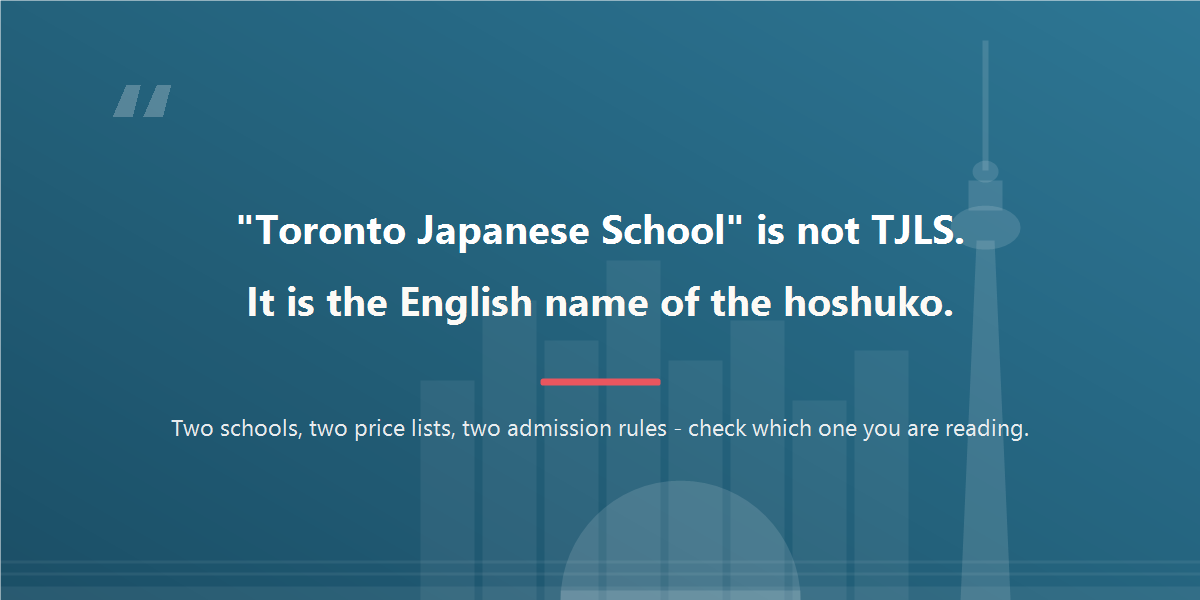
No. “Toronto Japanese School” is the English name of the MEXT-recognised hoshuko (トロント補習授業校) on Winona Drive, which teaches the Japanese curriculum to children with grade-level Japanese. TJLS is a separate community school at Orde Street Public School.
Can my child join with no Japanese?
Yes, in the JFL track, which the school says is open to complete beginners. The heritage track requires a child who communicates in Japanese daily. Either way, the children’s programme has a wait list, so submit the level check form as early as possible — the list for the following year opens in early February.
Does TJLS give Ontario high school credits?
No. The FAQ states that TJLS does not offer credits, and the children’s programme ends at Grade 8. Certificates of completion are issued when requirements are met.
Can I visit a class before enrolling?
Not a class. The school does not accept observation requests, but it can arrange a meeting with a homeroom teacher. Enquiries can be made in Japanese.
Where is TJLS, and is there parking?
Orde Street Public School, 18 Orde Street — the school has been near University and College since 1965 — a three-minute walk from Queen’s Park station. There is no parking in the school lot; the school points to the Princess Margaret garage on Murray Street. Orde Street is one-way westbound, which matters at drop-off.
Sources
- Toronto Japanese Language School: Registrar (dates and payment notes), Children’s Program Registration, Children’s Classes, Adult Program Registration, FAQ, School Handbook, Teachers 2025–26, Location, Board of Directors, The Ijikai, Programs
- Toronto hoshuko: torontohoshuko.ca, admissions, 2026 fee notice (15 March 2026)
- Toronto Kokugo Kyoshitsu (history, admission, fees, tuition page)
- Nikka Gakuen admission and fees; JCCC Japanese Language Program for Adults
- Consulate-General of Japan in Toronto, Classes on Japanese Culture in Ontario
- Third-party pages checked: Japademy, Japanese lessons in Toronto (updated 16 June 2026); Wikipedia, Toronto Japanese School. All checked 26 September 2026.