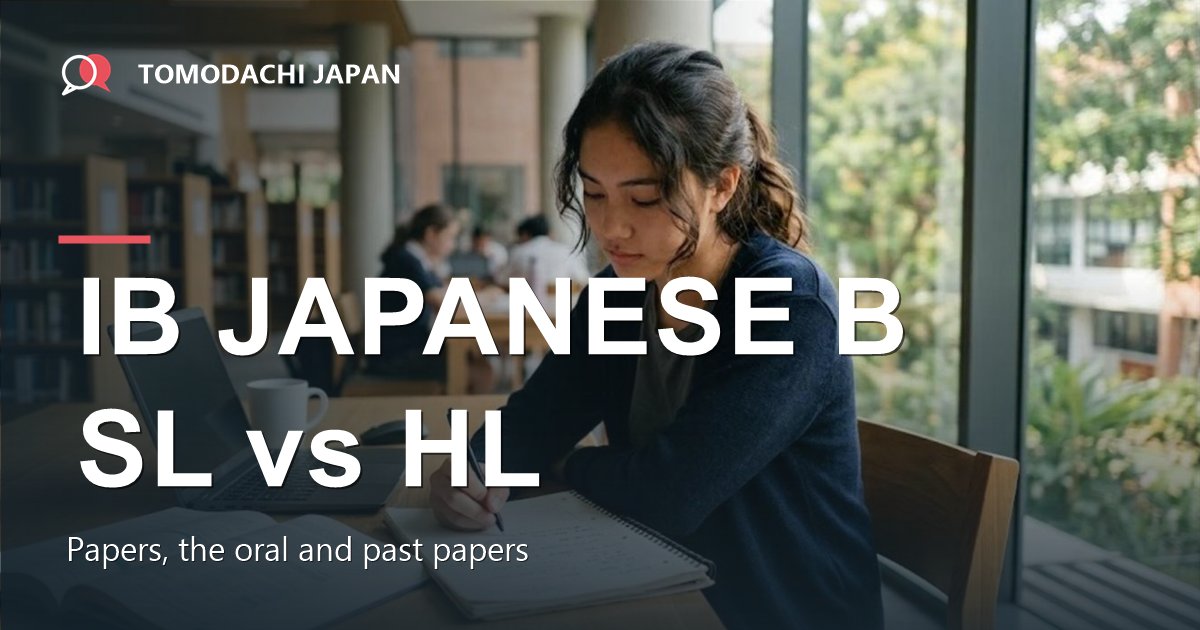
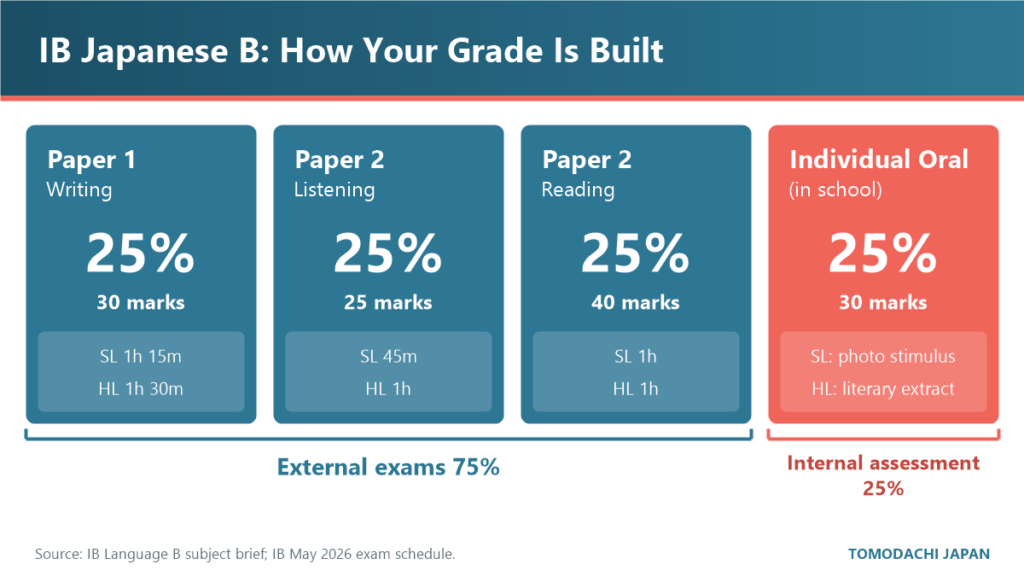
IB Japanese B is the IB Diploma Programme’s language acquisition course for students who already have some Japanese. You can take it at Standard Level (SL, 150 recommended teaching hours) or Higher Level (HL, 240 hours, plus two Japanese literary works). Both levels are assessed the same way: Paper 1 (one writing task, 25%), Paper 2 (listening 25% and reading 25%), and an individual oral done in school (25%). This guide maps every component, the five themes, the Japanese register each Paper 1 text type expects, and where to get official past papers legally.
Everything below is checked against the IB’s own published documents: the Language B subject brief for the course first assessed in 2020, the newer brief for the course first assessed in 2029, and the IB’s May 2026 examination schedule. Where the IB keeps details inside the full subject guide (which schools access through the IB’s Programme Resource Centre), we say so instead of guessing.

IB Japanese B assessment overview (SL and HL)
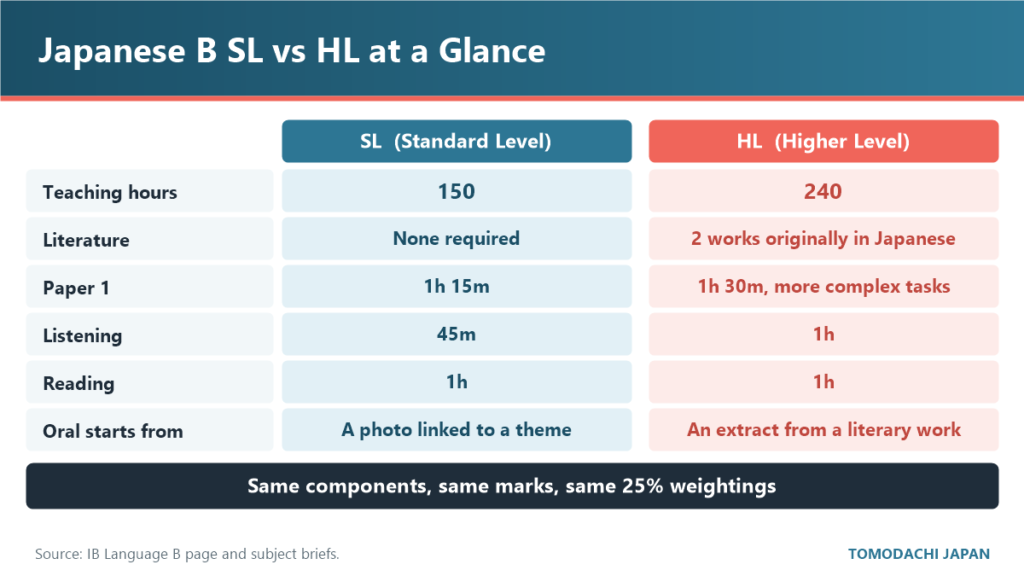
The good news for planning: the IB states that the assessment outlines for Language B SL and HL are identical. Same papers, same marks, same weightings. What changes between levels is the nature of the tasks: HL Paper 1 asks for more complex language and higher-order thinking with a longer length range, and the HL oral starts from a literary extract instead of a photo.
| Component | What you do | SL time | HL time | Marks | Weight |
|---|---|---|---|---|---|
| Paper 1 (productive skills) | One writing task chosen from three, in the text type that fits the task | 1h 15m | 1h 30m | 30 | 25% |
| Paper 2: Listening | Comprehension questions on three audio passages | 45m | 1h | 25 | 25% |
| Paper 2: Reading | Comprehension questions on three written texts | 1h | 1h | 40 | 25% |
| Individual oral (internal) | Presentation, follow-up discussion, then general conversation with your teacher | Done in school; SL starts from a visual image, HL from a literary extract | 30 | 25% | |
So 75% of your grade comes from external exams and 25% from the oral. Notice that the four components carry equal weight. A student who treats listening as an afterthought is gambling with a quarter of the grade, and in our experience listening is exactly where students who learned Japanese mostly from textbooks lose the most points.
Looking for a way to keep Japanese going from abroad?
TOMODACHI JAPAN is an online Japanese school for children growing up outside Japan. They talk with peers their own age in Japan every day, taught by teachers working at Japanese schools, in small classes of 8.
🎁 Register and we’ll email you our School Guide (PDF, in English) straight away. You’ll also be first to hear about tuition, scholarships and opening dates.
Free · takes about 30 seconds
Which syllabus are you on? (2020 vs. 2029)
The IB has published a subject brief for a revised Language B course with first assessment in 2029. If you sit your final exams before then, you are on the course first assessed in 2020. The good news is that the two briefs are very close: the same five themes, the same 75/25 split, the same three-way structure (Paper 1, Paper 2 with listening and reading, individual oral). The 2029 brief spells out a Paper 1 length range for word-based languages (250 to 400 words at SL, 450 to 600 at HL). Japanese is counted differently, so ask your teacher for the exact Japanese range in the guide your school uses.
The five prescribed themes
All of Japanese B is organized around five themes. The topics under each are listed by the IB as optional recommendations, not a required checklist, but past papers and orals draw on them heavily. The right-hand column shows the kind of Japan-specific angle that tends to make answers richer.
| Theme | IB guiding idea | Recommended topics (IB) | Japan angle to prepare |
|---|---|---|---|
| Identities アイデンティティ | The nature of the self and what it is to be human | Lifestyles, health and well-being, beliefs and values, subcultures, language and identity | Being a bilingual or mixed-heritage teen; otaku and fashion subcultures; school stress and sleep |
| Experiences 経験 | Events, experiences and journeys that shape our lives | Leisure, holidays and travel, life stories, rites of passage, customs and traditions, migration | Seijin-shiki (coming of age), New Year customs, school trips (shūgaku ryokō), moving abroad |
| Human ingenuity 人間の創意工夫 | How human creativity and innovation affect our world | Entertainment, artistic expressions, communication and media, technology, scientific innovation | Anime and manga as soft power, smartphones and LINE, robots and aging society |
| Social organization 社会組織 | How groups organize themselves through common systems or interests | Social relationships, community, social engagement, education, the working world, law and order | Bukatsu (school clubs), senpai and kōhai, school cleaning time, juku and entrance exams |
| Sharing the planet 地球の共有 | Challenges and opportunities faced by individuals and communities | Environment, human rights, peace and conflict, equality, globalization, ethics, urban and rural environment | Garbage sorting, disaster preparedness, rural depopulation, gender equality at work |
IB Japanese B Paper 1: writing
Paper 1 gives you three tasks and you write one. Each task sets up a situation, an audience and a purpose, and you choose an appropriate text type from the options offered. It is marked out of 30 and worth 25% of the final grade, with 1 hour 15 minutes at SL and 1 hour 30 minutes at HL.
Here is the part many students underestimate: in Japanese, choosing a text type is also choosing a register. English lets you write a blog and a speech in roughly the same voice. Japanese does not. A diary in です/ます form reads oddly; a speech to the school assembly in plain form sounds rude; a newspaper-style article usually switches to the である style. Getting the conventions and register right is visible to an examiner in the first two lines.
Text-type phrase bank with the right register
| Text type | Register | Opening (Japanese / romaji / English) | Closing (Japanese / romaji / English) |
|---|---|---|---|
| Email to a friend | Plain form (casual) | ゆいへ 元気? Yui e. Genki? To Yui: How are you? | じゃあ、またね。返事待ってるよ。 Jā, mata ne. Henji matteru yo. Talk soon. Waiting for your reply! |
| Email to a teacher or host family | です/ます (polite) | 田中先生 いつもお世話になっております。 Tanaka-sensei. Itsumo osewa ni natte orimasu. Dear Mr./Ms. Tanaka, thank you as always for your support. | どうぞよろしくお願いいたします。 Dōzo yoroshiku onegai itashimasu. Thank you very much in advance. |
| Blog post | です/ます (friendly polite) | みなさん、こんにちは!今日は〜について書きます。 Minasan, konnichiwa! Kyō wa … ni tsuite kakimasu. Hi everyone! Today I’m writing about … | 最後まで読んでいただき、ありがとうございました。 Saigo made yonde itadaki, arigatō gozaimashita. Thanks so much for reading to the end. |
| Diary entry | Plain form | 10月5日(月)晴れ 今日は〜。 Jūgatsu itsuka (getsu) hare. Kyō wa … Monday, October 5, sunny. Today … | 明日はもっとがんばろう。 Ashita wa motto ganbarō. I’ll try harder tomorrow. |
| Speech | です/ます (polite, spoken) | 皆さん、こんにちは。2年の〜です。今日は〜についてお話しします。 Minasan, konnichiwa. Ni-nen no … desu. Kyō wa … ni tsuite ohanashi shimasu. Hello, everyone. I’m … from Year 2. Today I’d like to talk about … | ご清聴ありがとうございました。 Goseichō arigatō gozaimashita. Thank you for listening. |
| Article (school or local newspaper) | である style (formal plain) | Headline, then: 最近、〜が問題になっている。 Saikin, … ga mondai ni natte iru. Recently, … has become a problem. | 一人一人が〜ことが大切ではないだろうか。 Hitori hitori ga … koto ga taisetsu de wa nai darō ka. Isn’t it important that each of us …? |
| Formal letter | です/ます with letter formulas | 拝啓 紅葉が美しい季節になりました。 Haikei. Kōyō ga utsukushii kisetsu ni narimashita. Dear Sir/Madam, the autumn leaves are now beautiful. | お体に気をつけてお過ごしください。 敬具 Okarada ni ki o tsukete osugoshi kudasai. Keigu. Please take care of yourself. Sincerely, |
| Notice or flyer | です/ます, short and clear | 〜のお知らせ … no oshirase Announcement: … | ご参加をお待ちしています。 Gosanka o omachi shite imasu. We look forward to seeing you there. |
| Interview transcript | です/ます between interviewer and guest | 本日はお忙しいところ、ありがとうございます。 Honjitsu wa oisogashii tokoro, arigatō gozaimasu. Thank you for making time for us today. | 貴重なお話をありがとうございました。 Kichō na ohanashi o arigatō gozaimashita. Thank you for sharing such valuable insights. |
From a Japanese teacher: The quickest way to look fluent in Paper 1 is to stay in one register from the first line to the last. Students who mix です/ます with plain form halfway through a blog post are not making a vocabulary mistake; they are telling the reader they lost track of who they are talking to. Pick the register the moment you pick the text type, and if you write a speech, keep the spoken markers (皆さん, お話しします, ご清聴ありがとうございました) because they show you know it will be heard, not read.
A current Japanese schoolteacher at TOMODACHI JAPAN
A simple Paper 1 routine
- First 10 minutes: read all three tasks, pick the one where you know the vocabulary, not the one that sounds most interesting. Circle the audience, purpose and text type.
- Plan in Japanese: a 4 to 5 line outline with the connectors you will use (まず, また, 一方で, つまり, このように).
- Write: include the format markers of your text type (title, date, greeting, sign-off) because they are part of what the task asks for.
- Last 10 minutes: check register consistency, particles (は/が, に/で), and kanji you are unsure of. If you are not sure of a kanji, write it in kana rather than guess.
IB Japanese B Paper 2: listening and reading
Paper 2 tests receptive skills and is split into two separately timed sections. In the May 2026 schedule, the IB set listening at 45 minutes for SL and 1 hour for HL, and reading at 1 hour for both levels. Listening is based on three audio passages (25 marks, 25%) and reading on three written texts (40 marks, 25%), all linked to the five themes.
Two practical points. First, the audio is authentic-style Japanese: announcements, interviews, radio segments. Students who only hear their teacher’s careful classroom Japanese often struggle with natural speed, contractions (〜ちゃう, 〜てる) and fillers (えーと, なんか). Second, reading texts are real-world text types too, so the phrase bank above helps in Paper 2 as well: if you recognize that a text opens with 拝啓, you already know its purpose and tone before reading a full sentence.
- Listening: read every question before the audio starts and predict the type of answer (a number, a place, a reason).
- Reading: answer in the form the question asks for. If it asks for a word from the text, copy it exactly.
- Both: learn question words cold (なぜ, どのように, 何のために) so you never misread what is being asked.
The IB Japanese B individual oral
The individual oral is the internal assessment: it is conducted by your teacher at school, marked out of 30, and worth 25%. According to the IB, it has three parts at both levels: a presentation by you, a follow-up discussion with your teacher about that presentation, and a general conversation that brings in at least one additional theme of the course. You prepare under supervision before you speak; your teacher will give you the exact preparation and speaking times from the subject guide.
- SL: the stimulus is a visual image clearly linked to one or more of the five themes. You describe it, connect it to Japanese-speaking cultures, and give your view.
- HL: the stimulus is an extract from one of the two Japanese literary works you studied in class. You present the extract, connect it to the work as a whole, and the general conversation then moves to the themes.
For the general conversation, the strongest students have short prepared opinions on every theme: two or three sentences each, with one concrete example from Japan and one from their own life. You cannot memorize a conversation, but you can make sure you never go blank on a topic.
From a Japanese teacher: In the HL oral, students who only retell the plot of the extract run out of things to say in a minute. The ones who score well build a bridge: this scene shows a character torn between family duty and personal wishes, which connects to Identities and to how Japanese society thinks about 家 (ie, the household). Once you name the theme yourself, the teacher’s follow-up questions land on ground you prepared, and the move into the general conversation feels natural instead of sudden.
A current Japanese schoolteacher at TOMODACHI JAPAN
IB Japanese B SL vs HL: which should you take?
The IB describes the difference in three ways: recommended teaching hours, the level of competency you are expected to reach, and literature at HL. Here it is side by side.
| Japanese B SL | Japanese B HL | |
|---|---|---|
| Recommended teaching hours | 150 | 240 |
| Literature | Not required | Two literary works originally written in Japanese |
| Paper 1 | 1h 15m; one task from three | 1h 30m; more complex tasks, higher-order thinking, longer length range |
| Paper 2 | Listening 45m, reading 1h | Listening 1h, reading 1h |
| Oral stimulus | A visual image linked to the themes | An extract from one of the two literary works |
| Marks and weightings | Identical at both levels (30 / 25 + 40 / 30; 25% each) | |
Rough rule of thumb from our classrooms: if you can read a short Japanese news article for teenagers without a dictionary on every line and hold a five-minute conversation about school life, HL is realistic. Heritage speakers who speak well at home but rarely read are a special case: HL can suit them, but only if they commit to reading two full works and building the written register they currently lack. If Japanese is one of your weaker subjects and you need your HL slots for university requirements, SL with a high grade is often the smarter choice. Check your intended universities’ language requirements before you decide.
Kanji expectations for IB Japanese B
Students search for an IB Japanese B SL kanji list a lot, so here is the honest answer: the IB’s public pages and subject briefs for Language B do not include a prescribed kanji list. The full subject guide your school uses is the place to check script requirements, and your teacher can confirm what applies to your exam session.
For a practical benchmark, use Japan’s own standards. Japanese elementary schools teach 1,026 kanji across grades 1 to 6 (the Ministry of Education’s grade-by-grade kanji table, in force since 2020), and the government’s list of common-use kanji, the jōyō kanji, has 2,136 characters (revised in 2010). Japanese B texts are written for real readers, so they draw on everyday kanji, not specialist ones.
- Reading: aim to recognize the elementary 1,026 comfortably by the start of year two, and keep growing from there. Theme vocabulary (環境, 教育, 技術, 文化, 社会) matters more than rare characters.
- Writing: be accurate with the kanji you use most in essays. Writing a word in kana is better than a wrong kanji.
- Learn kanji in words, not alone: 環境問題 (kankyō mondai, environmental problems) is more useful than 環 by itself.
IB Japanese B past papers: where to get them officially
Past papers are the single best practice resource, and there are legitimate ways to get them:
- Your school first. IB schools usually keep past papers, markschemes and Paper 2 audio for their subjects. Ask your Japanese teacher or DP coordinator.
- Follett IB Store. The IB closed its own store and made Follett its exclusive worldwide distributor for IB materials. Parents and students can buy from follettibstore.com, which advertised May 2026 exam packs and papers. Check the specific Japanese B listing for the session you want, since availability varies by language and session.
- Free format practice from the IB. The IB’s free Sample exam papers page includes English B specimen papers and markschemes for the course first assessed in 2020, plus Paper 2 audio. They are in English, but the structure is the same, so they are useful for understanding task wording and how the markscheme rewards answers.
A word of caution: many websites post IB papers without permission. Besides the copyright problem, they often mix up sessions, levels and syllabuses, so you can end up practicing the wrong format. Stick to your school and official channels. If you want to see how other exam systems compare, our guides to GCSE Japanese past papers and HSC Japanese Continuers past papers cover the same question.
A 12-month IB Japanese B study plan
This plan assumes your final exams are in May and you start seriously about a year out. Adjust the months for a November session.

| When | Focus | Weekly habit |
|---|---|---|
| Months 1 to 3 | Themes vocabulary and text types; HL: finish reading work one | One short piece of writing in a new text type; 20 minutes of Japanese audio daily |
| Months 4 to 6 | Oral practice with images (SL) or extracts (HL); grammar gaps | Two recorded 3-minute talks per week; review with a teacher or partner |
| Months 7 to 9 | Timed Paper 1 and Paper 2 sections; HL: finish work two | One timed Paper 1 every two weeks; one listening and one reading section per week |
| Months 10 to 12 | Full past papers under exam timing; mistake log | One full paper per week; re-write your weakest Paper 1 answer |
Good free input sources: NHK’s NEWS WEB EASY publishes news in simplified Japanese with furigana, which is excellent for Paper 2 reading and the Sharing the planet theme. Japanese YouTube channels aimed at teens give natural-speed listening. Manga and novels help too, especially for HL; our guide to manga for learning Japanese suggests titles by level.
Common mistakes in IB Japanese B
- Mixing registers. です/ます and plain form in the same piece, or a speech without spoken markers.
- Ignoring the format of the text type. A letter without 拝啓/敬具 or a greeting; a blog without a title; an article without a headline.
- Answering a different task. Writing a great essay about the environment when the task asked you to persuade classmates to join a club activity.
- Self-reference without awareness. Switching between 私, 僕 and あたし in one piece. In formal writing, 私 is the safe choice. Our explainer on ore, boku and watashi shows why it matters.
- Skipping listening practice. It is 25% of the grade and the hardest skill to cram.
- Memorized oral scripts. Teachers can hear recitation. Prepare ideas and phrases, not paragraphs.
- HL: plot summary instead of analysis. Connect the extract to the whole work and to a theme.
Frequently asked questions
Is IB Japanese B SL or HL harder?
HL. The assessment structure is the same, but HL has more teaching hours (240 vs. 150), requires two literary works originally written in Japanese, sets more complex Paper 1 tasks with a longer length range, and starts the oral from a literary extract.
How long is IB Japanese B Paper 1?
In the IB’s May 2026 examination schedule, Paper 1 is 1 hour 15 minutes at SL and 1 hour 30 minutes at HL. You write one task chosen from three, marked out of 30.
Is there an official IB Japanese B kanji list?
The IB does not publish one on its open website or in the Language B subject briefs. Check the full subject guide with your teacher. As a benchmark, the 1,026 kanji taught in Japanese elementary school cover most everyday texts.
Where can I find IB Japanese B past papers legally?
Ask your school first. Otherwise, official IB papers are sold through the Follett IB Store, the IB’s exclusive distributor. The IB’s free Sample exam papers page has English B specimen papers that show the same format.
What is the difference between Japanese B and Japanese ab initio?
Ab initio is for beginners with little or no Japanese and is offered at SL only. Japanese B is for students with some previous experience of the language and is offered at SL and HL. Both share the same five themes.
Can a heritage speaker take Japanese B?
Often yes, but placement is decided by your school under IB rules, and very strong speakers may be steered toward a Language A course instead. If you speak fluently but read and write less, Japanese B HL is a common fit, provided you put real work into written register and kanji.
Final thoughts
IB Japanese B rewards students who understand that language is always for someone: a friend, a teacher, a reader of the school paper, an examiner listening to your oral. Learn the four equally weighted components, prepare a few ideas for each of the five themes, and drill the register that goes with each text type. Those three habits move grades more than any amount of last-minute vocabulary lists.
Many IB students also find that the hardest part to practice alone is natural conversation, which feeds straight into the oral and the listening paper. At TOMODACHI JAPAN, kids and teens learn in small online groups taught by current schoolteachers in Japan, alongside Japanese peers their own age, so everyday Japanese comes from real exchanges rather than scripts. If you are comparing options, our guide to Japanese classes for teens is a good next read.